

U0100 on 2018-2026 Volvo XC40: Lost ECM Communication Causes and Fixes
Code U0100 on a Volvo XC40 almost always points to a basic electrical issue. Start by testing your battery; a weak or failing battery is the #1 cause. Modern Volvos are extremely sensitive to voltage, and even a slight drop can cause communication errors between modules. If the battery is good, check its terminals and the main chassis grounds for corrosion before suspecting a more complex wiring or module failure.
- Do not assume the worst. U0100 is most often caused by a simple, inexpensive electrical issue.
- Always start your diagnosis by testing the battery. A healthy battery should read ~12.6 volts with the engine off.
- If the battery is good, your next step is to inspect and clean the battery terminals and the main chassis ground connections.
- This code indicates a serious fault that can leave you stranded. It should be diagnosed as soon as possible.
- Replacing the ECM is expensive and rarely the solution. It should only be considered after all other possibilities are exhausted by a qualified technician.
What's Unique About the 2018-2026 Volvo XC40
Modern Volvos like the XC40 are notoriously sensitive to battery voltage. A battery that is even slightly weak can cause modules to drop off the communication network, making a U0100 code a very common symptom of a simple battery issue. Some earlier XC40 models used a dual-battery system (a main starter battery and a smaller support battery), where failure of the small support battery was a known issue that could cause widespread electrical faults. Additionally, the Central Electronic Module (CEM) in these vehicles acts as a primary gateway for the network. While not always the cause, software glitches or failures within the CEM can also lead to a communication breakdown with the ECM, a fact highlighted by software-related recalls on this platform.
Symptoms You May Notice
- Check Engine Light is on.
- Vehicle will not start, or cranks longer than usual.
- Engine stalls intermittently while driving.
- Multiple warning lights on the dashboard (e.g., ABS, Transmission, Airbag).
- Transmission may shift erratically or get stuck in one gear.
- Noticeable decrease in engine performance and fuel economy.
- Instrument cluster gauges may stop working or flicker.
- Infotainment screen may go black or reboot.
- Replacing the ECM when the actual problem was a weak battery or a corroded ground connection. Always diagnose the basic electrical system first.
- Replacing a control module when the issue is a software glitch that can be resolved with a dealer-installed update.
Most Likely Causes
- Weak or Failing Battery 🔴 High Probability → Shop Vehicle Battery Modern Volvos have a high electrical demand, and their control modules are very sensitive to low voltage. This is the most common trigger for communication codes, with issues sometimes appearing after the car sits for only a few days.
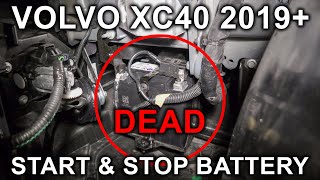
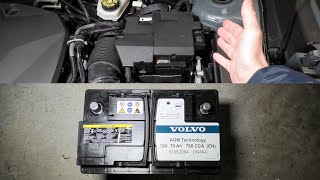
How to confirm: With the engine off, use a multimeter to test the battery voltage. A healthy battery should read approximately 12.6 volts. If it's below 12.2 volts, it needs charging and testing. A professional load test is the best way to confirm battery health. On models with a secondary support battery, that smaller battery is a frequent failure point and should also be tested. 🎬 See how to replace the support battery and reset the system
Typical fix: Recharge or replace the battery. If a new battery is installed, it may need to be registered with the vehicle's computer system to ensure proper charging.
Est. part cost: $250-$450 - Corroded Battery Terminals or Ground Straps 🟡 Medium Probability → Shop Engine Ground Strap Poor connections at the battery or at the main chassis ground points can create high resistance, mimicking a weak battery and causing voltage drops that disrupt module communication. Aftermarket companies even offer upgraded copper grounding hardware for Volvos to improve conductivity.
How to confirm: Visually inspect the battery terminals for white or greenish corrosion. Follow the negative battery cable to where it bolts to the chassis and inspect that connection for rust or looseness. A key grounding point is located near the left strut tower in the engine bay. Also, locate the main engine-to-chassis ground strap and check its condition.
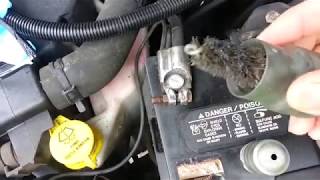
Typical fix: Clean the battery terminals and chassis ground connection points with a wire brush. Ensure all connections are tight. Replace corroded cables or straps if necessary. A ground cable for the XC40 Recharge has an OEM part number of 32362263 (replaces 32240315).
Est. part cost: $5-$100 - Blown Fuse for ECM or CEM ⚪ Low Probability
How to confirm: Consult the owner's manual to locate the fuse boxes (typically one in the engine bay and one inside the cabin). Check all fuses labeled 'ECM,' 'PCM,' or 'CEM' to see if any are blown. A 15-amp fuse is often responsible for ECM/TCM communication on some Volvo models.
Typical fix: Replace the blown fuse with a new one of the exact same amperage rating. If the fuse blows again immediately, it indicates a short circuit that needs to be diagnosed.
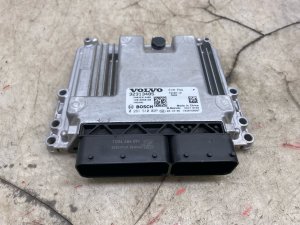
Est. part cost: $1-$5 - Faulty Engine Control Module (ECM) ⚪ Low Probability → Shop Engine Control Module (ECM)
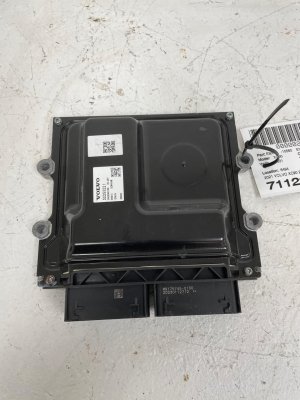
How to confirm: This should be the last resort after all other possibilities (battery, grounds, fuses, wiring) have been definitively ruled out. Diagnosis requires an advanced scan tool to confirm that only the ECM is unreachable. A technician may also test for power and ground directly at the ECM connector.
Typical fix: Replace the Engine Control Module. This is a costly repair that requires the new module to be programmed to the vehicle's VIN and security system by a dealer or specialized shop.
Rare But Worth Checking
- CAN Bus Wiring Damage: The communication wires themselves can be damaged by rodents, previous accident repairs, or chafing against a bracket. A visual inspection of the main wiring harnesses may reveal damage. Technicians can test the CAN network's integrity by measuring resistance between the CAN High and CAN Low pins at the OBD-II port; a healthy network should read 60 Ohms.
- Faulty Central Electronic Module (CEM): The CEM acts as a network hub. On some Volvo platforms, it's a known failure point due to water intrusion or internal faults. Water leaks from clogged sunroof drains are a common issue on Volvos and can lead to water damaging electronics located under the dashboard or carpet. 🎬 Watch: How to inspect and troubleshoot sunroof drain leaks
Diagnosis Steps
- Read All Codes: Use an OBD-II scanner to check for any other codes that may be present. Codes like U0101 or U0121 confirm a wider network issue.
- Check Battery Health: Test the battery's state of charge and perform a load test. A voltage reading below 12.4V (engine off) warrants a recharge and retest. Remember to test the support battery on applicable models.
- Inspect Electrical Connections: Clean and tighten the battery terminals. Inspect the main chassis ground (often near the strut tower) and engine ground strap for corrosion or damage.
- Check Fuses: Inspect all fuses related to the ECM and CEM in both the engine bay and interior fuse panels.
- Inspect Wiring Harness: Perform a visual inspection of the main wiring harnesses connected to the ECM. Look for any signs of rodent damage, chafing, or corrosion.
- Advanced Diagnostics: If the above steps don't resolve the issue, a professional technician should be consulted. They will use an advanced scan tool to see which modules are online, check for power and ground at the ECM connector, and test the resistance of the CAN bus network. A healthy CAN bus should measure 60 Ohms between pins 6 (CAN-H) and 14 (CAN-L) on the OBD-II port with the battery disconnected. An oscilloscope can be used to visualize the CAN signal data packets to check for signal integrity.
Parts You'll Likely Need
- Vehicle Battery
(OEM #30659531 (Support Battery, per a TSB for older platforms))— This is the most common cause of communication codes on modern Volvos due to their high electrical sensitivity.
Trusted brands: Bosch, Interstate, DieHard, Volvo Genuine
OEM price range: $350-$500
Aftermarket price range: $250-$400 - Engine Control Module (ECM) — If the module itself has failed internally, it must be replaced. This is a last resort after all other causes are eliminated.
Trusted brands: Bosch, Volvo Genuine
OEM price range: $1200-$1800
Aftermarket price range: $800-$1200
Related Codes That Often Appear With This One
- U0101 — This code means 'Lost Communication with TCM' (Transmission Control Module). It often appears with U0100 because the root cause (like a bad battery or CAN bus fault) affects communication with both the engine and transmission modules.
- U0121 — This code means 'Lost Communication with ABS Control Module'. Like U0101, it indicates a network-wide problem, as the same fault that isolates the ECM can also take the ABS module offline.
- U0140 — This code means 'Lost Communication with Body Control Module' (which on Volvos is the CEM). If you see this with U0100, it can point towards a problem with the CEM itself or a major network failure.
Technical Service Bulletins (TSBs) & Recalls
- Volvo Service Manager Bulletin SMB-39-001 (December 15, 2020): While not for U0100, this bulletin addresses premature brake pad wear, a common complaint on the XC40 platform. It extends warranty coverage for brake pad wear to 3 years/30,000 miles, indicating Volvo's acknowledgement of the issue.
- Volvo Parts Bulletin PB31-004-2018-08: This bulletin for older platforms highlights the maintenance requirements for the 12V support battery (part number 30659531), noting it must be maintained every 9 months, underscoring its importance and potential for failure.
Platform-Specific Known Issues
- A recall for the 2024 model year XC40 (NHTSA ID: 24V-010) involved a software issue in the Central Electronic Module (CEM) that caused a communication-related failure of the turn signal. While not directly for code U0100, this highlights the platform's potential for software-based network faults originating in the CEM.
- Some earlier XC40 models were equipped with a main starter battery and a smaller support battery for the start/stop system. Failure of this small support battery is a known issue that can cause widespread, difficult-to-diagnose electrical faults, including communication codes.
Mechanic-Grade Diagnostic Values
- CAN Bus Network Resistance — expected: ~60 Ohms. Failure: A reading of ~120 Ohms indicates an open circuit or one of the two terminating resistors is offline. A reading near 0 Ohms indicates a short between the CAN High and Low wires. A reading of ~40 Ohms may indicate an unintended third terminating resistor on the bus.
- CAN Bus Voltage (Key On, Engine Off) — expected: CAN High (Pin 6 to ground): ~2.6-2.7V. CAN Low (Pin 14 to ground): ~2.3-2.4V. The sum of both voltages should be approximately 5V.. Failure: Voltages that are stuck high, low, or at battery voltage indicate a short to power or ground. Using a multimeter may show fluctuating values around 2.5V; an oscilloscope is required for accurate signal waveform analysis.
Scan Tool Commands That Help
- Volvo VIDA (or equivalent like VXDIAG): CEM Software Reload — This is a critical step after replacing a Central Electronic Module (CEM) or when experiencing persistent, unexplainable communication faults. It is more comprehensive than a simple update and completely reinstalls the module's operating software, resolving deep-seated glitches.
- Specialized ECU Cloning Tools (e.g., OBDSTAR, K-TAG): Module Cloning / Synchronization — When replacing a failed ECM or CEM with a used part. Because these modules are VIN-locked, the data from the original module must be copied ('cloned') to the donor module, or the donor module must be synchronized with the vehicle's immobilizer system. This is not a dealer procedure but is common in the independent repair world.
Wiring & Ground Locations
- CEM Main Connector (Bench Testing Pins) — The Central Electronic Module (CEM) is integrated with the interior fuse panel, often located in the passenger compartment.. To rule out a faulty CEM, a technician may power it on a bench. For a 2021/2022 XC40, critical pins are: Power_supply_KL30A/B (Constant 12V+), IgnitionPowerRelayFB (Ignition 12V+), El1_GND/EL2_GND (Grounds), and CANHS+/CANHS- (High-speed CAN bus). Failure to power up or communicate on the bench points to an internal CEM fault.
- Sunroof Drain Tubes — Run from the corners of the sunroof assembly down through the A-pillars (front) and C/D-pillars (rear).. Clogged or disconnected front drain tubes are a notorious Volvo issue, causing water to leak into the cabin and drip onto the CEM and other electronics located under the dash or carpet, leading to corrosion and communication failures.
- Windshield Cowl Drains — Located at the base of the windshield under the plastic cowl panel.. If these drains become blocked with leaves and debris, rainwater can overflow the cowl and find its way into the cabin's fresh air intake, potentially soaking the blower motor, associated electronics, and the general area of the CEM.
Real Owner Repair Stories
- Reddit user report (2023 Volvo XC40) — Car was completely 'bricked' and would not start after a failed over-the-air (OTA) software update.
❌ Tried (didn't work) The car was unresponsive to all normal inputs.
✅ What actually fixed it Following advice from Volvo roadside assistance, the owner disconnected the 12V battery, waited one minute, and reconnected it. This hard reset allowed the car to start and function again, although it required a subsequent dealer visit to fix lingering infotainment bugs. - Volvo Forums user report (2021 Volvo XC40) — Soaked passenger side front and rear footwells after heavy rain.
❌ Tried (didn't work) Owner confirmed all windows and sunroof were closed.
✅ What actually fixed it The dealer found a sunroof drain tube was not properly installed at the factory. The repair involved removing the interior, drying everything, and correctly connecting the drain tube. This prevented future water damage to sensitive electronics like the CEM.
"I Checked Everything" — The Actual Cause
- A failed over-the-air (OTA) software update can put the vehicle into a non-communicative state that mimics a catastrophic hardware failure. All wiring, fuses, and modules may test perfectly fine. The actual cause is a software glitch that can sometimes be cleared by a hard reset (disconnecting the 12V battery for several minutes), but often requires a dealer visit for a software re-flash.
Model Year Variations Within This Range
- 2023-2026: Models from 2023 onward use the Android Automotive Operating System. This system is more susceptible to software-related communication faults, including failed Over-the-Air (OTA) updates that can 'brick' the vehicle and cause a no-start condition that mimics a U0100 hardware failure.
- 2018-2026 (Varies by Powertrain/Option): Models equipped with the Start/Stop function utilize a secondary, smaller support battery. Pass 2 noted this for 'earlier' models, but it is present on later models as well, including 2024. Failure of this support battery can introduce voltage instability into the electrical system, triggering communication codes like U0100.
- 2024: A Volvo Service Journal (SJ1001860) from April 2023 noted that official wiring diagrams for MY24 XC40s were delayed. This means technicians may be working with temporary or incomplete information when diagnosing complex electrical faults on the newest models, increasing diagnostic time.
Diagnostic Flowchart
Other Known Issues on This Vehicle
Issues unrelated to this code that are worth knowing about as an owner of this generation:
- Premature Rear Brake Pad and Rotor Wear 🟠 Medium — Commonly reported between 15,000-30,000 miles. So prevalent that Volvo issued a Service Manager Bulletin (SMB-39-001) extending warranty coverage for wear. (Ref: SMB-39-001)
- Infotainment System Freezing / Black Screen 🟠 Medium — Frequent complaint across all model years, particularly on vehicles with the Google-based system. Often requires a system reboot (holding down the home button) to temporarily fix.
- Clogged Sunroof Drains Leading to Water Leaks 🔴 High — A common issue on many Volvo models with panoramic sunroofs. If not maintained, drains clog with debris, causing water to back up and leak into the cabin, potentially damaging electronics.
- Support Battery Failure (Early Models) 🟠 Medium → Shop Vehicle Battery — On earlier XC40s equipped with a small secondary 12V battery, this component is known to fail prematurely, causing a no-start condition and various electrical warnings.
- Charging Issues (Recharge Models) 🟠 Medium — Owners of the plug-in hybrid and full EV models report issues with charging sessions failing to start, stopping unexpectedly, or charging at very slow speeds.
- Propulsion System Software Glitches (Recharge Models) 🔴 High — Some owners have experienced 'Propulsion System' warnings that can render the car immobile. This is often a software glitch that may require a dealer visit to reboot or reflash a control module like the Battery Energy Control Module (BECM). (Ref: Recalls have been issued for BECM software updates.)
Used vs. New Parts: Buying Guide for This Vehicle
When a used part is the smart pick: For expensive electronic modules like the Engine Control Module (ECM) or Central Electronic Module (CEM), a used part from a salvage vehicle can offer significant cost savings. However, it is NOT a plug-and-play solution.
Donor-vehicle mileage cap: roughly under 100000 miles for the part to have meaningful remaining life.
What to inspect on the donor part:
- Verify the part number on the donor module EXACTLY matches your original part.
- Inspect connectors for any bent pins, corrosion, or signs of water damage.
- Source parts from vehicles in dry climates to minimize the risk of pre-existing moisture damage.
- Ensure the donor part comes with a warranty and a clear return policy.
OEM-only on this vehicle (don't cheap out):
- Engine Control Module (ECM)
- Central Electronic Module (CEM)
Aftermarket brands forum-validated for this vehicle:
- Xemodex (For module remanufacturing and cloning services)
Brands owners have reported issues with on this vehicle:
- Unknown/unbranded electronic modules from online marketplaces like eBay or Amazon without a clear warranty, return policy, or established reputation for Volvo parts.
Real Owner Stories
Aggregated from forums and TSBs cited above. Mileages and costs reflect what owners reported in those sources.
2021 Volvo XC40
Symptoms: Water leaking from the sunroof due to an improperly installed drain tube; required removing seats and flooring to dry the interior and check for electronic damage.
What fixed it: Factory repair of the sunroof drain tube and drying out the vehicle's electronic components.
Source hint: Volvo Forums: 'Leak issue water from roof'
2023 Volvo XC40
Symptoms: The infotainment screen went completely black.
What fixed it: Holding the home button for an extended period to force a system reboot.
Source hint: Reddit r/XC40: 'Black screens'
2018-2020 Volvo XC40
Symptoms: Dead car and various electrical warnings on the dashboard.
What fixed it: Replacement of the faulty secondary support battery.
Source hint: Volvo XC40 Forums: 'Multiple owners report issues with faulty support batteries'
Related OBD-II Codes
Frequently Asked Questions
My 2024 XC40 has a turn signal failure; could this be related to the U0100 communication issues?
I heard the XC40 has two batteries. Which one causes these electrical codes?
Is there a specific ground point on the XC40 I should check for U0100?
My infotainment screen went black on my 2023 XC40. Is this a sign of a failing ECM?
Does Volvo have a maintenance schedule for the support battery to prevent these codes?
Are there upgraded parts to fix the grounding issues on the XC40?
Helpful Videos


We Have This Part in Stock

The information in this article is provided for general reference and educational purposes only. Vehicle specifications, procedures, and part compatibility can vary by production date, trim level, and region. Always consult your vehicle's factory service manual and verify part numbers before purchasing or performing repairs. Safety-critical components such as airbags, seat belts, and braking systems should be installed by a qualified professional.
- Volvo XC40:
- 🧭 Diagnostic Flowchart
- 🎬 Helpful Videos
- 🛍️ Shop This Part
- What's Unique About the 2018-2026 Volvo XC40
- Symptoms You May Notice
- Most Likely Causes
- Rare But Worth Checking
- Diagnosis Steps
- Parts You'll Likely Need
- Related Codes That Often Appear With This One
- Technical Service Bulletins (TSBs) & Recalls
- Platform-Specific Known Issues
- Mechanic-Grade Diagnostic Values
- Scan Tool Commands That Help
- Wiring & Ground Locations
- Real Owner Repair Stories
- "I Checked Everything" — The Actual Cause
- Model Year Variations Within This Range
- Other Known Issues on This Vehicle
- Used vs. New Parts: Buying Guide for This Vehicle
- Real Owner Stories
- 2021 Volvo XC40
- 2023 Volvo XC40
- 2018-2020 Volvo XC40
- Related OBD-II Codes
- Frequently Asked Questions
- 🎟️ Get 5% Off