

U0101 on 2005-2010 Chevrolet Cobalt: Lost Communication with TCM Causes and Fixes
On a 2005-2010 Cobalt, code U0101 almost always points to a failed Transmission Control Module (TCM) or a wiring/connector issue. While the TCM itself is a very common failure point on this platform, checking fuses, grounds, and the main connector on the transmission for corrosion or backed-out pins is a critical first step. Expect to pay around $100-$250 for a remanufactured TCM, plus potential programming costs.
- U0101 on a 2005-2010 Cobalt means the Transmission Control Module (TCM) has stopped communicating.
- The most common symptoms are a Check Engine Light and the transmission being stuck in one gear (limp mode).
- While you should always check fuses, grounds, and wiring first, the most probable cause for this code on this car is a failed TCM.
- This is not a DIY-friendly repair for beginners, as it involves diagnosing a vehicle network and likely requires programming a new module.
- Do not drive the vehicle. It is unsafe and you risk being stranded.
What's Unique About the 2005-2010 Chevrolet Cobalt
The first-generation Cobalt, along with other GM vehicles from this era using the 4T45E transmission, is known for TCM failures that trigger the U0101 code. The TCM is mounted externally on the transmission case, exposing it to heat, vibration, and potential fluid contamination, which can lead to internal solder joint failure. While wiring and connection issues are always a possibility, the high failure rate of the TCM itself makes it a primary suspect on this specific platform. Owners frequently report that replacing the TCM resolves the communication loss and associated symptoms after basic wiring checks prove fruitless. For instance, NHTSA ODI #10893338 describes a failure to communicate with the TCM where both codes U0101 and U2100 were present.
Symptoms You May Notice
- Check Engine Light is on
- Transmission will not shift gears, often stuck in 2nd or 3rd gear (limp mode)
- Harsh or erratic shifting
- Vehicle may not move when put into gear
- Loss of speedometer reading
- 'Power Steering' message may appear on the driver information center
- Gear position indicator on the dashboard may be blank or incorrect
- Traction Control (TC) light may be illuminated
- Replacing the entire transmission. The U0101 code is an electrical/communication issue, not a mechanical failure within the transmission itself.
- Replacing the Engine Control Module (ECM). While the ECM reports the code, it is doing so because it cannot hear from the TCM. The problem is rarely with the ECM.
- Replacing shift solenoids. While faulty solenoids can cause shifting problems, they typically set different codes (like P0751 or P0756) and do not cause a total loss of communication with the TCM.
Most Likely Causes
- Failed Transmission Control Module (TCM) 🔴 High Probability → Shop Transmission Assembly The TCM used in this platform (a T42 controller for the 4T45E transmission) is a known high-failure item. It is mounted directly to the transmission, where it is exposed to constant heat and vibration, leading to internal electronic faults and cracked solder joints over time.
How to confirm: After verifying power, ground, and CAN bus wiring to the TCM are intact, the module itself is condemned. A professional scan tool will be unable to communicate with the TCM, confirming it is offline. This is the last step after ruling out all other possibilities.
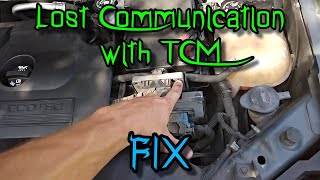
Typical fix: Replace the Transmission Control Module. The new module must be programmed to the vehicle's VIN. Many vendors sell pre-programmed modules. 🎬 See a step-by-step walkthrough on how to replace the TCM.
Est. part cost: $100-$250 - Damaged Wiring or Poor Connections 🟡 Medium Probability The main wiring harness connector at the TCM is a common point of failure. Pins can back out, corrode, or break, severing communication. GM TSB 08-07-30-021E specifically calls out backed-out terminals in the 16-way transmission connector. Harnesses can also chafe against the engine or transmission case.
How to confirm: Visually inspect the wiring harness leading to the TCM for any signs of chafing, breaks, or corrosion. Disconnect the 16-way connector at the TCM and check for bent, corroded, or backed-out pins. Test for continuity on the CAN bus wires (often Tan and Tan/Black) between the TCM and the OBD-II port (Pins 6 & 14). A forum user found the Red/White power wire to the TCM had corroded in half inside the harness loom.
Typical fix: Repair the damaged section of the wiring harness or clean/replace the faulty connector. Ensure the Terminal Position Assurance (TPA) lock is fully seated on the connector.
Est. part cost: $10-$50 - Loss of Power or Ground to the TCM 🟡 Medium Probability Grounding points on the chassis and engine block can corrode over time, creating a poor connection. A video from an owner specifically identifies the main ground point below the oil filter on the engine block and another under the driver's side headlight 🎬 Watch this owner identify the specific ground points causing communication loss. as potential culprits for communication issues.
How to confirm: Using a multimeter, check for 12V battery power and a solid ground connection at the appropriate pins on the TCM connector with the key on. Check the fuse for the TCM (often labeled TCM, ECM/TCM, or TRANS) in the underhood fuse box.
Typical fix: Replace the blown fuse or repair the open circuit in the power or ground wire. Clean corroded ground points on the engine block and chassis with a wire brush or sandpaper.
Est. part cost: $1-$20
Rare But Worth Checking
- Low Battery Voltage: → Shop Vehicle Battery
Diagnosis Steps
- Scan for Codes: Use an OBD-II scanner to confirm U0101 is the primary code. Note any other communication (U-prefix) codes from other modules. A professional scanner can attempt to communicate directly with the TCM, ECM, BCM, etc., to see which modules are offline.
- Check Fuses: Inspect the fuse(s) related to the Transmission Control Module (often labeled TCM or TRANS) in the underhood fuse panel. Replace if blown.
- Check Battery and Grounds: Ensure the battery has a full charge (12.4V+ at rest) and that the alternator is charging correctly (13.5-14.5V when running). Inspect and clean the main battery terminals and chassis ground points, especially the one on the engine block near the oil filter and the one under the driver's headlight.
- Visual Inspection: Thoroughly inspect the wiring harness and the 16-way connector at the Transmission Control Module. The TCM is located on the front of the transmission case. Look for any signs of physical damage, corrosion, fluid contamination, or loose pins.
- Check Power and Ground at TCM: Using a multimeter and a wiring diagram, disconnect the TCM connector and verify it is receiving battery voltage on the correct pin(s) and has a good ground connection on its ground pin(s). Lack of power or ground points directly to a wiring issue or blown fuse.
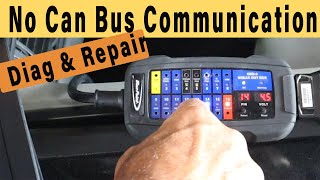
- Check CAN Bus Integrity: With the battery disconnected, check the resistance between the two CAN bus pins at the OBD-II port (Pins 6 and 14). You should read approximately 60 ohms. 🎬 Watch how to test CAN bus integrity and resolve network errors. A reading of 120 ohms suggests one of the terminating resistors is offline, and an open or shorted reading indicates a wiring fault.
- Isolate the TCM: If power, ground, and CAN bus wiring are all confirmed to be good, the Transmission Control Module itself is highly likely to have failed internally. This is a diagnosis by elimination.
Parts You'll Likely Need
- Transmission Control Module (TCM)
(OEM #24256960, 24252429, 24242391, 24234503, 24238659 (Part numbers often supersede; verify by VIN))— This module is the most frequent cause of the U0101 code on this specific vehicle due to a high rate of internal electronic failure from heat and vibration.
Trusted brands: ACDelco (OEM/Remanufactured), Dorman, Flagship One, Highway 71 Auto Parts
OEM price range: $200-$350
Aftermarket price range: $100-$250
Related Codes That Often Appear With This One
- U0100 — This is a general code for lost communication with the ECM/PCM. It can sometimes appear with U0101 if the network disruption is severe or if multiple modules are offline.
- U0073 — This code indicates a general Control Module Communication Bus 'A' Off error, pointing to a fault on the main CAN bus network that the TCM uses to communicate. This often indicates a wiring problem affecting the entire network.
- P1682 — This code for a faulty ignition switch was reported by an owner in NHTSA ODI #11354020 to appear alongside U0101.
Technical Service Bulletins (TSBs) & Recalls
- TSB 08-07-30-021E: This bulletin directly addresses loss of high-speed GMLAN communication and lists U0101 as a primary code. It points to backed-out terminals in the transmission harness connector, chafed wiring, and poor connections as likely causes before condemning a module.
- Special Coverage 12191 / Recall 12V459: Pertains to cracked fuel pump modules causing fuel leaks, a separate but important safety issue for this platform.
Platform-Specific Known Issues
- There are several critical recalls for the 2005-2010 Cobalt. The most significant are for the ignition switch (NHTSA 14V047) which can cause the car to shut off while driving, and the electric power steering motor (NHTSA 10V073) which can fail suddenly. While not a direct cause of U0101, the ignition switch issue can create widespread electrical problems, and it is crucial to ensure all recalls have been performed.
Mechanic-Grade Diagnostic Values
- CAN Bus Network Resistance — expected: Approximately 60 Ω. Failure: A reading of 120 Ω indicates a break in the circuit or a missing terminating resistor (one module is offline). A reading near 0 Ω indicates a short between the CAN High and CAN Low wires.
- CAN Bus Voltage (Key On, Engine Off) — expected: CAN High (Pin 6): ~2.5V to 3.5V. CAN Low (Pin 14): ~1.5V to 2.5V.. Failure: A technician noted that on a faulty Cobalt, the CAN Low pin was reading an abnormally high 4.4V. Unplugging the TCM caused the voltage to drop to a normal 2.5V, indicating an internal short in the TCM was pulling the bus voltage high.
- TCM Power Supply Voltage — expected: 12.0 - 12.6V (Battery Voltage). Failure: 0V or significantly lower voltage indicates a blown fuse, or an open/corroded power wire between the fuse block and the TCM.
- TCM Ground Resistance — expected: Less than 0.5 Ω. Failure: High resistance indicates a corroded or loose ground connection, preventing the module from powering on correctly.
Scan Tool Commands That Help
- GM Tech2 / GDS2: SPS (Service Programming System) Programming — This function is required after replacing the Transmission Control Module (TCM). The new module must be flashed with the correct software and vehicle's VIN to communicate with other modules and function correctly. This is typically done via a 'Pass-Thru' method with a subscription to GM's TIS2Web or the newer SPS2.
- GM Tech2 / GDS2: Module Status Check — Before diving into wiring, a technician will use the scan tool to poll all modules on the network. If the TCM does not respond or shows as 'offline', it confirms the communication loss that set the U0101 code in other modules like the ECM and BCM.
Wiring & Ground Locations
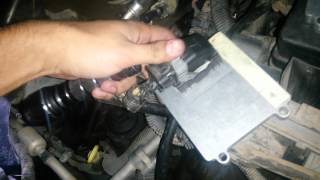
- TCM Connector (X2) — On the front of the 4T45-E transmission case, below the air intake tube. It is a 16-pin connector.. This is the primary connection point for all power, ground, and communication lines to the TCM. It is a frequent source of issues due to backed-out pins, corrosion, or harness damage. TSB 08-07-30-021E specifically targets this connector.
- G107 (Engine Block Ground) — On the front of the engine block, often near the starter motor or below the oil filter. It is part of the main negative battery cable harness.. This is a primary ground point for the engine and transmission electronics, including the TCM. Corrosion or a loose connection here can cause a floating ground and intermittent communication loss.
- G103 / G105 (Chassis Grounds) — G103 is located on the cowl, above the brake booster. G105 is located at the left front of the engine bay, behind the cooling fan relays, often under the driver's side headlight assembly.. These are major chassis and component ground points. While G103 primarily grounds interior modules like the BCM and instrument cluster, a fault here can disrupt the entire data network. G105 grounds several engine bay components, and poor connections can introduce electrical noise.
- Underhood Fuse Block (X50A) — On the driver's side of the engine compartment.. This fuse block contains the primary fuse for the TCM. A corroded fuse terminal or internal fault in the fuse block itself can cut power to the module. One case study found a faulty underhood fuse block was the cause of intermittent power loss to the ECM and TCM.
Real Owner Repair Stories
- CobaltSS.net forum user 'Bout time' (2006 Chevrolet Cobalt LS 2.2L) — Complete loss of communication with TCM, setting U0101. No speedometer, no shifting.
❌ Tried (didn't work) Adding a supplemental ground wire to the TCM., Cleaning all connectors at the BCM, TCM, and ECM., Taking it to a dealer, who diagnosed a 'frayed wire' and quoted $400 for a harness repair.
✅ What actually fixed it The owner performed a continuity test from the underhood fuse box (terminal A2) to the TCM connector (pin 32, a Red/White wire) and found it was an open circuit. After peeling back the harness loom, he discovered the wire had corroded completely in half due to a small nick in the wire's insulation. Splicing the wire and repairing the section fixed all symptoms and cleared the code. - NHTSA ODI #10406608 — An owner reported a loss of speedometer reading and found MIL code U0101 after taking the vehicle to a repair shop.
OEM Part Supersession History
24234503, 24238659, 24242391, 24243901→24252114, 24252429, and ultimately 24256960— Revisions to address internal component reliability and software updates.
Heads up: While many part numbers are physically interchangeable, they must be programmed with the correct software for the specific vehicle's VIN and options. Using a module from a different model year or engine size without correct programming will result in communication errors or improper transmission function. For example, part number 24256960 was used across many GM vehicles, not just the Cobalt.
Model Year Variations Within This Range
- 2005-2007 vs 2008-2010: The Cobalt received a facelift for the 2008 model year which included updated electronics and engine options. While the base 2.2L engine remained, the SS model switched from a supercharged 2.0L (LSJ) to a turbocharged 2.0L (LNF) engine. The TCM hardware (T42 controller) remained largely the same, but software calibrations are specific to the engine and model year. It's critical that a replacement TCM is programmed for the correct year and powertrain.
- 2005-2010: The base LS and LT trims used the 2.2L engine with the 4T45-E automatic transmission. The SS trim offered a 2.4L engine in some years, and 2.0L supercharged/turbocharged engines that were primarily paired with a manual transmission. This U0101 article is specific to models with the 4T45-E automatic transmission and its externally mounted T42 TCM.
Diagnostic Flowchart
Other Known Issues on This Vehicle
Issues unrelated to this code that are worth knowing about as an owner of this generation:
- Electric Power Steering (EPS) Failure 🔴 High — Very common across all model years. Can be intermittent or a complete failure. (Ref: NHTSA Recalls 10V073000, 14V153000.)
- Ignition Switch Malfunction 🔴 High → Shop Ignition Switch — Widespread issue leading to a major safety recall. The switch can move out of the 'Run' position, shutting off the engine and disabling airbags. (Ref: NHTSA Recalls 14V047, 14V171.)
- Fuel Leaks from Fuel Pump Module 🔴 High — Common in vehicles from warmer climates; the plastic ports on the fuel pump module can crack. (Ref: NHTSA Recalls 09V419000, 12V459000; Special Coverage 12191.)
- Key Stuck in Ignition 🟡 Low — Frequently reported by owners, often related to the shifter cable or ignition lock cylinder. (Ref: Related to ignition switch recalls, but also a separate common complaint.)
- Timing Chain Tensioner/Guide Failure 🟠 Medium — Can occur around 100,000 miles on the 2.2L and 2.4L Ecotec engines, causing rattling noises and potential engine damage if ignored.
Used vs. New Parts: Buying Guide for This Vehicle
When a used part is the smart pick: A used TCM from a junkyard can be a cost-effective option, but ONLY if you have access to GM's Service Programming System (SPS) via a Tech2 or other J2534 device to reprogram it. A used module will not work without being flashed to the recipient vehicle's VIN.
Donor-vehicle mileage cap: roughly under 100000 miles for the part to have meaningful remaining life.
What to inspect on the donor part:
- Check the 16-pin connector on the donor TCM for any bent, broken, or corroded pins.
- Avoid modules from vehicles with obvious signs of flood damage or front-end collision damage near the TCM location.
- If possible, get the VIN from the donor vehicle. This can sometimes help a programmer identify the original calibration file if needed.
Aftermarket brands forum-validated for this vehicle:
- ACDelco (Remanufactured)
- Dorman (Offers remanufactured units)
- Flagship One / Highway 71 Auto Parts (These vendors specialize in selling pre-programmed modules, which is a highly recommended option for DIY repair as it avoids the need for special programming tools).
Brands owners have reported issues with on this vehicle:
- Unbranded, 'no-name' modules from online marketplaces without a warranty or a clear programming service should be avoided. The cost savings are not worth the risk of receiving a non-functional or incorrectly programmed part.
Real Owner Stories
Aggregated from forums and TSBs cited above. Mileages and costs reflect what owners reported in those sources.
2006 Chevrolet HHR (Platform Mate)
Symptoms: The transmission was stuck in low gear (limp mode) and the speedometer was completely dead.
What fixed it: The issue was resolved by replacing the TCM, which required programming, or in some cases, repairing the wiring.
Source hint: ChevyHHR.net - 'UO101 code' thread
2005-2010 Chevrolet Cobalt
Symptoms: Vehicle entered limp mode, the speedometer stopped working, and a 'Power Steering' message appeared on the dash.
What fixed it: The primary causes identified were either a wiring fault or a failed Transmission Control Module.
Source hint: CobaltSS.net forum thread from 2012
2005-2010 Chevrolet Cobalt
Symptoms: Loss of communication with the TCM (U0101).
What fixed it: Found the Red/White power wire to the TCM had corroded in half inside the wiring harness loom.
Source hint: Article Context - forum user report
2005-2010 Chevrolet Cobalt
Symptoms: Intermittent communication issues and U0101 code.
What fixed it: Cleaning the main ground point located below the oil filter on the engine block and the ground under the driver's side headlight.
Source hint: Article Context - owner video
2007 Chevrolet Cobalt
Symptoms: An owner reported that the vehicle would not start back up, and an OBD2 scanner revealed codes P1682 for a faulty ignition switch and U0101 for the Transmission Control Module.
What fixed it: Diagnosis of the ignition switch and TCM communication.
Source hint: NHTSA ODI #11354020
Related OBD-II Codes
Frequently Asked Questions
Does GM TSB 08-07-30-021E apply to my Cobalt's U0101 code?
Can the common Cobalt ignition switch recall cause these communication issues?
Where is the Transmission Control Module (TCM) located on the 2005-2010 Cobalt?
Why is my power steering message appearing alongside a transmission code?
I found a blown fuse in the underhood box; could this be the cause?
Do I need to program a new TCM for my Cobalt?
Helpful Videos

We Have This Part in Stock

The information in this article is provided for general reference and educational purposes only. Vehicle specifications, procedures, and part compatibility can vary by production date, trim level, and region. Always consult your vehicle's factory service manual and verify part numbers before purchasing or performing repairs. Safety-critical components such as airbags, seat belts, and braking systems should be installed by a qualified professional.
- Chevrolet Cobalt:
- 🧭 Diagnostic Flowchart
- 🎬 Helpful Videos
- 🛍️ Shop This Part
- What's Unique About the 2005-2010 Chevrolet Cobalt
- Symptoms You May Notice
- Most Likely Causes
- Rare But Worth Checking
- Diagnosis Steps
- Parts You'll Likely Need
- Related Codes That Often Appear With This One
- Technical Service Bulletins (TSBs) & Recalls
- Platform-Specific Known Issues
- Mechanic-Grade Diagnostic Values
- Scan Tool Commands That Help
- Wiring & Ground Locations
- Real Owner Repair Stories
- OEM Part Supersession History
- Model Year Variations Within This Range
- Other Known Issues on This Vehicle
- Used vs. New Parts: Buying Guide for This Vehicle
- Real Owner Stories
- 2006 Chevrolet HHR (Platform Mate)
- 2005-2010 Chevrolet Cobalt
- 2005-2010 Chevrolet Cobalt
- 2005-2010 Chevrolet Cobalt
- 2007 Chevrolet Cobalt
- Related OBD-II Codes
- Frequently Asked Questions
- 🎟️ Get 5% Off