

U0101 on 2005-2010 Jeep Grand Cherokee: Lost Communication With TCM Causes and Fixes
On a 2005-2010 Jeep Grand Cherokee, code U0101 means the Transmission Control Module (TCM) has gone offline. This often forces the vehicle into 'limp mode.' Before replacing the expensive TCM or PCM, check for simple electrical issues like a weak battery, blown fuses (especially in the TIPM), or bad relays, as these are common and cheaper fixes. A faulty Totally Integrated Power Module (TIPM) is also a known culprit on these vehicles. **Crucially, on 3.7L and 3.0L Diesel models, the TCM is a sep
- U0101 means the Transmission Control Module (TCM) is offline, which will likely put your Jeep into limp mode.
- Always start with the simplest and cheapest fixes: check the battery, fuses, and relays before assuming the expensive TCM has failed.
- The TCM is a separate module located under the center console; its wiring should be inspected for damage or corrosion.
- If you replace the TCM, the new unit must be programmed with your vehicle's VIN to work correctly.
- There are no specific recalls or TSBs for U0101 on the 2005-2010 Grand Cherokee, so standard electrical diagnosis is required.
What's Unique About the 2005-2010 Jeep Grand Cherokee
For the 2005-2010 Grand Cherokee (WK generation), the location of the transmission controls depends on the engine. On models with the 3.7L V6 or 3.0L CRD diesel, the Transmission Control Module (TCM) is a separate computer located under the dashboard, to the right of the steering column. However, on models with the 4.7L or 5.7L Hemi V8 engines, the transmission control functions are integrated directly into the Powertrain Control Module (PCM) located in the engine bay; there is no separate TCM module. A key point of failure for this entire generation is the Totally Integrated Power Module (TIPM), which is the main fuse box under the hood. The TIPM contains internal relays and circuitry that can fail, cutting power or communication to the transmission controls and causing a U0101 code. Diagnosis often involves checking the TIPM's integrity in addition to standard electrical troubleshooting.
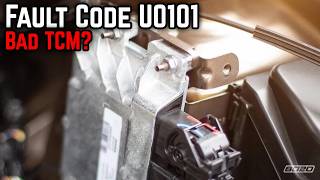
🎬 Watch: Professional guide to diagnosing and fixing U0101 codes.Symptoms You May Notice
- Check Engine Light is on
- Transmission warning light is illuminated
- Vehicle enters 'limp mode' (stuck in a single gear, usually 2nd or 3rd)
- Inability to shift out of Park
- Harsh or erratic shifting
- Gear indicator on the dashboard may be blank or incorrect
- PRNDL indicator lights on the shifter may turn red or all light up simultaneously
- Replacing the entire transmission when the issue is purely electrical.
- Replacing the TCM/PCM without first verifying power, ground, and CAN bus signals are present at the module's connector.
- Overlooking a faulty TIPM, which is a common source of power-related issues for various modules.
- Assuming a separate TCM exists on V8 models, leading to wasted time searching for a part that is integrated into the PCM.
Most Likely Causes
- Low Battery Voltage or Poor Connections 🔴 High Probability → Shop Vehicle Battery All control modules, including the TCM/PCM, require a stable voltage to communicate properly. Aging batteries or corroded terminals are a frequent source of intermittent electronic issues on Chrysler products of this era.
How to confirm: Test the battery with a multimeter. It should read approximately 12.6 volts with the engine off and 13.7-14.7 volts when running. Inspect battery terminals for corrosion and ensure they are tight.
Typical fix: Clean the battery terminals and cable ends thoroughly. Charge or replace the battery if it fails a load test.
Est. part cost: $100-$250 - Blown Fuse or Faulty Relay in the TIPM 🟡 Medium Probability The TIPM (Totally Integrated Power Module) is a known weak point. A simple fuse or an internal, non-serviceable relay can fail, cutting power to the TCM/PCM and causing it to go offline.
How to confirm: Check the fuses related to the TCM in the TIPM (under the hood). On some models, this is fuse #2. Swap the TCM relay (often marked K5) with an identical, known-good relay (like the horn or wipers relay) to see if the problem resolves. If swapping the relay works, the relay was bad. If a new fuse blows immediately, there is a short circuit.
Typical fix: Replace the blown fuse or faulty relay. If the issue is internal to the TIPM, the entire unit may need to be repaired or replaced.
Est. part cost: $1-$30 for a fuse/relay; $400-$1000 for a TIPM replacement. - Wiring Harness or Connector Issue 🟡 Medium Probability The wiring to the TCM (on V6/Diesel) or PCM (on V8s) can be susceptible to damage. A common, hard-to-find issue is poor pin fitment in the module connector, where a female pin loosens and makes intermittent contact with the male module pin.
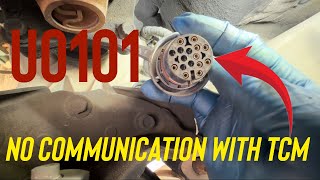
How to confirm: Visually inspect the wiring harness and connectors at the TCM/PCM. Look for corrosion, bent pins, or damaged wires. A common failure is a poor pin fit in the connector, which can be diagnosed by checking for voltage drop under load. Wiggling the harness while monitoring communication with a scan tool 🎬 See how to check for no communication with the TCM. can also help identify an intermittent connection.
Typical fix: Repair the damaged section of the wiring harness. Clean any corrosion from connectors using an electrical contact cleaner. Ensure all connections are secure. In cases of loose pin fit, the specific female terminal within the connector needs to be tightened or replaced.
Est. part cost: $10-$200 - Failed Transmission Control Module (TCM) or Powertrain Control Module (PCM) ⚪ Low Probability → Shop Engine Control Module (ECM) While less common than electrical issues, the control module itself can fail internally due to heat, vibration, or age. On V8 models, this means the entire PCM has failed, which can cause other engine-related issues as well.
How to confirm: This is a process of elimination. If the battery, TIPM (fuses/relays), and all wiring (power, ground, and CAN bus) have been tested and are confirmed to be good, the module itself is the likely culprit. A professional scan tool will be unable to establish communication with the module.
Typical fix: Replace the appropriate module (TCM for V6/Diesel, PCM for V8s). The new module must be programmed to the vehicle's VIN to function correctly.
Est. part cost: $250-$800
Rare But Worth Checking
- Faulty Powertrain Control Module (PCM): → Shop Engine Control Module (ECM) While rare, a fault within the PCM can sometimes manifest as a communication error with other modules. This should only be considered after all other possibilities are exhausted. On V8 models, this is a primary cause as the TCM is integrated within the PCM.
- Faulty Electronic Shifter Module (ESM): The shifter assembly itself is a module on the CAN bus. Some owners have reported that a faulty shifter module can disrupt network communication, leading to a U0101 code and the PRNDL lights all illuminating. One owner of a 2007 Commander with U0101 resolved the issue by cleaning the gear shift module's circuit board.
Diagnosis Steps
- Check Battery Health: Ensure the battery is fully charged (12.6V+ engine off) and the terminals are clean and tight. Low voltage is a primary cause of communication faults.
- Scan for All Codes: Use an advanced OBD-II scanner to read codes from ALL modules (PCM, ABS, BCM, etc.). Note if other modules are also reporting lost communication, which points to a network-wide issue.
- Inspect TIPM Fuses and Relays: In the under-hood fuse box (TIPM), locate the fuse and relay for the TCM. On many models, this is Fuse #2 and the K5 relay. Inspect the fuse and swap the relay with a known-good one of the same type to test.
- Inspect Module Wiring and Connector: Access the TCM (V6/Diesel under dash) or PCM (V8s in engine bay). Disconnect its connector(s) and inspect for corrosion, moisture, or bent/loose pins. A poor pin connection is a known issue.
- Test Power and Ground at Module: Using a multimeter and a vehicle-specific wiring diagram, confirm that the module connector has a stable 12V power supply with the key on, and a solid ground connection (less than 0.1 volts on the ground wire). A test light should illuminate brightly on the power pin.
- Test CAN Bus Wires: With the battery disconnected, check for 60 ohms of resistance between the two CAN bus pins at the module connector. This confirms the network terminating resistors are intact. 🎬 Watch this breakdown of the U0101 code and how to fix it. With the key on, you should see fluctuating voltage around 2.5V on each wire.
- Suspect the TCM/PCM or TIPM: If all power, ground, and data line tests pass, the control module itself is a likely cause. However, given the platform's history, an intermittent internal fault in the TIPM remains a strong possibility and is a common fix for this code.
Parts You'll Likely Need
- Transmission Control Module (TCM)
(OEM #P56044199AK, 04692390AF, 68235713AB)— For 3.7L and 3.0L models ONLY. This is the part to replace if all electrical checks (power, ground, wiring, TIPM) pass. Part numbers vary significantly by year, engine, and 2WD/4WD configuration, so always verify with your VIN. A replacement module will require programming.
Trusted brands: Mopar
OEM price range: $300-$600
Aftermarket price range: $200-$450 - Totally Integrated Power Module (TIPM)
(OEM #Varies by year/options (e.g., 68028007AB, 56049720AI))— The TIPM is a common failure point that can cause a U0101 code by cutting power to the TCM/PCM. If wiggling the TIPM or its connectors causes the transmission to start working intermittently, the TIPM is highly suspect.
Trusted brands: Mopar, Dorman (remanufactured)
OEM price range: $700-$1000
Aftermarket price range: $400-$600 - Automotive Relay — A faulty relay can cut power to the TCM, causing a total loss of communication. It's a simple and inexpensive part to swap for diagnosis before more complex work.
Trusted brands: Standard Motor Products, Bosch
Related Codes That Often Appear With This One
- P0700 — P0700 is a generic code set by the PCM to indicate that the TCM has stored a fault code. It's an informational code that tells you to check the transmission system for more specific codes. It will almost always be present with U0101 because the PCM logs P0700 when it detects the TCM is malfunctioning or offline.
- U0002 — This code indicates a CAN C Bus Performance issue. If you see this along with U0101, it points towards a broader network problem (like a wiring short or faulty module dragging the whole network down) rather than just an isolated TCM failure.
Technical Service Bulletins (TSBs) & Recalls
- TSB 08-024-05: This Technical Service Bulletin involves reprogramming (flashing) the Powertrain Control Module (PCM) with updated software. While it addresses certain CAN bus communication issues, it is unlikely to fix a U0101 code caused by a hard fault like a broken wire, faulty relay, or dead TCM.
Platform-Specific Known Issues
- TIPM Failure: The Totally Integrated Power Module (the main fuse box) is a notorious point of failure on this generation of Jeep/Dodge/Chrysler vehicles. Internal corrosion or failed solder joints can lead to intermittent power loss to the TCM, causing a U0101 code. A technician on a Dodge forum traced a U0101 on a similar platform to a bad TIPM that was cutting power.
- Cold Weather Sensitivity: Some owners of related Dodge vehicles with the same NAG1 transmission and electronics have reported that the U0101 code only appears in cold weather (e.g., below 50°F). This suggests a failing component (like a solder joint in the TCM or TIPM) is contracting in the cold and breaking an electrical connection.
Mechanic-Grade Diagnostic Values
- CAN Bus Network Resistance — expected: Approximately 60 Ω between CAN-H and CAN-L pins at the DLC or module connector (with battery disconnected).. Failure: A reading of 120 Ω indicates an open circuit or a missing terminating resistor. A reading significantly lower than 60 Ω (e.g., near 0 Ω) indicates a short between the CAN wires.
- CAN Bus Voltage (Key On, Engine Off) — expected: Both CAN-H and CAN-L should idle at approximately 2.5V. During active communication, CAN-H should fluctuate between 2.5V and 3.5V, and CAN-L should fluctuate between 2.5V and 1.5V.. Failure: A line stuck at 0V indicates a short to ground. A line stuck at 5V or 12V indicates a short to power. No fluctuation indicates no communication.
- TCM/PCM Power Supply — expected: 12.0V - 12.6V at the specified power supply pin(s) on the module connector with the key in the 'ON' position.. Failure: Voltage below 11.8V or 0V indicates a problem with the battery, fuse, relay (in the TIPM), or the power feed wire.
- TCM/PCM Ground Circuit Resistance — expected: Less than 0.5 Ω between the ground pin(s) on the module connector and a clean chassis ground point.. Failure: High resistance (anything over 1.0 Ω) indicates a corroded, loose, or broken ground connection (e.g., at G201 or G100).
Scan Tool Commands That Help
- wiTECH (Dealer Scan Tool): Initialize EGS / VIN Verification / PROXI Configuration Alignment — This series of functions is mandatory after replacing a TCM or PCM. It writes the vehicle's VIN to the new module and aligns it with the other modules on the network so they can communicate. Failure to do this will result in a no-start or persistent communication codes.
- wiTECH (Dealer Scan Tool): Reset Adaptive Values / Quick Learn — This function, found in the TCM's 'Misc Functions' menu, should be performed after a module replacement or major transmission service. It clears the learned shift adaptations and forces the module to relearn shift points and clutch pressures, which is crucial for proper transmission operation.
Wiring & Ground Locations
- TCM (3.7L/3.0L Only) — Under the driver's side dashboard, to the right of the steering column, often hidden behind an insulation panel.. This is the physical location of the module. The connector here is a primary point for checking power, ground, and CAN signals. It is also a known location for poor pin fitment issues.
- PCM (V8 Models) — In the engine bay, on the passenger side, near the firewall.. On 4.7L and 5.7L models, this module contains the transmission control logic. All power, ground, and CAN tests for the 'TCM' must be performed at the PCM connectors.
- G201 — Under the instrument panel, near the steering column.. This is a major interior ground point. A loose or corroded G201 can cause a poor ground for the separate TCM on V6/Diesel models, leading to communication loss.
- G100 (V8 Models) — Located on the left rear of the engine compartment.. This is a key ground point for the engine controls on V8 models. A fault here could interrupt the ground supply to the PCM, causing a U0101 among other issues.
- TIPM (Totally Integrated Power Module) — The main fuse and relay box in the engine compartment.. This module supplies power to the TCM/PCM via fuses and relays (e.g., Fuse #2, K5 Relay). It is a notorious failure point on this platform.
Real Owner Repair Stories
- GoTech YouTube Channel (Vehicle with CAN bus architecture, demonstrating a U0101 diagnosis.) — Harsh engagement into gear, stuck in 3rd gear ('limp mode'), multiple modules reporting lost communication with TCM.
❌ Tried (didn't work) Initial testing with piercing probes on the CAN wires at the TCM connector showed a normal signal, which was misleading.
✅ What actually fixed it The root cause was poor pin tension in the female connector at the TCM. The female pin for a CAN line was not making a solid connection with the male pin on the module. The technician discovered this when using a back-probe (which physically pushed the pin into contact) temporarily restored communication. The permanent fix was to repair or replace the affected terminal in the connector. - JeepForum.com user (2005-2010 Jeep Grand Cherokee WK) — U0101 code, transmission in limp mode, PRNDL lights may be lit up.
❌ Tried (didn't work) Assuming the TCM was faulty and preparing to replace it.
✅ What actually fixed it The problem was traced to a faulty K5 relay for the TCM located in the TIPM (underhood fuse box). Swapping the K5 relay with another known-good relay (like the one for the horn) immediately resolved the communication issue, confirming the relay was the failure point.
Model Year Variations Within This Range
- 2005-2010: The transmission control logic is in a separate TCM on 3.7L V6 and 3.0L Diesel models, but is integrated into the PCM on 4.7L and 5.7L V8 models. This fundamentally changes the diagnostic process and the part to be replaced.
- 2005-2010: The manufacturer of the separate TCM (on V6/Diesel models) may differ. Early models (e.g., 2005) have been reported with Siemens-branded TCMs, while later models may use Bosch. Compatibility between brands is not confirmed and should not be assumed.
- 2005-2007 vs 2008-2010: The layout and numbering of fuses in the TIPM (underhood fuse box) changed slightly between the 2005-2007 and 2008-2010 model years. Always consult the owner's manual or fuse box lid for the specific vehicle year when checking fuses.
Diagnostic Flowchart
Used vs. New Parts: Buying Guide for This Vehicle
When a used part is the smart pick: A used TIPM or separate TCM (for V6/Diesel) from a junkyard can be a cost-effective option, especially if you can verify it's from a vehicle that was running and not involved in a front-end collision. Used relays are perfect for diagnostic swapping.
Donor-vehicle mileage cap: roughly under 150000 miles for the part to have meaningful remaining life.
What to inspect on the donor part:
- For a TIPM, check for any signs of water intrusion, corrosion on the external connectors, or melted plastic.
- For a TCM, ensure the connectors are clean with no bent or corroded pins.
- Verify the part number on the used module EXACTLY matches the original part number. Part numbers for these modules are highly specific to year, engine, and drivetrain options.
- Ask the salvage yard if they have a return policy or offer a short-term warranty in case the part is also faulty.
OEM-only on this vehicle (don't cheap out):
- Powertrain Control Module (PCM) for V8 models: Due to the complexity of programming and the integration of the immobilizer system, using a new or professionally remanufactured, pre-programmed PCM is highly recommended over a random junkyard unit.
Aftermarket brands forum-validated for this vehicle:
- Dorman (for remanufactured TIPM)
- Cardone (for remanufactured electronics)
Brands owners have reported issues with on this vehicle:
- Unknown, no-name electronics from online marketplaces should be avoided due to high failure rates and lack of proper programming or quality control.
Real Owner Stories
Aggregated from forums and TSBs cited above. Mileages and costs reflect what owners reported in those sources.
Dodge Charger (similar electronics/transmission)
Symptoms: The U0101 code would only appear in cold weather.
What fixed it: After verifying that power, ground, and CAN bus voltages were correct, replacing and reprogramming the Transmission Control Module (TCM) ultimately fixed the problem.
Source hint: DodgeForum.com - 'U0101 - Lost Communication With TCM'
Related OBD-II Codes
Frequently Asked Questions
Where is the transmission control module (TCM) located on my 2005-2010 Grand Cherokee?
My Jeep threw a U0101 code. Which fuse should I check first?
Why does my U0101 code and limp mode only seem to happen in cold weather?
What is the TIPM and why is it a common suspect for a U0101 code?
I have a V8 Grand Cherokee. If the module is bad, do I replace the TCM or PCM?
Will reprogramming my computer with TSB 08-024-05 fix the U0101 code?
Helpful Videos
We Have This Part in Stock



The information in this article is provided for general reference and educational purposes only. Vehicle specifications, procedures, and part compatibility can vary by production date, trim level, and region. Always consult your vehicle's factory service manual and verify part numbers before purchasing or performing repairs. Safety-critical components such as airbags, seat belts, and braking systems should be installed by a qualified professional.
- Jeep Grand Cherokee:
- 🧭 Diagnostic Flowchart
- 🎬 Helpful Videos
- 🛍️ Shop This Part
- What's Unique About the 2005-2010 Jeep Grand Cherokee
- Symptoms You May Notice
- Most Likely Causes
- Rare But Worth Checking
- Diagnosis Steps
- Parts You'll Likely Need
- Related Codes That Often Appear With This One
- Technical Service Bulletins (TSBs) & Recalls
- Platform-Specific Known Issues
- Mechanic-Grade Diagnostic Values
- Scan Tool Commands That Help
- Wiring & Ground Locations
- Real Owner Repair Stories
- Model Year Variations Within This Range
- Used vs. New Parts: Buying Guide for This Vehicle
- Real Owner Stories
- Dodge Charger (similar electronics/transmission)
- Related OBD-II Codes
- Frequently Asked Questions
- 🎟️ Get 5% Off