

U0101 on 2007-2017 Mitsubishi Lancer: Lost Communication with TCM Causes and Fixes
On a 2007-2017 Mitsubishi Lancer, code U0101 means the car's computer has lost communication with the Transmission Control Module (TCM). Before suspecting a bad TCM, check for blown fuses (especially the 7.5A interior fuse #12), faulty relays, and inspect the wiring harness for damage, particularly under the battery tray where the main connector can become dislodged.
- U0101 on a Lancer is a communication error with the TCM, not a mechanical transmission fault.
- Before any expensive repairs, ALWAYS check the simple things first: battery voltage, ground connections, and fuses (especially interior fuse #12).
- The wiring harness under the battery tray is a known weak point; inspect it for damage or a loose connection.
- Driving with this code is unsafe as the transmission's behavior is unpredictable.
What's Unique About the 2007-2017 Mitsubishi Lancer
The 2007-2017 Lancer generation uses either a Continuously Variable Transmission (CVT) or a dual-clutch TC-SST (in Ralliart/Evo models), both of which are heavily reliant on their electronic control modules. Owners have found that simple electrical issues, like a single blown 7.5A interior fuse that powers multiple systems including the CVT control relay, can trigger this code and mimic total transmission failure. Furthermore, the wiring harness connector to the transmission, located under the battery tray, is a known weak point that can become disconnected from vibration or during battery service, making it a prime suspect. A user on the EvolutionM forums reported this exact scenario after heavy braking caused enough vibration to disconnect the harness.
Generation note: The 2007-2017 model years cover the ninth generation of the Mitsubishi Lancer (DE, ES, GTS, GT, Ralliart) and the Lancer Evolution X. The causes and symptoms are broadly similar across these models as they share the same fundamental CAN bus architecture, whether equipped with the Jatco CVT or the Getrag TC-SST dual-clutch transmission. Platform mates like the Mitsubishi Outlander, Dodge Caliber, and Jeep Patriot/Compass share similar electrical architecture and can exhibit the U0101 code for the same reasons.
Symptoms You May Notice
- Check Engine Light and/or 'Service Required' message is displayed.
- Transmission warning light is on.
- "Transmission Overheating, Slow Down" message may appear.
- Vehicle enters 'limp mode,' severely limiting engine power and speed.
- Gear selector indicator on the dashboard may be blank, incorrect, or all lit up.
- Inability to shift the transmission out of Park.
- Harsh, erratic, or delayed shifting.
- Transmission may feel stuck in a single gear (often 3rd).
- Vehicle may stall or fail to start.
- ASC/Traction Control warning lights may illuminate.
- Replacing the Transmission Control Module (TCM) without first thoroughly checking all fuses, relays, and wiring harness connections.
- Assuming there is an internal mechanical failure with the transmission when it is actually an electrical or communication problem.
- Overlooking a weak battery or poor ground connection as the root cause of the communication error.
Most Likely Causes
- Blown Fuse or Faulty Relay 🔴 High Probability A single fuse can power multiple critical components. Owners have specifically identified the #12 7.5A fuse in the interior fuse box as a common culprit that powers the CVT control relay, A/C, ABS, and other systems. A faulty relay in the power distribution center was also the subject of a recall for 2015-2017 models (SR-17-005), which could cause stalling or power loss.
How to confirm: Visually inspect fuses in both the interior and engine bay fuse boxes, particularly any labeled for the transmission (CVT), ECU, or control modules. Test relays or swap with a known good one. A Reddit user diagnosed the #12 fuse issue when their A/C wouldn't turn off.
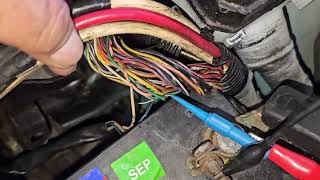
Typical fix: Replace the blown fuse or faulty relay. Keep extra 7.5A fuses on hand. 🎬 Watch: How to find and replace Lancer fuses
Est. part cost: $1-$20 - Wiring Harness or Connector Issue 🔴 High Probability The main transmission wiring harness connector is located under the battery tray, making it susceptible to being knocked loose during battery replacement or damage from vibration. Wires can also chafe or corrode over time. Moisture can also enter connectors and cause shorts.
How to confirm: Visually inspect the wiring harness and connectors between the ECM and TCM for any signs of damage, corrosion, or looseness. Pay special attention to the area under and around the battery. A continuity test on the CAN High and CAN Low wires can confirm circuit integrity.
Typical fix: Securely reconnect, clean, or repair the damaged wiring or connector.
Est. part cost: $0-$100 - Low Battery Voltage or Poor Ground Connection 🟡 Medium Probability → Shop Vehicle Battery Control modules require a stable voltage to communicate properly. An old battery or corroded ground straps can cause intermittent communication dropouts, especially during cold weather or when starting the car. One owner on EvolutionM noted their battery read only 11 volts when experiencing the issue.
How to confirm: Test the battery voltage with a multimeter (should be ~12.6V engine off, ~14V engine on). Inspect the main battery terminals and chassis ground connections for corrosion and tightness.
Typical fix: Replace the weak battery, or clean/tighten the ground connections.
Est. part cost: $5-$250 - Failed Transmission Control Module (TCM) ⚪ Low Probability → Shop Transmission Assembly While possible, module failure is less common than wiring or power supply issues. Mitsubishi's own service literature advises ruling out all other causes before condemning the TCM. However, internal circuit board damage or memory failure can cause a U0101 code.
How to confirm: This requires a professional diagnosis. After confirming the TCM has proper power, ground, and a healthy CAN bus connection, a scan tool will be used to attempt communication. If it fails to communicate, 🎬 Watch: Diagnosing a Lancer TCM communication failure the module is likely faulty.
Typical fix: Replace the Transmission Control Module. This requires programming by a dealer or specialized shop to match the vehicle's VIN.
Est. part cost: $450-$1500
Rare But Worth Checking
- Failed Engine Control Module (ECM): → Shop Engine Control Module (ECM) The ECM is a critical part of the CAN network. While it's a rare failure point for this specific code, it is a possibility if all other causes have been ruled out.
- CAN Bus Network Fault: A short or open circuit in the CAN bus wiring itself, not directly at the TCM connector, can disrupt communication for multiple modules. This is difficult to trace and requires specialized diagnostic procedures.
Diagnosis Steps
- Check for other stored trouble codes to see if other modules are also reporting communication issues.
- Check and replace any blown fuses related to the transmission, engine control, or A/C system. Pay close attention to the 7.5A fuse #12 in the interior fuse panel.
- Test the vehicle's battery and charging system to ensure stable voltage (12.6V+ engine off, ~14V engine on).
- Inspect all battery and chassis ground connections for corrosion and tightness.
- Remove the battery and battery tray. 🎬 See this step-by-step battery removal walkthrough Thoroughly inspect the wiring harnesses and connectors underneath for damage, corrosion, or loose pins. Ensure the main connector to the transmission is securely plugged in.
- If accessible, check for power and ground at the TCM connector using a multimeter.
- If the above steps do not resolve the issue, a professional diagnosis using a factory scan tool is needed to test the CAN bus network integrity and pinpoint the fault.
Parts You'll Likely Need
- Fuse — A blown fuse, particularly the 7.5A interior fuse #12, is a commonly reported and inexpensive fix for this code on Lancers.
Trusted brands: Bussmann, Littlefuse
OEM price range: $1-$5
Aftermarket price range: $1-$3 - Transmission Control Module (TCM)
(OEM #Varies by year and transmission (e.g., CVT vs TC-SST))— If wiring, power, and ground issues are ruled out, the TCM itself may have failed. This is the most expensive potential solution and often requires dealer programming.
Trusted brands: Mitsubishi (OEM)
OEM price range: $600-$900
Aftermarket price range: $400-$700 (remanufactured) - CVT/TC-SST Relay
(OEM #e.g., 8627A049 (common Mitsubishi relay))— A faulty relay can cut power to the TCM. A recall (SR-17-005) was issued for defective relays on 2015-2016 Lancers.
Trusted brands: Mitsubishi (OEM), Denso
Related Codes That Often Appear With This One
- P1590 — This Mitsubishi-specific code for 'TCM to ECM communication error' is often triggered alongside U0101, as they both relate to the communication link between the transmission and engine computers.
- U0100 — This is a more general 'Lost Communication with ECM/PCM' code. If seen with U0101, it could indicate a broader network problem.
- U0401 — Indicates 'Invalid Data Received From ECM/PCM'. This can appear when communication is intermittent or corrupted, often accompanying a total loss of communication code like U0101.
Technical Service Bulletins (TSBs) & Recalls
- Recall SR-17-005: Affects 2015-2016 Lancers for defective relays that can cause engine stalling or overheating. This could be a potential cause for the U0101 code if the relay powers the TCM circuit.
- Recall SR-16-006: Affects 2016 Lancers for a CVT control unit software issue causing acceleration delay. Dealers would reprogram the CVT control unit. While not directly causing U0101, it shows the importance of correct TCM software.
- TSB-10-23-005: Mentions an issue with incorrect CVT dipstick markings on early (2008-2009) models, leading to improper fluid levels and potential overheating, though not a direct cause of U0101.
Platform-Specific Known Issues
- For Lancer Ralliart and Evolution models with the TC-SST transmission, a software 're-teach' may be necessary after a communication loss event to restore normal function, as documented by one owner on EvolutionM.
Mechanic-Grade Diagnostic Values
- CAN Bus Termination Resistance — expected: ~60 Ω (measured across CAN High and CAN Low pins with power off). Failure: A reading of ~120 Ω indicates one of the two terminating resistors is offline. A reading significantly different from 60 Ω or 120 Ω suggests a wiring short or open.
- CAN Bus Voltage (Key On, Engine Off) — expected: CAN High (CAN_H): ~2.5-2.7 V; CAN Low (CAN_L): ~2.5-2.3 V.. Failure: Voltages that are stuck high, low, or at battery/ground potential indicate a short in the wiring or a faulty module pulling the bus down.
- TCM Power Supply Voltage — expected: >12.0 V with key on, engine off. Should be stable and close to battery voltage.. Failure: Voltage below 12.0V, or a significant voltage drop when the TCM is connected, points to a high-resistance feed wire, poor connection, or an internal short in the TCM drawing too much current.
- TCM Ground Circuit Resistance — expected: <0.5 Ω (measured between the TCM ground pin and a clean chassis ground point).. Failure: Resistance higher than 0.5 Ω indicates a corroded or loose ground connection, which can cause intermittent module operation.
- Battery Voltage for TCM Programming — expected: 12.0 V - 13.5 V. Failure: Voltage outside this range during programming with the MUT-III tool can cause the programming to fail.
Scan Tool Commands That Help
- Mitsubishi MUT-III: Write calibration value (Calibration value Read&save) — This function must be used on the OLD TCM before removal to save its unique calibration and serial number data. Failure to do this can complicate the installation of the new module.
- Mitsubishi MUT-III: Write calibration value (Saved calibration value writing) — This function is used to write the data saved from the old TCM into the NEW TCM after it is installed. This is a critical step for programming the replacement module.
- Mitsubishi MUT-III: Calibration value reset — Used after replacing the CVT assembly or valve body to initialize learned values. This procedure requires specific actions like holding the brake and accelerator pedals.
- Mitsubishi MUT-III: CVT LEARNING PROCEDURE — After initializing or replacing components, the TCM's learned values must be re-established through a specific driving and learning procedure guided by the scan tool.
- Evoscan / Tactrix OpenPort: SST "Re-teach" Procedure — For TC-SST equipped models (Ralliart/Evo), if the U0101 code appears after a non-mechanical event (like an accidental shift to neutral at speed), a software re-teach may be required to reset the transmission's logic, even if no parts are faulty.
Wiring & Ground Locations
- Main Transmission Harness Connector — Underneath the battery and battery tray in the engine bay.. This is a major junction for communication and power to the transmission. It is notoriously prone to being knocked loose during battery service or from engine/road vibration, causing a total loss of communication.
- Ground Points G14 / G15 — Located behind the left kick panel inside the cabin (for 2008 models).. These are chassis ground points. While not exclusively for the TCM, a poor connection here can affect multiple electronic systems and introduce noise or voltage drops that disrupt CAN bus communication.
- TCM Power/Ground Wires — At the TCM connector, often located in the driver-side wheel well area. One video identified a Green/Black wire (power) and a Brown wire (ground).. These specific wires provide operating power to the TCM. A voltage drop test should be performed here under load (plugged in) to confirm the integrity of the power and ground circuits back to the source.
- CAN Bus Wires — Typically a twisted pair of wires running to all major control modules. Colors can vary, but a 2012 Lancer diagram shows Green and White/Red at the ECU. A generic chart suggests other possibilities. Always verify with a vehicle-specific diagram.. These two wires (CAN High and CAN Low) are the direct communication lines. A short or open on either wire will sever communication with the TCM.
Real Owner Repair Stories
- EvolutionM forum user 'Duke204' (2009 Mitsubishi Lancer Ralliart (TC-SST)) — After hard driving and braking, heard a 'gentle clunk,' got 'slow down' message, transmission went to neutral. Gear indicator disappeared and car would not engage any gear. Codes U0101 and P1590.
❌ Tried (didn't work) Letting the car cool down overnight., Initial visual inspection without removing components.
✅ What actually fixed it The main wiring harness connector to the transmission, located under the battery tray, had become disconnected due to extreme vibration. Plugging the connector back in securely resolved all issues. - Reddit user 'bpaq3' (Mitsubishi Lancer (CVT), ~70k miles) — Felt a small clunk/disengagement while driving. Every light on the dash came on, steering wheel locked up, couldn't shift out of park.
❌ Tried (didn't work) Checking wiring harnesses under the hood., Initially suspecting major transmission or engine failure.
✅ What actually fixed it Replaced the #12 7.5A fuse in the interior fuse box. The user realized this was the issue because their A/C would not turn off, and this single fuse powers the A/C, CVT control relay, ABS, and other systems. - EvolutionM forum user (Mitsubishi Lancer Evolution MR (TC-SST)) — Codes P1590 & U0101 appeared after accidentally shifting into neutral while driving. Transmission went into limp mode.
❌ Tried (didn't work) Checking every connection, fuse, and relay., Checking for transmission fluid leaks.
✅ What actually fixed it The ECU had put the transmission into a protective limp mode that could not be cleared by a simple code reset. The fix was to perform a software "re-teach" for the TC-SST using a tool like an Evoscan/Tactrix cable and appropriate software.
"I Checked Everything" — The Actual Cause
- In cases involving the TC-SST transmission, a U0101 code can be triggered by a software logic fault rather than a physical one. One owner reported that after checking all fuses, relays, and wiring connections with no faults found, the problem was only resolved by performing a transmission 're-teach' procedure using specialized software. This resets the module's operating parameters and was necessary after an unusual event (accidental shift to neutral at speed) confused the TCM.
Model Year Variations Within This Range
- 2007-2017: The diagnostic path can differ significantly based on the transmission. CVT-equipped models (DE, ES, GTS) are prone to the #12 fuse issue and issues related to the Jatco JF011E transmission. TC-SST equipped models (Ralliart, Evolution) have different failure modes, such as the harness connector vibrating loose and the potential need for a software 're-teach' after logic faults.
- 2007-2017: Mitsubishi used different versions of the CVT transmission over the Lancer's life (e.g., CVT-2, CVT-7, CVT-8). Replacing the CVT assembly or TCM requires different initialization and learning procedures with the MUT-III scan tool depending on the specific CVT type installed in the vehicle.
Diagnostic Flowchart
Other Known Issues on This Vehicle
Issues unrelated to this code that are worth knowing about as an owner of this generation:
- CVT Overheating and Premature Failure 🔴 High — Common, especially on earlier 2008-2014 models and in hot climates or under heavy load. Often presents as a 'Slow Down' warning. Some owners report issues after 100,000 miles. (Ref: TSB-10-23-005 addressed incorrect fluid level markings on early models. Using incorrect (non-CVT) fluid is a common cause of failure.)
- Clear Coat and Paint Peeling 🟡 Low — Widespread cosmetic issue, particularly on dark colors like red and black. The clear coat delaminates or develops white spots over time due to UV exposure. (Ref: No official recall, but it is a widely acknowledged problem. Some owners have had limited success with dealer goodwill repairs out of warranty.)
- Front Lower Control Arm / Crossmember Corrosion 🔴 High — Common in regions that use road salt. Corrosion can cause the front crossmember to rust through, potentially leading to control arm detachment. (Ref: Recall SR-20-003 was issued for 2008-2010 Lancers in salt-belt states to inspect and either seal or replace the front crossmember.)
- Engine Stalling 🟠 Medium — Reported across various model years. Can be caused by multiple issues, including faulty relays (subject of recall SR-17-005), a dirty throttle body, or a failing MAP sensor. (Ref: Recall SR-17-005 for defective relays.)
- Blower Motor Resistor Failure 🟡 Low — A common issue where the HVAC fan only works on the highest setting or not at all. It's typically the resistor pack, not the motor itself.
Used vs. New Parts: Buying Guide for This Vehicle
When a used part is the smart pick: A used part is a smart choice for simple, non-electronic components related to this repair, such as wiring harness pigtail connectors, relays, or the battery tray. These parts have no complex electronics and can be sourced from a junkyard for a low cost.
Donor-vehicle mileage cap: roughly under 120000 miles for the part to have meaningful remaining life.
What to inspect on the donor part:
- For wiring connectors: Inspect for brittle plastic, corrosion on pins, or any cut wires.
- For relays: Look for the correct part number and avoid any with signs of water damage or melted casing.
- Ensure the donor vehicle was not involved in a front-end collision that could have damaged the components you are pulling.
OEM-only on this vehicle (don't cheap out):
- Transmission Control Module (TCM): This is the most critical OEM-only part. A used TCM from another vehicle will not be plug-and-play. It is programmed with the original vehicle's VIN and specific transmission calibration data. A new or remanufactured TCM must be programmed to your specific vehicle using a Mitsubishi MUT-III dealer scan tool.
Brands owners have reported issues with on this vehicle:
- Unknown/No-Name TCMs: Avoid generic, unbranded TCMs from online marketplaces. They are highly unlikely to be programmed correctly and may cause further diagnostic issues or damage.
Real Owner Stories
Aggregated from forums and TSBs cited above. Mileages and costs reflect what owners reported in those sources.
2009 Mitsubishi Lancer Ralliart
Symptoms: U0101 and P1590 codes appeared after heavy vibrations; the owner found the transmission was not communicating properly.
What fixed it: Found a disconnected wiring harness under the battery tray that had come loose.
Source hint: EvolutionM - 'U0101 and P1590 codes, HELP!'
2015-2017 Mitsubishi Lancer
Symptoms: The owner experienced the A/C not turning off and the transmission throwing U0101 and P1590 codes.
What fixed it: Replaced the #12 7.5A fuse in the interior fuse box which powers the CVT control relay.
Source hint: Reddit (r/mitsubishi) - '[SOLVED] U0101 & P1590...'
Mitsubishi Lancer Evolution (TC-SST)
Symptoms: The vehicle entered limp mode with P1590 and U0101 codes after a communication loss event.
What fixed it: Performed a software 're-teach' to restore normal transmission function.
Source hint: EvolutionM - 'P1590 and U0101 codes'
2008-2014 Mitsubishi Lancer — ~100000 miles
Symptoms: 'Slow Down' warning and transmission overheating symptoms.
What fixed it: Correcting fluid levels (referencing TSB-10-23-005) or addressing CVT failure, often caused by using non-CVT fluid.
Source hint: TSB-10-23-005 and general CVT failure notes
Related OBD-II Codes
Frequently Asked Questions
My 2015 Lancer is stalling and losing power; could this be related to a known recall?
Why did my Lancer display a 'Transmission Overheating' message along with the U0101 code?
I just changed my battery and now I have a U0101 code. What should I check first?
My A/C stopped working at the same time the transmission warning light came on. Is there a link?
Does my 2016 Lancer have a software update for the transmission?
Can a weak battery cause the U0101 code even if the car still starts?
Helpful Videos
Used OEM Parts in Stock
New Aftermarket Parts Available

The information in this article is provided for general reference and educational purposes only. Vehicle specifications, procedures, and part compatibility can vary by production date, trim level, and region. Always consult your vehicle's factory service manual and verify part numbers before purchasing or performing repairs. Safety-critical components such as airbags, seat belts, and braking systems should be installed by a qualified professional.
- Mitsubishi Lancer:
- 🧭 Diagnostic Flowchart
- 🎬 Helpful Videos
- 🛍️ Shop This Part
- What's Unique About the 2007-2017 Mitsubishi Lancer
- Symptoms You May Notice
- Most Likely Causes
- Rare But Worth Checking
- Diagnosis Steps
- Parts You'll Likely Need
- Related Codes That Often Appear With This One
- Technical Service Bulletins (TSBs) & Recalls
- Platform-Specific Known Issues
- Mechanic-Grade Diagnostic Values
- Scan Tool Commands That Help
- Wiring & Ground Locations
- Real Owner Repair Stories
- "I Checked Everything" — The Actual Cause
- Model Year Variations Within This Range
- Other Known Issues on This Vehicle
- Used vs. New Parts: Buying Guide for This Vehicle
- Real Owner Stories
- 2009 Mitsubishi Lancer Ralliart
- 2015-2017 Mitsubishi Lancer
- Mitsubishi Lancer Evolution (TC-SST)
- 2008-2014 Mitsubishi Lancer — ~100000 miles
- Related OBD-II Codes
- Frequently Asked Questions
- 🎟️ Get 5% Off