

U0101 on 2011-2017 Nissan Juke: Lost Communication with TCM Causes and Fixes
On a 2011-2017 Nissan Juke, code U0101 means the Transmission Control Module (TCM) has gone offline, usually forcing the vehicle into 'limp mode'. The most common causes are faulty wiring, poor connector pin tension at the TCM, or a failed TCM. A replacement TCM is costly and must be programmed by a professional, making this a difficult DIY fix.
- U0101 on your Juke means the transmission computer is offline, which is a critical fault.
- Do not drive the vehicle. It is likely in a fail-safe 'limp mode' and is not safe for normal road use.
- Before suspecting the expensive TCM, have a professional thoroughly check all related wiring, connectors, fuses, and power/ground circuits.
- If the TCM needs replacement, it is not a DIY job. The new module must be professionally installed and programmed to your vehicle.
- Given the known issues with the Juke's TCM, ensure the diagnosing technician is aware of this platform-specific weakness.
What's Unique About the 2011-2017 Nissan Juke
The 2011-2017 Nissan Juke uses a Continuously Variable Transmission (CVT), and its associated TCM is a known point of failure. While generic causes like wiring damage are always the first place to check, the Juke's TCM is susceptible to internal electronic failure and, just as importantly, poor pin tension in its main connector. The vertically-mounted connector can loosen over time, causing an intermittent loss of communication. There are also documented cases of specialists performing board-level repairs on the Juke's TCM, specifically replacing the CAN communication chip to resolve this code. This suggests that beyond simple wiring checks, the module and its immediate connection are more common culprits on this platform compared to others.
Symptoms You May Notice
- Check Engine Light is on
- Transmission warning light (often an 'AT' light) is on
- Vehicle enters 'limp mode,' limiting engine RPM and speed
- Transmission will not shift or is stuck in one gear (e.g., 3rd gear)
- Harsh or abrupt engagement when shifting into Drive or Reverse
- Gear position indicator (PRNDL) on the dashboard may be blank or incorrect
- Vehicle may stall or refuse to start
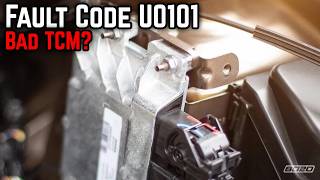
- Vehicle feels sluggish, especially in extreme cold weather 🎬 Watch: A detailed breakdown of the U0101 code and common fixes., sometimes accompanied by multiple 'U' codes
- Dangerous lurching or instances where the transmission will not engage, as noted in NHTSA ODI #11631268
- A no-crank, no-start condition, which may be intermittent (Manufacturer Bulletin #NTB21-002)
- Replacing the entire transmission when the fault is purely electrical.
- Replacing the ECM (Engine Control Module) when the code clearly points to a communication loss with the TCM.
- Condemning the TCM without first performing a pin drag test on the connector and a voltage drop test on the power/ground circuits.
Most Likely Causes
- Wiring or Connector Issues 🔴 High Probability The TCM connector is a frequent point of failure due to poor pin tension or corrosion. The harness can also be exposed to vibration, heat, and moisture, leading to damage over time. The TCM is located under the dashboard, behind the glove box area, making the harness susceptible to damage during other interior repairs.
How to confirm: Visually inspect the wiring harness leading to the TCM for any signs of chafing, breaks, or corrosion. Disconnect the TCM connector (with the battery disconnected) and check for corroded, bent, or loose pins. A 'pin drag test' using a sacrificial male pin is the best way to check for proper female pin tension. Simply re-seating the connector firmly can sometimes temporarily fix the issue, confirming a connection problem.
Typical fix: Repair the damaged section of wire, clean the connector terminals, or replace the connector pigtail. In many documented cases, the fix involves carefully tightening the female pins in the connector 🎬 See this walkthrough on fixing lost communication with the TCM. to ensure a solid connection with the male pins on the TCM.
Est. part cost: $10-$50 - Faulty Transmission Control Module (TCM) 🟡 Medium Probability → Shop Transmission Assembly The Juke's TCM is known to fail internally, sometimes due to a faulty CAN transceiver chip or other board-level components. Failures can be triggered by heat, vibration, or voltage spikes. Some owners report the issue appearing only in extreme cold, which led to a dealer replacing the TCM. In some cases, the TCM may even show as "UNKWN" in the scan tool's present status (Bulletin #NTB21-002A).
How to confirm: This is confirmed by exclusion. If all power, ground, and CAN bus wiring to the module have been tested and are confirmed to be good (especially checking for voltage drop under load), the TCM itself is the likely culprit.
Typical fix: Replace the Transmission Control Module. The new module MUST be programmed to the vehicle by a dealer or a qualified independent shop with Nissan-specific software. Remanufactured TCMs are available and are a cost-effective option.
Est. part cost: $600-$1200 - Power or Ground Supply Fault 🟡 Medium Probability A weak battery, failing alternator, or corroded ground straps can cause intermittent voltage drops that knock modules offline. These issues are common on aging vehicles.
How to confirm: Check the battery voltage (should be ~12.6V with engine off, ~14V with engine running). Use a multimeter to test for 12V+ at the TCM's power pin and check for near-zero resistance on the ground pin to the chassis. A more effective test is a voltage drop test on the power and ground circuits while the system is active to ensure the wiring can carry the required current.
Typical fix: Replace a weak battery, fix the charging system, or clean/tighten the main engine/chassis ground connections. One critical ground point is G100, often located in the passenger footwell area.
Est. part cost: $5-$300 - Blown Fuse ⚪ Low Probability A voltage spike or short circuit can blow the fuse that powers the TCM.
How to confirm: Locate the fuse for the TCM in the vehicle's fuse box (consult the owner's manual or a service manual) and visually inspect it or test it for continuity. On some Nissans, this may be in the IPDM (Intelligent Power Distribution Module).
Typical fix: Replace the blown fuse. If the fuse blows again immediately, it indicates a short circuit in the wiring that must be found and repaired.
Est. part cost: $1-$5
Rare But Worth Checking
- Short Circuit in Unrelated System:
Diagnosis Steps
- Perform a full vehicle scan with a high-quality OBD-II scanner to see which other modules are reporting a loss of communication with the TCM. Note all codes present. As noted in Bulletin #NTB21-002A, U0101 may be stored in the ECU or the Shifter Control Unit (SCU) as past or current.
- Check the battery and charging system. Ensure battery voltage is above 12.4V and the alternator is charging correctly (~14V). Low voltage is a common cause of communication errors.
- Inspect all fuses related to the transmission and engine computers, including those in the IPDM (Intelligent Power Distribution Module).
- Disconnect the battery. Locate the TCM, which is typically under the dashboard near the center console/glove box area. Carefully inspect its wiring harness and connector for any visible damage, corrosion, or loose pins.
- Crucial Step: With the connector unplugged, perform a 'pin drag test' on the female terminals of the harness connector to check for adequate tension. Loose pins are a very common, often overlooked cause.
- Using a multimeter and the vehicle's wiring diagram, verify that the TCM connector has proper power (12V+) and ground. Perform a voltage drop test on both power and ground circuits to ensure the wiring can handle the electrical load. A simple resistance check is not sufficient.
- If power and ground are good, check the CAN bus circuit. With the battery disconnected, measure the resistance between the two CAN wires (CAN High and CAN Low) at the DLC or TCM connector. It should be approximately 60 ohms. A reading of 120 ohms indicates a break in the circuit or a missing terminating resistor.
- If all wiring, power, grounds, and pin tension test good, the Transmission Control Module (TCM) is the most likely cause of the failure.
- Before replacing the TCM, consider having a specialist re-check the diagnosis, as it is an expensive part that requires programming.
Parts You'll Likely Need
- Transmission Control Module (TCM)
(OEM #31036-1XF0C, 31036-1TU0A, 31036-1TU2A, 310F6-1VA1A (Part numbers vary by year, model, and AWD/FWD. Always verify with VIN).)— If wiring and power supply are confirmed to be good, the module itself is the next logical point of failure. These modules are known to fail on the Juke.
Related Codes That Often Appear With This One
- P0700 — P0700 is a generic code that means the TCM has requested the check engine light be turned on. If you see P0700, it means the TCM was, at some point, online and able to send that request. If you ONLY see U0101, it means the TCM is completely offline and cannot communicate at all.
- U0100 — This code means 'Lost Communication with ECM/PCM'. Seeing U0100 and U0101 together strongly suggests a network-wide problem, a faulty CAN gateway, or a power/ground issue affecting multiple critical modules, rather than just a single faulty TCM.
- U0122 — This code means 'Lost Communication with Vehicle Dynamics Control Module'. Seeing this with U0101 can point towards a broader CAN bus issue or a power supply problem affecting several modules, as seen in an owner's experience in extreme cold.
Technical Service Bulletins (TSBs) & Recalls
- While no TSB was found specifically for U0101 on the Juke, Nissan has issued numerous TSBs for CVT-related issues. For example, NTB15-014 addresses CVT judder and diagnostic logic, and NTB20-105 was issued for other codes on 2015-2017 models, indicating the complexity and known issues with the overall CVT control system.
- Manufacturer Bulletin #NTB21-002 (and #NTB21-002A) addresses a no-crank, no-start condition across other Nissan models where DTC U0101 is stored in the ECU or SCU, or the TCM shows as "UNKWN" in the scan tool.
Platform-Specific Known Issues
- The TCM on the Nissan Juke is known to be a potential failure point, with some owners and technicians documenting internal circuit board failures that cause code U0101.
- A forum user on nicoclub.com detailed a saga with a 2013 Juke throwing U0101 and other codes in extreme cold (-26F). After initially suspecting the weather, the dealer ultimately replaced the TCM which resolved the issue, suggesting some modules are sensitive to temperature extremes.
- Poor pin tension on the main TCM connector is a significant and often-missed failure point. The large, vertically-oriented connector can work itself loose or have insufficient contact, causing intermittent communication loss that mimics a failed module.
Mechanic-Grade Diagnostic Values
- CAN Bus Resistance — expected: Approximately 60 Ω. Failure: A reading of 120 Ω suggests an open circuit or a missing terminating resistor. A reading near 0 Ω indicates a short between the CAN High and CAN Low wires.
- CAN High Voltage (Key On, Engine Off) — expected: 2.5V to 3.5V. Failure: Voltage outside this range indicates a potential short to power or ground, or a faulty module on the network.
- CAN Low Voltage (Key On, Engine Off) — expected: 1.5V to 2.5V. Failure: Voltage outside this range indicates a potential short to power or ground, or a faulty module on the network.
- TCM Power Supply Pins (at TCM connector) — expected: Battery Voltage (~12.6V with key on, engine off). Failure: Low or no voltage indicates a problem with the fuse, relay, or wiring from the power distribution module.
- TCM Ground Pins (at TCM connector) — expected: Less than 0.5 Ω resistance to chassis ground.. Failure: High resistance indicates a corroded or loose ground connection, which can cause intermittent module operation.
Scan Tool Commands That Help
- Nissan CONSULT III Plus: Self Diagnostic Results (in TRANSMISSION module) — Used to view and erase DTCs stored specifically within the TCM. If the tool cannot communicate with the module at all, it confirms the 'no communication' fault.
- Nissan CONSULT III Plus: ECU Information (in TRANSMISSION module) — To read the current part number and software calibration ID of the installed TCM. This is critical for checking for software updates or ordering the correct replacement part.
- Nissan CONSULT III Plus: TCM Calibration Data "Write" Procedure — This function is mandatory after replacing the CVT assembly, valve body, or the TCM itself. It writes specific calibration data to the module to ensure proper transmission operation.
Wiring & Ground Locations
- TCM Connector (F101) — A diagnostic video on a Juke shows the TCM and its connector located under the dash, accessible after removing the glove box. The connector has multiple pins for power, ground, and CAN signals.. This is the primary connection point for all power, ground, and communication lines to the TCM. Testing for voltage and resistance at these pins is a critical diagnostic step.
- TCM Power and Ground Pins — On the TCM connector, diagnostic videos show pins 45 & 46 for battery power, 47 & 48 for ignition power, and 41 & 42 for grounds.. A loss of power on pins 45, 46, 47, or 48, or a bad ground on pins 41 or 42, will cause the TCM to go offline and trigger U0101. These are the first pins to test with a multimeter.
- Ground Point G100 — A diagnostic video on a similar vehicle platform shows ground point G100 located in the passenger side footwell area, behind the kick panel.. The TCM ground circuits (pins 41, 42) ultimately connect to the chassis at a master ground point. Pass 2 mentioned G100, and while a Juke-specific diagram was not found, this is a common location for main body grounds and should be inspected for corrosion or looseness.
- IPDM E/R (Intelligent Power Distribution Module Engine Room) — Located in the left side of the engine compartment.. This module contains fuses and relays that supply power to the TCM. A failure within the IPDM or its associated fuses can cut power to the transmission computer.
Real Owner Repair Stories
- YouTube channel 'Automotive Diagnostics & Programming' (Nissan Juke (year not specified, F15 generation)) — CAN bus communication fault codes, including U1000 (a general CAN fault often seen with other U-codes). The technician observed a corrupted signal on the CAN network using an oscilloscope.
❌ Tried (didn't work) Initially followed an aftermarket wiring diagram which was incorrect, leading to wasted diagnostic time.
✅ What actually fixed it The technician performed a board-level repair on the TCM. He sourced a CAN communication chip from a donor TCM, desoldered the faulty chip from the patient TCM, and soldered the good chip in its place. This restored proper CAN communication from the module. - NHTSA ODI #11114960 — An owner of a similar Nissan model reported that multiple dashboard lights illuminated. Upon inspection, the vehicle was found to have the U0101 lost communication code.
OEM Part Supersession History
Multiple→Multiple— Nissan frequently updates TCM part numbers to reflect software and potential hardware revisions.
Heads up: It is critical to match the part number or use a verified superseded part number when replacing the TCM. Even if a module fits physically, an incorrect part number can lead to incompatibility. All replacements, new or used, require programming/calibration to the specific vehicle's VIN and transmission characteristics.
Diagnostic Flowchart
Used vs. New Parts: Buying Guide for This Vehicle
When a used part is the smart pick: A used TCM from a reputable salvage yard can be a cost-effective option, but ONLY if you have a confirmed plan for programming. It makes sense if you have access to a Nissan dealership or a well-equipped independent shop that has the Nissan CONSULT III Plus software and is willing to program a customer-supplied used part.
Donor-vehicle mileage cap: roughly under 100000 miles for the part to have meaningful remaining life.
What to inspect on the donor part:
- Verify the part number on the used TCM matches your original part number exactly.
- Purchase from a seller that offers a warranty or return policy.
- Inspect the connector pins on the used module for any signs of corrosion, damage, or being bent.
- Ensure the donor vehicle was not involved in a flood, as water damage can cause latent electronic failures.
OEM-only on this vehicle (don't cheap out):
- Transmission Control Module (TCM) - While used OEM is an option, brand-new aftermarket TCMs for this specific application are not common or well-regarded. The complexity and programming requirements make new OEM or professionally remanufactured OEM units the most reliable choices.
Aftermarket brands forum-validated for this vehicle:
- Remanufacturing services like Flagship One or UpFix may offer repaired and pre-programmed modules, which can be a viable alternative to a new OEM part.
Brands owners have reported issues with on this vehicle:
- Avoid generic, unbranded TCMs from online marketplaces without a clear warranty and programming support.
Real Owner Stories
Aggregated from forums and TSBs cited above. Mileages and costs reflect what owners reported in those sources.
2013 Juke
Symptoms: A flurry of communication codes, including U0101 and U0122, appeared suddenly during a cold snap of -26F. The dealer initially cleared the codes, blaming the weather, but the problem returned.
What fixed it: The dealer replaced the Transmission Control Module (TCM), which permanently resolved the issue.
Source hint: nicoclub.com Forum: U0101 and several other codes all in one day
NHTSA Reported Incident
Symptoms: An owner reported dangerous lurching and instances where the transmission would not engage. A diagnostic scan revealed code U0101, indicating bad communication between the TCM and the vehicle.
Source hint: NHTSA ODI #11631268
Related OBD-II Codes
Frequently Asked Questions
Where is the Transmission Control Module (TCM) located on my 2011-2017 Juke?
My Juke only shows the U0101 code when it's extremely cold outside. Is this a known problem?
My mechanic wants to replace the expensive TCM. Is there a common, cheaper fix I should check first?
Can I buy a new TCM online and install it myself to save money?
Are there any official Nissan TSBs for the U0101 code on the Juke?
What is a 'pin drag test' and why is it important for this code?
Helpful Videos
We Have This Part in Stock

The information in this article is provided for general reference and educational purposes only. Vehicle specifications, procedures, and part compatibility can vary by production date, trim level, and region. Always consult your vehicle's factory service manual and verify part numbers before purchasing or performing repairs. Safety-critical components such as airbags, seat belts, and braking systems should be installed by a qualified professional.
- Nissan Juke:
- 🧭 Diagnostic Flowchart
- 🎬 Helpful Videos
- 🛍️ Shop This Part
- What's Unique About the 2011-2017 Nissan Juke
- Symptoms You May Notice
- Most Likely Causes
- Rare But Worth Checking
- Diagnosis Steps
- Parts You'll Likely Need
- Related Codes That Often Appear With This One
- Technical Service Bulletins (TSBs) & Recalls
- Platform-Specific Known Issues
- Mechanic-Grade Diagnostic Values
- Scan Tool Commands That Help
- Wiring & Ground Locations
- Real Owner Repair Stories
- OEM Part Supersession History
- Used vs. New Parts: Buying Guide for This Vehicle
- Real Owner Stories
- 2013 Juke
- NHTSA Reported Incident
- Related OBD-II Codes
- Frequently Asked Questions
- 🎟️ Get 5% Off