

U0101 on 2013-2019 Nissan Sentra: Lost Communication With TCM Causes and Fixes
On a 2013-2019 Sentra, code U0101 almost always points to a problem with the Transmission Control Module (TCM) or its related wiring. The most common fix is a TCM software update performed by a dealer, but it can also indicate a failed TCM or a wiring fault. This is not a simple DIY fix due to the need for specialized diagnostic and programming tools.
- U0101 on a 2013-2019 Sentra is a serious code indicating a loss of communication with the transmission's computer (TCM).
- Before any expensive repairs, have a Nissan dealer check if your vehicle needs a TCM software update, as this is a very common fix.
- Do not drive the vehicle. It can enter a low-power limp mode or stall, which is unsafe.
- If software and wiring are not the cause, the TCM itself has likely failed and will need to be replaced and programmed.
- This is not a typical DIY repair due to the need for specialized diagnostic tools and programming capabilities.
What's Unique About the 2013-2019 Nissan Sentra
The 2013-2019 (B17 generation) Sentra is known for widespread issues with its Jatco RE0F11A CVT. Many symptoms like jerking, hesitation, and loss of power are directly linked to how the TCM controls the transmission. Nissan has issued multiple Technical Service Bulletins (TSBs) and even a voluntary service campaign (PM562 for 2013-2014 models) to reprogram the TCM to address these drivability complaints. Therefore, a U0101 code on this specific vehicle is often related to faulty TCM software or an outright TCM failure, which is more common on this platform than on many other cars.
Generation note: The 2013-2019 Nissan Sentra covers the entire B17 generation. While the issues are common across this generation, a specific voluntary service campaign (PM562) to reprogram the TCM was issued for 2013-2014 models to address potential CVT belt slippage and improve durability.
Symptoms You May Notice
- Check Engine Light is illuminated
- Vehicle enters 'limp mode,' limiting speed to 30-45 mph.
- Harsh or erratic shifting.
- Transmission feels like it's slipping or hesitating on acceleration.
- Vehicle may not shift out of Park or may get stuck in one gear.
- The gear selector indicator (PRNDL) on the dashboard may disappear or stop updating.
- A no-crank, no-start condition, which manufacturer service bulletins like TSB Bulletin #NTB21-002 note can occur intermittently when U0101 is stored.
- Replacing the entire CVT assembly. While CVT failure is common on these cars, U0101 is an electrical communication code. The underlying cause of the communication loss must be diagnosed first. A new transmission will not fix a wiring problem or a software issue.
Most Likely Causes
- Corrupt or Outdated TCM Software 🔴 High Probability Nissan has released multiple software updates and service campaigns to fix drivability issues related to the CVT control logic in the TCM. Campaign PM562 specifically addressed low hydraulic pressure that could cause belt slip.
How to confirm: A Nissan dealership or a professional shop with a compatible scan tool (like CONSULT) can check the current software calibration of the TCM against Nissan's service database to see if an update is available for the vehicle's VIN.
Typical fix: Reprogramming the TCM with the latest software from Nissan. This must be done with a compatible scan tool and a stable power supply to the vehicle during the flash.
Est. part cost: $0-$250 (Labor for reprogramming, may be free under a campaign) - Failed Transmission Control Module (TCM) 🟡 Medium Probability → Shop Transmission Assembly Given the high rate of CVT-related issues on this platform, internal failure of the TCM itself is a common point of failure. The TCM is often integrated with the valve body inside the transmission, exposing it to heat and vibration. TSB Bulletin #NTB21-002A notes that in some cases of U0101, the TCM may even show as "UNKNOWN" in the scan tool's present module list.
How to confirm: If the TCM cannot be communicated with at all (even with a professional scan tool) and all power, ground, and network wiring to the module test good, the TCM is condemned.
Typical fix: Replacement of the TCM. The new module must be programmed to the vehicle's VIN. This is often done as part of a valve body replacement.
Est. part cost: $600-$900 - Wiring Harness or Connector Damage 🟡 Medium Probability The wiring harness leading to the transmission can be exposed to heat, moisture, and road debris, leading to corrosion or broken wires at the main TCM connector or along the harness.
How to confirm: Visually inspect the wiring harness and connectors going to the TCM for any signs of green corrosion, loose pins, or physical damage. Perform a continuity test on the CAN bus wires (CAN High and CAN Low) between the TCM and the Data Link Connector (DLC).
Typical fix: Repairing the damaged section of the wire or cleaning/replacing the corroded connector. Sometimes the pins in the connector can back out, requiring the connector to be repinned or replaced.
Est. part cost: $20-$200 - Loss of Power or Ground to the TCM ⚪ Low Probability While not specific to the Sentra, all electronic modules require stable power. A simple blown fuse or a corroded ground strap can take the entire module offline.
How to confirm: Using a multimeter and the vehicle's wiring diagram, check for 12V+ power and a solid ground connection (less than 0.5 ohms of resistance) at the TCM's electrical connector.
Typical fix: Replacing the blown fuse (and diagnosing the cause of the overcurrent) or cleaning and re-securing the ground connection point to the chassis.
Est. part cost: $1-$50
Diagnosis Steps
- Scan for Codes: Use a professional-grade scanner that can communicate with all modules (ECM, BCM, ABS, etc.), not just the ECM. Confirm if U0101 is the only code, or if other modules also report lost communication with the TCM. As noted in TSB Bulletin #NTB21-002, the code may be stored in the Engine Control Unit (ECU) or the Shifter Control Unit (SCU) in either PAST or CURRENT status.
- Check for TSBs: Ask a dealer to check your VIN for open recalls or service campaigns. Specifically mention campaign PM562 for 2013-2014 models and TSBs like NTB17-034h for CVT judder, which involve a TCM reprogram.
- Check Power and Ground: Locate the TCM and its fuse in the vehicle's service manual. Verify the fuse is intact. Use a multimeter to confirm the TCM is receiving battery voltage (approx. 12V) and has a clean ground connection (less than 0.5 ohms to chassis ground).
- Inspect Wiring: Visually inspect the entire wiring harness and connectors between the ECM and the TCM. Look for any green corrosion, chafed wires, loose pins, or damage from road debris or heat.
- Test CAN Bus: With the battery disconnected, measure the resistance between pins 6 (CAN High) and 14 (CAN Low) on the OBD-II port. A reading of approximately 60 ohms indicates the main network terminating resistors are intact. A reading of 120 ohms suggests a break in the circuit or that one of the terminating modules (often the ECM or TCM) is offline.
- Isolate the Module: If the CAN resistance is incorrect, disconnect the TCM connector. If the resistance at the OBD-II port changes from 120 ohms to 60 ohms (or vice-versa), it points towards a problem with the TCM or its connector. If there's no change, the fault is likely in the wiring between the DLC and the TCM.
- Attempt Communication: If all wiring, power, and grounds are good, attempt to communicate directly with the TCM using a scan tool. If it still won't respond, the TCM has likely failed internally.
- Reprogram or Replace: If communication is possible, a TCM reprogram is the next logical step. If communication is not possible after all other steps, the TCM needs to be replaced and the new one programmed to the vehicle.
Parts You'll Likely Need
- Transmission Control Module (TCM)
(OEM #310F6-3BE0A (for 2013-14 models), 31036-4AT0B (for 2014-16 models). Part numbers are year-specific and must be verified by VIN.)— Internal failure of the module is a common cause for this code on Sentras, especially after ruling out software and wiring issues.
Trusted brands: Nissan (OEM)
OEM price range: $600-$900
Aftermarket price range: $300-$500 (Remanufactured)
Related Codes That Often Appear With This One
- P07xx codes (e.g., P0746, P0776, P17F0) — These are transmission-specific codes related to solenoids, judder, or mechanical performance. They may be stored in the TCM's memory before it goes offline, or they may be triggered by the same underlying issue causing the communication loss. TSBs NTB17-034h and NTB19-075a directly link these codes to CVT judder issues that may require TCM reprogramming or mechanical repairs.
Technical Service Bulletins (TSBs) & Recalls
- PM562: Voluntary Service Campaign for 2013-2014 Sentra models to reprogram the TCM to address CVT performance issues by increasing hydraulic pressure to prevent belt slip.
- NTB17-034h / NTB19-075a: These are critical TSBs for addressing CVT judder and related DTCs (P0746, P0965, P17F0). The very detailed diagnostic flowchart may lead to TCM reprogramming, valve body replacement, or full CVT replacement depending on findings like metal debris in the pan.
- NTB17-041a: Details additional service (like TCM data writing) required when replacing a CVT control valve or the entire transmission assembly, highlighting the need for programming.
- TSB Bulletin #NTB21-002 / NTB21-002A: While primarily referencing the Frontier, these manufacturer bulletins provide authoritative insight into how U0101 can cause intermittent no-crank/no-start conditions and result in the TCM appearing as "UNKNOWN" in diagnostic software.
Platform-Specific Known Issues
- The B17 Sentra's Jatco CVT8 (RE0F11A) is subject to numerous complaints and even class-action lawsuits for issues like judder, hesitation, and premature failure. Code U0101 is often a symptom of the broader electronic control problems affecting this transmission. In many forum discussions, owners report that the U0101 code appeared shortly before or at the same time as total transmission failure, requiring a full CVT replacement.
Mechanic-Grade Diagnostic Values
- CAN Bus Network Resistance — expected: ~60 Ω. Failure: A reading of ~120 Ω indicates an open circuit or one terminating module is offline. A reading near 0 Ω indicates a short between CAN High and CAN Low lines.
- CAN High Voltage to Ground (Key On) — expected: 2.5V to 3.5V. Failure: Voltage outside this range indicates a potential short to power or ground on the CAN High line.
- CAN Low Voltage to Ground (Key On) — expected: 1.5V to 2.5V. Failure: Voltage outside this range indicates a potential short to power or ground on the CAN Low line.
- TCM Power Supply at Connector — expected: 12.0V - 12.6V (Key On). Failure: Low or no voltage indicates a problem with the fuse, relay, or power supply wiring.
- TCM Ground Resistance at Connector — expected: < 0.5 Ω to chassis ground. Failure: High resistance indicates a poor ground connection, which can cause the module to go offline.
Scan Tool Commands That Help
- Nissan CONSULT or compatible J2534 device with NERS software: TCM Reprogramming — This is used to update the TCM with the latest software from Nissan to fix known bugs and drivability issues. It is a primary fix for this code on Sentras. A stable power supply of 13.4-13.5V is critical during this process.
- Nissan CONSULT: Work Support / Bidirectional Control — After verifying power, ground, and CAN bus integrity, a bidirectional scanner can attempt to directly communicate with the TCM. If the tool can force the TCM to perform a function (like a solenoid test), it proves the module is online, pointing to a network-level issue. If it cannot communicate, it helps condemn the TCM.
- Nissan CONSULT or compatible J2534 device: Write IP Characteristics / CVT Initialization — This is required after replacing the valve body or the entire transmission. It involves writing calibration data from a QR code or CD that comes with the new part to the TCM. For the Sentra's 1.8L engine, this step may not require a QR code but still needs initialization. Failure to do this can cause harsh shifting and other issues even if the U0101 code is gone.
Wiring & Ground Locations
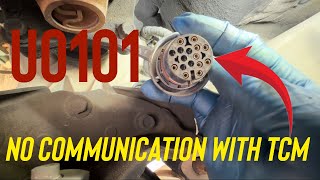
- TCM Main Connector — On the transmission itself, integrated with the valve body. The external harness connector is a round, twist-lock connector on the side of the transmission case.. This is the single point of connection for all power, ground, and CAN bus signals to the TCM. Corrosion from moisture or fluid contamination on these pins is a common cause of communication loss.
- TCM Ground — The solenoids and TCM inside the transmission are grounded through the valve body to the metal case of the transmission itself. The main transmission case is then grounded to the chassis via a ground strap.. A corroded or loose main transmission ground strap can create a high-resistance ground path for the TCM, causing it to malfunction or lose communication intermittently.
Real Owner Repair Stories
- Reddit r/MechanicAdvice user (Nissan vehicle with remanufactured transmission) — Vehicle starts but has a permanent U0101 code, will not shift, and the gear indicator on the dash is blank.
❌ Tried (didn't work) Erasing codes with a consumer scan tool, Disconnecting the battery for several minutes, Checking fuses #40 (Transmission Ignition) and #57 (TCM/ECM)
✅ What actually fixed it The user found transmission fluid on the main electrical connector. Thoroughly cleaning the connector and pins with electrical contact cleaner resolved the communication issue. - NHTSA ODI #11114960 — An owner reported that their dashboard lights illuminated and a diagnostic check revealed the U0101 lost communication code. Despite the code being present, the service department initially refused to keep the vehicle for extended diagnosis.
- NHTSA ODI #11631268 — A Nissan owner described dangerous lurching and instances where the transmission would not engage, citing U0101 as the diagnostic code representing bad communication between the TCM and the vehicle.
OEM Part Supersession History
310F6-3BE0A→Unknown, but this part number is listed for 2013-2016 Sentra and 2012-2014 Versa models.— Part consolidation and potential revisions.
Heads up: Part number 31036-9KE0C is listed as an 'Other Part Number' for 310F6-3BE0A, suggesting potential interchangeability, but this must be confirmed by VIN with a dealer.
Model Year Variations Within This Range
- 2013-2016: The B17 Sentra received a facelift in 2016 which included exterior and interior design changes. While the core powertrain remained, wiring harnesses and module locations could have minor differences. The early models (2013-2014) were the specific target of the PM562 TCM reprogramming campaign.
- 2013-2014 vs. 2015-2018: A TSB related to code P0101 (MAF sensor) shows different repair procedures by year. For 2013-2014 models, the fix involves replacing the PCV valve, cleaning the throttle body, and reprogramming the ECM. For later years, only a throttle body cleaning and/or idle air volume relearn is required. This highlights that Nissan frequently adjusted control module software and related hardware throughout the B17 generation.
Diagnostic Flowchart
Other Known Issues on This Vehicle
Issues unrelated to this code that are worth knowing about as an owner of this generation:
- Premature CVT Failure & Judder 🔴 High — Extremely common across the entire generation. Symptoms can appear at any mileage but are frequently reported between 60,000 and 100,000 miles. (Ref: Multiple TSBs including NTB17-034h and NTB19-075a address judder, hesitation, and DTCs like P17F0.)
- Faulty Brake Light Switch 🟠 Medium — Widespread enough to trigger a major recall (PM971) for 2016-2019 models. (Ref: Recall PM971. Can cause brake lights to fail and may prevent the engine from starting.)
- Mass Air Flow (MAF) Sensor Issues 🟠 Medium — Commonly reported, often triggering a P0101 or P0102 code. Can be caused by a dirty sensor, cracked intake boot, or require an ECM reflash. (Ref: TSB NTB16-027d exists for the P0101 code, suggesting other causes besides a bad sensor.)
- Cracked Air Intake Hose 🟡 Low — A common cause for lean codes (P0171) and MAF codes (P0101), as unmetered air enters the engine.
- Faulty Master Brake Cylinder 🔴 High — Reported on 2013 models, causing the brake pedal to go to the floor with little effect.
Used vs. New Parts: Buying Guide for This Vehicle
When a used part is the smart pick: A used TCM/valve body assembly from a junkyard can be a cost-effective option IF you have access to a professional who can reprogram it. It is not a plug-and-play part.
Donor-vehicle mileage cap: roughly under 60000 miles for the part to have meaningful remaining life.
What to inspect on the donor part:
- Verify the donor vehicle was not in a front-end collision that could have damaged the transmission.
- Inspect the main electrical connector on the transmission for any bent pins, corrosion, or damage.
- If possible, get the VIN of the donor car to help with potential programming needs.
- Ask for a warranty or return period from the salvage yard.
OEM-only on this vehicle (don't cheap out):
- Transmission Control Module (TCM). While remanufactured units exist, a used OEM module that is properly reprogrammed is often more reliable than a new, unproven aftermarket one. New OEM is the safest but most expensive option.
Brands owners have reported issues with on this vehicle:
- Unknown or unbranded TCMs from online marketplaces without a warranty or clear programming instructions should be avoided. The programming is critical to function.
Real Owner Stories
Aggregated from forums and TSBs cited above. Mileages and costs reflect what owners reported in those sources.
2013-2017 Nissan Sentra — ~80000 miles
Symptoms: Widespread CVT failure, jerking, and loss of power. The U0101 code appeared shortly before total transmission failure.
What fixed it: Full CVT replacement.
Source hint: CarComplaints.com and vehicle_specific_issues section regarding B17 Sentra Jatco CVT8
2016 Nissan Sentra
Symptoms: User reported a P0101 code (often appearing alongside transmission software issues) and general drivability problems.
What fixed it: Cleaning the throttle body and reflashing the ECM/TCM per Nissan TSB recommendations.
Source hint: Reddit r/cartalk - '2016 Nissan Sentra MAF sensor failure?'
Related OBD-II Codes
Frequently Asked Questions
Does the PM562 service campaign apply to my 2013 Nissan Sentra?
My 2015 Sentra is shaking and has a U0101 code; is there a TSB for this?
Can I fix the U0101 code by just replacing the TCM myself?
Is it true that a U0101 code on a Sentra often means the whole transmission is failing?
Could a simple fuse cause my Sentra to lose communication with the TCM?
How much does it cost to fix the TCM software issue mentioned in the Nissan campaigns?
Helpful Videos

![How To Test CAN BUS With A Multimeter [CAN Bus Resistance Check] Mechanic Mindset](https://img.youtube.com/vi/JPE42HSJxAk/mqdefault.jpg)

We Have This Part in Stock

The information in this article is provided for general reference and educational purposes only. Vehicle specifications, procedures, and part compatibility can vary by production date, trim level, and region. Always consult your vehicle's factory service manual and verify part numbers before purchasing or performing repairs. Safety-critical components such as airbags, seat belts, and braking systems should be installed by a qualified professional.
- Nissan Sentra:
- 🧭 Diagnostic Flowchart
- 🎬 Helpful Videos
- 🛍️ Shop This Part
- What's Unique About the 2013-2019 Nissan Sentra
- Symptoms You May Notice
- Most Likely Causes
- Diagnosis Steps
- Parts You'll Likely Need
- Related Codes That Often Appear With This One
- Technical Service Bulletins (TSBs) & Recalls
- Platform-Specific Known Issues
- Mechanic-Grade Diagnostic Values
- Scan Tool Commands That Help
- Wiring & Ground Locations
- Real Owner Repair Stories
- OEM Part Supersession History
- Model Year Variations Within This Range
- Other Known Issues on This Vehicle
- Used vs. New Parts: Buying Guide for This Vehicle
- Real Owner Stories
- 2013-2017 Nissan Sentra — ~80000 miles
- 2016 Nissan Sentra
- Related OBD-II Codes
- Frequently Asked Questions
- 🎟️ Get 5% Off