

U0140 on 2008-2012 Ford Kuga: Lost Communication With Body Control Module Fixes
On a 2008-2012 Ford Kuga, code U0140 almost always points to a faulty Instrument Panel Cluster, not the Body Control Module itself. The cluster's internal solder joints fail, disrupting the CAN bus network. A professional repair service for the cluster is the most common fix, costing around $150-$300, and is much more likely to solve the issue than replacing the BCM.
- For a 2008-2012 Ford Kuga, U0140 is most likely caused by a faulty Instrument Panel Cluster, not the Body Control Module.
- Do not replace the BCM until you have ruled out the instrument cluster, battery, and wiring.
- Symptoms include a no-start condition, erratic gauges, multiple warning lights, and failure of electrical components like windows and lights.
- The most reliable and cost-effective solution is to have your original instrument cluster professionally repaired and re-soldered.
- This is a complex electrical issue; professional diagnosis is strongly recommended to avoid replacing incorrect parts.
What's Unique About the 2008-2012 Ford Kuga
For the first-generation Ford Kuga (2008-2012), and related platforms like the Ford Focus (2008-2011) and C-Max (2007-2011), the U0140 code has a very specific and common cause that is different from many other vehicles. The fault is rarely the Body Control Module itself. Instead, it is almost always caused by an internal failure of the Instrument Panel Cluster (IPC). The IPC in these models acts as a critical gateway on the communication network, bridging the high-speed (HS-CAN) and medium-speed (MS-CAN) networks. When its internal components or, most commonly, the solder joints on the main connector pins crack from thermal stress and vibration, it disrupts the entire network. This leads other modules to incorrectly report a loss of communication with the BCM, even though the BCM is likely fine. Owners often mistakenly replace the BCM only to find the problem persists, because the root cause was the instrument cluster all along.
Symptoms You May Notice
- Multiple warning lights illuminated on the dashboard (engine, ABS, traction control, immobilizer).
- Gauges on the instrument cluster sweeping erratically, freezing, or not working at all.
- Vehicle fails to start or has intermittent starting problems, often with a flashing immobilizer light.
- Loss of body electrical functions, such as power windows, central locking, interior lights, or wipers.
- Headlights or exterior lights not working correctly.
- Air conditioning (A/C) system failure.
- Message on the display such as 'Transmission Malfunction' or 'Engine Malfunction'.
- Cruise control stops working.
- Replacing the Body Control Module (BCM) without first investigating the Instrument Panel Cluster. On this specific vehicle, the cluster is the most likely cause, and a BCM replacement will not fix the issue.
Most Likely Causes
- Faulty Instrument Panel Cluster (IPC) 🔴 High Probability → Shop Instrument Cluster This is a widely documented failure point for the 2008-2012 Kuga and related Ford models. The solder joints on the main connector pins and internal components on the cluster's circuit board crack over time due to thermal cycles and vibration, causing intermittent network communication.
How to confirm: Scan all vehicle modules. If the instrument cluster is logging multiple communication codes (like U1900) or is not communicating at all, and you have various unrelated symptoms, the cluster is the primary suspect. Tapping on the dashboard or wiggling the connector behind the cluster may temporarily restore function, which is a strong indicator of this fault.
Typical fix: The instrument cluster must be removed and sent to a specialist electronics repair service for rebuilding. They will re-solder the weak points on the circuit board, particularly the main connector, and replace any failed components. This is more reliable and cost-effective than buying a used cluster, which will likely have the same fault.
Est. part cost: $150-$300 for a professional repair service. - Low Battery Voltage or Faulty Alternator 🟡 Medium Probability → Shop Vehicle Battery These vehicles can be sensitive to low voltage, which can cause multiple modules to drop off the network and generate communication codes.
How to confirm: Test the battery voltage with the engine off; it should be above 12.4V. With the engine running, check the alternator output; it should be between 13.7V and 14.7V. A simple load test at an auto parts store can confirm battery health.
Typical fix: Charge or replace the battery. If the alternator is faulty, it will need to be replaced.
Est. part cost: $100-$250 for a new battery, $250-$500 for an alternator. - Wiring Harness or Connector Issue ⚪ Low Probability Water ingress into the passenger footwell can corrode the connectors on the Body Control Module (which is also the fuse box). This is a known, but less common, issue than the cluster failure.
How to confirm: Visually inspect the wiring and connectors at the Instrument Cluster and the Body Control Module (typically located behind the glove box, integrated into the fuse box). Check for any signs of corrosion, water damage (damp carpets), or loose/damaged pins.
Typical fix: Repair the damaged section of the wiring harness. Clean corroded connectors and grounds, and ensure all connections are secure. If the BCM is corroded, it may need replacement.
Est. part cost: $10-$100 for wiring supplies. - Faulty Body Control Module (BCM) ⚪ Low Probability → Shop Body Control Module While BCM failure can happen, it is far less common than the instrument cluster fault for this specific code on this vehicle. It is often misdiagnosed.
How to confirm: This should only be considered after the Instrument Cluster, battery, and wiring have been ruled out. A professional will need to use an advanced scan tool to attempt to communicate directly with the BCM and verify it is truly offline while the rest of the network is functional.
Typical fix: Replace the BCM/fuse box assembly. The new module must be programmed to the vehicle's VIN and configuration using Ford-specific diagnostic software like FORScan.
Est. part cost: $300-$600 for a new BCM, plus programming costs.
Rare But Worth Checking
- Blown Fuse: Always a quick and easy check. A blown fuse supplying power to the BCM or Instrument Cluster can cause this code.
- Aftermarket Accessory Interference: A poorly installed remote start, alarm system, or stereo can interfere with the CAN bus network and cause communication errors.
Technical Service Bulletins (TSBs) & Recalls
While specific to other Ford models, manufacturer service bulletins highlight how U0140 often appears alongside other communication faults. For instance, TSB Bulletin #SSM 48563 notes that U0140 can be set in the powertrain control module (PCM), transmission control module (TCM), and instrument panel cluster (IPC), often accompanied by a malfunction indicator lamp (MIL) and transmission shift concerns.
Diagnosis Steps
- Read all fault codes from all modules using a capable OBD-II scanner (FORScan is highly recommended for Fords). Note which modules are reporting U0140 and look for U0155 or U1900.
- Check the battery. Ensure voltage is above 12.4V with the engine off and that the charging system is working correctly (13.7V-14.7V running).
- Inspect fuses related to the BCM (passenger fuse box) and Instrument Cluster.
- Focus on the Instrument Panel Cluster. With the ignition on, gently tap the top of the dashboard above the cluster. If gauges flicker, lights change, or function returns temporarily, the cluster's internal solder joints are almost certainly the fault.
- If the tap test is inconclusive, inspect the passenger footwell and BCM/fuse box area for any signs of water intrusion or corrosion on the connectors.
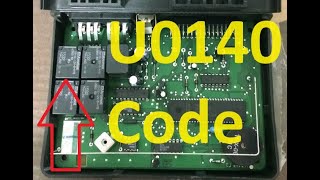
- If the cluster is suspect, the next step is to remove it. A visual inspection of the main connector pins on the circuit board may reveal cracked solder joints.
- If all wiring, power, and grounds are good, the fault is highly likely to be internal to the Instrument Panel Cluster. Send it to a specialist for testing and repair.
- Only consider replacing the BCM as a last resort after all other possibilities have been exhausted.
Parts You'll Likely Need
- Instrument Panel Cluster Repair Service — This is the most common fix for U0140 on this vehicle. The original cluster has known soldering defects that are corrected during the rebuilding process.
Trusted brands: ECU Testing, BBA Reman, Cartronix
OEM price range: N/A (Repair Service)
Aftermarket price range: $150-$300 - Instrument Panel Cluster
(OEM #8V4T-10849-xx, 8U4T-10849-xx (e.g., 8U4T-10849-MJ))— If the cluster is damaged beyond repair, a replacement is needed. A used part will likely have the same defect. A new or refurbished part will require programming.
Trusted brands: Motorcraft (OEM)
OEM price range: $500-$800
Aftermarket price range: $200-$400 (Used/Refurbished) - Body Control Module (BCM) / Smart Junction Box
(OEM #7M5T-14A073-xx (e.g., 7M5T-14A073-JG))— This is a possible, but much less likely, cause of the failure. It is often replaced by mistake. Replacement requires VIN programming.
Related Codes That Often Appear With This One
- U1900 — This is a general CAN Communication Bus Fault code. It often appears alongside U0140 when the instrument cluster is failing, indicating a broader network problem caused by the faulty gateway.
- U0155 — This code means 'Lost Communication with Instrument Panel Cluster (IPC)'. If other modules log this code along with U0140, it strongly points to the IPC as the source of the network failure.
- U0100 — This means 'Lost Communication with ECM/PCM'. It can be logged as a symptom when the network gateway (the instrument cluster) fails, disrupting communication across the entire system.
Platform-Specific Known Issues
- Owner Experience: Intermittent Non-Start and Erratic Gauges: An owner on kugaownersclub.co.uk described their 2010 Kuga intermittently failing to start, with all dashboard lights flashing and gauges sweeping wildly. After replacing the battery with no success, they sent their instrument cluster for repair. The repair service confirmed faulty solder joints, rebuilt the cluster, and upon reinstallation, all problems were resolved. This is a classic story for this fault.
- Misdiagnosis: BCM Replacement Fails to Fix Issue: A post on talkford.com detailed a garage replacing the Body Control Module (BCM) at significant cost to fix a U0140 code and associated electrical problems. The issues returned shortly after. Further research led them to the common instrument cluster fault. After having the original cluster repaired, the U0140 code was permanently cleared and all functions returned to normal, confirming the BCM was replaced unnecessarily.
Mechanic-Grade Diagnostic Values
- CAN Bus Network Resistance — expected: Approximately 60 Ω between CAN_H and CAN_L pins at the OBD-II port (pins 6 & 14) with the battery disconnected.. Failure: A reading of 120 Ω indicates one of the two terminating resistors (one is in the cluster) is offline. A reading of 0 Ω indicates a short between the two lines. A reading significantly different from 60 Ω (e.g., 40-45 Ω) could indicate a third, unintended resistor on the network or a failing module.
- CAN Bus Voltage (Key On, Engine Off) — expected: With the network active, CAN_H should be ~2.7V and CAN_L should be ~2.3V, with a differential of ~0.4V. During data transmission (dominant state), CAN_H rises toward 3.5V and CAN_L falls toward 1.5V. Using a multimeter will only show an average voltage.. Failure: Both lines showing the same voltage (e.g., 2.5V or 0V) indicates an idle or faulted bus. Voltages shorted to ground (0V) or power (~5V or 12V) indicate a wiring fault.
- Instrument Cluster Connector (C809) Power/Ground — expected: Pin 29 (+12v Battery): Constant 12V+. Pin 15 (+12v START/RUN): 12V+ with ignition on. Pin 31 (Ground) and Pin 91 (Ground): Less than 0.2 Ω resistance to a known good chassis ground.. Failure: Missing voltage at pins 29 or 15 points to a fuse or power supply issue. High resistance on ground pins 31 or 91 indicates a bad ground connection, which can cause the cluster to malfunction.
Scan Tool Commands That Help
- Instrument Cluster Self-Diagnostic Mode: → Shop Instrument Cluster Enter 'TEST' mode — This is a free, built-in tool to quickly check cluster functionality without an external scanner. To enter, press and hold the 'SET' or tripmeter reset button, then turn the ignition to position II. Release the button when 'TEST' appears on the display. You can then cycle through tests for gauges, the LCD screen, and view stored DTCs directly on the cluster.
- FORScan: IPC Module Self-Test — After establishing a connection with the vehicle, you can run a specific self-test on the Instrument Panel Cluster (IPC). This can help confirm if the module is responding and may generate specific fault codes that are not visible with a generic OBD-II reader, further isolating the problem to the cluster itself.
- FORScan: Network Test — This function pings all modules on the HS-CAN and MS-CAN networks and provides a topology map of what is communicating. If the Instrument Cluster (IPC) is showing as offline or has numerous communication errors with other modules, it reinforces the diagnosis that the cluster is the faulty gateway.
Wiring & Ground Locations
- Instrument Cluster Connector (C809) — The main electrical connector that plugs into the back of the Instrument Panel Cluster.. This is the physical point of failure. The solder joints for the pins on this connector crack on the cluster's circuit board, causing the network interruption. Wiggling this connector can often temporarily restore function, confirming the fault location.
- Instrument Cluster Ground — A primary ground point is located under the dash, behind the plastic kick panel in front of the driver's door. The cluster itself has ground connections at Pins 31 and 91 of the C809 connector.. A poor ground connection to the instrument cluster can cause it to malfunction and drop off the network, mimicking an internal failure. Verifying this ground is clean and tight is a critical diagnostic step.
- BCM/GEM Module Ground — The Body Control Module (also the General Electronic Module or GEM) is located behind the glove box. Its ground points are typically secured to the chassis nearby.. While less common for this specific U0140 issue on the Kuga, a poor ground at the BCM itself can cause it to stop communicating. This should be checked if the instrument cluster has been ruled out as the cause.
- HS-CAN & MS-CAN Wires at Cluster — At the C809 cluster connector: HS-CAN is on Pins 4 (GY) & 4 (GY/RD). MS-CAN is on Pins 5 (BU) & 5 (BU/RD). Note: Pin numbers appear duplicated in the source, likely a typo, but wire colors are key.. These are the specific wires that carry the network data through the cluster. The cluster acts as a gateway between these two networks. A failure here isolates modules on either side from each other.
Real Owner Repair Stories
- FordOwnersClub.com forum user (2009 Ford Mondeo (shares platform/cluster with Kuga)) — Engine misfires, limp mode, A/C failure, forward alert errors, multiple warning lights. Resets after switching car off and on.
❌ Tried (didn't work) Ford dealer replaced unknown parts for $1600 with no change., Dealer suggested replacing ABS module for $1500 with no guarantee.
✅ What actually fixed it An independent mechanic found and cleaned corroded plugs on a module (likely the ABS module given the context) which fixed the issue for several months. When the problem returned, the owner retrieved code U0140. The resolution points to a wiring/connector issue rather than a module failure, which is a common secondary cause after the instrument cluster.
Documented NHTSA Reports
- NHTSA ODI #11715107: An owner reported a series of communication errors including U0140 "Lost communication with body control module," U0155 "lost communication with instrument panel control module," and U2403 "Ethernet failure with instrument panel cluster."
- NHTSA ODI #11693477: A report describes diagnostic codes U0140:00-08 indicating BCM missing communication and U1A00:87-08 regarding an APIM private communication network malfunction.
- NHTSA ODI #11704877: An owner noted that multiple communication fault codes, including U0100, U0131, U0140, and U0151, appeared when the ignition was on with the engine off, though some cleared after starting.
- NHTSA ODI #10937177: A report lists U0140:00 as a stored code in the PSCM module alongside various BCM and BECM codes such as B10D7:87 and U3003:16.
OEM Part Supersession History
8V4T-10849-xx→8U4T-10849-xx— Part revision and update, likely to address internal component issues. The core failure of solder joints may still exist in earlier revisions of the superseding part number.
Heads up: Part numbers are specific to fuel type (petrol/diesel) and feature set (e.g., with or without large central display). The cluster must be compatible with the vehicle's original configuration. A replacement cluster, new or used, will require programming with FORScan or IDS to match the vehicle's VIN, mileage, and PATS (immobilizer) key data.
Diagnostic Flowchart
Other Known Issues on This Vehicle
Issues unrelated to this code that are worth knowing about as an owner of this generation:
- PowerShift Transmission Problems 🔴 High → Shop Transmission Assembly — Common on 2.0 TDCi models. Issues like jerky shifting, hesitation, or complete failure can occur, sometimes before 100,000 km. Problems are often related to internal clutch components or low/contaminated fluid.
- Haldex AWD System Malfunction 🟠 Medium — The 'AWD Malfunction' warning is common. It's typically caused by a clogged filter and a subsequent pump failure in the Haldex coupling. Ford considered it 'non-serviceable', but specialists recommend fluid/filter changes every 30,000 miles.
- Tailgate Wiring Harness Failure 🟡 Low — On models with a power tailgate, the wiring loom that passes from the body to the tailgate can fatigue and break from repeated opening and closing. This leads to the tailgate not opening/closing, or other tailgate electrical functions failing.
- Diesel Particulate Filter (DPF) Clogging 🟠 Medium — Like many diesels of its era, the 2.0 TDCi is prone to DPF issues, especially if used primarily for short trips. This can cause poor performance, increased fuel consumption, and warning lights.
- Battery Drain and Alternator Failure 🟠 Medium → Shop Vehicle Battery — Reports of premature battery drain and alternator failure are common. A failing alternator can cause a host of electrical issues and warning lights due to unstable voltage.
Used vs. New Parts: Buying Guide for This Vehicle
When a used part is the smart pick: A used instrument cluster is generally NOT recommended for this repair. The solder joint failure is a design and age-related flaw, meaning a used part from a donor vehicle of the same era is highly likely to have the same defect or develop it soon after installation.
What to inspect on the donor part:
- If buying used is the only option, try to source a part from the latest possible model year (e.g., 2011-2012) as it may have later revisions.
- Ask the seller if the cluster has been previously repaired or remanufactured. A professionally repaired unit is more valuable than an original used one.
OEM-only on this vehicle (don't cheap out):
- Instrument Panel Cluster Repair Service: This is the most highly recommended path. Sending your original unit for repair ensures it is returned programmed for your car and with the specific solder joint defect corrected.
- Body Control Module (BCM): If the BCM is truly faulty (a rare occurrence for this code), an OEM or OEM-remanufactured part is strongly advised. Used BCMs are often VIN-locked and can be difficult or impossible to reprogram to a different vehicle.
Aftermarket brands forum-validated for this vehicle:
- For Repair Services: ECU Testing, BBA Reman, and Autotronics are frequently mentioned in forums as reliable specialists for repairing these Ford instrument clusters.
Brands owners have reported issues with on this vehicle:
- Avoid unbranded, cheap aftermarket clusters from online marketplaces. They often have software compatibility issues, incorrect gauge calibrations, and will still require complex programming that may not even be possible.
Real Owner Stories
Aggregated from forums and TSBs cited above. Mileages and costs reflect what owners reported in those sources.
2010 Ford Kuga
Symptoms: Intermittently failing to start, all dashboard lights flashing, and gauges sweeping wildly. Replacing the battery did not fix the issue.
What fixed it: Sent the instrument cluster to a repair service to have faulty solder joints rebuilt.
Source hint: kugaownersclub.co.uk owner experience cited in vehicle_specific_issues
2008-2012 Ford Kuga
Symptoms: U0140 code and associated electrical problems. A garage previously replaced the Body Control Module (BCM) but the issues returned shortly after.
What fixed it: Repairing the original instrument cluster's internal circuitry, which permanently cleared the U0140 code.
Source hint: talkford.com post detailed in vehicle_specific_issues
2008-2011 Ford Focus (Platform Mate)
Symptoms: U0140 code and a host of electrical symptoms identical to the Kuga, caused by the instrument cluster acting as a network gateway.
What fixed it: Re-soldering the common dry joint issues on the instrument cluster circuit board.
Source hint: fordownersclub.com/forums/topic/120029-please-help-fault-code-u0140-e-forscan/
2009 Ford Kuga 2.0 TDCi — ~62000 miles
Symptoms: Diagnostic process for U0140, U0155, and U1900 codes. Symptoms pointed to the IPC (Instrument Panel Cluster) due to its gateway function.
What fixed it: Addressing cold solder joint failures within the Instrument Panel Cluster (IPC).
Source hint: elektroda.pl/rtvforum/topic3899321.html
Related OBD-II Codes
Frequently Asked Questions
My 2010 Kuga has erratic gauges and won't start; could this be the Instrument Panel Cluster (IPC)?
Can I just buy a used instrument cluster to fix the U0140 code on my Kuga?
I'm seeing 'Transmission Malfunction' on my 2008 Kuga display along with U0140; is my gearbox failing?
How can I quickly test if my Kuga's dashboard issues are caused by the cluster hardware?
Could water in the passenger footwell cause the U0140 communication code?
Is the U0140 code on my Kuga related to the battery or alternator?
Helpful Videos
We Have This Part in Stock

The information in this article is provided for general reference and educational purposes only. Vehicle specifications, procedures, and part compatibility can vary by production date, trim level, and region. Always consult your vehicle's factory service manual and verify part numbers before purchasing or performing repairs. Safety-critical components such as airbags, seat belts, and braking systems should be installed by a qualified professional.
- Ford Kuga:
- 🧭 Diagnostic Flowchart
- 🎬 Helpful Videos
- 🛍️ Shop This Part
- What's Unique About the 2008-2012 Ford Kuga
- Symptoms You May Notice
- Most Likely Causes
- Rare But Worth Checking
- Technical Service Bulletins (TSBs) & Recalls
- Diagnosis Steps
- Parts You'll Likely Need
- Related Codes That Often Appear With This One
- Platform-Specific Known Issues
- Mechanic-Grade Diagnostic Values
- Scan Tool Commands That Help
- Wiring & Ground Locations
- Real Owner Repair Stories
- Documented NHTSA Reports
- OEM Part Supersession History
- Other Known Issues on This Vehicle
- Used vs. New Parts: Buying Guide for This Vehicle
- Real Owner Stories
- 2010 Ford Kuga
- 2008-2012 Ford Kuga
- 2008-2011 Ford Focus (Platform Mate)
- 2009 Ford Kuga 2.0 TDCi — ~62000 miles
- Related OBD-II Codes
- Frequently Asked Questions
- 🎟️ Get 5% Off