

U0140 on 2006-2011 Mercury Milan: Lost Communication with BCM Causes and Fixes
This code means the Body Control Module (BCM) has stopped communicating. On a Milan, this is often due to wiring issues, a bad ground connection, or a faulty Instrument Cluster, not always the BCM itself. Expect a diagnostic-heavy repair.
- U0140 indicates a communication loss with the Body Control Module, affecting features like lights, locks, and windows.
- Do not immediately replace the BCM. The most common causes on a Milan are a bad ground, a wiring fault, or a failing Instrument Cluster.
- Diagnosis must start with checking the battery, fuses, and ground connections.
- A professional-level scan tool is required for proper diagnosis; a basic code reader is not sufficient.
- This is a complex electrical issue, and professional service is highly recommended to avoid unnecessary parts replacement.
What's Unique About the 2006-2011 Mercury Milan
The 2006-2011 Mercury Milan is built on the Ford CD3 platform, shared with the Ford Fusion and Lincoln MKZ/Zephyr. On these Ford-family vehicles of this era, the Instrument Panel Cluster (IPC) often acts as a gateway module for the communication network. A failing IPC, often due to internal solder joint failures, can disrupt the network and cause other modules, like the BCM, to appear offline, triggering a U0140 code. Therefore, what seems like a BCM problem can actually be a faulty instrument cluster, a common issue on these cars.
Generation note: This range covers the entire first generation of the Mercury Milan. The 2006-2009 models are pre-facelift, while the 2010-2011 models are the facelifted version. While they share the same fundamental platform, there can be differences in wiring and module locations. However, the common causes for a U0140 code, particularly related to the instrument cluster and wiring, are consistent across this generation.
Symptoms You May Notice
- Check engine light is on
- Multiple warning lights on the dashboard (ABS, Airbag, Traction Control, Anti-Theft)
- Power windows, door locks, or mirrors not working
- Interior or exterior lights acting erratically, flickering, or not turning on/off
- Windshield wipers operating on their own or not at all
- Remote keyless entry fails to work
- Vehicle may not start or may stall
- Gauges on the instrument cluster behaving erratically or dropping to zero
- Wrench light may be illuminated on the dash
- Replacing the Body Control Module (BCM) first. The code often results from a problem with the BCM's power, ground, or network connection, not an internal BCM failure. The Instrument Panel Cluster is another major suspect that should be investigated before the BCM.
Most Likely Causes
- Poor BCM Ground Connection 🔴 High Probability Ford platforms of this era are known for having ground points in locations susceptible to moisture and corrosion. The primary ground points for the dash and BCM can become loose or corroded, causing intermittent communication loss.
How to confirm: Locate the primary grounds for the BCM and instrument panel. On the Milan, key grounds are G200/G201 (center of dash), G202 (left side of dash), and G203 (base of right 'A' pillar). Inspect them for corrosion or looseness. Perform a voltage drop test on the ground circuit; it should be less than 0.1 volts.
Typical fix: Remove the ground connection, clean the terminal and the chassis mounting point to bare metal with a wire brush or sandpaper, and re-secure it tightly. Apply dielectric grease to prevent future corrosion.
Est. part cost: $0-$10 - Damaged Wiring or Loose Connector 🟡 Medium Probability Wiring harnesses can chafe against sharp metal edges in the dash, A-pillars, or kick panels over time, leading to shorts or open circuits in the CAN bus network. Water intrusion from a leaking windshield or clogged sunroof drains can also corrode connectors at the BCM.
How to confirm: Visually inspect the wiring harness leading to the BCM (located in the driver's side kick panel area) and the Instrument Cluster. Check the main BCM connectors for loose pins, corrosion, or water intrusion. Pay close attention to harness routing near sharp brackets.
Typical fix: Repair the damaged section of wire with a new piece of wire and solder/heat shrink connectors. Clean corroded connectors with a specialized cleaner or replace the connector pigtail if necessary.
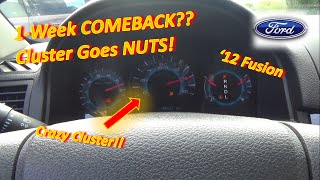
Est. part cost: $10-$50 - Faulty Instrument Panel Cluster (IPC) 🟡 Medium Probability → Shop Instrument Cluster The IPC on these models acts as a network gateway. Solder joint failures on the cluster's circuit board are a known issue that can disrupt the entire CAN bus. Ford issued TSB 06-17-9 for this issue on the related Ford 500/Freestyle and Mercury Montego, and the failure mode is identical on the Fusion/Milan platform. 🎬 Watch: See how a failing cluster behaves on this platform
How to confirm: With the key on, gently tap on the top of the dashboard above the cluster. If symptoms (gauges sweeping, lights flickering, communication loss) appear, disappear, or change, it strongly indicates a faulty IPC. A professional would use a scope to check network signals at the cluster.
Typical fix: The instrument cluster must be removed and either sent to a specialist for repair of the circuit board (re-soldering the main connector pins) or replaced with a new/remanufactured unit. A replacement often requires programming to the vehicle's mileage and key information.
Est. part cost: $200-$600 - Low Battery Voltage or Charging System Fault ⚪ Low Probability → Shop Vehicle Battery
How to confirm: Test the battery voltage with the car off (should be >12.4V) and with the engine running (should be 13.5V-14.5V). A weak or failing battery can cause unpredictable behavior and communication codes from various electronic modules.
Typical fix: Charge or replace the battery. If the charging system is at fault, diagnose and replace the alternator.
Est. part cost: $150-$400
Rare But Worth Checking
- Faulty Body Control Module (BCM): → Shop Body Control Module While the code directly points to the BCM, the module itself is less likely to fail than the wiring, grounds, or other gateway modules that support it. It should only be replaced after all other possibilities have been exhaustively ruled out. Water intrusion is a common cause of BCM failure when it does occur.
- Aftermarket Accessory Interference: Improperly installed remote starters, alarms, or stereo systems can tap into CAN bus wires and introduce electrical noise or draw excessive power, disrupting communication and causing U-codes.
Diagnosis Steps
- Verify Battery Health: Check the battery voltage and charging system operation. Ensure voltage is stable and above 12.4V at rest. Low voltage can cause numerous communication faults.
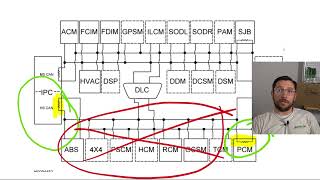
- Perform a Full System Scan: Use a professional-grade scan tool that can communicate with all modules (BCM, PCM, ABS, IPC, etc.). Note all 'U' codes present and which modules are not responding. A basic engine code reader will not be sufficient. 🎬 Watch: Step-by-step network communication testing on a Fusion
- Check for Power and Ground at the BCM: Using a wiring diagram, locate the BCM (in the driver's side kick panel area). Verify it has constant battery power, ignition power, and a solid ground connection using a multimeter. Check grounds G200, G201, G202, and G203 for integrity.
- Inspect BCM Connectors and Wiring: Disconnect the BCM and inspect the connectors for corrosion, moisture, or bent/loose pins. Trace the harness for any visible signs of chafing or damage, especially where it passes through the firewall or near dash support brackets.
- Test the CAN Bus Network: With the battery disconnected, measure the resistance between pins 6 (CAN-High) and 14 (CAN-Low) at the OBD-II port. A healthy network should read approximately 60 ohms. A reading of 120 ohms indicates a break in the wiring or a failed terminating resistor (often in the IPC or PCM). An open circuit or a short to ground points to a wiring fault.
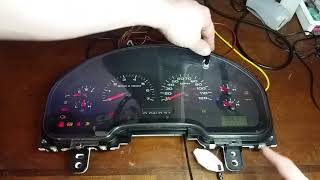
- Tap Test the Instrument Cluster: 🎬 Watch: How to test a Ford instrument cluster With the ignition on, tap the top of the dashboard above the instrument cluster. If this causes symptoms or codes to appear or disappear, the Instrument Cluster has internal connection failures and is highly suspect.
- Isolate the Fault: If the network is down (e.g., resistance is incorrect), a technician may unplug modules one by one to see if communication is restored. This can help identify a faulty module that is crashing the entire network.
Parts You'll Likely Need
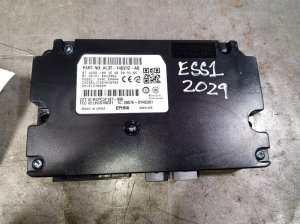
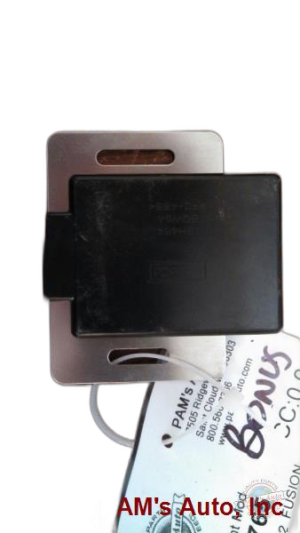
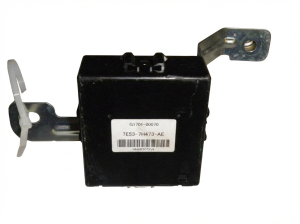
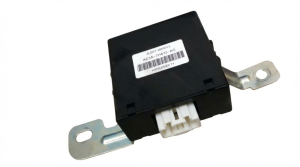
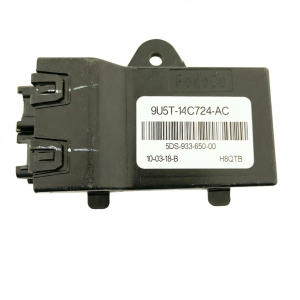
- Body Control Module (BCM) — This is the module indicated by the code, but it should only be replaced after all other wiring, ground, and network issues have been ruled out.
Trusted brands: Motorcraft
OEM price range: $400-$700
Aftermarket price range: $250-$450 - Instrument Panel Cluster (IPC) — A common failure point on this platform that acts as a network gateway. A fault here can cause a U0140 code. Often repairable by a specialist.
Trusted brands: Motorcraft, Dorman
OEM price range: $500-$800
Aftermarket price range: $200-$400 (Remanufactured)
Related Codes That Often Appear With This One
- U0073 — This code means 'Control Module Communication Bus 'A' Off', indicating a total network failure. If you see this with U0140, it points to a major network problem like a shorted wire or a failed gateway module (like the IPC), not just an issue with the BCM.
- U0155 — This code means 'Lost Communication With Instrument Panel Cluster (IPC)'. Seeing U0140 and U0155 together strongly suggests the problem is with the IPC or the network wiring connecting the modules, rather than an individual module failure.
Technical Service Bulletins (TSBs) & Recalls
- TSB 06-17-9: While officially for the Ford 500/Freestyle and Mercury Montego, this TSB describes the exact intermittent instrument cluster failure (gauges sweeping, intermittent power loss) that affects the Fusion/Milan. It points to an internal cluster fault, corroborating it as a primary cause for network communication codes.
Platform-Specific Known Issues
- The instrument cluster solder joint failure is a very common cause for this code on the Mercury Milan and its Ford Fusion sibling. Tapping the dash above the cluster is a surprisingly effective diagnostic test.
Mechanic-Grade Diagnostic Values
- CAN Bus Network Resistance — expected: ~60 Ohms. Failure: A reading of ~120 Ohms indicates an open circuit or a failed termination resistor in a module (like the IPC or PCM). A reading near 0 Ohms indicates a short between the CAN High and CAN Low wires.
- CAN Bus Voltage (Key On, Engine Off) — expected: CAN-High (Pin 6): ~2.7V. CAN-Low (Pin 14): ~2.3V. Both should be mirror images of each other.. Failure: Voltages that are stuck high (near 5V or 12V) or low (near 0V), or that do not mirror each other, indicate a short to power, short to ground, or an internal module fault.
- BCM Power Supply Voltage — expected: 12.2V - 12.8V. Failure: Voltage below 12.2V at the BCM connector indicates a power supply issue (fuse, wiring, battery) that can cause the module to drop offline.
- BCM Ground Circuit Voltage Drop — expected: < 0.1 Volts (100 mV). Failure: A reading higher than 0.1V indicates excessive resistance in the ground circuit, which can cause intermittent communication issues.
Scan Tool Commands That Help
- Ford IDS / FORScan: IPC Self-Diagnostic Mode — This is a built-in cluster test, not requiring an external scan tool. It's used to verify gauge, light, and LCD function. To enter, press and hold the trip reset button, turn the ignition to ON, and release the button when 'TEST' appears. This can help confirm if the cluster is powering on and partially functional, even if it's not communicating on the network.
- Ford IDS / FORScan: PATS (Passive Anti-Theft System) Key Programming — This function is mandatory when replacing the Instrument Panel Cluster (IPC). The keys are programmed to the cluster. After installing a replacement IPC, this command is used to erase old keys and program at least two of the owner's keys to the new module, which allows the car to start.
Wiring & Ground Locations
- BCM (SJB) — Under the driver's side of the dashboard, to the left of the steering column. It is integrated with the interior fuse panel, also known as the Smart Junction Box (SJB).. This is the module that is reported as offline. All power, ground, and network connections must be verified at its connectors (e.g., C2280 series).
- G200 / G201 — Under the instrument panel, near the center of the dash, often on a support bracket behind the radio area.. These are primary ground points for multiple dash components, including the instrument cluster and other modules. A loose or corroded connection here can cause widespread communication issues.
- G203 — Located at the base of the right-hand (passenger side) 'A' pillar, behind the kick panel trim.. This ground serves components in the passenger side dash area. While less likely to be the primary cause for a BCM code (which is on the driver's side), network problems can be caused by any poor ground on the bus.
- G301 — Under the driver door opening, near the floor, just behind the 'A' pillar.. A floor-level ground that is susceptible to moisture and corrosion from wet shoes or water leaks, potentially affecting door module functions controlled by the BCM.
- MS-CAN Bus Wires — Pins 3 (GY/OG) and 11 (VT/OG) at the OBD-II port. These wires run to the BCM, IPC, and other modules throughout the dash area.. These are the specific network wires that carry data to and from the BCM. A short or open on these wires is a direct cause of communication loss.
Real Owner Repair Stories
- Ford Fusion Forum user (2010 Ford Fusion (same platform)) — Multiple warning lights (ABS, traction control, airbag), gauges dropping to zero, 'Check Brake System' and 'Check Advancetrac' messages, transmission shifting hard, speedometer not working.
❌ Tried (didn't work) Replacing the battery., Checking fuses.
✅ What actually fixed it The problem was a faulty instrument cluster. The owner confirmed this by tapping on the dash, which would cause the symptoms to appear or disappear. The final fix was to remove the instrument cluster and send it to a repair service to have the solder joints on the main connector re-soldered. This resolved all communication issues and codes.
Model Year Variations Within This Range
- 2010-2011: The 2010-2011 facelifted Milan models have different instrument cluster part numbers (starting with AE5T or BE5T) than the pre-facelift 2006-2009 models. While the failure mode (bad solder joints) is similar, the parts are not physically or electronically interchangeable.
Diagnostic Flowchart
Other Known Issues on This Vehicle
Issues unrelated to this code that are worth knowing about as an owner of this generation:
- Defective Electronic Throttle Body 🔴 High — Common on 2009-2011 models with both 2.5L and 3.0L engines. Can occur at relatively low mileage (e.g., under 60k miles). (Ref: Ford had a Customer Satisfaction Program (13N03) for this issue, but it has since expired. The issue causes the vehicle to enter 'limp mode' with a wrench light, resulting in a sudden loss of power.)
- Harsh Shifting / Transmission Failure (6F35) 🟠 Medium → Shop Transmission Assembly — Affects models with the 6-speed 6F35 automatic transmission. Issues include harsh shifts, delayed engagement, and slipping. Often caused by a leaking axle seal leading to low fluid, or internal valve body/solenoid issues. (Ref: Multiple TSBs exist for software updates to address shift quality. A major recall (22S43) was issued for a detached shifter cable bushing that could cause the vehicle to roll away.)
- Broken Interior Door Handles 🟡 Low — Extremely common across all model years. The plastic handle assembly frequently breaks, preventing the door from being opened from the inside. (Ref: No TSB or recall, but it is a widely reported failure. Aftermarket replacements are readily available.)
- Leaking Transmission Cooler Lines 🟠 Medium → Shop Transmission Assembly — Common in regions where road salt is used. The metal lines running to the transmission cooler are prone to rust and corrosion, leading to transmission fluid leaks. (Ref: No recall, but it's a frequent repair noted by owners in rust-belt states.)
Used vs. New Parts: Buying Guide for This Vehicle
When a used part is the smart pick: A used Instrument Panel Cluster (IPC) from a junkyard can be a cost-effective option, but ONLY if you are prepared for the required programming. Repairing your original cluster is often the best path as it avoids all programming and mileage issues. A used BCM is generally NOT recommended as it is often VIN-locked and may not be reprogrammable.
Donor-vehicle mileage cap: roughly under 150000 miles for the part to have meaningful remaining life.
What to inspect on the donor part:
- For an IPC, find a donor vehicle with equal or LOWER mileage than your own. It is illegal to roll back an odometer, but services can legally roll a lower-mileage cluster forward to match your car's true mileage.
- Inspect the clear plastic lens for deep scratches or hazing.
- Ensure the donor vehicle is the same model year range and has the same engine type (e.g., non-hybrid) to ensure compatibility.
OEM-only on this vehicle (don't cheap out):
- Body Control Module (BCM)
Aftermarket brands forum-validated for this vehicle:
- For a replacement IPC, sending the original unit to a dedicated electronics repair service (like Circuit Board Medics or similar) is a highly recommended path with a high success rate.
- Dorman offers remanufactured instrument clusters, but reviews suggest quality can be inconsistent, though they typically come with a warranty.
Brands owners have reported issues with on this vehicle:
- No-name, unverified used BCMs from online marketplaces are extremely high-risk due to VIN locking and potential for being pre-damaged.
Real Owner Stories
Aggregated from forums and TSBs cited above. Mileages and costs reflect what owners reported in those sources.
2006-2011 Mercury Milan
Symptoms: Gauges on the instrument cluster behaving erratically or dropping to zero; initial suspicion was the BCM.
What fixed it: The discovery that the instrument cluster or a bad ground was the actual culprit rather than the BCM itself.
Source hint: fordfusion.net threads regarding 'U0140 no communication' and 'instrument cluster failure'
2006-2011 Mercury Milan
Symptoms: Intermittent instrument cluster failure including gauges sweeping and intermittent power loss.
What fixed it: Repair of the instrument cluster circuit board (re-soldering the main connector pins) or replacement of the unit.
Source hint: TSB 06-17-9 and related platform failure modes described in vehicle_specific_issues
Related OBD-II Codes
Frequently Asked Questions
Does TSB 06-17-9 apply to my Mercury Milan if I'm seeing U0140 and erratic gauges?
Why are my power windows and wipers acting up along with the U0140 code?
Is there a simple way to test if my instrument cluster is causing the U0140 code?
Could a bad battery cause a U0140 communication code on a 2010 Mercury Milan?
Where are the BCM ground points located on the Mercury Milan?
Does the Mercury Milan share this U0140 issue with the Ford Fusion?
Helpful Videos
We Have This Part in Stock

The information in this article is provided for general reference and educational purposes only. Vehicle specifications, procedures, and part compatibility can vary by production date, trim level, and region. Always consult your vehicle's factory service manual and verify part numbers before purchasing or performing repairs. Safety-critical components such as airbags, seat belts, and braking systems should be installed by a qualified professional.
- Mercury Milan:
- 🧭 Diagnostic Flowchart
- 🎬 Helpful Videos
- 🛍️ Shop This Part
- What's Unique About the 2006-2011 Mercury Milan
- Symptoms You May Notice
- Most Likely Causes
- Rare But Worth Checking
- Diagnosis Steps
- Parts You'll Likely Need
- Related Codes That Often Appear With This One
- Technical Service Bulletins (TSBs) & Recalls
- Platform-Specific Known Issues
- Mechanic-Grade Diagnostic Values
- Scan Tool Commands That Help
- Wiring & Ground Locations
- Real Owner Repair Stories
- Model Year Variations Within This Range
- Other Known Issues on This Vehicle
- Used vs. New Parts: Buying Guide for This Vehicle
- Real Owner Stories
- 2006-2011 Mercury Milan
- 2006-2011 Mercury Milan
- Related OBD-II Codes
- Frequently Asked Questions
- 🎟️ Get 5% Off