

U1000 on 2011-2023 Chrysler 300: CAN Bus Communication Failure Causes and Fixes
Code U1000 on a 2011-2023 Chrysler 300 almost always points to a basic electrical problem. Before suspecting expensive computers, fully charge and load-test the battery. Then, thoroughly clean the battery terminals in the trunk and all main ground connections, especially the points in the engine bay near the fenders. This simple fix resolves the majority of cases.
- Do not panic and replace expensive computers. U1000 is most often caused by a weak battery or a bad connection.
- Always start your diagnosis with the simplest and cheapest fixes: fully charge and test the battery, then clean all battery and ground connections.
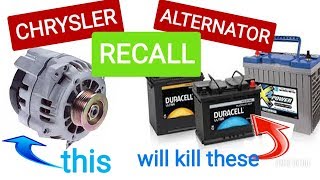
- If you have a 2011-2014 3.6L model, be aware of the alternator recall, as a failing alternator is a known cause for these symptoms.
- Use a scan tool that can read codes from all modules. A generic U1000 is not very helpful, but a more specific code like U0100 will point you in the right direction.
What's Unique About the 2011-2023 Chrysler 300
The second-generation Chrysler 300, like its predecessor, has a complex electrical system where a single point of failure can cause widespread issues. The battery is located in the trunk, and the long cable run to the front of the car creates more opportunities for voltage drops and connection problems, which are primary triggers for this code. Key ground points to inspect are G100 (left front of engine bay) and G101 (right front of engine bay). Furthermore, some 2011-2014 models with the 3.6L engine were recalled for alternator failures that could cause the vehicle to stall and lose all electrical power, directly leading to communication codes like U1000. While the Totally Integrated Power Module (TIPM) was a notorious failure point on the first generation, basic electrical health remains the most common culprit on these later models. The network is segmented into different buses (e.g., CAN-C for critical systems, CAN-IHS for interior) with the TIPM acting as a central gateway, meaning a problem on one bus can sometimes be isolated from the others.
Symptoms You May Notice
- Check Engine Light is on
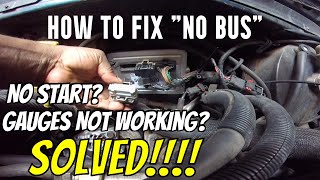
- "no bus" message displayed o 🎬 Watch: How to troubleshoot a "no bus" no-start issuen the instrument cluster
- Engine stalls while driving
- Engine cranks but will not start
- All instrument panel gauges suddenly drop to zero
- Erratic operation of wipers, radio, or power windows
- ABS, Traction Control, or other warning lights are illuminated
- Horn may honk randomly
- Vehicle may not shift out of Park or be stuck in one gear (limp mode)
- Replacing the Powertrain Control Module (PCM) when the fault is actually a weak battery, poor ground connection, or a faulty TIPM.
- Replacing the battery without cleaning the corroded terminal clamps and ground points, leaving the underlying connection issue unresolved.
- Replacing individual components like the fuel pump or starter when their failure to operate is caused by a faulty TIPM not supplying them with power.
Most Likely Causes
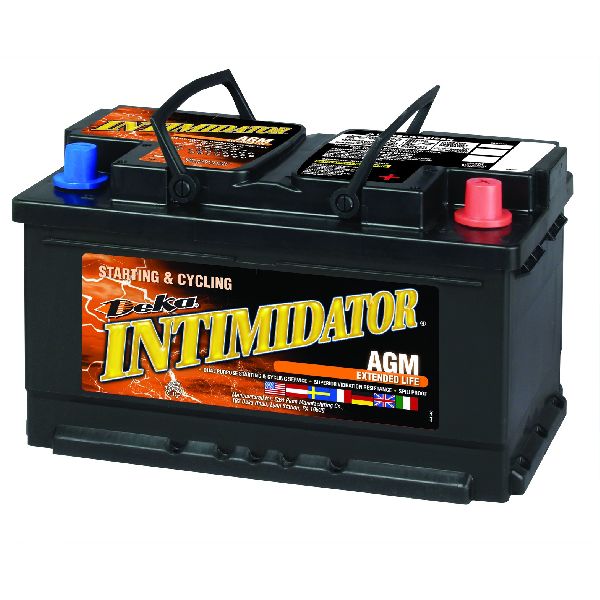
- Weak or Failing Battery 🔴 High Probability → Shop Vehicle Battery Modern vehicle electronics are highly sensitive to voltage. A battery that is even slightly weak can cause modules to drop off the communication network during startup or while driving. A failing Intelligent Battery Sensor (IBS) on the negative terminal can also cause improper charging and lead to a low voltage state.
How to confirm: Use a multimeter to test the battery voltage with the engine off; a healthy battery should read at least 12.4 volts. For a definitive test, have the battery load-tested at an auto parts store, as a battery can show good voltage but fail under load.
Typical fix: Replace the vehicle's battery. If the battery is newer, investigate for a parasitic draw or a faulty Intelligent Battery Sensor (IBS).
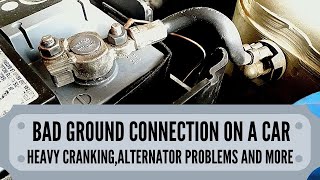
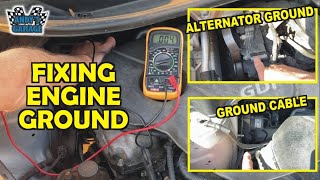
Est. part cost: $150-$300 - Corroded or Loose Battery Terminals and Ground Connections 🔴 High Probability → Shop Vehicle Battery The battery is in the trunk, and its terminals can corrode over time. More importantly, the main chassis and engine ground straps are critical for stable communication, and they can loosen or corrode. Key locations are the main body grounds in the engine bay (G100/G101) and the engine-to-chassis ground strap.
How to confirm: Visually inspect the battery terminals in the trunk for white or greenish powder. Locate and check the main ground straps in the engine bay (often near the passenger and driver side fender wells) and from the engine block to the chassis for tightness and corrosion.
Typical fix: Disconnect the battery (negative terminal first). Thoroughly clean the battery posts and terminals with a wire brush and a baking soda/water solution. Disassemble, clean chassis ground points with a wire brush until they are on bare metal, and re-secure them tightly.
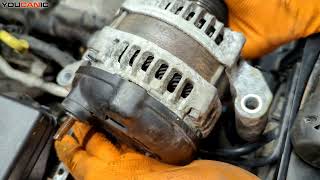
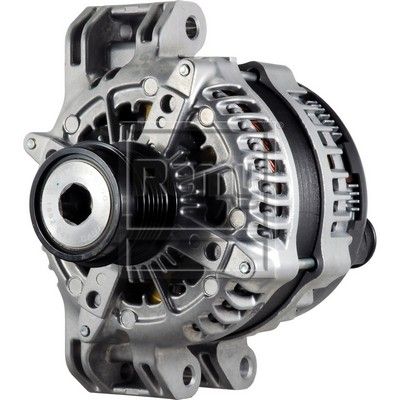
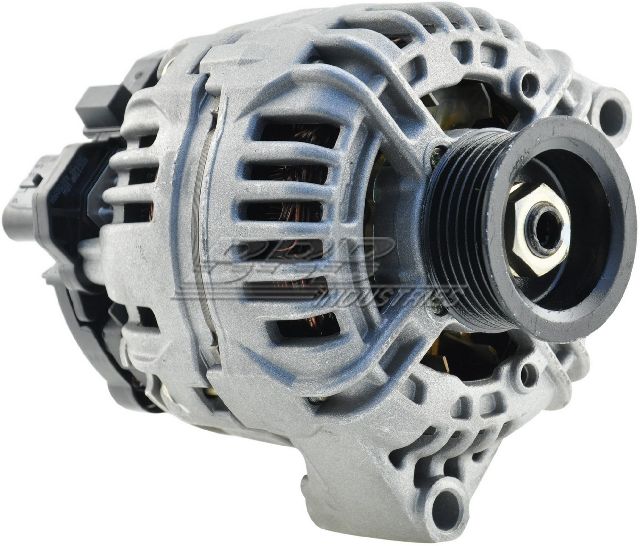
Est. part cost: $5-$20 - Faulty Alternator 🟡 Medium Probability → Shop Alternator A recall (NHTSA 14V-634) was issued for 2011-2014 models with the 3.6L engine and 160-amp Denso alternator due to sudden failure. The failure is caused by thermal fatigue of the internal diodes, which can lead to a complete loss of charging, vehicle stalling with little to no warning, and even fire risk.
How to confirm: With the engine running, test the voltage at the battery terminals. It should be between 13.2 and 14.5 volts. If it's below this range or fluctuating wildly, the alternator is likely failing. Check your VIN with an NHTSA search to see if your vehicle was part of the recall.
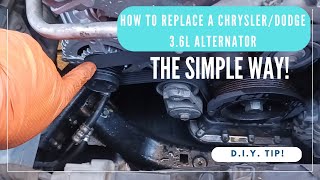
Typical fix: Replace the alternator. The recall remedy was a replacement alternator assembly (Part numbers like CBWHP602AA for RWD models). 🎬 See this step-by-step 3.6L alternator replacement guide
Est. part cost: $250-$600 - Faulty Totally Integrated Power Module (TIPM) 🟡 Medium Probability → Shop Fuse Box The TIPM acts as the central hub for power and communication. Internal failures of relays or the circuit board are a known issue on Chrysler platforms and can cut power or communication to essential modules like the PCM, triggering a U1000 code.
How to confirm: This is difficult to confirm without professional tools. A mechanic would check for power output from the TIPM to the non-communicating module. Swapping identical relays (e.g., horn relay for fuel pump relay) can be a temporary diagnostic step. Multiple, seemingly unrelated electrical issues are a strong sign of TIPM failure.
Typical fix: The TIPM may need to be repaired by a specialist service (e.g., Circuit Board Medics, GoECM) or replaced entirely. Replacement often requires programming to the vehicle's VIN.
Est. part cost: $300-$1000 - Damaged CAN Bus Wiring ⚪ Low Probability Wiring harnesses can become chafed, corroded, or damaged by rodents, especially in areas where they pass through the firewall or are close to the engine or in the trunk.
How to confirm: Visually inspect the wiring harnesses connected to the PCM, TIPM, and BCM. Look for any signs of abrasion, pinching, or corrosion on the pins of the connectors. A professional would use a multimeter to check for 60 ohms of resistance across pins 6 and 14 of the OBD-II port (with the battery disconnected) to verify CAN bus integrity.
Typical fix: Repair the damaged section of the wiring harness or clean the affected connector.
Est. part cost: $20-$200
Rare But Worth Checking
- Faulty Powertrain Control Module (PCM): → Shop Engine Control Module (ECM) While possible, the PCM itself is rarely the true cause. It is often misdiagnosed when the actual problem is a bad ground, poor connection, or a faulty TIPM that isn't providing power to the PCM. Always eliminate all other possibilities before condemning the PCM.
- Other Failed Modules: Any module on the network (ABS, shifter, radio, etc.) can short out internally and disrupt communication for the entire system. A faulty factory or aftermarket radio has been reported by some owners to cause a 'no bus' error. Diagnosing this requires an advanced scan tool to see which modules are offline.
- Faulty Intelligent Battery Sensor (IBS): → Shop Vehicle Battery Located on the negative battery terminal, a faulty IBS can misreport the battery's state of charge, leading the vehicle's charging system to undercharge the battery. This can result in a low voltage condition that triggers communication codes.
Diagnosis Steps
- Check Battery Health: Use a multimeter to verify battery voltage is above 12.4V. Have the battery load-tested at an auto parts store to confirm it can hold a charge under load. A weak battery is the #1 cause.
- Inspect and Clean Connections: Disconnect the battery. Thoroughly clean the battery terminals in the trunk. Locate and clean the main chassis ground points (G100/G101 in the engine bay) and the engine-to-chassis ground strap until they are shiny.
- Perform a Full System Scan: Use an OBD-II scanner capable of reading codes from all vehicle modules (ABS, BCM, TCM, etc.). Note which modules are reporting a loss of communication. The U1000 code is often too generic; companion codes like U0100 are key to narrowing down the problem.
- Check Alternator Output: Start the engine and measure the voltage at the battery. A healthy charging system should read between 13.2V and 14.5V. If you have a 2011-2014 3.6L, be highly suspicious of the alternator.
- Inspect Fuses and Relays: Check all fuses in the TIPM (under-hood fuse box) related to the PCM, BCM, and TCM. You can try swapping identical relays (like the horn relay with the fuel pump relay) to see if the problem changes.
Parts You'll Likely Need
- Vehicle Battery — A weak or failing battery is the most common cause of network communication codes on this vehicle.
Trusted brands: Mopar, Interstate, DieHard
OEM price range: $200-$300
Aftermarket price range: $150-$250 - Totally Integrated Power Module (TIPM) — This is a known failure point on Chrysler platforms that acts as a central communication and power gateway. An internal fault can cause a U1000 code when other causes are ruled out.
Trusted brands: Mopar, Dorman (Remanufactured)
OEM price range: $700-$1200
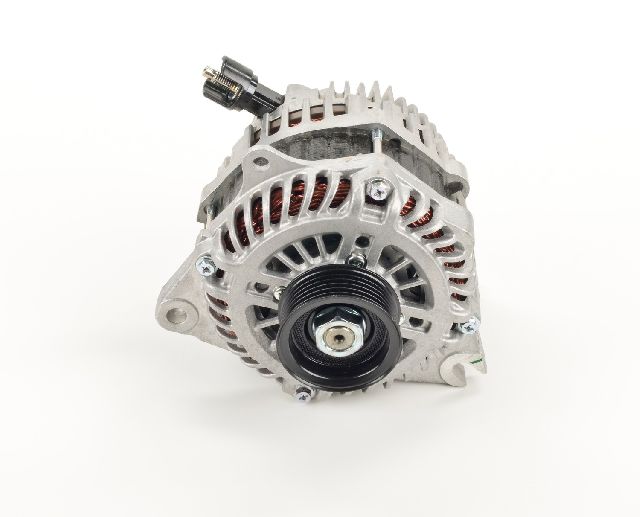
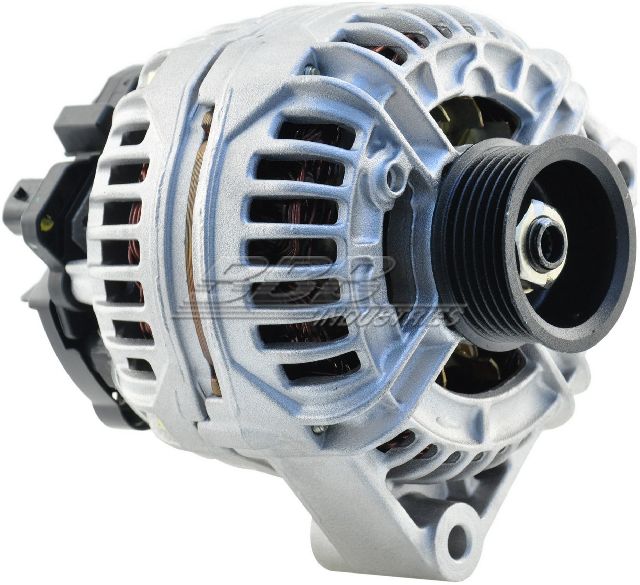
Aftermarket price range: $300-$800 - Alternator — Particularly on 2011-2014 3.6L models, a failing alternator can cause system-wide voltage issues and communication failures.
Trusted brands: Mopar, Denso, Bosch
OEM price range: $400-$700
Aftermarket price range: $250-$500
Related Codes That Often Appear With This One
- U0100 — This code specifically means 'Lost Communication with ECM/PCM'. If the U1000 code is present because the engine computer is the module that has gone offline, U0100 will almost always be stored with it.
- P0562 — This code means 'System Voltage Low'. It often accompanies communication codes because low battery voltage is a primary cause of modules failing to communicate properly.
- U0140 — This code means 'Lost Communication with Body Control Module'. It can appear alongside U1000 if the BCM is the source of the network disruption or is also offline. A PCM software update under TSB 18-013-22 addresses this code.
Technical Service Bulletins (TSBs) & Recalls
- TSB 18-013-22: Released in January 2022 for 2021 models with the 3.6L engine, this TSB involves reprogramming the PCM to fix a condition where numerous 'Lost Communication' codes (U0101, U0140, U0155, etc.) could be set.
- NHTSA Recall 14V-634: While a recall and not a TSB, this is critical information. It addresses sudden alternator failure on 2011-2014 models with the 3.6L engine and 160-amp alternator, a direct cause of electrical system collapse and communication codes.
Platform-Specific Known Issues
- NHTSA Recall 14V-634: Affects some 2011-2014 Chrysler 300 models with a 3.6L engine and 160-amp alternator. The alternator may fail, leading to a vehicle stall and loss of electrical power, which can trigger communication codes.
Documented NHTSA Reports
- NHTSA ODI #11244385: A report on a similar electrical architecture describes the vehicle losing engine power and throwing codes P0700, U0073, and U1000. The owner noted the car would buck and the odometer, RPM gauge, and temperature gauges would fluctuate.
- NHTSA ODI #11461728: In a cross-manufacturer reference, U1000 was linked to "Lost Communication with TCM," where the module overheated due to its physical location, leading to delayed shifting and check engine lights.
- NHTSA ODI #10171770: An owner reported that when the vehicle stalled, it lost ignition input, with a scan revealing codes U1000, U1016, U1152, B1372, and U1088. The fix involved replacing the ignition switch.
- NHTSA ODI #10970695: A diagnostic report noted a U1000 and CAN system failure where the instrument cluster had no communication despite power and ground being present, requiring a cluster replacement and BCM retest.
- NHTSA ODI #10681194: An owner reported a U1000 code and identified it as a ground harness problem. Despite cleaning battery terminals on both sides, the vehicle would not start.
Mechanic-Grade Diagnostic Values
- CAN Bus Network Resistance — expected: 53.5 to 67 Ohms (ideally ~60 Ohms). Failure: A reading of ~120 Ohms indicates an open circuit or a missing termination resistor. A reading below 53.5 Ohms indicates a short between the CAN High and CAN Low wires.
- CAN Bus Voltage (Key On, Engine Off) — expected: CAN High (Pin 6 at DLC) to Ground: ~2.5-3.0V. CAN Low (Pin 14 at DLC) to Ground: ~2.0-2.5V.. Failure: Voltages that are stuck high, low, or at 0V point to a short to power, short to ground, or an open circuit. The two lines should mirror each other during data transmission.
Scan Tool Commands That Help
- wiTECH, Autel MaxiSys, or equivalent advanced scanner: Relearn TIPM / Restore Vehicle Configuration — This function is critical after replacing the TIPM. It forces the new module to learn the vehicle's VIN and optional features (like fog lights, sunroof, etc.) from the other modules on the network, preventing configuration mismatch errors.
- wiTECH or equivalent: Body Verification Test — This is a guided diagnostic routine within the factory scan tool used to confirm if all expected body-related modules are communicating properly after a repair or during diagnosis.
Wiring & Ground Locations
- Star Connector (Front) — Typically located behind/under the glove box area. It's a central splice pack where multiple CAN bus wires converge.. This is a primary diagnostic point. A technician can disconnect individual branches of the CAN bus here to isolate a faulty module or wiring section that is bringing down the entire network.
- Star Connector (Rear) — In the trunk, near the battery and spare tire, often under a small cover.. This is another central hub for the CAN bus, particularly for modules located in the rear of the vehicle. It's essential for diagnosing network issues and is also the connection point for some key programming procedures on later models.
- G305 / G306 — G305 is located at the base of the right 'C' pillar or in the right side of the luggage compartment. G306 is on the right side of the engine compartment.. These are body and component ground points. Like the main engine grounds (G100/G101), corrosion or looseness at these locations can cause intermittent communication failures for modules grounded there.
- Security Gateway Module (SGW) — On 2018+ models, this can be located behind the OBD-II port, behind the radio, or under the driver's side dash.. The SGW controls access to the vehicle's diagnostic network. To perform advanced diagnostics or bidirectional commands on these newer models, a technician must use a bypass cable (like a 12+8 connector) to connect directly to the network behind the SGW.
Real Owner Repair Stories
- Reddit user on r/Chrysler300 (2010 Chrysler 300) — After installing an aftermarket Chinese head unit, numerous safety systems threw errors (AWD, ESP, ACC unavailable) and audio would cut out.
❌ Tried (didn't work) Checking CAN bus dip switch settings on the interface., Contacting the wiring harness manufacturer (Crux) for support, who suggested trying another brand.
✅ What actually fixed it The problem was the Crux brand wiring interface. Replacing the interface with one from PAC Audio resolved all communication errors and made the aftermarket radio work correctly. - iATN (International Automotive Technicians Network) forum post (Chrysler/Dodge vehicle with CAN-C architecture) — No crank, all dash lights illuminated, key fobs not working, and no communication with any modules on the CAN-C bus (powertrain, brakes, airbags).
❌ Tried (didn't work) Unplugging the ABS, PCM, and TIPM modules did not restore communication.
✅ What actually fixed it An aftermarket alarm system had been improperly installed by tapping into the CAN bus wires at the Wireless Control Module (WCM) on the steering column. The aftermarket module had gotten wet and was shorting out the network. Unplugging the faulty aftermarket module immediately restored all vehicle communications and allowed the car to start.
OEM Part Supersession History
Various TIPM Part Numbers→Various Remanufactured Part Numbers— Failures of internal relays and circuit boards are common.
Heads up: When replacing a TIPM, the base part number is most important; the last two letters often indicate minor revisions. However, a replacement TIPM (new or used) MUST be programmed/configured to the vehicle's VIN to ensure all options (e.g., fog lights, sunroof) work correctly. A used TIPM from a car with different features may not operate everything even if the part number is identical.
Model Year Variations Within This Range
- 2015-2023: The 2015 facelift introduced significant electrical changes, including a rotary dial electronic shifter, electric power steering, and a new 7-inch driver information display. These systems add new modules to the CAN bus, creating different potential failure points compared to 2011-2014 models.
- 2018-2023: Introduction of the Security Gateway Module (SGW). This module blocks direct diagnostic access from the OBD-II port. To diagnose a U1000 code on these models, a technician needs an authenticated scan tool or a physical bypass cable (often a 12+8 pin adapter) to connect to the Star Connector or other access point behind the SGW.
Diagnostic Flowchart
Other Known Issues on This Vehicle
Issues unrelated to this code that are worth knowing about as an owner of this generation:
- Rocker Arm Bearing Failure ('Pentastar Tick') 🔴 High — Common on 3.6L V6, especially earlier 2011-2016 models, but can occur at any mileage. Often presents as a distinct ticking noise from the upper engine.
- Cracked Oil Filter / Cooler Housing 🔴 High — Very common on the 3.6L V6, typically between 60,000-120,000 miles. The plastic housing can crack, causing significant oil leaks, which can lead to low oil levels and engine damage.
- HEMI Lifter/Camshaft Failure ('Hemi Tick') 🔴 High — Common on the 5.7L V8 with MDS. A ticking sound can be a precursor to a collapsed lifter roller, which can damage the camshaft. Often occurs in higher mileage vehicles but can happen earlier.
- ZF 8-Speed Transmission Shifting Issues 🟠 Medium → Shop Transmission Assembly — Some owners report harsh shifts, shuddering, or delayed engagement. Can sometimes be addressed with a fluid service or software update, but may indicate internal wear. (Ref: A recall was issued for the electronic shifter design on some 2012-2014 models, which could lead to rollaway incidents, though this is separate from internal transmission issues.)
- Alternator Failure (2011-2014 3.6L) 🔴 High → Shop Alternator — Subject of a major safety recall (NHTSA 14V-634). The 160-amp alternator can fail suddenly without warning, causing the vehicle to stall. (Ref: NHTSA Recall #14V-634 / Chrysler Recall #P60)
- Warped or Bubbling Dashboard/Door Panels 🟡 Low — Commonly reported cosmetic issue where the leather or vinyl covering on the dashboard and interior door panels can separate and bubble, especially in hot climates.
Used vs. New Parts: Buying Guide for This Vehicle
When a used part is the smart pick: A used TIPM from a junkyard is a viable budget option, but ONLY if you have access to a scan tool that can perform the 'Restore Vehicle Configuration' function or you use a mail-in programming service. Otherwise, features may not work. Used alternators, starters, and basic sensors are generally acceptable.
Donor-vehicle mileage cap: roughly under 80000 miles for the part to have meaningful remaining life.
What to inspect on the donor part:
- For a TIPM, check for any signs of water intrusion, corrosion on the pins, or a melted/burnt plastic smell.
- For any module, ensure the connector pins are straight and clean.
- Check the donor vehicle's VIN to see if it had similar options to your car, which increases the chance of a used TIPM being a closer match.
- For an alternator, spin the pulley by hand. It should be smooth with no grinding noises or excessive resistance.
OEM-only on this vehicle (don't cheap out):
- Wireless Control Module (WCM) / Keyless Ignition Node (KIN)
- Keys / Key Fobs
- Powertrain Control Module (PCM) is often best purchased as a pre-programmed remanufactured unit rather than a junkyard part to avoid security and software mismatch issues.
Aftermarket brands forum-validated for this vehicle:
- Alternator: Denso (OEM supplier), Mechman (High-Output), JS Alternators (High-Output).
- CAN Bus Interface for Radio: PAC Audio.
- Battery: Interstate, DieHard, Odyssey (AGM upgrade).
Brands owners have reported issues with on this vehicle:
- CAN Bus Interface for Radio: Crux (some users have reported issues causing network errors).
- Unbranded 'Chinese Android' head units can come with poorly designed CAN decoders that disrupt the network.
Real Owner Stories
Aggregated from forums and TSBs cited above. Mileages and costs reflect what owners reported in those sources.
2013 Chrysler 300C
Symptoms: Recurring 'NO BUS' error with multiple warning lights and erratic wipers.
What fixed it: The owner detailed these as classic symptoms of a communication cluster failure, often requiring checks of the battery, grounds, or TIPM.
Source hint: https://www.carcomplaints.com/Chrysler/300C/2013/electrical/no_bus.shtml
2011 Chrysler 300
Symptoms: 'no bus' error and the car will not start.
What fixed it: Checking the battery, ground connections, and investigating the PCM or TIPM for internal failures.
Source hint: https://www.300cforums.com/threads/no-bus-error-and-now-car-wont-start.103708/
2011-2014 Chrysler 300 3.6L
Symptoms: Sudden loss of electrical power and vehicle stalling while driving.
What fixed it: Replacement of the alternator assembly (Part numbers like CBWHP602AA) under NHTSA Recall 14V-634.
Source hint: NHTSA Recall 14V-634
Related OBD-II Codes
Frequently Asked Questions
My 2011 Chrysler 300 3.6L stalled suddenly and won't restart. Could this be related to a recall?
I have a 2021 Chrysler 300 and my scanner shows multiple 'Lost Communication' codes. Is there a known software fix?
Why does my instrument cluster display a 'no bus' message and drop all gauges to zero?
Where are the main ground points I should check on my 2011-2023 Chrysler 300 to fix a U1000?
Can a faulty battery sensor cause communication errors on this vehicle?
My car is stuck in one gear and won't shift out of Park. Is this related to U1000?
Helpful Videos

Used OEM Parts in Stock
New Aftermarket Parts Available


The information in this article is provided for general reference and educational purposes only. Vehicle specifications, procedures, and part compatibility can vary by production date, trim level, and region. Always consult your vehicle's factory service manual and verify part numbers before purchasing or performing repairs. Safety-critical components such as airbags, seat belts, and braking systems should be installed by a qualified professional.
- Chrysler 300:
- 🧭 Diagnostic Flowchart
- 🎬 Helpful Videos
- 🛍️ Shop This Part
- What's Unique About the 2011-2023 Chrysler 300
- Symptoms You May Notice
- Most Likely Causes
- Rare But Worth Checking
- Diagnosis Steps
- Parts You'll Likely Need
- Related Codes That Often Appear With This One
- Technical Service Bulletins (TSBs) & Recalls
- Platform-Specific Known Issues
- Documented NHTSA Reports
- Mechanic-Grade Diagnostic Values
- Scan Tool Commands That Help
- Wiring & Ground Locations
- Real Owner Repair Stories
- OEM Part Supersession History
- Model Year Variations Within This Range
- Other Known Issues on This Vehicle
- Used vs. New Parts: Buying Guide for This Vehicle
- Real Owner Stories
- 2013 Chrysler 300C
- 2011 Chrysler 300
- 2011-2014 Chrysler 300 3.6L
- Related OBD-II Codes
- Frequently Asked Questions
- 🎟️ Get 5% Off