

U1000 Code on 2007-2012 Hyundai Santa Fe: CAN Communication Failure Causes and Fixes
U1000 on a 2007-2012 Santa Fe means there's a communication breakdown on the vehicle's internal computer network. Start by testing the battery and checking all major chassis and engine ground straps for corrosion or looseness, as these are the most common and cheapest fixes for intermittent network issues.
- U1000 is a network problem, not a specific part failure. Do not replace expensive computers without a full diagnosis.
- Always start with the simplest and most common causes: test the battery and thoroughly inspect all major ground connections.
- An advanced scan tool that can communicate with all modules (ABS, TCM, BCM, etc.) is essential for identifying which part of the network has failed.
- On AWD models, a faulty 4WD control module is a possible, though not common, cause for this code and should be investigated if other modules are offline.
What's Unique About the 2007-2012 Hyundai Santa Fe
For the second-generation (CM) Santa Fe, the U1000 code does not point to a single, common recurring part failure mentioned in recalls or numerous TSBs, unlike some other vehicles. Instead, diagnosis relies on standard electrical troubleshooting. However, there are documented cases on this platform where a less-obvious module, like the 4WD control module located in the passenger footwell, has failed and brought down the entire network, triggering this code in other primary systems like the ABS and engine computers.
Symptoms You May Notice
- Check Engine Light is on
- ABS and/or Electronic Stability Control (ESC) warning lights are on
- Flashing 'pre-heat' or other warning indicators
- Transmission may enter 'limp mode' or exhibit harsh shifting
- Loss of 4WD functionality or inoperative diff-lock light
- Gauges on the instrument cluster may behave erratically or stop working
- Vehicle may not start in some cases
- Intermittent loss of features like power windows or climate control
- Replacing a major control module like the ECM or ABS unit without first verifying its power, ground, and the integrity of the CAN bus wiring. The code often indicates a problem with the support system, not the module itself.
Most Likely Causes
- Weak or Failing Battery 🔴 High Probability → Shop Vehicle Battery Low system voltage during startup is a common cause of temporary communication glitches across all modern vehicles. A battery can sometimes have enough power to start the engine but not enough to keep all modules online, causing a U1000 code.
How to confirm: Test the battery with a multimeter or electronic battery tester. A healthy, resting battery should be at approximately 12.4-12.6 volts. Check the voltage while cranking; it should not drop below 10 volts.
Typical fix: Replace the vehicle's 12V battery.
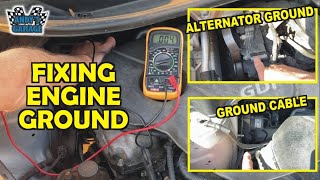
Est. part cost: $150-$250 - Poor Ground Connections 🟡 Medium Probability Over time, the main ground straps from the battery to the chassis and from the engine to the chassis can corrode or become loose, creating electrical resistance that disrupts module communication. These are often un-insulated braided straps exposed to the elements.
How to confirm: Visually inspect the main ground points for fraying or corrosion. Key locations are from the negative battery terminal to the chassis, and from the engine block to the chassis. Use a multimeter to perform a voltage drop test on the ground side of the circuit. There should be less than 0.2 volts between the negative battery terminal and the chassis/engine block.
Typical fix: Remove, clean all contact points to bare metal, and tighten all corroded or loose ground connections. Replace any damaged ground straps. 🎬 Watch: How to test and clean engine grounds
Est. part cost: $10-$50 - Damaged Wiring or Corroded Connectors 🟡 Medium Probability Wiring harnesses can be damaged by abrasion, impact, or rodents, while connectors for modules exposed to the elements can suffer from water intrusion and corrosion. On the Santa Fe, pay close attention to harnesses near the battery tray and any connectors located under the vehicle or in the passenger footwell area, which can be subject to moisture.
How to confirm: Perform a detailed visual inspection of the wiring harnesses, especially around the engine bay and under the vehicle. Disconnect connectors of suspect modules and check for green or white corrosion on the pins.
Typical fix: Repair the damaged section of wiring. Clean corroded connectors with an electrical contact cleaner or replace the connector and pins if damage is severe.
Est. part cost: $20-$100 - Faulty Control Module ⚪ Low Probability Any module on the CAN bus can fail internally, causing it to stop communicating or to send corrupt data that disrupts the entire network. On the 2007-2012 Santa Fe, the 4WD/Transfer Case Control Module has been documented as a specific point of failure that can bring down the network.
How to confirm: Use an advanced scan tool to perform a network test or 'roll call' to see which module(s) are not responding. If a module is offline, verify its power, ground, and CAN connections are good before condemning the module.
Typical fix: Replace the faulty module. The replacement module will likely need to be programmed or coded to the vehicle.
Est. part cost: $200-$800
Diagnosis Steps
- Scan for All Codes: Use an OBD-II scanner capable of reading all vehicle modules. Record any U-codes, C-codes, B-codes, and P-codes. A specific code like U0121 (Lost Communication with ABS) is a crucial clue.
- Check Battery Health: Test the battery's state of charge and its ability to hold a load during cranking. A weak battery is a very common cause of communication codes.
- Inspect Fuses: Check all fuses related to the various control modules, particularly any that are not communicating. Check fuse boxes in the engine bay and inside the cabin.
- Inspect Grounds: Visually inspect the main battery-to-chassis ground, the engine-to-chassis ground strap, and any other major ground points you can locate. Look for corrosion, looseness, or damage.
- Perform a Network 'Roll Call': Using an advanced scan tool, attempt to communicate with every module on the vehicle. Make a list of any modules that do not respond.
- Isolate the Faulty Circuit: If a specific module is offline, locate it. (For example, the 4WD module is often in the passenger footwell). Visually inspect its connector for corrosion or damage.
- Verify Power and Ground at the Module: Using a multimeter and a vehicle-specific wiring diagram, confirm that the non-communicating module is receiving proper battery voltage and has a solid ground connection at its connector.
- Check CAN Bus Wiring: If power and ground are good, check the CAN High and CAN Low wires at the module's connector for continuity and to ensure they are not shorted to each other, to power, or to ground. With the battery disconnected, you should measure approximately 60 ohms of resistance across the CAN High and CAN Low pins at the OBD-II port.
- Isolate the Module: If all wiring, power, and grounds are good, the module itself is the most likely culprit. To confirm, you can try disconnecting the module to see if communication is restored with the rest of the network. If it is, the disconnected module was causing the network to crash.
Parts You'll Likely Need
- 12V Battery — A weak battery is the most common trigger for intermittent communication fault codes.
Trusted brands: Bosch, Duralast, Interstate
OEM price range: $200-$300
Aftermarket price range: $150-$250 - Ground Strap — Engine or chassis ground straps can corrode and fail, creating high resistance that disrupts module communication.
Trusted brands: Standard Motor Products, Dorman
OEM price range: $25-$50
Aftermarket price range: $10-$30 - 4WD Control Module (Transfer Case Control Module)
(OEM #95440-2B900, 95440-2B950)— This is a documented, though uncommon, cause of CAN bus failure on this specific Santa Fe platform.
Trusted brands: Hyundai (OEM)
OEM price range: $400-$700
Related Codes That Often Appear With This One
- U01xx (e.g., U0121, U0100) — While U1000 is a general communication failure, more specific U01xx codes often accompany it, pointing to the exact module that is offline (e.g., U0121 for ABS, U0100 for ECM).
- C1702 — This 'variant coding error' code can appear in the ABS module if it cannot communicate with another required module (like the 4WD module) to determine the vehicle's configuration.
Technical Service Bulletins (TSBs) & Recalls
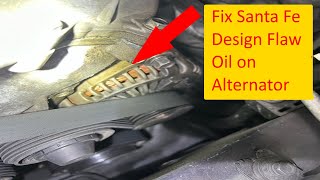
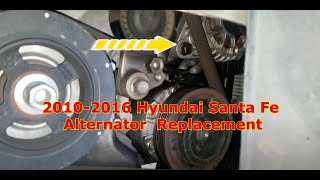
- Service Campaign 936 / TSB 15-01-031: Addresses leaking front valve cover gaskets on 2007-2009 3.3L models, where leaking oil can drip onto and destroy the alternator, causing charging system failure and subsequent low voltage issues that could trigger communication codes.
- Service Campaign 976: Supersedes Campaign 936, providing an updated inspection and repair procedure including the installation of an oil protector kit to shield the alternator.
Mechanic-Grade Diagnostic Values
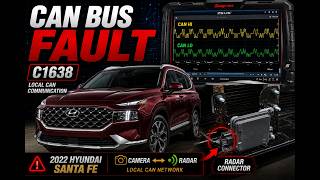
- CAN Bus Network Resistance (Battery Disconnected) — expected: ~60 Ohms (±5%). Failure: A reading of ~120 Ohms indicates an open circuit or one terminating module is offline. A reading near 0 Ohms indicates a short between CAN High and CAN Low wires.
- CAN High Voltage (Key On, Engine Off, measured at Pin 6 of OBD-II port to ground) — expected: 2.5V - 3.5V (typically ~2.6V-2.7V). Failure: Voltage stuck at 0V, 5V, or battery voltage indicates a short or open circuit.
- CAN Low Voltage (Key On, Engine Off, measured at Pin 14 of OBD-II port to ground) — expected: 1.5V - 2.5V (typically ~2.3V-2.4V). Failure: Voltage stuck at 0V, 5V, or battery voltage indicates a short or open circuit.
- Module Ground Voltage Drop (Key On) — expected: Less than 0.2 Volts. Failure: A reading higher than 0.2V between a module's ground pin and the negative battery terminal indicates a poor ground connection.
Scan Tool Commands That Help
- Hyundai GDS (Global Diagnostic System): DTC Analysis / All System Scan — To perform a 'roll call' of all modules on the network. The GDS can identify which specific modules are not responding, which is the first step in isolating the source of the U1000 code.
- Hyundai GDS (Global Diagnostic System): Vehicle S/W Management (Special Function) — After replacing a control module (like the ECM, TCM, or ABS module), this function is used to perform VIN writing, reset adaptive values, or program the new module to the vehicle to ensure it communicates correctly on the network.
Wiring & Ground Locations
- OBD-II DLC (Data Link Connector) — Under the driver's side dashboard, typically to the left of the steering column.. This is the primary access point for testing the entire CAN bus network. Resistance is measured between Pin 6 (CAN High) and Pin 14 (CAN Low).
- G101 / G102 — Engine compartment, near the battery tray area.. These are primary engine bay ground points. Corrosion or looseness here can affect the ECM, TCM, and ABS module, which are common sources of network communication faults.
- GF05 — Base of the left 'B' pillar (between the front and rear doors).. This is a main interior ground point. A fault here could affect cabin-located modules like the 4WD control module or instrument cluster.
- ABS Module Connector — On the ABS hydraulic unit, located in the engine compartment, typically near the firewall on the driver's side.. A common point for checking power, ground, and CAN signals directly at the ABS module, which is a potential source of the U1000 code.
Real Owner Repair Stories
- YouTube video by 'That car guy' (2009 Hyundai Santa Fe) — ABS, ESP, and brake warning lights were on. Vehicle would sometimes go into limp mode. Stored code C1625 (CAN Timeout).
❌ Tried (didn't work) The owner first checked wiring connectors and grounds, which all appeared to be in good condition.
✅ What actually fixed it The ABS module itself was faulty. Replacing the ABS module and programming the new unit resolved all the warning lights and the communication code.
Model Year Variations Within This Range
- 2010-2012: The 2010 model year introduced a mid-cycle facelift with new engine options (2.4L I4 and 3.5L V6) and updated electronics. While the fundamental CAN bus architecture is similar, wiring diagrams and module locations may differ slightly from the 2007-2009 models. Always verify wiring diagrams specific to the vehicle's production date.
Diagnostic Flowchart
Other Known Issues on This Vehicle
Issues unrelated to this code that are worth knowing about as an owner of this generation:
- Leaking Front Valve Cover Gasket (3.3L V6) 🔴 High — Very common on 2007-2009 models with the 3.3L V6. Oil leaks directly onto the alternator, causing it to fail, which can lead to stalling. (Ref: Service Campaigns 936 and 976 (TSB 15-01-031))
- Faulty Fuel Level Sending Unit 🟠 Medium — Widespread issue on 2007-2009 models, causing the fuel gauge to read empty or inaccurately, often triggering a Check Engine Light.
- Leaking Oil Pressure Switch/Sensor 🟠 Medium — Common on V6 models. The switch can leak oil externally or fail internally, causing a flickering oil light even with correct oil levels.
- Prematurely Worn Suspension Components 🟡 Low — Ball joints, tie rods, and control arm bushings can wear out relatively quickly, leading to suspension noises and alignment problems.
- ABS Module Electrical Short 🔴 High → Shop ABS Control Module — A recall was issued for 2007 models where moisture can enter the ABS module, potentially causing an electrical short and engine compartment fire, even when the vehicle is off. (Ref: NHTSA Recall 20V061000)
Used vs. New Parts: Buying Guide for This Vehicle
When a used part is the smart pick: Used electronic control modules (ECM, TCM, ABS, 4WD) can be a cost-effective option, provided they come from a reputable salvage yard with a warranty and return policy. A used wiring harness section can also be viable for repairing localized damage.
Donor-vehicle mileage cap: roughly under 150000 miles for the part to have meaningful remaining life.
What to inspect on the donor part:
- For modules, check for any signs of water damage, corrosion on the pins, or physical damage to the case.
- For wiring harnesses, ensure the connectors are intact with no broken locking tabs, and inspect for any cuts, abrasions, or previous repairs.
- Verify the part number on the used module exactly matches the original part.
OEM-only on this vehicle (don't cheap out):
- Ground Straps: While aftermarket straps exist, OEM parts often have better corrosion resistance and fitment. Given their low cost, OEM is a safe bet.
- Control Modules: While used OEM is an option, avoid unbranded new aftermarket modules. They often have software compatibility issues and a high failure rate. Stick with original OEM parts, either new or used.
Brands owners have reported issues with on this vehicle:
- Unbranded, no-name electronic modules sold on marketplaces like eBay or Amazon should be avoided due to a high likelihood of software incompatibility or premature failure.
Documented NHTSA Reports
While U1000 is often generic, cross-manufacturer records provide insight into its nature. An owner report in NHTSA ODI #10681194 describes U1000 as a ground harness problem where cleaning battery terminals did not resolve the issue. Similarly, NHTSA ODI #10169405 notes that a dealership report identified the code as an electrical and ground wire problem. In cases involving transmission issues, NHTSA ODI #11461728 describes lost communication with the TCM, noting that the module may overheat due to its location. For instrument cluster failures, NHTSA ODI #10970695 mentions a CAN system diagnosis failure where the cluster could not communicate despite power and ground being present. Additionally, NHTSA ODI #10171770 reports that a vehicle stalling was linked to a loss of ignition input, with U1000 appearing alongside several other communication codes.
Real Owner Stories
Aggregated from forums and TSBs cited above. Mileages and costs reflect what owners reported in those sources.
2009 Hyundai Santa Fe 3.3L V6
Symptoms: Front valve cover gasket leaking oil directly onto the alternator, leading to alternator failure and vehicle stalling.
What fixed it: Installation of an oil protector kit and replacement of the alternator/gasket as per Service Campaign 976.
Source hint: r/HyundaiSantaFe - '2007-2009 Service Campaign for Cylinder Head Cover Oil Leak'
2009 Hyundai Santa Fe
Symptoms: Fuel level sensors stopped working, causing the fuel gauge to read inaccurately.
What fixed it: Replacement of the fuel level sending units.
Source hint: CarComplaints.com - '2009 Hyundai Santa Fe Fuel Level Sensors Stopped Working'
Related OBD-II Codes
Frequently Asked Questions
I have a 2008 Santa Fe 3.3L and my alternator just failed. Could this be related to the U1000 code?
My fuel gauge is reading empty even though the tank is full. Is this part of the U1000 communication issue?
Which specific control module is most likely to crash the CAN bus on a 2007-2012 Santa Fe?
How can I check if a bad ground is causing my U1000 code?
What is the 'oil protector kit' mentioned in Hyundai service bulletins?
Can a weak battery cause a U1000 even if the engine still starts?
Helpful Videos

We Have This Part in Stock

The information in this article is provided for general reference and educational purposes only. Vehicle specifications, procedures, and part compatibility can vary by production date, trim level, and region. Always consult your vehicle's factory service manual and verify part numbers before purchasing or performing repairs. Safety-critical components such as airbags, seat belts, and braking systems should be installed by a qualified professional.
- Hyundai Santa Fe:
- 🧭 Diagnostic Flowchart
- 🎬 Helpful Videos
- 🛍️ Shop This Part
- What's Unique About the 2007-2012 Hyundai Santa Fe
- Symptoms You May Notice
- Most Likely Causes
- Diagnosis Steps
- Parts You'll Likely Need
- Related Codes That Often Appear With This One
- Technical Service Bulletins (TSBs) & Recalls
- Mechanic-Grade Diagnostic Values
- Scan Tool Commands That Help
- Wiring & Ground Locations
- Real Owner Repair Stories
- Model Year Variations Within This Range
- Other Known Issues on This Vehicle
- Used vs. New Parts: Buying Guide for This Vehicle
- Documented NHTSA Reports
- Real Owner Stories
- 2009 Hyundai Santa Fe 3.3L V6
- 2009 Hyundai Santa Fe
- Related OBD-II Codes
- Frequently Asked Questions
- 🎟️ Get 5% Off