

U1000 on 2014-2024 Infiniti Q50: CAN Communication Failure Causes and Fixes
On a 2014-2024 Infiniti Q50, a U1000 code is almost always caused by a weak battery or a poor ground connection. Before attempting complex diagnostics, fully charge and test the battery and clean the main battery and chassis ground points. This is a common issue on many Nissan and Infiniti vehicles.
- U1000 is a network communication code. Do NOT immediately replace the part or module that has the code stored in it.
- Always start with the basics: The most likely cause is a weak battery or a bad ground. Fully test the battery and clean all major ground connections before proceeding.
- This code is complex. If a new battery and clean grounds don't fix the issue, professional diagnosis with a specialized scan tool is strongly recommended to avoid wasting money on incorrect parts.
- Do not drive the vehicle. A CAN communication failure can affect critical safety systems and leave you stranded.
What's Unique About the 2014-2024 Infiniti Q50
The Infiniti Q50 is packed with advanced electronics, including systems like Direct Adaptive Steering (DAS), that all rely on the CAN bus network for flawless operation. This high density of electronic modules means a communication breakdown like a U1000 code can cause a cascade of seemingly unrelated symptoms, from a no-start condition to various warning lights. Owner and technician experiences consistently show that the root cause is often not a complex module failure, but rather a simple issue with the vehicle's basic electrical foundation, like battery voltage or ground integrity. In some cases, disconnecting the battery can cause the Direct Adaptive Steering to stop working without throwing a specific error code, further complicating diagnosis. A particularly notorious issue on the Q50 is water intrusion from clogged sunroof drains, which leaks directly onto the Body Control Module (BCM) located in the passenger-side footwell, causing widespread electrical chaos and CAN-related codes.
Symptoms You May Notice
- Check Engine Light is on
- Multiple warning lights illuminated on the dashboard (VDC, SLIP, ABS, AWD)
- Vehicle will not start or has an intermittent no-start condition.
- Transmission may be stuck in one gear (limp mode).
- Loss of power steering assist, especially on models with Direct Adaptive Steering.
- Malfunctioning electronics, such as the audio system, climate control, or infotainment displays (screens may freeze, flash, or go black).
- Erratic gauge behavior
- Key System Error message on the dash.
- Engine fans running constantly even when the engine is off.
- "Unavailable, Front Radar Obstruction" warning, disabling intelligent cruise control.
- Replacing the control module that stored the U1000 code. The module storing the code is usually the one reporting the problem, not the one causing it.
- Replacing the ECM without first checking the battery and grounds.
- Chasing individual symptoms (like replacing a transmission speed sensor for a limp mode issue) without addressing the underlying network-wide communication fault.
Most Likely Causes
- Weak or Failing Battery 🔴 High Probability → Shop Vehicle Battery Modern vehicles like the Q50 have a high constant power draw. A battery that is slightly degraded may have enough power to crank the engine but not enough to keep all modules online during voltage drops, triggering a communication code. Many forum users report that a new battery resolved their U1000 and other related electrical issues.
How to confirm: Test the battery with a digital multimeter (should be >12.4V with engine off) and, more importantly, with a professional load tester to check its health under load. A simple voltage check is often not sufficient. Freeze frame data from a scanner may show a voltage drop to around 10V when the code was set.
Typical fix: Replace the vehicle battery and clean the terminals thoroughly. Ensure the new battery is properly registered with the vehicle's system if required.
Est. part cost: $150-$350 - Poor Ground Connections 🔴 High Probability Nissan and Infiniti vehicles are noted in TSBs and forums for being susceptible to corroded or loose ground points, which can create electrical resistance and disrupt sensitive network communications. This includes the main battery ground, engine-to-chassis grounds, and even grounds for specific components like the exhaust system.
How to confirm: Visually inspect the main battery ground cable, engine-to-chassis ground straps, and any grounding points near the fuse box (IPDM) and ECM. Look for corrosion (green or white powder) or looseness. Perform a voltage drop test on the ground side for a definitive diagnosis.
Typical fix: Disconnect the ground cables, clean the contact points on the cable end and the chassis with a wire brush until shiny, and re-secure them tightly. Apply a dielectric grease to prevent future corrosion. 🎬 Watch: How to clean and repair vehicle ground connections A user on YouTube demonstrated this fix successfully by cleaning heavily corroded battery terminals.
Est. part cost: $0-$20 - Damaged CAN Bus Wiring 🟡 Medium Probability Wiring can be damaged from previous accidents, rodent intrusion, or abrasion against other components. A faulty front-facing radar sensor, which is part of the CAN network, can also cause this code if it's damaged or disconnected.
How to confirm: Visually inspect the wiring harnesses, particularly around the engine bay, behind the dashboard, and near any areas with previous repairs. Advanced diagnosis involves using a multimeter to check for 60 Ohms of resistance between CAN High (Pin 6) and CAN Low (Pin 14) at the OBD-II port with the battery disconnected, as specified in Infiniti TSB ITB10-029a.
Typical fix: Repair the damaged section of wire. This may involve soldering, using professional-grade butt connectors with heat shrink, or replacing a section of the harness. In the case of a bad radar sensor, the sensor itself would need replacement.
Est. part cost: $10-$100 for wire repair, $200-$800 for a used radar sensor. - Faulty Control Module ⚪ Low Probability While less common than power/ground issues, any of the dozens of modules on the network can fail internally and either stop communicating or broadcast junk data that disrupts the entire network. The IPDM (Intelligent Power Distribution Module) and BCM (Body Control Module) are key suspects when a module is at fault. The BCM is especially vulnerable due to water leaks from clogged sunroof drains.
How to confirm: This is a process of elimination. After confirming power and grounds are good, a technician will use a scan tool to see which module is offline and then disconnect it to see if the rest of the network comes back to life. A faulty IPDM may cause a no-start where the engine only runs while physically holding a relay closed. A technician diagnosed a faulty IPDM by finding the CAN low wire was shorted to ground internally within the module.
Typical fix: Replace the faulty module (e.g., BCM, IPDM, ABS module) and perform any necessary programming or configuration with a factory-level scan tool. A used IPDM for a Q50 can be found online.
Est. part cost: $300-$1500+
Rare But Worth Checking
- Improperly Installed Aftermarket Electronics: If you have recently installed an aftermarket stereo, remote start, or alarm, it's a primary suspect. These devices are often tapped into the CAN bus and can cause interference if not installed correctly. One owner on Reddit noted their U1000 issues began after an engine swap, suspecting a mismatch between the new engine's TCM and the car's ECU. Infiniti also warns that aftermarket OBD plug-in devices (like for insurance monitoring) can cause interference or damage.
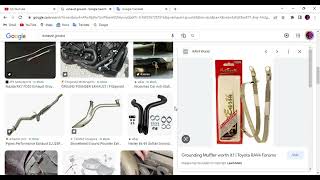
- Missing Exhaust Ground Strap: → Shop Engine Ground Strap One owner reported that a U1000 code appeared after an aftermarket exhaust was installed without transferring the factory ground strap. The O2 sensors require a solid ground via the exhaust, and its absence can cause electrical noise that disrupts the CAN bus, leading to a U1000 code.
- Corrupted Infotainment SD Card: The Q50's upper infotainment screen (DCU) uses an internal SD card for its software. Several owners have reported that if this card becomes corrupted, it can cause the entire unit to get stuck in a boot loop, leading to communication issues on the network. Replacing the SD card from a used unit, rather than the entire screen, has fixed the problem for some.
Diagnosis Steps
- Read all stored Diagnostic Trouble Codes (DTCs) with a quality OBD-II scanner. Pay close attention to any other U-codes, as they will point to which module is offline.
- Check Battery Health: Verify battery voltage is above 12.4V. Perform a load test to ensure the battery is healthy and not just surface-charged. Clean battery terminals and posts thoroughly, as even light corrosion can be the cause.
- Inspect All Grounds: Locate, remove, clean, and tighten the main battery-to-chassis ground, engine-to-chassis grounds, and any grounds near the main fuse box (IPDM). Don't forget the exhaust ground if any exhaust work has been done.
- Check for Water Intrusion: Inspect the passenger footwell carpet for dampness. Clogged sunroof drains are notorious for leaking water onto the BCM, causing U1000 and other electrical faults.
- Check Fuses: Inspect all fuses related to control modules in both the interior and engine bay fuse boxes.
- Perform CAN Resistance Check: Disconnect the negative battery terminal. Use a multimeter to measure the resistance between Pin 6 (CAN High) and Pin 14 (CAN Low) on the OBD-II port. A healthy network should read approximately 60 Ohms, as specified by Infiniti TSB ITB10-029a.
- Use Vehicle Self-Diagnostics: The Q50 has a hidden self-diagnostics menu accessible through the infotainment screen that can show the connection status of various modules. This can help identify which component is not communicating.
- Isolate the Fault: If the above steps do not resolve the issue, the problem is likely a specific module or wiring fault. This advanced step involves disconnecting modules one by one to see if the network communication is restored. This is best left to a professional.
Parts You'll Likely Need
- Vehicle Battery — A weak or failing battery is the most common cause of network communication codes on the Q50 due to voltage drops during startup.
Trusted brands: Interstate, DieHard, Bosch, ACDelco
OEM price range: $250-$400
Aftermarket price range: $150-$300 - Intelligent Power Distribution Module (IPDM)
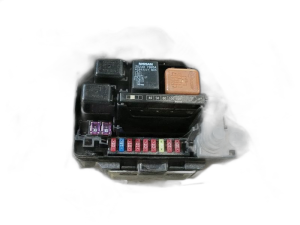
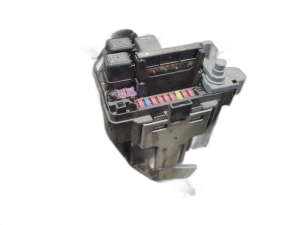
(OEM #284B7-5CA0D)— The IPDM is a central hub for power and communication. It contains integrated relays and fuses and is a terminating module for the CAN bus. Internal failure can bring down the network.
Trusted brands: Infiniti (OEM)
OEM price range: $300-$500
Aftermarket price range: $150-$350 (Used)
Related Codes That Often Appear With This One
- U0xxx — Other U-codes (e.g., U0100, U0101, U0121) are very common with U1000. They specify which module has lost communication (e.g., U0100 is Lost Communication with ECM, U0101 is Lost Communication with TCM).
- B2xxx, C1xxx — Body (B) and Chassis (C) codes often appear because the modules controlling those systems (BCM, ABS, VDC) are offline or not receiving necessary data from other modules. A B261A code, for example, points to a communication issue between the Ignition Button, IPDM, and BCM.
Technical Service Bulletins (TSBs) & Recalls
- ITB10-029a - 'CAN COMMUNICATION CODES – DIAGNOSTIC TIPS & GUIDELINES'. This bulletin provides general diagnostic procedures for U1000 on Nissan/Infiniti vehicles, emphasizing that the module setting the code is often not the faulty part and outlining steps for checking CAN resistance.
- ITB10029A - 'SERVICE INFORMATION'. Related to communication codes U1000, U1001, U1002, U1010, this bulletin notes that when a module reports a U1000 code, it is typically operating normally and that technicians should always diagnose communication codes first.
- ITB17-010 - 'MIL ON WITH P0090 AND U1000 AND/OR U1001 STORED'. While issued for other models in the lineup, this bulletin highlights that U1000 can frequently be stored alongside fuel system codes like P0090 (FRP Control System).
- ITB17-004b - 'ACCESSORY DRIVE BELT NOISY OR HAS COME OFF'. Details an issue on 2016-2017 3.0T models where a misaligned A/C compressor can cause the serpentine belt to be noisy or come off entirely.
- Warranty Extension for 2016-2018 VR30DDTT Turbochargers. Infiniti extended the warranty to 10 years/120,000 miles for turbo failures causing excessive white smoke, a common issue on early 3.0T models.
Mechanic-Grade Diagnostic Values
- CAN Bus Network Resistance — expected: ~60 Ohms. Failure: A reading of ~120 Ohms indicates one of the two terminating resistors (or the wiring to it) has failed. A reading of 0 Ohms indicates a short between CAN High and CAN Low lines.
- CAN Bus Terminating Module Resistance — expected: ~120 Ohms. Failure: A reading significantly different from 120 Ohms at a terminating module (like the ECM or BCM) indicates a faulty internal resistor.
- Battery Voltage During Freeze Frame Data — expected: >12.0V. Failure: A voltage drop to around 10.1V at the moment the U1000 code is set strongly suggests a failing battery or a severe grounding issue.
Scan Tool Commands That Help
- Infiniti CONSULT-III plus: CAN Diag Support Monitor — This is the primary function used by dealers to diagnose CAN issues. It displays a network diagram (V-CAN screen) showing which modules are communicating and which are offline, quickly pinpointing the source of the communication break.
- Infiniti CONSULT-III plus: Self-Diagnostic results — After running the CAN Diag Support Monitor, this function allows the technician to see the specific DTCs stored in each individual module, helping to correlate the CAN failure with other system faults.
- Infiniti CONSULT-III plus: ECU Reprogramming / Configuration — This is required after replacing a major control module like the BCM, ECM, or IPDM. The new module must be programmed with the vehicle's VIN and specific configuration to function correctly and communicate on the network.
Wiring & Ground Locations
- BCM (Body Control Module) — Located in the passenger side footwell, behind the kick panel.. This is a critical communication hub. It is highly susceptible to water damage from clogged front sunroof drains, which drip directly onto it, causing corrosion and failure that generates U1000 codes.
- IPDM E/R (Intelligent Power Distribution Module Engine Room) — Located in the engine compartment, next to the battery under a plastic cover.. The IPDM is a terminating module for the CAN bus and controls power to many other modules. A failure here can bring down the entire network. It's a common point for checking CAN resistance and for diagnosing no-start conditions.
- Engine Compartment Grounds (E134, E135, E136, E137, E140) — Located on the left and right rear of the engine compartment, on the chassis frame rails.. These are the main grounding points for numerous modules and sensors in the engine bay, including the ABS control unit, cooling fan module, and steering angle sensor. Corrosion at these points can cause intermittent communication failures.
- Front Radar Sensor — Mounted in the lower front grille/bumper area. On some models (like Q60), it's housed within the Infiniti emblem.. This sensor is a node on the CAN bus. If it is disconnected, damaged, or internally faulty, it can disrupt the network and cause a U1000 code, often accompanied by an 'Unavailable, Front Radar Obstruction' message.
Real Owner Repair Stories
- YouTube channel 'Global Commerce CA' (2018 Infiniti Q50) — No start, multiple warning lights, U1000 code present.
❌ Tried (didn't work) Checking wiring harnesses for visible damage.
✅ What actually fixed it The technician diagnosed a faulty IPDM (Intelligent Power Distribution Module). With the battery disconnected, he back-probed the CAN low wire at the IPDM connector and found continuity to ground, indicating an internal short within the module itself. Replacing the IPDM and reprogramming the keys resolved the no-start and communication issues. - YouTube channel 'G Auto Repair' (2018 Infiniti Q50) — Multiple warning lights, U1000 code, 'Front Radar Obstruction' message.
❌ Tried (didn't work) The previous shop could not diagnose the issue.
✅ What actually fixed it The technician discovered the front radar sensor was physically missing from its bracket in the front bumper support. A previous repair shop had likely removed it to install an aftermarket intercooler. Installing a new radar sensor immediately cleared the U1000 code and associated warning lights without needing calibration (as the car had not been in an accident). - YouTube channel 'FIXING A NO START INFINITI Q50 BCM SUNROOF LEAK' (Infiniti Q50 (year not specified)) — No start condition, BCM got wet.
❌ Tried (didn't work) Owner had a plastic bag over the roof, indicating they knew about the leak but hadn't fixed the root cause.
✅ What actually fixed it The technician removed the BCM from the passenger footwell, which was visibly wet. He cleaned the module and its connectors and reinstalled it, which restored the crank/start function. He then performed a permanent fix by re-routing the clogged sunroof drain tube to the A/C drain line, preventing future water damage to the BCM.
OEM Part Supersession History
284B1-4HB0A, 284B1-4HB0C, 284B1-4HB0D, 284B1-4HB0E, 284B1-4HB1A→284B1-4HB1B— Revision and consolidation of part for early-generation models.
Heads up: These part numbers are for the 2014-2016 models and are not compatible with later years.284B1-4HK0A→N/A— Part for mid-generation models.
Heads up: This BCM fits 3.0L and 3.5L models from roughly 2016-2019. It is critical to match the part number exactly.27760-6HL0A→N/A— Part for late-generation models, often listed as 'Air Conditioner Control Amplifier' but is the BCM.
Heads up: This BCM is for the latest models, typically with the 3.0L V6. It is not interchangeable with earlier BCMs. Replacement requires mandatory programming by a dealer or specialist.
Model Year Variations Within This Range
- 2018-2024: Later model Q50s (approx. 2018+) may use a different BCM (part number 27760-6HL0A) than earlier models. Additionally, a '3-Channel CAN Gateway Controller Module' (e.g., 284T1-6HH0C) becomes a more distinct part of the network architecture, providing another potential point of failure.
- 2016+: With the introduction of the VR30DDTT engine in 2016, the complexity of the CAN system increased. An engine swap between different years or models (e.g., a VR30 swap into a car that didn't originally have it) can cause U1000 codes if the TCM and ECU identifiers do not match, leading to communication conflicts.
Diagnostic Flowchart
Other Known Issues on This Vehicle
Issues unrelated to this code that are worth knowing about as an owner of this generation:
- Premature Turbocharger Failure (VR30DDTT) 🔴 High — Common on 2016-2018 models with the 3.0L twin-turbo engine, typically between 60,000-80,000 miles. Symptoms include white/blue smoke from the exhaust and increased oil consumption. (Ref: Limited Emission Warranty Extension (10yr/120k miles) for 2016-18 Q50 & 2017-18 Q60 models.)
- Serpentine Belt Failure (VR30DDTT) 🔴 High — Affects 2016-2017 models with the 3.0T engine. A misaligned A/C compressor pulley can cause the belt to shred or come off, leading to a loss of the water pump and alternator. (Ref: ITB17-004b)
- Direct Adaptive Steering (DAS) Malfunctions 🟠 Medium — Early models (2014-2016) were subject to recalls for software issues causing a lack of steering responsiveness. Owners report the system can feel unnatural or fail without warning. (Ref: NHTSA ID: 16V430000 (Recall))
- Infotainment System (InTouch) Lag and Freezing 🟡 Low — Particularly common on earlier 2014-2015 models, the dual-screen system can be slow to boot, freeze, or have the top screen go black. This is sometimes caused by a corrupted internal SD card.
- Premature Brake Wear 🟠 Medium — Many owners of all model years report having to replace brake pads and rotors much earlier than expected, sometimes in as little as 5,000-10,000 miles, due to warped rotors.
Used vs. New Parts: Buying Guide for This Vehicle
When a used part is the smart pick: Used control modules like the BCM, IPDM, or Front Radar Sensor are a viable, cost-effective option, often saving hundreds or even over a thousand dollars compared to new OEM parts. Since these are electronic modules and not wear items, a part from a lower-mileage, non-collision donor vehicle is a smart choice.
Donor-vehicle mileage cap: roughly under 100000 miles for the part to have meaningful remaining life.
What to inspect on the donor part:
- Match the OEM part number on the sticker EXACTLY. Do not rely on visual similarity; even a single digit difference can mean incompatibility.
- For a BCM, inspect the housing and connector pins for any signs of white or green corrosion, which indicates water damage.
- Buy from a reputable auto recycler that offers a warranty (e.g., 1-year warranty) and has good reviews.
- Confirm the donor vehicle was not involved in a major flood or fire.
OEM-only on this vehicle (don't cheap out):
- Battery: While not strictly OEM-only, using a high-quality AGM battery that meets or exceeds Infiniti's specifications is critical due to the high electronic load.
- Control Modules (BCM, IPDM, ECM): While used OEM is a good option, avoid unbranded, new aftermarket modules. Their quality and compatibility are unproven and can cause more issues. Stick with new OEM or used OEM.
Brands owners have reported issues with on this vehicle:
- Generic/unbranded OBD-II plug-in devices: Infiniti explicitly warns that aftermarket telematics or monitoring devices plugged into the OBD-II port can cause interference and damage to vehicle systems.
Real Owner Stories
Aggregated from forums and TSBs cited above. Mileages and costs reflect what owners reported in those sources.
2014-2024 Infiniti Q50
Symptoms: Vehicle experienced a no-start condition and threw a U1000 code.
What fixed it: Cleaning heavily corroded battery terminals to restore a proper electrical connection.
Source hint: YouTube video titled 'U1000 Code Fix | Cleaning Battery Terminals'
2014-2024 Infiniti Q50
Symptoms: U1000 and C1136 codes present; owner questioned the necessity of a ground strap on the exhaust system.
What fixed it: Ensuring the exhaust ground strap was properly connected and clean to maintain network stability.
Source hint: YouTube video titled 'U1000 C1136 Code for Infiniti G35 G37 Q50 Nissan 350Z 370Z Why is there a ground on my Exhaust'
2014-2024 Infiniti Q50
Symptoms: U1000 code appearing alongside BCM-related codes and a 'Key System Error' message.
What fixed it: Replacing the vehicle battery with a new unit, as the old one could not maintain sufficient voltage for the modules.
Source hint: Reddit thread discussing U1000 along with BCM-related codes
2014-2024 Infiniti Q50
Symptoms: An owner reported the transmission continuously slipping and storing code U1000.
What fixed it: While the specific fix was not detailed in the report, the code was linked directly to the transmission slippage (NHTSA ODI #11434945).
2014-2024 Infiniti Q50
Symptoms: A report describes a systemic U1000 Electrical Network Jam caused by an obsolete or unconfigured 2G TCU, which resulted in critical failures including disabled airbags.
What fixed it: The report notes the issue stemmed from a non-conforming testing asset running in Factory Debug Mode (NHTSA ODI #11727548).
Related OBD-II Codes
Frequently Asked Questions
Can a bad battery really cause a U1000 code on my Q50 even if the car still starts?
Does Infiniti TSB ITB10-029a apply to my U1000 diagnosis?
Why is my Q50 showing a 'Key System Error' and 'Front Radar Obstruction' along with U1000?
Could a sunroof leak be related to my U1000 communication error?
Is there a way to check which module is failing using the Q50's screens?
I recently had exhaust work done and now have a U1000 code; is there a connection?
Helpful Videos

We Have This Part in Stock

The information in this article is provided for general reference and educational purposes only. Vehicle specifications, procedures, and part compatibility can vary by production date, trim level, and region. Always consult your vehicle's factory service manual and verify part numbers before purchasing or performing repairs. Safety-critical components such as airbags, seat belts, and braking systems should be installed by a qualified professional.
- Infiniti Q50:
- 🧭 Diagnostic Flowchart
- 🎬 Helpful Videos
- 🛍️ Shop This Part
- What's Unique About the 2014-2024 Infiniti Q50
- Symptoms You May Notice
- Most Likely Causes
- Rare But Worth Checking
- Diagnosis Steps
- Parts You'll Likely Need
- Related Codes That Often Appear With This One
- Technical Service Bulletins (TSBs) & Recalls
- Mechanic-Grade Diagnostic Values
- Scan Tool Commands That Help
- Wiring & Ground Locations
- Real Owner Repair Stories
- OEM Part Supersession History
- Model Year Variations Within This Range
- Other Known Issues on This Vehicle
- Used vs. New Parts: Buying Guide for This Vehicle
- Real Owner Stories
- 2014-2024 Infiniti Q50
- 2014-2024 Infiniti Q50
- 2014-2024 Infiniti Q50
- 2014-2024 Infiniti Q50
- 2014-2024 Infiniti Q50
- Related OBD-II Codes
- Frequently Asked Questions
- 🎟️ Get 5% Off