

U1000 on 2007-2014 Mercedes-Benz C-Class: CAN Bus Fault Causes and Fixes
On a 2007-2014 C-Class (W204), code U1000 is almost always a CAN bus communication failure caused by water damage to a Signal Acquisition Module (SAM) or footwell wiring connectors. Check for wet carpets in the front footwells or moisture in the trunk before replacing any parts. The most common culprits are clogged sunroof drains and leaking taillight seals.
- U1000 on a W204 C-Class is a network communication code, not a single part failure.
- Before any other diagnosis, thoroughly check for water damage in the front footwells (under carpet) and in the trunk around the fuse box (Rear SAM).
- Fix any water leaks (clogged drains, bad seals) before replacing electronic modules, or the new part will fail again.
- Diagnosing the specific faulty module requires a professional scan tool; this is not a DIY-friendly code for beginners.
- Any replacement SAM or Gateway module will require professional programming to work with your car.
What's Unique About the 2007-2014 Mercedes-Benz C-Class
The W204 C-Class is particularly susceptible to U1000 codes due to water intrusion issues. Clogged sunroof drains or windshield cowls can allow water to soak critical electronics. Unlike many cars where this code might point to a random module failure, on the W204, the first suspicion should always be water damage in one of three key areas: the Front SAM in the engine bay, the Rear SAM in the trunk, or the CAN bus connectors (specifically the X30/4 and X30/7 distribution blocks) located in the wiring channels under the carpet in the driver and passenger footwells.
Generation note: This guide covers the W204 generation of the Mercedes-Benz C-Class, sold from 2007 to 2014 (model years 2008-2014 in North America). The issues described are characteristic of this specific platform.
Symptoms You May Notice
- Multiple, seemingly unrelated warning lights on the instrument cluster (ABS, ESP, SRS, Check Engine).
- Cooling fan running at maximum speed even when the engine is cold (a classic sign of Front SAM failure).
- Exterior lights malfunctioning (e.g., headlights won't turn on, brake lights stuck on, one indicator permanently on).
- Windshield wipers, horn, or power windows not working or behaving erratically.
- Intermittent no-start or crank-no-start condition.
- Radio or COMAND infotainment system randomly shutting down or showing an anti-theft message.
- Inability to get a response from the vehicle with a standard OBD-II scanner.
- Steering may feel heavy or the steering wheel locks while driving at low speed.
- Replacing individual components like a fuel pump or light bulb when the real issue is the SAM module that controls them.
- Replacing the instrument cluster because of multiple warning lights, when the cluster is simply reporting errors from other non-communicating modules.
- Assuming a module is bad when the issue is simply corrosion in the CAN distribution block that connects to it.
Most Likely Causes
- Water Damage to CAN Bus Connectors 🔴 High Probability Clogged sunroof drains are a well-documented issue on the W204, causing water to pool in the footwells directly where the main CAN bus distribution connectors (often referred to as X30/4 and X30/7) are located under the carpet and door sill plates.
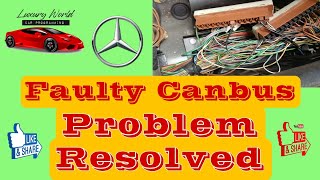
How to confirm: Peel back the carpet in the front driver and passenger side footwells, and remove the plastic door sill trim. Inspect the wiring channels for any signs of moisture, standing water, or green/white corrosion on the electrical connector blocks. 🎬 Watch: How to find and resolve W204 CAN bus faults There are typically three connectors on the driver's side (for a right-hand drive car) and at least one on the passenger's side.
Typical fix: The connectors must be unplugged, thoroughly cleaned of all corrosion, and dried. In many forum-documented cases, cleaning is insufficient and the corroded connector block and wire terminals must be replaced entirely. Splicing wires directly is a last resort.
Est. part cost: $20-$100 - Failed Rear Signal Acquisition Module (SAM) 🔴 High Probability The Rear SAM is located in the trunk area (typically on the right side, behind the trim panel) and is highly vulnerable to water damage from leaking taillight gaskets or clogged rear sunroof drains.
How to confirm: Inspect the trunk, particularly on the right side near the fuse panel and under the trunk floor, for any signs of moisture, condensation, or corrosion on the SAM itself. A Mercedes-specific scanner will often show 'no communication' with the Rear SAM or list multiple faults related to rear-body functions (fuel pump, taillights, etc.).
Typical fix: The source of the water leak must be found and repaired first. The Rear SAM must then be replaced and programmed (SCN coded) to the vehicle. Used modules are available but require programming.
Est. part cost: $150-$400 - Failed Front Signal Acquisition Module (SAM) 🟡 Medium Probability The Front SAM, located in the engine bay fuse box, can be damaged by water overflowing from a clogged windshield cowl drain. It can also fail from internal electronic faults even without water damage.
How to confirm: Check for moisture or corrosion inside the main fuse box in the engine bay. A key symptom is the radiator fan running at full speed immediately after startup. A diagnostic scan may show no communication with the Front SAM or multiple front-end electrical faults (wipers, lights, horn).
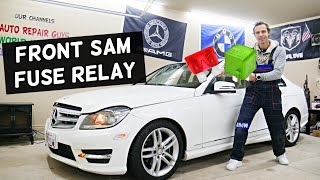
Typical fix: Replace the Front SAM module. 🎬 Watch: Front SAM module fuse and relay replacement guide This part must be programmed to the vehicle after installation. Some specialists offer services to clone your old SAM's data to a new one, creating a plug-and-play replacement.
Est. part cost: $200-$500 - Weak or Failing Battery ⚪ Low Probability → Shop Vehicle Battery The W204's complex electronics are sensitive to voltage. A battery that provides insufficient or fluctuating voltage during startup can cause random communication faults between modules, triggering a U1000 code.
How to confirm: Test the battery with a digital multimeter and a load tester. A healthy battery should show ~12.6V at rest and should not drop below 10.5V during cranking. This should be the first check before diving into more complex diagnostics.
Typical fix: Replace the vehicle's main battery. Ensure the replacement meets or exceeds the OEM specifications for Cold Cranking Amps (CCA) and capacity.
Est. part cost: $180-$350
Rare But Worth Checking
- Faulty Central Gateway Module (CGW): The CGW is the master router for all CAN bus networks. On the W204, the CGW is integrated into the Front SAM, so a failure of the CGW is effectively a failure of the Front SAM. Diagnosis requires a high-level scan tool to confirm.
- Damaged Wiring Harness: A wire in the CAN bus harness could be chafed or broken due to vibration, a previous repair, or rodent damage. This requires manually tracing the harness to find the open or short circuit, which is extremely labor-intensive.
- Faulty Electronic Steering Lock (ESL/ELV): A failing ESL module, a very common W204 issue, can sometimes disrupt CAN communication and prevent the car from starting, occasionally logging a U1000 code alongside other faults. The primary symptom is the key turning in the ignition with no response and the steering wheel remaining locked.
Diagnosis Steps
- Read Fault Codes with a Mercedes-Specific Scanner: A generic scanner will only show U1000 or fail to connect. A tool like Xentry/DAS is needed to perform a 'quick test' and see which specific modules are reporting 'no communication' or are offline.
- Check and Load Test the Battery: Ensure the battery voltage is above 12.4V and that it holds a load. A weak battery is a simple fix that can cause complex electronic issues.
- Inspect for Water Intrusion: This is the most critical step for a W204. Pull up the front carpets and remove the plastic door sill covers to inspect the CAN connectors (X30/4, X30/7) in the footwells. Inspect the trunk area for moisture around the Rear SAM, especially under the spare tire and behind the right-side liner. Check the engine bay fuse box (Front SAM) for any signs of water from the windshield cowl.
- Address Water Leaks: If water is found, 🎬 See this step-by-step sunroof drain cleaning walkthrough do not proceed until the source is fixed. Use compressed air to clean sunroof drains, replace leaking taillight seals, or clear cowl drains as needed.
- Inspect and Clean/Replace Connectors: If corrosion is found on CAN bus connectors, disconnect the battery, then carefully clean the terminals with an electronics contact cleaner. If corrosion is severe, or if cleaning doesn't resolve the issue, replace the plastic connector blocks entirely. They are an inexpensive part from the dealer.
- Test CAN Bus Resistance: With the battery disconnected, measure the resistance between Pin 6 (CAN-H) and Pin 14 (CAN-L) at the OBD-II port. A healthy network should read approximately 60 Ohms. A reading of 120 Ohms indicates a missing terminating resistor (often in a module or a break in the wiring), while a reading near 0 Ohms indicates a short circuit between the CAN high and low lines.
- Isolate the Faulty Module: If a specific module is suspected from the scan tool data, a technician may disconnect it from the CAN bus and re-test the network. If the 60 Ohm resistance returns to normal after disconnecting a module, that module is likely the source of the fault.
Parts You'll Likely Need
- Rear Signal Acquisition Module (Rear SAM)
(OEM #A2049001102, A2049005101, A2045458201 (Numbers vary by year/options, VIN confirmation is essential)) - Front Signal Acquisition Module (Front SAM)
(OEM #A2045456301, A2049005401, A2129009805 (Numbers vary by year/options, VIN confirmation is essential)) - CAN Bus Connector / Energy Distributor
Related Codes That Often Appear With This One
- U0100 — Lost Communication With ECM/PCM. This often appears with U1000 when the engine control module is the specific unit that has dropped off the network.
- U0121 — Lost Communication With Anti-Lock Brake System (ABS) Control Module. This indicates the ABS/ESP module is not communicating, often a symptom of the same underlying CAN bus failure.
- U0141 — Lost Communication With Body Control Module ('Front SAM' in Mercedes terminology). This code specifically points towards a communication failure with the Front SAM.
- U0142 — Lost Communication with Body Control Module B ('Rear SAM' in Mercedes terminology). This code points directly to a communication failure with the Rear SAM.
Technical Service Bulletins (TSBs) & Recalls
- While no specific TSB for U1000 was found, Mercedes-Benz has issued an extended warranty (20 years/unlimited miles) for the rear subframe on W204 models due to corrosion, which highlights the platform's susceptibility to environmental factors.
Platform-Specific Known Issues
- Clogged sunroof drains are a primary cause of water entering the cabin and damaging the CAN bus connectors in the footwells.
- Degraded taillight housing seals are a common source of water leaks into the trunk, which then damages the Rear SAM.
Documented NHTSA Reports
- NHTSA ODI #10681194 describes a U1000 code as a ground harness problem; an owner reported that the vehicle would not start and cleaning battery terminals did not resolve the issue (Nissan reference).
- An owner reported in NHTSA ODI #10970695 that a U1000 code appeared alongside a CAN system diagnosis failure where the instrument cluster could not get mileage, requiring cluster replacement and BCM retesting (Nissan reference).
- NHTSA ODI #10171770 notes that when a vehicle stalled, it lost ignition input and logged codes U1000, U1016, and U1152, eventually requiring an ignition switch replacement (Chevrolet reference).
- According to NHTSA ODI #11461728, a U1000 code was associated with lost communication with the TCM, causing delayed shifting and check engine lights (Mazda reference).
- NHTSA ODI #10929763 describes a scenario where a radiator leak ruined the transmission, resulting in a U1000 code and a vehicle that would not restart (Nissan reference).
Mechanic-Grade Diagnostic Values
- CAN Bus Network Resistance — expected: ~60 Ω. Failure: A reading of ~120 Ω suggests a break in the circuit or a faulty terminating resistor in a module. A reading near 0 Ω indicates a short between the CAN High and CAN Low wires.
- CAN Bus Voltage (Key ON) — expected: CAN-H: ~2.7V, CAN-L: ~2.3V. Failure: Significant deviation from these voltages, or voltages that don't mirror each other (one high, one low), can indicate a short to power or ground on one of the lines.
Scan Tool Commands That Help
- Xentry/DAS: Initial Quick Test — This is the first step in any diagnosis. It polls all control modules on the network and provides a list of which ones are communicating and which have faults (marked with an 'F') or are completely offline. This is essential for narrowing down the location of the CAN bus break.
- Xentry/DAS: Guided Diagnosis — After a Quick Test identifies a fault, selecting the fault code will often initiate a guided test plan. The software will suggest specific checks, such as resistance measurements or component actuations, based on the specific fault, helping the technician systematically find the root cause.
- Xentry/DAS: SCN Coding (Software Calibration Number) — This function is required after replacing a major control unit like a Front or Rear SAM. It programs the new module with the vehicle's specific configuration and VIN, ensuring all features work correctly. This is a dealer-level function that requires an online connection.
Wiring & Ground Locations
- X30/7 — CAN B (Interior) distribution block located in the wiring channel under the carpet/sill plate in the driver's side footwell (LHD).. This is a primary junction for many interior modules. It is highly susceptible to water damage from clogged sunroof drains, leading to corrosion that disrupts the entire CAN B network.
- X30/4 — CAN B (Interior) distribution block located in the wiring channel under the carpet/sill plate in the passenger's side footwell (LHD).. Similar to X30/7, this connector is a common failure point due to water intrusion in the passenger footwell, causing widespread communication faults.
- Front SAM (N10/1) — Located in the main fuse and relay box in the engine compartment, on the driver's side.. The Front SAM integrates the Central Gateway (CGW) for the W204. A failure here, often due to water from the cowl or internal faults, can bring down the entire vehicle network.
- Rear SAM (N10/2) — Located behind the trim panel on the right side of the trunk/luggage compartment.. Controls all rear-body electronics. It's a terminating resistor for the CAN bus and is extremely vulnerable to water from leaking taillight seals, causing faults with lights, the fuel pump, and central locking.
- Main Chassis Ground Points — Key grounds are located near the battery in the engine bay, under the carpet in the footwells, and in the trunk area.. A corroded or loose ground point for a major module (like a SAM) can cause intermittent and difficult-to-diagnose communication errors that mimic a module failure.
Real Owner Repair Stories
- MHH Auto forum user (2009 W204 C-Class) — Multiple CAN communication issues, no communication with the ME (Motor Electronics), and the cooling fan running at high speed.
❌ Tried (didn't work) Running a quick test with DAS (older software, Xentry is preferred for W204).
✅ What actually fixed it The consensus from senior forum members was that the cause was either a faulty Central Gateway (integrated into the Front SAM) or, more likely, corrosion on the 'Green CAN' (Chassis CAN) connections on the floor due to water ingress. The recommended fix was to physically inspect and clean the CAN distribution blocks in the footwells. - AutoGMT forum user (W204 C200 Kompressor) — Recurrent failure of the Rear SAM module. The instrument panel would flash, half the buttons would stop working, and the sunroof and high beam controls would fail. The car had previously required a new Front SAM and a repaired Rear SAM.
❌ Tried (didn't work) Replacing a chip on the Rear SAM and reprogramming it worked temporarily but the module failed again after 3 weeks.
✅ What actually fixed it The root cause was identified as water ingress from a clogged sunroof drain into the passenger footwell. Although the modules themselves did not appear wet, the moisture in the cabin and on the CAN connectors was causing the repeated electronic failures. The final fix required addressing the water leak first, then properly repairing or replacing the affected wiring and modules.
Model Year Variations Within This Range
- 2007-2011 (Pre-Facelift) vs. 2012-2014 (Facelift): The Front and Rear SAM modules are different between pre-facelift and facelift (LCI) models. A facelift Front SAM cannot be directly retrofitted to a pre-facelift car without causing errors (like ABS/ESP warnings) and functional problems (like rear door locks not working). The facelift models use different door control modules (212 part numbers) that are incompatible with the older SAMs. When sourcing a used SAM, it is critical to match it not only by part number but also to the correct pre- or post-facelift vehicle generation.
Diagnostic Flowchart
Other Known Issues on This Vehicle
Issues unrelated to this code that are worth knowing about as an owner of this generation:
- Electronic Steering Lock (ESL/ELV) Failure 🔴 High — Extremely common. Often fails without warning, typically between 60k-120k miles. Results in a no-crank, no-start situation where the key turns but nothing happens.
- Rear Subframe Corrosion/Failure 🔴 High — Widespread enough for Mercedes to issue a 20-year/unlimited-mile extended warranty in many markets. The subframe can rust from the inside out, potentially leading to structural failure. (Ref: MBUSA Warranty Extension - 20 Years / Unlimited Miles)
- M272 Engine Balance Shaft Gear Wear 🔴 High — Affects V6 (M272) engines in early models (approx. 2007-2008). The gear on the balance shaft wears prematurely, causing timing issues and a check engine light (codes P0016, P0017). Repair is extremely expensive. (Ref: Previously a subject of a class-action lawsuit. Affects engines outside a specific serial number range.)
- 7G-Tronic (722.9) Transmission Conductor Plate Failure 🟠 Medium → Shop Transmission Assembly — Common across many Mercedes models with this transmission. The conductor plate, which houses speed sensors and solenoids, fails electronically. This can cause harsh shifting, getting stuck in gear, or limp mode.
- Leaking Taillight Gaskets 🟠 Medium — Very common. The foam gaskets for the taillight assemblies degrade over time, allowing water to enter the trunk, which can then damage the Rear SAM and other electronics.
Used vs. New Parts: Buying Guide for This Vehicle
When a used part is the smart pick: A used SAM (Front or Rear) is a very common and cost-effective repair strategy, but ONLY if you use a cloning service. A used module cannot be simply installed and programmed by the dealer; it must have the data from your original module transferred to it.
Donor-vehicle mileage cap: roughly under 150000 miles for the part to have meaningful remaining life.
What to inspect on the donor part:
- Verify the part number is an exact match to your original module.
- Inspect the donor module's casing for any signs of water damage, such as white chalky residue or corrosion, especially around the connector pins.
- Ask the seller if the donor car had any flood damage. Avoid parts from flooded vehicles at all costs.
- Ensure the donor vehicle is the same model generation (pre-facelift vs. facelift) as yours.
OEM-only on this vehicle (don't cheap out):
- Signal Acquisition Modules (SAMs) - While used OEM units are fine with cloning, avoid no-name aftermarket SAMs as they often lack proper functionality and can't be coded correctly.
Aftermarket brands forum-validated for this vehicle:
- For SAM module repair, several mail-in cloning services have positive reputations on forums and eBay, such as Pelican Diagnostics and Velectronix. These services transfer your original module's data to a compatible used part, creating a plug-and-play replacement without needing dealer SCN coding.
Brands owners have reported issues with on this vehicle:
- Generic, unbranded SAM modules sold on marketplaces. These are almost never a viable solution for a Mercedes-Benz.
Real Owner Stories
Aggregated from forums and TSBs cited above. Mileages and costs reflect what owners reported in those sources.
2011 Mercedes-Benz C-Class (W204)
Symptoms: Water damage on front passenger side; car cuts out and won't crank.
What fixed it: Inspection and cleaning/replacement of the CAN junction block locations that suffered water damage.
Source hint: mbworld.org thread titled 'water damage front passenger sides car cuts wont crank'
2008-2014 Mercedes-Benz C-Class (W204) — ~90000 miles
Symptoms: Electronic Steering Lock (ESL/ELV) failure where the steering wheel locks while driving at low speed or the car fails to start.
What fixed it: Replacement of the Electronic Steering Lock (ESL/ELV) module.
Source hint: vehicle_specific_issues: Electronic Steering Lock (ESL/ELV) Failure
2012 Mercedes-Benz C-Class (W204)
Symptoms: Front SAM issues including radiator fan running at full speed and multiple front-end electrical faults.
What fixed it: Replacement of the Front SAM module and SCN coding/programming to the vehicle.
Source hint: mbworld.org thread titled 'front sam'
Mercedes-Benz C-Class (W204)
Symptoms: An owner reported a U1000 code alongside a no-start condition; the vehicle required towing after attempts to clean battery terminals failed to resolve the issue.
What fixed it: Diagnosis of a ground harness problem as indicated by the U1000 fault code.
Source hint: NHTSA ODI #10681194
Mercedes-Benz C-Class (W204)
Symptoms: Instrument cluster failure where mileage could not be retrieved, accompanied by U1000 and CAN system diagnosis failure.
What fixed it: Replacement and programming of the instrument cluster followed by a retest for BCM failure.
Source hint: NHTSA ODI #10970695
Related OBD-II Codes
Frequently Asked Questions
Why is my C-Class radiator fan running at maximum speed even when the engine is cold?
I found water in my passenger footwell; could this cause the U1000 code?
Is there a TSB or extended warranty for the corrosion issues on my 2007-2014 C-Class?
Can I use a standard OBD-II scanner to diagnose U1000 on my Mercedes?
My COMAND system is showing an anti-theft message and the radio is shutting down; is this related?
Where is the Rear SAM located, and why does it fail?
Helpful Videos

The information in this article is provided for general reference and educational purposes only. Vehicle specifications, procedures, and part compatibility can vary by production date, trim level, and region. Always consult your vehicle's factory service manual and verify part numbers before purchasing or performing repairs. Safety-critical components such as airbags, seat belts, and braking systems should be installed by a qualified professional.
- Mercedes-Benz C-Class:
- 🧭 Diagnostic Flowchart
- 🎬 Helpful Videos
- What's Unique About the 2007-2014 Mercedes-Benz C-Class
- Symptoms You May Notice
- Most Likely Causes
- Rare But Worth Checking
- Diagnosis Steps
- Parts You'll Likely Need
- Related Codes That Often Appear With This One
- Technical Service Bulletins (TSBs) & Recalls
- Platform-Specific Known Issues
- Documented NHTSA Reports
- Mechanic-Grade Diagnostic Values
- Scan Tool Commands That Help
- Wiring & Ground Locations
- Real Owner Repair Stories
- Model Year Variations Within This Range
- Other Known Issues on This Vehicle
- Used vs. New Parts: Buying Guide for This Vehicle
- Real Owner Stories
- 2011 Mercedes-Benz C-Class (W204)
- 2008-2014 Mercedes-Benz C-Class (W204) — ~90000 miles
- 2012 Mercedes-Benz C-Class (W204)
- Mercedes-Benz C-Class (W204)
- Mercedes-Benz C-Class (W204)
- Related OBD-II Codes
- Frequently Asked Questions
- 🎟️ Get 5% Off