

U1000 on 2009-2016 Mercedes-Benz E-Class: CAN Communication Failure Causes and Fixes
U1000 on a Mercedes E-Class indicates a communication failure between electronic modules on the CAN bus network. The most common causes are a weak battery, a failing auxiliary battery, poor ground connections, or a single faulty control module (often the ABS unit) pulling the network down. Diagnosis requires a professional scan tool like XENTRY to identify which module is offline.
- U1000 is a general network communication error; it does not point to a specific part.
- The first and most important diagnostic step is to check the battery's health and test its voltage under load.
- Diagnosis is nearly impossible without a professional scan tool that can communicate with all of the vehicle's modules individually.
- Do not start replacing modules randomly. The goal is to find the single source of the network disruption, which could be a simple wiring or ground issue.
- This is a complex electrical issue; professional diagnosis is highly recommended to avoid costly misdiagnoses.
What's Unique About the 2009-2016 Mercedes-Benz E-Class
The W212 generation E-Class is known for its complex network of electronic modules controlling everything from safety systems to comfort features. Unlike a simple sensor code, U1000 on this platform is rarely about a single failed part. It's typically a symptom of a broader network issue. One module failing, a bad ground, or a voltage drop can create a cascade of communication errors across the entire vehicle, sometimes logging dozens of faults simultaneously. Diagnosis absolutely requires a Mercedes-specific scan tool (like STAR/XENTRY) to see the full network topology, perform a 'roll-call' of all modules, and identify which specific module has gone silent. Common failure points that can trigger a U1000 include the ABS/ESP module, the rear SAM (Signal Acquisition Module) due to water ingress, and even the auxiliary battery.
Generation note: The 2009-2016 range covers the entire W212 generation, which had a major facelift for the 2014 model year. The pre-facelift (2009-2013) and post-facelift (2014-2016) models have different electronic components and module software. While the diagnostic principles for a U1000 code are the same, the specific module causing the fault and its location may differ. For instance, the Central Gateway (CGW) may be a separate unit in the passenger footwell on earlier models, but integrated into the front SAM on later ones.
Symptoms You May Notice
- Check Engine Light is on
- Multiple warning lights on the dashboard (e.g., ABS, ESP, Airbag, "Pre-Safe Functions Limited")
- Electrical glitches, like windows, seats, or climate control not working intermittently
- Transmission stuck in one gear (limp mode)
- Engine performance issues, including poor acceleration or stalling
- In severe cases, a no-crank or no-start condition
- COMAND head unit randomly shutting off or not displaying information
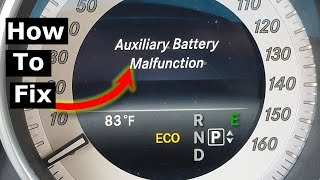
- Brake-related warnings like "Auxiliary Battery Malfunction"
- Replacing the ECU (Engine Control Unit) first. The U1000 code is a network code, not necessarily an engine code. The fault is often in a completely different module, like the ABS or a door controller.
- Clearing the codes and hoping they don't return. While a temporary voltage drop can cause a one-time U1000 code, if there is an underlying hardware issue, the code will return quickly.
- Replacing the auxiliary battery without checking the main battery and charging system first. A weak charging system will quickly ruin new batteries.
Most Likely Causes
- Weak or Failing Battery (Main or Auxiliary) 🔴 High Probability → Shop Vehicle Battery Modern Mercedes-Benz vehicles are packed with electronics highly sensitive to voltage. A weak main battery can cause modules to fail initialization. The W212 also has an auxiliary battery (or a voltage converter/capacitor on later models) that supports the ECO start/stop and brake hold functions; its failure is very common and can cause widespread electrical warnings.
How to confirm: Test the main battery voltage with a multimeter; it should be ~12.6V engine off and >14V running. Perform a load test. For the auxiliary battery, an "Auxiliary Battery Malfunction" message is a clear sign. Testing its voltage may show a reading below 12V, indicating failure.
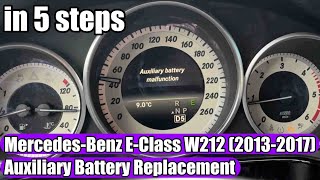
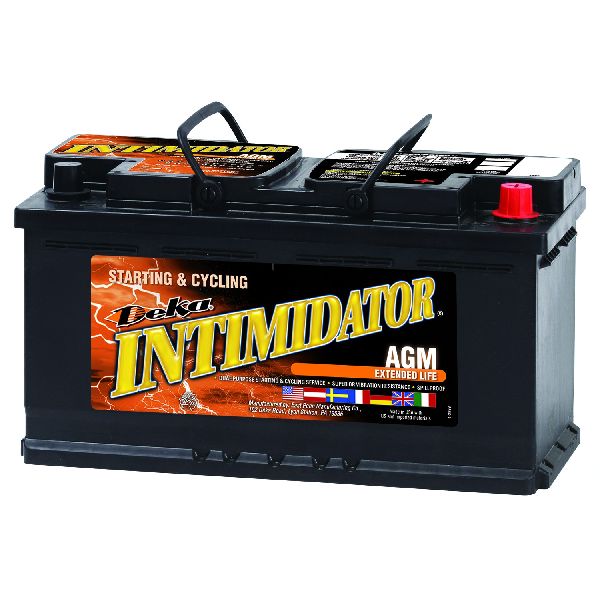
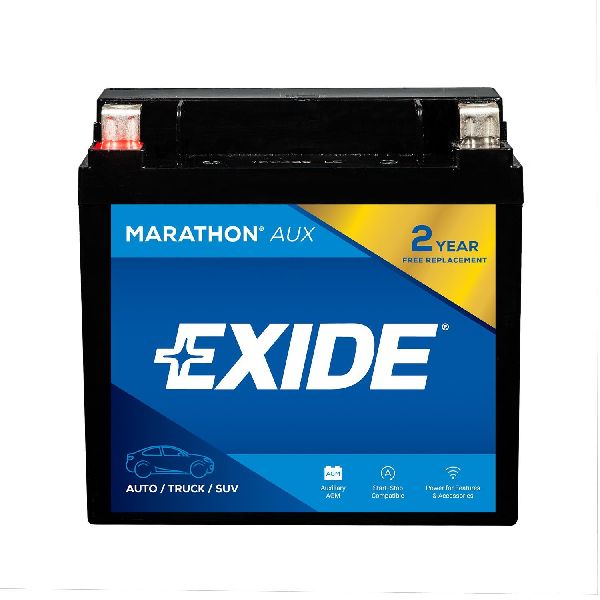
Typical fix: Replace the main AGM battery and register it. For the auxiliary battery, replace the small battery located either in the trunk or behind the driver's side dash panel. 🎬 Watch: How to replace the auxiliary battery On facelift models, this may be a voltage converter module in the passenger footwell.
Est. part cost: $200-$400 (Main), $50-$150 (Auxiliary) - Corroded or Loose Ground Straps/Connections 🟡 Medium Probability → Shop Engine Ground Strap The vehicle relies on numerous ground points (W-points) to complete electrical circuits. The main engine-to-chassis strap, often located near the transmission bell housing, is susceptible to corrosion and can cause unstable voltage for control modules.
How to confirm: Visually inspect main ground straps: battery-to-chassis (W10), engine-to-chassis (near bell housing), and various points in the engine bay (W70, W9, W11). Look for green/white corrosion or looseness. A voltage drop test across the strap while the engine is cranking is the definitive test.
Typical fix: Remove, clean the contact points on the strap and chassis with a wire brush until shiny, and re-secure tightly. Replace any heavily corroded or frayed straps. OEM part number for a common strap is A2125400941.
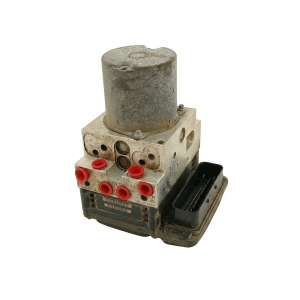
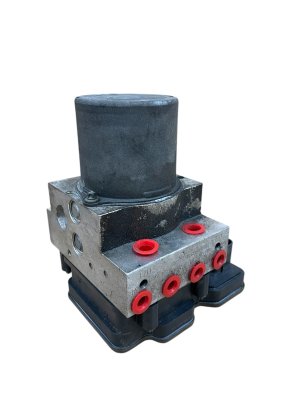
Est. part cost: $20-$50 - Faulty ABS/ESP Control Module 🟡 Medium Probability → Shop ABS Control Module The ABS/ESP module is a critical node on the high-speed powertrain CAN bus (CAN-C). Internal failure of this module is a well-documented issue on the W212 platform and will immediately take down communication, often resulting in a U1000 code and various ABS/ESP/Pre-Safe warnings.
How to confirm: Use a Mercedes-specific scan tool. If the ABS module is the only one not communicating, or if it reports internal fault codes (like C1000), it is highly suspect. The ABS pump motor may also run continuously or not at all.
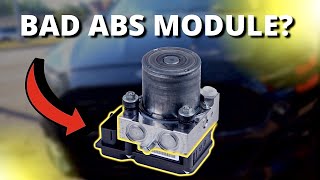
Typical fix: The faulty module must be replaced and then coded/programmed to the vehicle using XENTRY. Remanufactured units are a cost-effective option. A common part number for the hydraulic unit is A2124313512. 🎬 Watch: Symptoms of a bad ABS module
Est. part cost: $800-$2000+ (New OEM), $300-$800 (Remanufactured) - Damaged CAN Bus Wiring / Water Ingress ⚪ Low Probability Water leaks are a known issue. Clogged sunroof drains can cause water to enter the passenger footwell, damaging the Central Gateway (on pre-facelift models) or CAN bus connectors. Leaking taillight seals can allow water into the trunk, damaging the Rear SAM (Signal Acquisition Module).
How to confirm: Visually inspect wiring harnesses and module locations for physical damage or corrosion, especially in the passenger footwell and trunk area behind the right-side trim. With the battery disconnected, check for resistance between CAN High and CAN Low wires at the OBD-II port (pins 6 and 14); it should be ~60 Ohms.
Typical fix: Repair the damaged section of the wiring harness. Dry out, clean, or replace corroded connectors or modules (e.g., Rear SAM). The source of the water leak (drains, seals) must be fixed to prevent recurrence.
Est. part cost: $5-$100 (wiring), $400-$800 (new SAM)
Rare But Worth Checking
- Faulty Central Gateway Module (CGW/ZGW): The CGW is the central router for all CAN bus communication. On pre-facelift W212s, it's often located in the passenger footwell and is susceptible to water damage. A failure here will cause massive communication loss across multiple networks. On facelift models, its function is often integrated into the Front SAM.
- Aftermarket Electronics Interference: Improperly installed aftermarket devices (remote starters, alarms, audio equipment) that are tapped into the CAN bus can disrupt communication and cause a U1000 code.
- Faulty Rear SAM (Signal Acquisition Module): While wiring damage from water is common, the Rear SAM itself can fail due to this water ingress. It is located in the right side of the trunk and is critical for rear lighting and other body functions. Failure can disrupt the CAN-B network. 🎬 See this guide on rear SAM failure symptoms
Diagnosis Steps
- Connect a Mercedes-specific diagnostic tool (like STAR/XENTRY) capable of reading manufacturer codes from all modules.
- Perform a full vehicle scan and save all fault codes. Do not clear them yet.
- Analyze the list of codes. Look for the module that has the most communication faults pointing to it, or the module that is completely unresponsive ('No Communication'). This is your primary suspect.
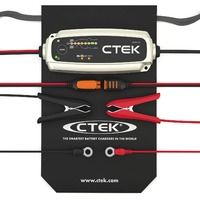
- Check the battery and charging system. Ensure voltage is stable and within specification (12.6V+ engine off, 14.0V+ engine on). Perform a load test on the main battery.
- Check for an 'Auxiliary Battery Malfunction' message on the dash. If present, address this first as it's a common and simple fix.
- Inspect all major ground connections, especially the battery-to-chassis (W10) and engine-to-chassis.
Parts You'll Likely Need
- AGM Battery — Low voltage is a primary trigger for communication faults on this platform.
Trusted brands: Varta, Bosch, Interstate
OEM price range: $300-$450
Aftermarket price range: $200-$350 - ABS/ESP Control Module
(OEM #A2124313512)— This is a common module to fail and cause network-wide communication issues. The part number A2124313512 is frequently cited for the W212.
Trusted brands: Bosch, ATE
OEM price range: $1200-$2500
Aftermarket price range: $300-$800 (remanufactured) - Auxiliary Battery
(OEM #N000000004039)— Failure of this small battery is extremely common and triggers multiple dashboard warnings.
Trusted brands: Mercedes-Benz OEM, Fiamm
OEM price range: $100-$150
Aftermarket price range: $50-$80 - Engine Ground Strap
(OEM #A2125400941)— The engine-to-chassis ground strap is prone to corrosion and can cause a host of electrical issues when its resistance increases.
Trusted brands: Mercedes-Benz OEM
OEM price range: $25-$40
Aftermarket price range: $15-$25
Related Codes That Often Appear With This One
- Multiple U-codes (e.g., U0121, U0101) — A U1000 code indicates a network problem. You will almost always see a cascade of other communication codes from various modules that have lost communication with the failing module. U0121 (Lost Communication with ABS) is particularly common.
- Codes specific to the failed module — If the ABS module has failed, you will likely see the U1000 code alongside specific ABS/ESP internal fault codes (like C1000), which helps identify the source.
Platform-Specific Known Issues
- Water Damage to Rear SAM: A very common owner experience involves water leaking past degraded taillight seals and collecting in the right-rear trunk compartment, directly where the Rear SAM is located. This causes corrosion and failure, leading to malfunctions of tail lights, fuel gauge, and trunk release, often accompanied by CAN bus communication errors. Owners on MBWorld.org forums frequently discuss replacing the gaskets and drying or replacing the SAM.
- Auxiliary Battery Failure: → Shop Vehicle Battery Countless owners of W212 E-Class vehicles report seeing the 'Auxiliary Battery Malfunction' warning on their dashboard. This is often one of the first electrical issues a W212 owner will face. While the primary function is for the start/stop system, its failure can cause a cascade of seemingly unrelated electrical warnings, confusing the diagnostic process for codes like U1000.
- Central Gateway Location and Water Damage: On pre-facelift models (2009-2013), the Central Gateway Module (CGW) is often located in the front passenger footwell. Clogged sunroof drains can cause this area to flood, destroying the module and severing communication between the different CAN networks. Forum threads detail owners peeling back wet carpet to find a corroded CGW as the root cause of their 'dead' car.
Documented NHTSA Reports
While U1000 is a manufacturer-specific code, cross-manufacturer records highlight the critical nature of network integrity. For instance, NHTSA ODI #10681194 describes U1000 as a ground harness problem where cleaning battery terminals was insufficient to resolve the fault. Similarly, NHTSA ODI #11461728 notes that U1000 can indicate lost communication with the TCM, sometimes caused by module overheating due to its physical placement. In other cases, such as NHTSA ODI #10970695, the code appeared alongside instrument cluster communication failures where power and ground were present but the CAN system diagnosis failed. Furthermore, NHTSA ODI #10171770 reports that U1000 can be associated with a vehicle stalling due to lost ignition input, and NHTSA ODI #11727548 describes a "systemic U1000 Electrical Network Jam" resulting from obsolete or unconfigured telematics hardware.
Mechanic-Grade Diagnostic Values
- CAN Bus Network Resistance — expected: ~60 Ohms. Failure: A reading of ~120 Ohms indicates a missing terminating resistor or an open circuit in one of the CAN lines. A reading significantly less than 60 Ohms (e.g., 40-45 Ohms) can indicate an additional, unwanted termination or a shorted module.
- CAN Bus Voltage (Key ON, Engine OFF) — expected: CAN High (Pin 6) should be ~2.5–3.5V. CAN Low (Pin 14) should be ~1.5–2.5V. Both lines should idle near 2.5V.. Failure: A line stuck high (at battery voltage) or low (at 0V) indicates a short to power or ground. Voltages that do not mirror each other or are outside the expected range point to a network problem.
- CAN Bus Baud Rate — expected: 500 kbit/s for CAN-C (Powertrain) and CAN-E (Chassis).. Failure: Incorrect baud rate settings in a replaced or incorrectly coded module will cause it to not communicate.
Hidden / Shadow Codes Worth Checking
- Stored 'f' vs. Current/Stored 'F' faults in XENTRY: In the XENTRY diagnostic system, a lowercase 'f' indicates a fault that is only stored in memory and is not currently active. A capital 'F' indicates a fault that is both current and stored. A U1000 code appearing as a capital 'F' signifies an active, ongoing network disruption. (see via Mercedes-Benz XENTRY/DAS (dealer-level diagnostic software).)
- Event Memory entries: Alongside the U1000 fault code, the Central Gateway (CGW) and other modules store 'Event Memory' data. This can provide timestamps and context, such as which module was 'not reachable' at the time of the fault, helping to isolate the root cause more effectively than the U-code alone. (see via XENTRY/DAS, by navigating into the specific control module's 'Faults' and then 'Event Memory' tabs.)
Scan Tool Commands That Help
- XENTRY/DAS: Initial Quick Test — This is the first step in any diagnosis. It performs a 'roll call' of all control units on the network. Modules that do not respond will be flagged, immediately pointing the technician to the source of the communication loss.
- XENTRY/DAS: Initial startup of a new control unit — After replacing a module like a SAM, ABS unit, or CGW, this function is used to integrate it into the vehicle. It often involves SCN (Software Calibration Number) coding, which downloads vehicle-specific data from Mercedes-Benz servers to configure the new part.
- Vediamo / DTS Monaco: Variant Coding — This is advanced engineering software used when a standard XENTRY 'initial startup' is insufficient, particularly with used modules. It allows a technician to manually change the coding of a module (e.g., changing a VIN, or enabling/disabling features) to match the car's configuration. This was used by one owner to make a used ESP module work.
Wiring & Ground Locations
- CGW (Central Gateway) — On pre-facelift models (2009-2013), it is a separate module located in the front passenger footwell, under the carpet. On facelift models (2014-2016), its function is integrated into the Front SAM (N10/1) under the hood.. As the network router, its failure or water damage in pre-facelift models is a primary suspect for a U1000 code that affects multiple CAN buses.
- W10 — Main battery ground point, located on the chassis near the front strut top mount in the engine bay.. A poor connection here creates an unstable ground reference for all electronics, leading to widespread communication faults.
- W70, W9, W11 — Various ground points located in the engine bay, typically on the inner fender structures.. These ground various engine and chassis electronics. Corrosion at these points can cause isolated modules to lose communication.
- CAN Bus Distributors (e.g., X30/21, X30/32) — These are small connector blocks (potential distributors) located in various places, such as under the carpet or behind trim panels, where multiple CAN wires join together. For example, the CAN-C (Drive Train) distributor is X30/21.. Corrosion or a bad connection inside one of these distributors can take down an entire segment of the network. They also contain the 60-ohm terminating resistors for the network.
- Rear SAM (N10/2) — Located in the trunk on the right side, behind the trim panel.. It's a major node on the interior CAN bus (CAN-B) and is highly prone to failure from water leaking past the taillight seals.
Real Owner Repair Stories
- Reddit user, Mercedes technician (Multiple W212 E-Class models) — Blind Spot Assist Inoperative message, often accompanied by network communication codes.
❌ Tried (didn't work) Replacing only one of the two rear radar sensors., Clearing codes without addressing the root cause.
✅ What actually fixed it The rear bumper-mounted blind spot radar sensors have a poor housing seal, allowing water and road salt to enter and corrode the internal electronics and connector pins. This shorts out the sensor, which then disrupts CAN bus communication. The final fix is to replace the corroded sensor(s) and repair the corroded pins in the wiring harness connector. As a preventative measure, the technician recommends sealing the seam of the new sensor housing with automotive-grade urethane or epoxy before installation. - MBWorld.org forum user (2009 W212 E220) — EDB, ESP, ABS inoperable error on the dash after a crash damaged the original ESP module.
❌ Tried (didn't work) Installing a used ESP module with the same part number, which initially resulted in a VIN mismatch error., Clearing fault codes after writing the correct VIN; the ESP light would return upon driving.
✅ What actually fixed it The donor ESP module came from a car with different options (automatic transmission, variable steering). The final resolution required using advanced software (Vediamo) to manually perform 'Variant Coding' on the used module to match the exact equipment and features of the recipient car. Standard VIN writing with XENTRY was not enough.
OEM Part Supersession History
A2129005424→A2129008324, A2228700789— This is a common LED headlight control module (ballast) for facelift W212 models. Part numbers are frequently updated due to hardware revisions or supplier changes.
Heads up: While multiple part numbers may be listed as compatible, they often have different hardware (HW) and software (SW) numbers printed on them. For guaranteed compatibility, it's best to match the full original part number. Using a superseded part may require SCN coding to load the correct software.
Model Year Variations Within This Range
- 2009-2013 (Pre-Facelift): These models typically use a separate, physical auxiliary battery (small motorcycle-style battery) located either in the trunk or behind the dashboard to support the electrical system. They also have a distinct Central Gateway Module (CGW) located in the passenger footwell, which is a common point of failure due to water ingress.
- 2014-2016 (Post-Facelift): The auxiliary battery was replaced with a 'voltage converter module' or capacitor, usually located in the passenger footwell or trunk. The function of the Central Gateway (CGW) was integrated into the Front SAM (N10/1), eliminating the separate module in the footwell. The CAN bus architecture was also updated, with CAN-G being renamed to CAN-E2 around March 2013.
Diagnostic Flowchart
Other Known Issues on This Vehicle
Issues unrelated to this code that are worth knowing about as an owner of this generation:
- 7G-Tronic Conductor Plate/Turbine Speed Sensor Failure 🔴 High — Common after 100,000-150,000 km, can cause harsh shifting or limp mode.
- Air Suspension (Airmatic) Leaks 🟠 Medium — Struts and bags can develop leaks after 80,000-120,000 km, causing the vehicle to sag and the compressor to run excessively.
- Fading Interior Wood Trim 🟡 Low — Very common for the wood trim, especially on the center console and doors, to fade and discolor from UV exposure.
- Leaking Oil Filter Housing Gasket (M272/M276 V6) 🟠 Medium — A very common oil leak on the V6 engines. The leaking oil can drip onto and damage the accessory belt tensioner.
- Rear Taillight Gasket Leaks 🔴 High — The foam gaskets for the taillights degrade, allowing water into the trunk, which can destroy the Rear SAM module.
- Crankshaft Position Sensor Failure 🟠 Medium — A common cause for a 'crank no start' condition, especially when the engine is warm.
Used vs. New Parts: Buying Guide for This Vehicle
When a used part is the smart pick: Used parts are a viable option for modules that do not contain the primary immobilizer data and can be reprogrammed or 'cloned'. This includes the Rear SAM, Front SAM, and ABS/ESP modules. Buying used is cost-effective, but success heavily depends on having access to advanced diagnostic tools.
Donor-vehicle mileage cap: roughly under 100000 miles for the part to have meaningful remaining life.
What to inspect on the donor part:
- Match the OEM part number EXACTLY. Even a single digit difference can mean incompatibility.
- Inspect for any signs of water damage, such as corrosion on the pins or discoloration on the housing.
- If possible, source the part from a vehicle with a known history and similar options.
- For modules like the ABS/ESP unit, ensure the donor car did not have crash data stored.
OEM-only on this vehicle (don't cheap out):
- Central Gateway Module (CGW) for pre-facelift models. Due to its critical role as the network router, using a new, correctly coded part is essential for stability.
- Electronic Ignition Switch (EIS) and Electronic Steering Lock (ESL), as these are core immobilizer components and cannot be easily swapped.
Aftermarket brands forum-validated for this vehicle:
- For control modules, 'remanufactured' units from reputable suppliers who offer a warranty are the best alternative to new OEM. They are often original units that have been repaired and tested.
- For batteries, brands like Varta or Bosch are often the original equipment manufacturer for Mercedes-Benz and are excellent alternatives to dealer-branded parts.
Brands owners have reported issues with on this vehicle:
- Unknown, no-name electronic modules from online marketplaces. These often lack proper quality control and may not be programmable to the vehicle, leading to more diagnostic headaches.
- For a complex CAN bus issue, avoid generic aftermarket scan tools that cannot perform Mercedes-specific functions like SCN coding or initial startup.
Real Owner Stories
Aggregated from forums and TSBs cited above. Mileages and costs reflect what owners reported in those sources.
2012 E350
Symptoms: Multiple warning lights including ABS, ESP, and 'Pre-Safe Functions Limited' appeared on the dashboard. The car entered limp mode and the ABS pump motor was suspected of failing.
What fixed it: Replacement and programming of the ABS/ESP control module (hydraulic unit part A2124313512) using XENTRY.
Source hint: Vehicle_specific_issues and common_causes regarding ABS/ESP module failure
2010 E-Class (Pre-facelift)
Symptoms: The car was 'dead' with no communication between modules. Upon inspection, the front passenger footwell carpet was found to be wet.
What fixed it: Clearing clogged sunroof drains and replacing the water-damaged Central Gateway Module (CGW) located in the passenger footwell.
Source hint: Vehicle_specific_issues: Central Gateway Location and Water Damage
2014 E-Class (Facelift)
Symptoms: Dashboard displayed 'Auxiliary Battery Malfunction' followed by various intermittent electrical glitches and a U1000 code.
What fixed it: Replaced the voltage converter module located in the passenger footwell.
Source hint: Common_causes: Weak or Failing Battery (Main or Auxiliary)
2013 E-Class
Symptoms: Tail lights malfunctioning, fuel gauge reading incorrectly, and trunk release not working, accompanied by CAN bus communication errors.
What fixed it: Replaced degraded taillight gaskets to stop water ingress and replaced the corroded Rear SAM (Signal Acquisition Module) in the trunk.
Source hint: Vehicle_specific_issues: Water Damage to Rear SAM
Related OBD-II Codes
Frequently Asked Questions
My dashboard says 'Auxiliary Battery Malfunction' and I have a U1000 code. Are they related?
I found water in my trunk near the Rear SAM; could this cause the U1000 code?
Where is the Central Gateway (CGW) located on my 2011 E-Class, and why does it matter for U1000?
Can a bad ground strap cause U1000 on a Mercedes W212?
Is the ABS/ESP module a common failure point for communication codes on this platform?
What should the battery voltage be to prevent initialization-related U1000 codes?
Helpful Videos
Used OEM Parts in Stock
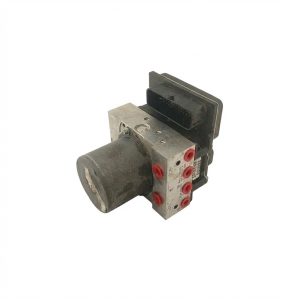
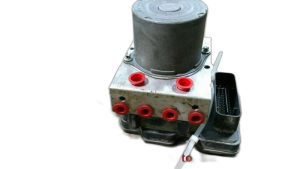
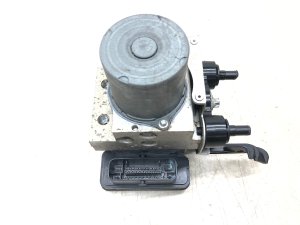
New Aftermarket Parts Available



The information in this article is provided for general reference and educational purposes only. Vehicle specifications, procedures, and part compatibility can vary by production date, trim level, and region. Always consult your vehicle's factory service manual and verify part numbers before purchasing or performing repairs. Safety-critical components such as airbags, seat belts, and braking systems should be installed by a qualified professional.
- Mercedes-Benz E-Class:
- 🧭 Diagnostic Flowchart
- 🎬 Helpful Videos
- 🛍️ Shop This Part
- What's Unique About the 2009-2016 Mercedes-Benz E-Class
- Symptoms You May Notice
- Most Likely Causes
- Rare But Worth Checking
- Diagnosis Steps
- Parts You'll Likely Need
- Related Codes That Often Appear With This One
- Platform-Specific Known Issues
- Documented NHTSA Reports
- Mechanic-Grade Diagnostic Values
- Hidden / Shadow Codes Worth Checking
- Scan Tool Commands That Help
- Wiring & Ground Locations
- Real Owner Repair Stories
- OEM Part Supersession History
- Model Year Variations Within This Range
- Other Known Issues on This Vehicle
- Used vs. New Parts: Buying Guide for This Vehicle
- Real Owner Stories
- 2012 E350
- 2010 E-Class (Pre-facelift)
- 2014 E-Class (Facelift)
- 2013 E-Class
- Related OBD-II Codes
- Frequently Asked Questions
- 🎟️ Get 5% Off