

U1000 on 2008-2017 Volvo XC60: Network Communication Failure Causes and Fixes
On a 2008-2017 Volvo XC60, code U1000 indicates a network communication failure. The most common causes are water damage to the Central Electronic Module (CEM) from clogged sunroof drains, a failing ABS module, or chafed wiring. Diagnosis is complex and professional help is recommended.
- U1000 on a P3 XC60 is very often caused by water damage to the Central Electronic Module (CEM).
- Before any other diagnosis, check for dampness in the passenger footwell and clean the sunroof drains.
- A failing ABS module is the second most likely cause and can be confirmed by specific ABS-related codes.
- Replacing a CEM is not a simple swap; it requires a data cloning service to program the new module to the car.
- Diagnosis requires Volvo-specific tools; generic OBD-II scanners are insufficient.
What's Unique About the 2008-2017 Volvo XC60
The first-generation Volvo XC60 (P3 platform) is known for having specific vulnerabilities that lead to network communication faults like U1000. The primary issue is the location of the Central Electronic Module (CEM) on the passenger side, which is highly susceptible to water damage from clogged sunroof drains or leaking windshield seals. This water ingress is a very common and well-documented problem that can destroy the CEM, taking the entire network down. Unlike other vehicles where this code might be a simple glitch, on an XC60 it often signals a serious underlying hardware problem.
Symptoms You May Notice
- Multiple, seemingly unrelated warning lights on the dashboard (SRS Airbag, Brake, Check Engine).
- Instrument cluster (speedometer, tachometer, fuel gauge) stops working or behaves erratically.
- Center console controls (radio, climate control) become completely non-functional.
- Power windows, mirrors, and central locking stop working.
- Transmission may get stuck in Park or enter a 'limp mode'.
- No-start condition where the engine cranks but won't fire, or doesn't crank at all.
- Windshield wipers or horn may activate on their own or not work at all.
- "Anti-Skid Service Required" message is very common as the ABS module is a key node on the network.
- Replacing the instrument cluster (DIM). While the cluster goes dead, it is usually a symptom of the network failure, not the cause.
- Replacing the battery without load testing it first. A battery can show good voltage but still be too weak to properly run the vehicle's electronics under load.
- Replacing the CEM without first confirming water damage or ruling out wiring and other module faults. The CEM is expensive and requires programming, so it should not be the first part replaced without a thorough diagnosis.
Most Likely Causes
- Water Damage to Central Electronic Module (CEM) 🔴 High Probability The CEM is located under the passenger side glove box, directly in the path of water from commonly clogged sunroof drains or leaking windshield seals. This is a widely reported design flaw.
How to confirm: Peel back the passenger side carpet and insulation to check for dampness, standing water, or signs of corrosion on the CEM and its connectors. A professional would use VIDA to see if the CEM is communicating. Often, the first sign for an owner is a wet floor or condensation inside the car.
Typical fix: The CEM must be removed. 🎬 See this step-by-step guide on how to remove the CEM If corrosion is minor, it can sometimes be cleaned. More often, the module must be replaced. A new or used CEM requires a data cloning service to transfer the vehicle's specific programming from the old unit to the new one. This is a critical step; the car will not start without it.
Est. part cost: $500-$1200 for a new or professionally rebuilt and cloned CEM. Cloning services alone cost around $185-$250 if you provide a used donor module. - Chafed or Shorted CAN Bus Wiring 🟡 Medium Probability Wiring harnesses can rub against metal brackets behind the dashboard or in door jambs over time, causing a short circuit that brings down the network. Rodent damage in the engine bay near the wiper cowl has also been reported.
How to confirm: This requires a technician to perform a resistance check on the CAN bus wires (should be ~60 ohms between CAN High and CAN Low) and meticulously inspect harnesses in known problem areas, such as behind the radio and where they pass into the doors.
Typical fix: Repairing the damaged section of the wire and protecting it from future damage with loom or foam padding.
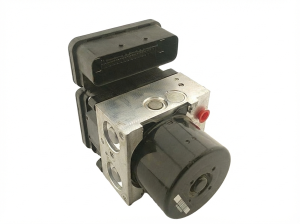
Est. part cost: $5-$20 for wiring repair supplies. - Failing ABS Control Module 🟡 Medium Probability → Shop ABS Control Module The ATE Teves ABS modules used on these Volvos are known to fail internally due to solder joint fractures from heat and vibration, causing communication faults on the CAN bus.
How to confirm: A scan with a Volvo-specific tool may show a loss of communication with the ABS module (code U0121) alongside other codes. The ABS and TRACS/DSTC warning lights are almost always illuminated with this failure.
Typical fix: The ABS module is removed and sent to a specialist for rebuilding. This is a common and reliable repair that is much cheaper than a new unit from the dealer. The vehicle can still be driven with the module removed, but will have no ABS, traction control, or speedometer in some cases.
Est. part cost: $200-$400 for a professional rebuild service. - Weak or Failing Battery ⚪ Low Probability → Shop Vehicle Battery The P3 platform is highly sensitive to system voltage. A battery that is weak or failing can cause voltage drops during startup or operation, leading to temporary communication errors between modules.
How to confirm: Test the battery with a digital multimeter (should be above 12.4V with engine off) and, more importantly, with a proper load tester to check its actual health. Many auto parts stores do this for free.
Typical fix: Replace the 12V battery.
Est. part cost: $180-$350
Rare But Worth Checking
- Faulty Alarm Siren Module: A failing internal battery in the alarm siren module can leak and corrode the circuit board, causing it to short circuit the LIN bus, which can sometimes manifest as wider CAN bus issues or prevent OBD-II communication. If you get an "Alarm System Service Required" message, this is a strong possibility.
- Faulty Radiator Anti-Tamper Device (2010-2013 models): Volvo issued TSB TJ27910 for an issue where this device (Part No. 31321504) could fail and cause a loss of communication with the Engine Control Module (ECM), sometimes triggering charging system warnings.
- Short in Rear View Camera Wiring/Module: → Shop Video Camera On models equipped with a backup camera, the wiring in the tailgate hinge area can fray over time, causing a short that disrupts the network. In other cases, the camera module itself fails. A flickering or blue screen on the camera display before total failure is a common symptom.
Diagnosis Steps
- Check and load-test the 12V battery. Ensure it is fully charged and healthy before proceeding.
- Perform a full system scan with a Volvo-specific tool (like VIDA) to see which modules are not communicating. Generic OBD-II scanners are not sufficient.
- Inspect the passenger footwell for any signs of moisture. Peel back the carpet and physically check the Central Electronic Module (CEM) and its connectors for water damage or corrosion.
- If water is found, identify and fix the source of the leak. The most common culprits are the front sunroof drains. These can be cleared using string trimmer line or compressed air. 🎬 Watch: How to clear clogged sunroof drains on an XC60 A leaking windshield seal is another common cause.
- If no water is present, inspect the CAN bus wiring harnesses for physical damage. Key areas include behind the radio/center console, under the wiper cowl, and in the door jambs.
- If the ABS module is not communicating, inspect its connector for corrosion. If clean, the module itself is the likely suspect and should be sent to a specialist for testing and rebuilding.
- If all else fails, the issue may be an internal failure of the CEM or another module on the network. This level of diagnosis should be performed by a professional with an oscilloscope to analyze the CAN bus signals directly.
Parts You'll Likely Need
- Central Electronic Module (CEM) — This is the most common point of failure, usually due to water damage from the infamous clogged sunroof drains on the XC60. It acts as the central hub for the network.
Trusted brands: Volvo (OEM)
OEM price range: $1000-$1400 (requires dealer programming)
Aftermarket price range: $400-$700 (for a rebuild/cloning service) - ABS Control Module Repair Service — Internal failure of the ABS module is a common cause of CAN bus faults on this platform. Rebuilding the original unit is the standard, cost-effective fix.
Trusted brands: ATE (OEM), ECU Testing (Rebuilder), Xemodex (Rebuilder), ACTRONICS (Rebuilder)
OEM price range: $1200+
Aftermarket price range: $200-$400 (for a rebuild service)
Related Codes That Often Appear With This One
- CEM-U001000 — This is a more specific Volvo code indicating a problem on the Medium Speed CAN bus, often logged in the CEM itself when a major network fault occurs.
- U015500 — Lost Communication with Driver Information Module (Instrument Cluster). This is a direct result of the network failure.
- U016400 — Lost Communication with Climate Control Module. This is logged when the center console controls go dead due to the network fault.
- U0121 — Lost Communication With Anti-Lock Brake System (ABS) Control Module. This often points to the ABS module itself being the source of the network disruption.
Technical Service Bulletins (TSBs) & Recalls
- TJ27910
Platform-Specific Known Issues
- Sunroof Drain Design Flaw: The front sunroof drain tubes are prone to clogging with debris or detaching from the sunroof cassette nipple, causing water to run down the A-pillar and directly onto the CEM. Regular cleaning is a critical preventative measure.
- CEM Location Vulnerability: The placement of the Central Electronic Module (CEM) directly under the path of potential water leaks from both the sunroof and windshield makes it exceptionally vulnerable to damage that causes network failures.
Mechanic-Grade Diagnostic Values
- CAN Bus Network Resistance — expected: ~60 Ohms. Failure: A reading of ~120 Ohms indicates one of the two terminating resistors (or the module containing it) is disconnected/failed. An open-circuit (high resistance) or short (near 0 Ohms) indicates a wiring fault.
- High-Speed CAN Bus Voltage (at OBD-II Port) — expected: CAN High (Pin 6) and CAN Low (Pin 14) should both be at ~2.5V when idle (recessive state). During communication (dominant state), CAN High goes to ~3.5V and CAN Low drops to ~1.5V.. Failure: Voltages stuck high or low, or not mirroring each other, indicate a short to power, ground, or a faulty transceiver in a module.
- Medium-Speed CAN Bus Voltage (at OBD-II Port) — expected: CAN High (Pin 3) and CAN Low (Pin 11) follow the same voltage pattern as the high-speed bus: ~2.5V at rest, toggling to ~3.5V (High) and ~1.5V (Low) during communication.. Failure: A signal that is shorted to ground or does not show the characteristic square wave on an oscilloscope indicates a wiring or module fault.
Scan Tool Commands That Help
- Volvo VIDA: Network Graph/Topology View — To get a visual representation of all control modules on the network and see which ones are reporting as 'offline' or 'not communicating'. This is the first step in isolating the fault domain.
- Volvo VIDA: CEM Reload or Reprogram — This is a dealer-level function required after replacing the Central Electronic Module. It downloads vehicle-specific software and security information to the new module. An independent shop with a VIDA subscription can also perform this.
- Volvo VIDA: Readout of all DTCs in all modules — Unlike generic scanners, VIDA polls every single module on the car's network. A U1000 code is often accompanied by more specific 'Lost Communication with...' codes in other modules, which helps pinpoint the origin of the network failure.
Wiring & Ground Locations
- OBD-II Port (DLC) — Under the driver's side dashboard, to the left of the steering column.. Provides direct access to both CAN networks for testing. High-Speed CAN is on Pins 6 (CAN-H) and 14 (CAN-L). Medium-Speed CAN is on Pins 3 (CAN-H) and 11 (CAN-L).
- CAN Bus Terminating Resistors — The two 120-Ohm terminating resistors are not separate parts. For the High-Speed CAN, they are integrated inside the Engine Control Module (ECM) and the ABS module. For the Medium-Speed CAN, they are in the CEM and another module like the PDM/DDM.. If you measure 120 Ohms on the bus, it often means one of these key modules is unplugged or has failed internally, taking its terminating resistor off the network.
- CEM Connectors C1:30 & C1:31 — On the Central Electronic Module under the passenger side glovebox.. These are the pins for the Medium-Speed CAN bus (CAN-H and CAN-L). A wiring diagram shows these are Violet-Orange and Grey-Orange wires. Probing here can help determine if a fault is upstream or downstream of the CEM.
- Chassis Ground — The main electrical system is single-pole and uses the vehicle chassis as a ground conductor. Key ground points are located near the battery in the engine bay and under the dashboard.. A corroded or loose main ground connection can cause floating voltages and intermittent communication errors across all modules, mimicking a CAN fault.
Real Owner Repair Stories
- VolvoForums user 'arrancoote' (2009 Volvo XC60 (RHD)) — Multiple communication errors, scanner could not talk to the CEM. The car ran and drove, but many interior electronics were dead.
❌ Tried (didn't work) The car was sold as having a bad CEM, but the owner suspected a wiring issue., Inspected wiring looms, no visible damage found after gutting much of the interior.
✅ What actually fixed it The fault was a short circuit on the PCB of the driver's seat control module due to a manufacturing defect (bad solder job). The owner found it by systematically unplugging modules one by one until the CAN bus resistance reading returned to normal.
Documented NHTSA Reports
- An owner reported in NHTSA ODI #10681194 that after a no-start condition and a U1000 code, the issue was identified as a ground harness problem, though cleaning battery terminals did not resolve it.
- NHTSA ODI #10171770 describes a vehicle that stalled and lost ignition input, with a scan revealing U1000 among other codes; the fix involved replacing the ignition switch.
- A manufacturer service bulletin notes that U1000 can be associated with a "systemic Electrical Network Jam" from an obsolete or unconfigured 2G TCU, which can lead to critical failures like disabled airbags (NHTSA ODI #11727548).
- In some cross-manufacturer cases, U1000 has been linked to instrument cluster communication failures where the cluster cannot retrieve mileage (NHTSA ODI #10970695) or TCM overheating due to its placement directly on the transmission (NHTSA ODI #11461728).
Model Year Variations Within This Range
- 2013-2014: Some models in this range with flickering or failing backup cameras had a known issue that could be resolved by installing a signal equalizer (Volvo Part No. 31471726) in the camera wiring harness in the rear cargo area, rather than replacing the entire camera.
Diagnostic Flowchart
Other Known Issues on This Vehicle
Issues unrelated to this code that are worth knowing about as an owner of this generation:
- Excessive Oil Consumption (T6 Engines) 🔴 High — Common on 3.0L T6 engines, often appearing after 80,000 miles. Caused by faulty piston rings. Volvo has addressed this with service campaigns and extended warranties in some cases. (Ref: P10207 / P10186)
- Clogged PCV/Oil Trap System 🟠 Medium — Common failure around 60k-100k miles on 2.0L engines, but can affect others. A torn diaphragm causes a whistling noise, rough idle, and can lead to oil leaks due to high crankcase pressure.
- Automatic Transmission Hesitation/Rough Shifting 🟠 Medium → Shop Transmission Assembly — Particularly noted in the earlier 6-speed Geartronic transmissions. Can manifest as hesitation, jerky shifts, or slipping. Often related to the valve body or old fluid, despite Volvo's 'lifetime fluid' claim.
- Clogged Diesel Particulate Filter (DPF) 🟠 Medium — Affects diesel models, especially those used primarily for short journeys, preventing the DPF from reaching temperature to regenerate. Leads to warning lights and reduced performance.
- Failing Power Tailgate Struts 🟡 Low — The gas struts for the powered tailgate can weaken or fail, causing the tailgate to not open fully or to close unexpectedly.
Used vs. New Parts: Buying Guide for This Vehicle
When a used part is the smart pick: For the Central Electronic Module (CEM) and the ABS Control Module, using a donor part from a junkyard is a very common and smart choice, BUT ONLY if you use a cloning/rebuild service. A used module cannot be plugged directly into the car as it contains the immobilizer and configuration data from the donor vehicle.
Donor-vehicle mileage cap: roughly under 150000 miles for the part to have meaningful remaining life.
What to inspect on the donor part:
- For a CEM: MUST have the exact same OEM part number as your original. Inspect the casing for any signs of water intrusion, pry marks, or heat discoloration. Ask the seller if they can confirm the donor car did not have electrical issues.
- For an ABS Module: Match the ATE part number. Check the electrical connector pins for any corrosion or damage. It is often better to send your original module for a rebuild than to buy a used one of unknown condition.
- Verify the donor vehicle was not from a flood or had major collision damage.
Aftermarket brands forum-validated for this vehicle:
- For CEM Cloning/Repair: Xemodex, ECU Testing, Pelican Diagnostics.
- For ABS Module Rebuilding: Xemodex, ECU Testing, ACTRONICS.
Brands owners have reported issues with on this vehicle:
- Unknown eBay cloning services with little or negative feedback. A failed clone can render both your original and donor modules useless.
Real Owner Stories
Aggregated from forums and TSBs cited above. Mileages and costs reflect what owners reported in those sources.
2011-2018 Volvo S60/V60
Symptoms: Network communication failures caused by water leaks and module failures, similar to other P3 platform vehicles.
What fixed it: Identifying and fixing the source of the leak (often sunroof drains) and addressing the resulting CEM damage.
Source hint: Platform Mates section regarding 2011-2018 Volvo S60/V60
2008-2017 Volvo XC60
Symptoms: U1000 codes stemming from water-damaged CEMs due to clogged sunroof drains; owners discussed drying out and cleaning the module.
What fixed it: Replacement and cloning of the Central Electronic Module (CEM) was often required when cleaning failed.
Cost: $185-$250
Source hint: Swedespeed forum citations
2008-2017 Volvo XC60
Symptoms: U1000 tied to ABS module internal failures and electrical issues on the P3 platform.
What fixed it: Sending the ABS control module to a specialist for a professional rebuild of internal solder joints.
Cost: $200-$400
Source hint: Matthews Volvo Site forum citations
Related OBD-II Codes
Frequently Asked Questions
Is there a Technical Service Bulletin for electrical network issues on my XC60?
Why is my XC60 displaying 'Anti-Skid Service Required' along with the U1000 code?
Can I use a generic OBD-II scanner to diagnose this issue on my Volvo?
My passenger floor is wet and my electronics are acting up; are these related?
If I buy a used CEM to fix the communication error, will it work immediately?
Can a bad battery cause these 'U' communication codes on the XC60?
Helpful Videos

We Have This Part in Stock

The information in this article is provided for general reference and educational purposes only. Vehicle specifications, procedures, and part compatibility can vary by production date, trim level, and region. Always consult your vehicle's factory service manual and verify part numbers before purchasing or performing repairs. Safety-critical components such as airbags, seat belts, and braking systems should be installed by a qualified professional.
- Volvo XC60:
- 🧭 Diagnostic Flowchart
- 🎬 Helpful Videos
- 🛍️ Shop This Part
- What's Unique About the 2008-2017 Volvo XC60
- Symptoms You May Notice
- Most Likely Causes
- Rare But Worth Checking
- Diagnosis Steps
- Parts You'll Likely Need
- Related Codes That Often Appear With This One
- Technical Service Bulletins (TSBs) & Recalls
- Platform-Specific Known Issues
- Mechanic-Grade Diagnostic Values
- Scan Tool Commands That Help
- Wiring & Ground Locations
- Real Owner Repair Stories
- Documented NHTSA Reports
- Model Year Variations Within This Range
- Other Known Issues on This Vehicle
- Used vs. New Parts: Buying Guide for This Vehicle
- Real Owner Stories
- 2011-2018 Volvo S60/V60
- 2008-2017 Volvo XC60
- 2008-2017 Volvo XC60
- Related OBD-II Codes
- Frequently Asked Questions
- 🎟️ Get 5% Off