

U1424 on 2014-2017 Jeep Cherokee 3.2L: Implausible Engine Torque Signal Fixes
On a 2014-2017 Jeep Cherokee with the 3.2L V6, code U1424 is almost always caused by outdated Powertrain Control Module (PCM) software. The fix is a software update performed by a Jeep dealer or qualified shop, as outlined in multiple Technical Service Bulletins (TSBs). Expect this to cost around one hour of shop labor, typically between $150 and $300. Do not replace any parts before verifying the software is current.
- U1424 on your Jeep Cherokee is almost certainly a software issue, not a broken part.
- The first and most important step is to have a Jeep dealer or qualified shop check if your PCM and TCM have the latest software per TSBs 18-035-16 REV. A and 21-006-17 REV. B.
- Do not replace any expensive parts like the PCM, TCM, or transmission before verifying the software is up-to-date.
- If other engine codes are present (especially timing codes like P0018 or sensor codes like P0335), they should be diagnosed first, as U1424 can be a symptom of another problem.
What's Unique About the 2014-2017 Jeep Cherokee
The 2014-2017 Jeep Cherokee (KL) platform is highly susceptible to setting this code due to overly sensitive software logic from the factory. This was one of the first applications of the 3.2L Pentastar engine and the ZF 9-speed automatic, and numerous software updates were released to fix initial issues. Chrysler/Jeep has released multiple Technical Service Bulletins (TSBs) to address this exact issue by reprogramming the Powertrain Control Module (PCM) and/or the Transmission Control Module (TCM). This makes it a well-documented and known issue where the first step should always be a software check, not parts replacement.
Symptoms You May Notice
- Check Engine Light is on
- Electronic Stability Control (ESC) light may be on
- Vehicle may enter 'limp mode' with reduced power or get stuck in a fixed gear.
- Erratic or harsh shifting
- Hesitation during acceleration
- In many cases, no noticeable drivability issues
- Replacing the Powertrain Control Module (PCM) before checking for software updates.
- Replacing the Transmission Control Module (TCM) or the entire transmission.
- Replacing camshaft or crankshaft sensors when no other related codes are present.
- Replacing the throttle body assembly.
Most Likely Causes
- Outdated Powertrain or Transmission Control Module Software 🔴 High Probability → Shop Transmission Assembly Manufacturer TSBs #18-035-16 REV. A and #21-006-17 REV. B directly cite this code as being resolved by a software update for this vehicle and engine combination. The diagnostic logic was overly sensitive in the original software, causing the PCM to flag torque values that were actually normal.
How to confirm: A Jeep dealer or a well-equipped independent shop can use a scan tool like wiTECH to check the current software calibration ID against the latest version available from the manufacturer's service portal.
Typical fix: Reprogramming (flashing) the PCM and/or TCM to the latest software version. The TSBs note that both modules should be checked for updates, as a TCM update often requires the PCM to be updated first.
Est. part cost: $0 - Weak or Failing Battery ⚪ Low Probability Modern vehicles with complex CAN bus communication networks, like the Cherokee KL, are sensitive to voltage fluctuations. A weak battery can cause random communication codes to appear without any actual component failure, especially during engine start-up.
How to confirm: Perform a battery load test with a digital battery tester. The voltage should be above 12.4V at rest and remain stable during startup. Check alternator output to ensure it is between 13.2V and 14.5V while the engine is running.
Typical fix: Replace the vehicle's battery and clean the terminals. Ensure the new battery meets or exceeds OEM specifications.
Est. part cost: $150-$300
Rare But Worth Checking
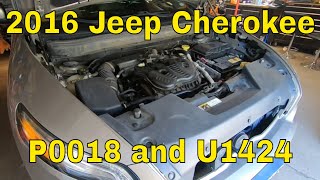
- Slipped Camshaft Tone Ring: → Shop Engine Camshaft On the 3.2L Pentastar engine, the tone ring on the exhaust camshaft can physically slip, causing incorrect readings. This is almost always accompanied by a timing correlation code like P0018. The U1424 code is a symptom of the implausible data from the cam sensor. A user on Reddit with a similar Chrysler 3.6L V6 confirmed this exact failure pattern, where replacing the camshaft resolved both a cam code and U1424. A YouTube video of a 2016 Cherokee with P0018 and U1424 confirmed the fix was replacing the camshaft due to a slipped tone ring.
- Failing Crankshaft Position Sensor: → Shop Engine Crankshaft Position Sensor While less common than the software issue, a failing crankshaft position sensor can send erratic data to the PCM. This can cause the PCM to broadcast an implausible torque signal to other modules. This cause is more likely if code P0335 is also present.
Diagnosis Steps
- Scan for all trouble codes from all modules. Pay close attention to any other codes that are present, especially from the TCM, ABS, and BCM.
- Check for applicable Technical Service Bulletins (TSBs). For this vehicle, TSBs #18-035-16 REV. A and #21-006-17 REV. B are highly relevant. Note any other codes listed in the TSBs that may be stored in your vehicle.
- Using a dealer-level scan tool (like wiTECH), verify if the PCM and TCM software is the latest version. This involves comparing the vehicle's current Calibration ID to the latest available on FCA's servers. If not, reprogram the module(s) as per the TSB instructions.
- While flashing, ensure a stable power supply is connected to the vehicle, maintaining 13.2V to 13.5V to prevent module failure.
- Test the battery and charging system. Ensure the battery passes a load test and that the alternator provides stable voltage. A weak battery is a known cause of spurious communication codes.
- If codes return after a software update, investigate any other stored codes first. For example, if P0018 or P034x codes are present, investigate the camshaft tone rings and sensors. If P0335 is present, investigate the crankshaft position sensor circuit.
- If U1424 is the only code and it persists after a software update on a vehicle with a healthy battery, a more in-depth diagnosis of the CAN bus wiring and module communication will be necessary, checking for corrosion on connectors or damaged wires between the PCM and TCM.
Parts You'll Likely Need
- PCM/TCM Software Update — This is not a physical part, but a service. It is the most common and direct fix for the U1424 code on this specific vehicle, as documented in multiple TSBs.
OEM price range: $150-$300 (Labor)
Aftermarket price range: $0
Related Codes That Often Appear With This One
- P0018 — This crankshaft/camshaft correlation code often appears with U1424 when the mechanical root cause is a slipped camshaft tone ring on the 3.2L engine.
- P0335 — A Crankshaft Position Sensor Circuit fault can provide incorrect data to the PCM, leading the PCM to broadcast an implausible torque signal. TSB #18-035-16 REV. A lists this code along with U1424 as being fixed by a software update.
- U0402 — Stands for 'Implausible Data Received From TCM'. This code indicates a direct communication conflict between the engine and transmission modules. Both U1424 and U0402 are frequently listed together in TSBs as being resolved by a PCM/TCM software update.
Technical Service Bulletins (TSBs) & Recalls
- 18-035-16 REV. A: Flash: Powertrain Diagnostic And System Improvements. This TSB explicitly lists U1424 as a code fixed by a PCM software update for the 2015 Jeep Cherokee 3.2L. It also notes the TCM must be updated after the PCM flash.
- 21-006-17 REV. B: Flash: Transmission Diagnostic and Shift Enhancements. This TSB for the 2017 Cherokee 3.2L lists U1424 as a code fixed by a TCM software update, and also addresses limp mode and shift quality complaints.
Platform-Specific Known Issues
- This code is the subject of Technical Service Bulletin (TSB) 18-035-16 REV. A, which instructs dealers to reprogram the PCM with updated software to correct the fault, along with several other potential codes like P0335 and U0402.
- TSB 21-006-17 REV. B also lists U1424 as a code resolved by a TCM software update and notes that the PCM must also be checked for the latest software version. This TSB also addresses symptoms like limp mode and shift hesitation.
- A post on DodgeForum.com regarding a Durango with a similar engine highlights that U1424 is often secondary to another fault, like a crankshaft sensor, and that a weak battery is a common underlying cause for such communication codes.
Mechanic-Grade Diagnostic Values
- CAN C Bus Network Resistance — expected: Approximately 60 Ohms. Failure: A reading of ~120 Ohms indicates a missing termination resistor in a module (like the PCM or ABS module) or a break in the circuit. A reading near 0 Ohms indicates a short between the CAN High and CAN Low wires.
- Module Flashing Battery Voltage — expected: 13.2V to 13.5V. Failure: Voltage dropping below 13.2V or climbing above 13.5V during a reflash procedure can cause the process to fail or corrupt the module.
Scan Tool Commands That Help
- wiTECH or advanced aftermarket (Appcar DiagFCA): PROXI Configuration Alignment — This procedure is required after replacing a major control module like the PCM, BCM, or ABS module to synchronize the vehicle's configuration across the network. A flashing odometer is a key indicator that a PROXI alignment is needed. Failure to perform this can result in various communication codes, including U-codes, and features not working correctly.
- wiTECH: TCM Quick Learn — This procedure should be performed after a TCM software flash or replacement to reset and learn the clutch adaptive values. It is also used to address customer complaints of poor or erratic shift quality. The procedure is found under the 'Misc Functions' tab for the TCM.
- wiTECH: VIN Verification — After reprogramming or replacing a TCM, this routine must be run to ensure the module has the correct Vehicle Identification Number stored.
Wiring & Ground Locations
- PCM (Powertrain Control Module) — Located in the engine bay, on the driver's side, near the firewall and strut tower.. The PCM is the source of the engine torque signal. All communication for this code originates from or is sent to this module. Its connectors (C1, C2, etc.) are key testing points for CAN bus signals.
- TCM (Transmission Control Module) — The TCM for the 9-speed transmission is integrated into the valve body, inside the transmission itself. It is not an externally accessible module.. The TCM is the primary recipient of the engine torque signal and uses it for shift calculations. A communication breakdown between the internal TCM and the external PCM is what sets code U1424.
- CAN C Bus Wires — These are a twisted pair of wires running between all major control modules, including the PCM, TCM, ABS, and the Star Connector/Gateway. On wiring diagrams, they are typically labeled CAN C (+) and CAN C (-).. This is the physical data network that carries the torque signal. A short or open in these wires will cause communication failures. Testing resistance between pins 6 (CAN High) and 14 (CAN Low) at the DLC is the primary network health check.
- G103 / G104 (Engine Block Grounds) — While specific KL Cherokee diagrams are scarce, on similar Jeep platforms (like the WJ), critical engine grounds are located on the engine block, often near the A/C compressor or dipstick tube mount. One key ground is typically on the passenger side of the engine block.. The PCM relies on a clean ground connection to the engine block. A poor ground at G103 (which grounds the PCM on other Jeeps) can cause erratic module behavior and corrupt data signals, leading to communication codes like U1424.
Real Owner Repair Stories
- YouTube - Pine Hollow Auto Diagnostics (2016 Jeep Cherokee 3.2L) — Vehicle would go into limp mode, sometimes reverse would not work. Codes P0018 and U1424 were present.
❌ Tried (didn't work) Clearing codes would temporarily fix the issue, but it would always return.
✅ What actually fixed it The tone ring on the Bank 2 exhaust camshaft had slipped slightly. Using a special tool to check the camshaft's orientation with the engine at TDC revealed the misalignment. Replacing the affected camshaft resolved both the P0018 and the U1424 codes.
Model Year Variations Within This Range
- 2014-2015: Early model year vehicles were most susceptible to the software issues causing U1424 and poor shifting. TSB 21-035-14 REV. A specifically addresses the 2015 model year to enable the 'Quick Learn' procedure and improve shift quality, indicating earlier software was less robust.
Diagnostic Flowchart
Other Known Issues on This Vehicle
Issues unrelated to this code that are worth knowing about as an owner of this generation:
- Power Transfer Unit (PTU) Failure 🔴 High — Common enough to trigger multiple recalls (e.g., NHTSA #20V343). Can occur at various mileages. Symptoms include grinding/whining noises, 'Service 4WD' light, and binding on turns. (Ref: Multiple recalls issued, including for 2014-2017 models. Failure can cause loss of power or rollaway in Park.)
- Cracked Oil Filter Housing / Cooler Assembly 🟠 Medium — A very common source of significant oil leaks on the 3.2L/3.6L Pentastar. Often misdiagnosed as an oil pan or rear main seal leak. (Ref: TSB #9003357 addresses correct o-ring installation to prevent leaks.)
- Harsh/Erratic Shifting (ZF 9-Speed) 🟠 Medium — Very common on early models (2014-2016). Many owners report rough shifts, delays, and lunging. Often improved but not always eliminated by software updates. (Ref: Numerous TCM software updates were released to improve shift quality, such as TSB 21-006-17 Rev. B.)
- Excessive Oil Consumption 🟠 Medium — Reported by some owners of the 3.2L V6, though more notoriously documented on the 2.4L I4 engine. Owners report needing to add oil between changes. (Ref: TSBs exist for the 2.4L engine (e.g., 09-006-20 REV. B), and TSB S1809000007 Rev mentions oil consumption for the platform.)
- Driveshaft and Rear Differential Issues 🟡 Low — Less common, but can be very expensive. Reports of driveshaft hanger bearing failure (requiring full shaft replacement) and rear differential gear/bearing problems have been noted by owners.
Used vs. New Parts: Buying Guide for This Vehicle
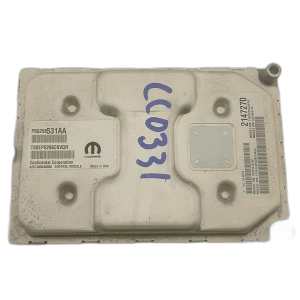
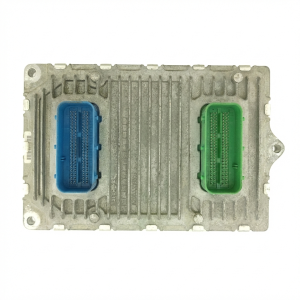
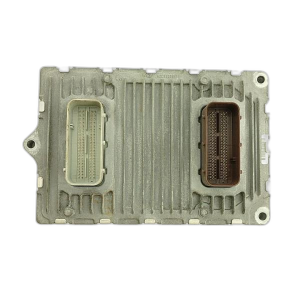
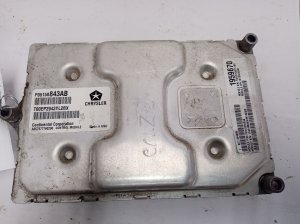
When a used part is the smart pick: A used Powertrain Control Module (PCM) can be a cost-effective alternative to a new one if the original is physically damaged (e.g., water intrusion, connector damage). However, it is not a simple plug-and-play repair.
Donor-vehicle mileage cap: roughly under 80000 miles for the part to have meaningful remaining life.
What to inspect on the donor part:
- Ensure the part number on the used PCM matches the original exactly.
- Source the PCM from a donor vehicle with the identical engine (3.2L V6), transmission, and drivetrain (FWD/AWD).
- Inspect the connectors for any signs of corrosion, bent pins, or physical damage.
- Obtain the VIN of the donor vehicle if possible, as it may be needed during programming.
OEM-only on this vehicle (don't cheap out):
- PCM/TCM Software Flashing: This is a service, not a part, and can only be performed by a dealer or a shop with an active wiTECH subscription.
- Powertrain Control Module (PCM): While a used module can be installed, it MUST be reprogrammed to the vehicle. This involves writing the correct VIN and performing a PROXI alignment, which requires dealer-level tools. Some advanced aftermarket tools may offer this capability, but it is complex.
Aftermarket brands forum-validated for this vehicle:
- Crankshaft/Camshaft Sensors: NTK, Delphi, and Bosch are generally considered reliable OE-quality alternatives to Mopar.
Brands owners have reported issues with on this vehicle:
- No-name/unbranded electronic sensors: Forum discussions and mechanic experience frequently warn against using cheap, unbranded sensors for critical inputs like the crank and cam sensors, as they have a high failure rate and can cause persistent, hard-to-diagnose issues.
Real Owner Stories
Aggregated from forums and TSBs cited above. Mileages and costs reflect what owners reported in those sources.
2015 Chrysler 200 3.6L V6
Symptoms: The vehicle was throwing codes U1424, P0344, and P0340.
What fixed it: Replacing the bank 1 exhaust camshaft due to a slipped tone ring.
Source hint: Reddit r/MechanicAdvice
2015 Chrysler 200C 3.6L V6
Symptoms: Recurring U1424 code that caused the vehicle to enter limp mode.
What fixed it: The owner noted it is a common Chrysler issue often requiring a software fix if not a mechanical fault.
Source hint: CarKiller.com
2016-2017 Dodge Durango 3.6L V6
Symptoms: CEL codes P0335, U1424, P1DD2, and U0140.
What fixed it: The U1424 was determined to be a secondary symptom of a P0335 crankshaft sensor code or a weak battery.
Source hint: DodgeForum.com
Related OBD-II Codes
Frequently Asked Questions
My 2015 Jeep Cherokee 3.2L is throwing code U1424; is there a specific software update for this?
Can a bad battery cause the U1424 code on my Cherokee KL?
I have a 2017 Cherokee 3.2L with shift hesitation and U1424. Is this covered by a TSB?
Does the TCM update for U1424 require any other modules to be updated?
What should I check if U1424 appears alongside crankshaft or camshaft codes?
Is the U1424 code related to the 9-speed transmission issues common in 2014-2016 models?
Helpful Videos
We Have This Part in Stock

The information in this article is provided for general reference and educational purposes only. Vehicle specifications, procedures, and part compatibility can vary by production date, trim level, and region. Always consult your vehicle's factory service manual and verify part numbers before purchasing or performing repairs. Safety-critical components such as airbags, seat belts, and braking systems should be installed by a qualified professional.
- Jeep Cherokee:
- 🧭 Diagnostic Flowchart
- 🎬 Helpful Videos
- 🛍️ Shop This Part
- What's Unique About the 2014-2017 Jeep Cherokee
- Symptoms You May Notice
- Most Likely Causes
- Rare But Worth Checking
- Diagnosis Steps
- Parts You'll Likely Need
- Related Codes That Often Appear With This One
- Technical Service Bulletins (TSBs) & Recalls
- Platform-Specific Known Issues
- Mechanic-Grade Diagnostic Values
- Scan Tool Commands That Help
- Wiring & Ground Locations
- Real Owner Repair Stories
- Model Year Variations Within This Range
- Other Known Issues on This Vehicle
- Used vs. New Parts: Buying Guide for This Vehicle
- Real Owner Stories
- 2015 Chrysler 200 3.6L V6
- 2015 Chrysler 200C 3.6L V6
- 2016-2017 Dodge Durango 3.6L V6
- Related OBD-II Codes
- Frequently Asked Questions
- 🎟️ Get 5% Off