

U3000 on 2002-2010 Porsche Cayenne: Control Module Fault Causes and Fixes
On a 2002-2010 Porsche Cayenne, code U3000 almost always points to either a weak battery or, more seriously, water damage to a control module. Before any expensive repairs, fully charge and test the battery. If the problem persists, check for damp carpets under the front seats, which indicates clogged drains have allowed water to damage the KESSY (keyless entry) or Body Control Module (BCM).
- U3000 is a generic code; you MUST use a Porsche-specific scanner to find out which module is at fault.
- Before any complex diagnostics, fully charge and load test the battery. A weak battery is a very common culprit for this code.
- The most likely serious cause on a 2002-2010 Cayenne is water damage. Immediately check for dampness under the front carpets and in the spare tire well.
- Proactively cleaning all sunroof and body drains twice a year is the single most important preventative maintenance to avoid this expensive problem.
- Do not replace any control module without professional diagnosis and fixing the root cause (water leak or bad battery), as the new module will also fail. All modules require programming to the vehicle.
What's Unique About the 2002-2010 Porsche Cayenne
The first-generation Cayenne (955/957) is notoriously prone to water ingress from clogged body and sunroof drains. Unlike many other vehicles, this isn't an occasional issue; it's a well-documented design vulnerability shared with its platform mates, the VW Touareg and Audi Q7. Water often pools in the cabin floor, directly where critical and expensive electronics like the KESSY (Keyless Entry & Start) module and Body Control Module (BCM) are located. Therefore, a U3000 code on this platform immediately elevates suspicion of water damage, making a visual inspection for moisture as important as the electronic diagnosis itself.
Generation note: This guide covers the entire first generation of the Porsche Cayenne, which includes the 955 (2002-2006) and the facelifted 957 (2007-2010). The core architecture and, most importantly, the vulnerability to water leaks from clogged drains are common to both sub-generations.
Symptoms You May Notice
- Multiple warning lights on the dashboard (e.g., ABS, PSM, Airbag).
- Vehicle will not start or crank, sometimes accompanied by an 'Immobiliser Activated' message.
- Central locking, power windows, or interior lights not working.
- Keyless entry and start functions are inoperative.
- Transmission may be stuck in a single gear (limp mode).
- Parasitic battery drain, leading to a dead battery after sitting.
- Hazard lights flashing uncontrollably.
- Sloshing sound of water from behind the dashboard or in the rocker panels when turning.
- Immediately replacing a control module without checking for water damage or testing the battery. The new module will quickly be destroyed if the root cause (the water leak) is not fixed first.
- Replacing the battery but failing to register it with the vehicle's computer, leading to improper charging and continued electrical faults.
Most Likely Causes
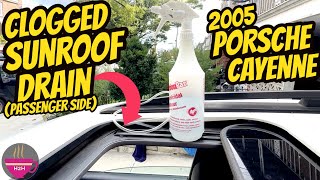
- Water Damage to Control Modules from Clogged Drains 🔴 High Probability The Cayenne has multiple drains (sunroof, cowl/bulkhead, A/C) that are prone to clogging 🎬 Watch: How to unclog a passenger sunroof drain with leaves and debris. When they clog, water overflows into the cabin, pooling in the footwells where control modules are located.
How to confirm: Peel back the carpets in the front footwells, especially under the driver's seat. 🎬 See how to fix wet footwell carpet leaks Any sign of moisture, corrosion on wiring, or a damp smell is a strong indicator. The KESSY module is under the driver's seat; the Body Control Module (BCM) is in the driver's side dashboard/footwell area. A sloshing sound when cornering is a dead giveaway that the cowl plenums are full of water.
Typical fix: First, find and clear all clogged drains to prevent recurrence. Many owners recommend removing the rubber drain grommets entirely or trimming their tips to prevent future clogs. The damaged module and any corroded connectors/wiring must be replaced. The new module will require programming by a dealer or specialist with a PIWIS tool. In some cases of minor corrosion, the module's circuit board can be professionally cleaned and repaired.
Est. part cost: $400-$1200 - Weak or Failing Battery 🔴 High Probability → Shop Vehicle Battery Complex vehicle electronics are highly sensitive to voltage. During engine cranking, a weak battery's voltage can drop significantly, causing modules to fail their startup self-checks and post communication error codes. This is a common trigger for a U3000 code across many modern Porsche models.
How to confirm: Test the battery with a digital multimeter and, more importantly, a load tester. A healthy battery should show ~12.6V at rest and not drop below 10V during cranking. Many auto parts stores will test batteries for free. Be aware that a battery can show good voltage but still fail under load.
Typical fix: Replace the vehicle's main battery. Ensure the new battery is properly registered to the vehicle's electrical system using a capable scan tool to inform the BCM of the new battery's capacity and age.
Est. part cost: $200-$450 - Leaking Rear Washer Fluid Line 🟡 Medium Probability A known failure point is a washer fluid line connector located at the base of the passenger's side A-pillar (on LHD vehicles). When it separates, often due to pressure from a clogged rear nozzle or from age, it leaks washer fluid directly onto wiring harnesses and can drip down towards the Body Control Module (BCM), causing corrosion and failure.
How to confirm: If you activate the rear washer and notice fluid is not spraying, or if you find unexplained blue-tinted moisture in the passenger's footwell, inspect the A-pillar base and BCM connectors for blue/green corrosion or wetness.
Typical fix: Repair the leaking washer fluid line by re-seating the connector and securing it with tape or a small zip-tie. The BCM will likely need to be replaced and programmed if it has been damaged by the fluid.
Est. part cost: $5-$20 for the line, $500+ for a BCM if damaged.
Rare But Worth Checking
- Corroded Ground Wires: Water ingress in the footwells can also corrode the main ground wire connection points located on the floor pan, leading to a host of difficult-to-diagnose electrical issues that can trigger a U3000 code.
- Failing Steering Column Control Module: → Shop Steering Column The steering column module, which handles signals from the ignition switch and steering angle sensor, can fail and cause a U3000 code along with starting issues or PSM/ABS warnings. Diagnosis requires a Porsche-specific scanner to isolate the fault to this module.
Diagnosis Steps
- Scan the vehicle with a Porsche-specific diagnostic tool (e.g., PIWIS) to determine which specific module is logging the U3000 fault. This is the most critical step.
- Fully charge and load-test the vehicle's battery. Replace it if it fails the load test, clear codes, and re-test. Ensure the new battery is registered.
- Thoroughly inspect the driver and passenger footwells for any signs of moisture. Pull back the carpet, especially under the driver's seat, to check the KESSY module and surrounding wiring.
- Listen for a water 'sloshing' sound from the dashboard area during turns. This indicates the cowl drain plenums are full and need immediate clearing.
- Check for moisture in the rear cargo area, specifically in the spare tire well and around the amplifier, which can indicate clogged rear sunroof drains.
- Systematically test and clean all body drains. This includes the four sunroof drains, the two cowl (bulkhead) drains behind the front wheel liners, and the A/C evaporator drain. Many owners use trimmer line or compressed air to clear sunroof drains and remove the cowl drain grommets completely. 🎬 Watch: How to clear every water drain port
- If a specific module was identified in step 1, visually inspect it and its electrical connectors for green or white corrosion. Clean any corroded terminals and re-test. If the board is damaged, replacement is necessary.
- If a module is confirmed to be faulty and there are no signs of water damage, check its dedicated fuses and power/ground supplies before ordering a replacement.
- If a module requires replacement, it must be programmed to the vehicle by a qualified technician.
Parts You'll Likely Need
- KESSY Control Module (Keyless Entry)
(OEM #3D0909135T (955), 3D0909139 (955))— This module is located directly on the floor under the driver's seat, making it the first victim of water ingress from clogged drains.
Trusted brands: Porsche (OEM)
OEM price range: $500-$700
Aftermarket price range: $300-$500 (used/rebuilt) - Body Control Module (BCM)
(OEM #7L5937049AA, 95561812700 (957))— Located in the driver's side footwell/dashboard area, it is highly susceptible to damage from a leaking rear washer fluid line in the A-pillar or from severe water intrusion.
Trusted brands: Porsche (OEM)
OEM price range: $450-$650
Aftermarket price range: $250-$400 (used/rebuilt) - Vehicle Battery — Low voltage is a primary cause of communication faults. It's the first and cheapest thing to rule out.
Related Codes That Often Appear With This One
- Multiple other U-codes (e.g., U0140, U0155) — If a primary gateway or body module is failing, it can cause a cascade of communication errors with other modules on the network. U0140 (Lost Communication with Body Control Module) is particularly common.
- Various B-codes and C-codes — Faults in body (B-codes) or chassis (C-codes) modules are often the root cause that leads to the generic U3000 code being set by the main gateway module.
- 00003 — This is another Porsche-specific code for 'Control Module Internal Failure' that often appears alongside U3000, especially when the KESSY module is the culprit.
- 01176 — This VAG-style fault code means 'Key - Implausible Signal' and often points to a problem with the communication between the key, the ignition's reader coil, and the KESSY module.
Platform-Specific Known Issues
- Clogged Sunroof Drains: The four drain tubes, one at each corner of the sunroof cassette, become clogged with debris, causing water to overflow the drain channel and leak into the headliner and down the pillars.
- Clogged Cowl (Bulkhead) Drains: Drains located in the plenum chamber behind the front wheel wells get blocked by leaves and road debris. This causes the plenum to fill with water, which then spills into the cabin footwells. Owners often remove the restrictive rubber grommets to prevent recurrence.
- Clogged A/C Evaporator Drain: The evaporator drain can clog, causing condensation to back up and leak into the passenger footwell.
Mechanic-Grade Diagnostic Values
- CAN Bus Voltage (High and Low lines) — expected: In a recessive (idle) state, both CAN High and CAN Low lines should be at approximately 2.5V. In a dominant (active data) state, CAN High should rise to ~3.5V and CAN Low should drop to ~1.5V.. Failure: If both lines are stuck at 2.5V, it may indicate they are shorted together. Voltages outside the expected ranges or a lack of switching between states indicates a bus fault, short to power, or short to ground.
- Main Engine-to-Chassis Ground Resistance — expected: 0.0 to 0.2 Ohms.. Failure: A reading higher than 0.2 Ohms indicates excessive resistance from corrosion or a loose connection, which can cause widespread, intermittent electrical faults.
Hidden / Shadow Codes Worth Checking
- 01176: Key: Implausible Signal. This VAG-specific fault often accompanies an 'Immobiliser Active' message and points to a failure in the communication loop between the key transponder, the reader coil at the ignition switch, and the KESSY module. (see via VCDS (VAG-COM), PIWIS, or other advanced European vehicle scanners.)
- 0576: Terminal 15 (diagnosis of feedback signal lead). This KESSY-specific fault indicates a short or open circuit on the wire that confirms the ignition-on status. A short to power on this line can prevent the vehicle from recognizing the 'ignition off' state, which can then prevent it from being started again. (see via PIWIS or other Porsche-specific diagnostic tools.)
Scan Tool Commands That Help
- PIWIS (Porsche): Control Unit Programming & Teaching — This is mandatory after replacing the KESSY, BCM, or ELV (Steering Lock) modules. The function guides the technician through a specific sequence to securely pair the new module to the vehicle's immobilizer system.
- PIWIS (Porsche): Integration Test — After performing a software update or module programming, the integration test is run to confirm that all control units have been updated successfully and are communicating correctly on the network.
- VCDS (VAG-COM): Immobilizer Adaptation (Channel 01) — For advanced users who have extracted the vehicle's security PIN, this function allows for the matching of new or existing keys to the KESSY module without dealer intervention.
Wiring & Ground Locations
- KESSY Module Connector A — The KESSY module is located under the driver's side dashboard, above the accelerator pedal.. For no-communication faults, testing CAN bus signals directly at the module is crucial. Check Pin 21 for CAN Drive Low and Pin 22 for CAN Drive High. For ignition-related issues, check Pin 14 for the Terminal 15 feedback signal.
- Main Ground Points — Key grounds susceptible to issues include a strap from the engine to the passenger side strut tower, another from the engine block to the chassis frame underneath the vehicle, and a critical ground bundle under the carpet on the passenger side floor pan.. Water ingress in the cabin (passenger side) can corrode the floor pan ground bundle, causing erratic behavior of multiple modules. Poor engine grounds can cause starting and charging issues that trigger low-voltage communication faults.
- BCM (Onboard Supply Control Unit) — Located in the driver's side dashboard area, to the left of the steering column.. This module controls numerous body functions and is a primary suspect, especially if the rear washer fluid line has leaked inside the A-pillar. A shorted output wire from this module can cause a U3000 code.
Documented NHTSA Reports
While U3000 is often related to water ingress on the Cayenne platform, it is important to note that this code is used across various manufacturers to indicate internal control module failures. For example, NHTSA ODI Investigation #PE14030 regarding electric power steering failures in other makes notes that U3000 sub-codes (such as U3000-46 or U3000-49) can be stored alongside other chassis faults, sometimes requiring the replacement of the entire electronic steering system.
Real Owner Repair Stories
- Rennlist Forum User (2004 Porsche Cayenne S (955)) — Needed to program new key fobs without going to the dealer.
❌ Tried (didn't work) Attempting to program keys with VAG-COM without the secret security PIN.
✅ What actually fixed it The owner physically removed the KESSY module, connected an EEPROM reader to the 93C86 chip on the circuit board, and downloaded the module's data (dump file). Using a separate software tool, he extracted the 4-digit security PIN from this file. With the PIN, he was able to use VAG-COM's 'Security Access' function and successfully adapt new keys to the car himself. - RennTech.org Forum User (2006 Porsche Cayenne S (955)) — Interior overhead lights not working, blowing fuse #12 which powered the 'Network control module' (BCM).
❌ Tried (didn't work) Replacing the fuse, which would blow again immediately.
✅ What actually fixed it The user identified the specific output wire from the BCM that was shorted to ground (a red wire for 'Term 30G' on connector K2). By isolating this wire, other BCM functions were restored. The ultimate fix required tracing this wire through the main harness to find the location of the short circuit. The user was seeking diagrams for a distribution point labeled 'SP_S386' to complete the repair.
OEM Part Supersession History
7L5937049AA→95561812700— Part update for the Body Control Module (BCM) for the 957 generation.
Heads up: These parts are specific to the 957 (2008-2010) Cayenne.Multiple KESSY PNs→N/A - Must Match— KESSY modules are specific to vehicle options and year ranges. There is no single supersession chain. Compatible part numbers for the 955/957 generation include 3D0909135M, 3D0909135P, 3D0909139, 3D0909139E, 7L0909137, among others.
Heads up: When sourcing a used KESSY module for cloning, the part number MUST be identical to the original, faulty unit. Even a single letter difference can indicate an incompatible hardware or software version.
Model Year Variations Within This Range
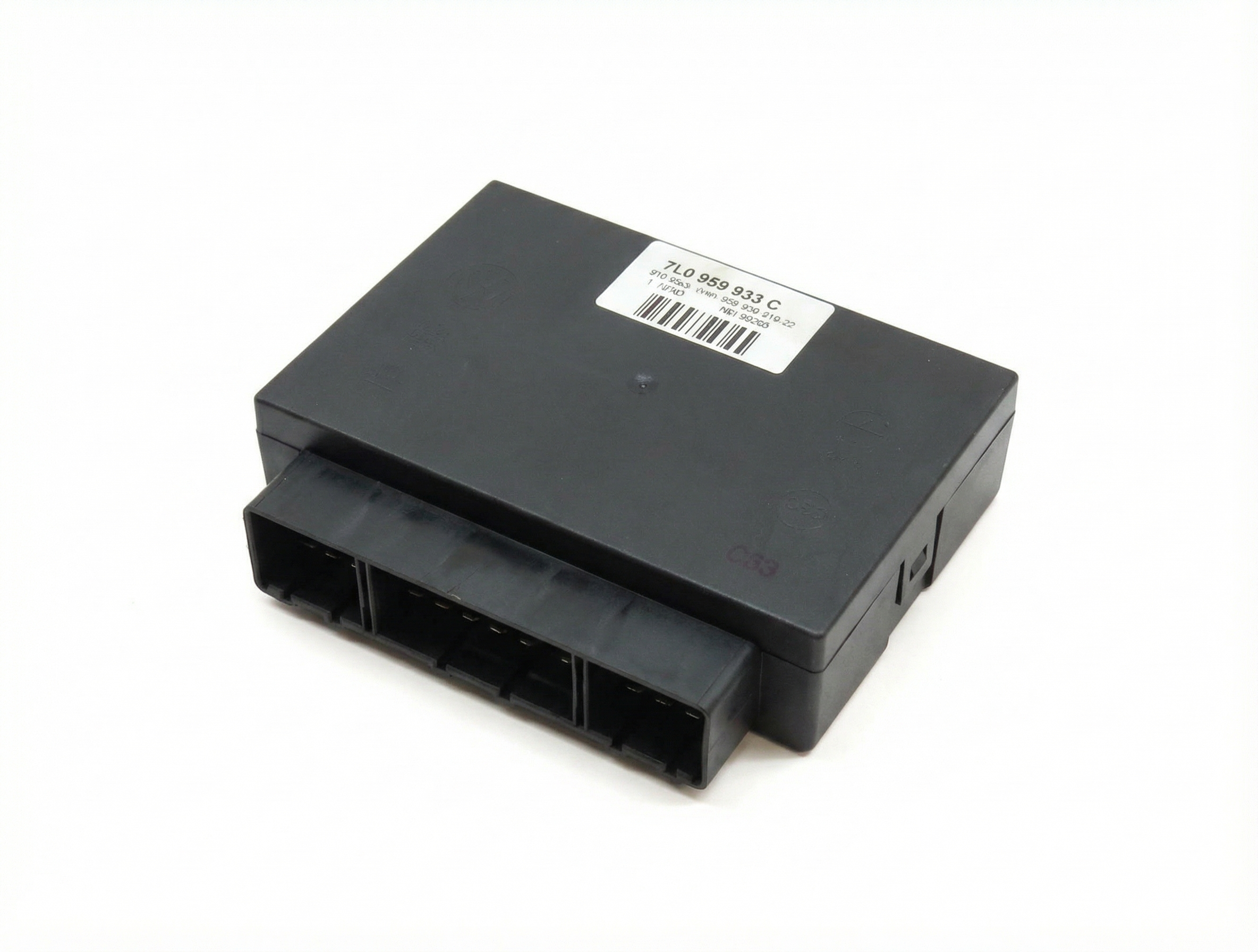
- 2002-2006 (955): The KESSY and Comfort modules often have different part numbers than the later 957 models (e.g., 7L0959933C, 3D0909135M). While the failure mode (water damage) is the same, the specific replacement part must be sourced for the correct generation.
- 2007-2010 (957): The Body Control Module (BCM) part number was updated for the facelift (e.g., 95561812700). The core electrical architecture and vulnerabilities remain largely the same as the 955.
Diagnostic Flowchart
Other Known Issues on This Vehicle
Issues unrelated to this code that are worth knowing about as an owner of this generation:
- V8 Plastic Coolant Pipe Failure 🔴 High — Extremely common on 2003-2006 V8 models (955). It is a matter of 'when,' not 'if,' they will fail, typically between 60k-100k miles. (Ref: Porsche released an updated aluminum pipe kit to permanently fix the issue.)
- Cardan Shaft Center Support Bearing Failure 🔴 High — A near-100% failure item on all 955/957 models. The rubber support deteriorates, causing a loud thumping/banging noise under acceleration. Failure can occur anywhere from 60k miles onward.
- V8 Engine Bore Scoring 🔴 High — A serious and engine-destroying issue, most prevalent in 4.5L V8s (955) and 2008 4.8L V8s (957). It is more common in cars from colder climates. Symptoms include a rhythmic ticking noise when warm and high oil consumption.
Used vs. New Parts: Buying Guide for This Vehicle
When a used part is the smart pick: A used KESSY or BCM is a very smart choice, but ONLY if you send both your original (faulty) module and the used donor module to a specialist for a 'cloning' service. This service transfers the VIN and immobilizer data from your old module to the used one, making it plug-and-play. This avoids expensive dealer programming of a new module.
Donor-vehicle mileage cap: roughly under 150000 miles for the part to have meaningful remaining life.
What to inspect on the donor part:
- Part number must be an EXACT match to your original module.
- Inspect the casing for any signs of water stains, oxidation, or pry marks.
- Check all connector pins to ensure they are straight, clean, and free of any green or white corrosion.
- Ask the seller if the donor vehicle had any electrical issues or was involved in a flood.
OEM-only on this vehicle (don't cheap out):
- KESSY Control Module
- Body Control Module (BCM)
Brands owners have reported issues with on this vehicle:
- There are no direct aftermarket replacements for these specific, programmed control modules. Avoid any listing that claims to be a 'universal' or 'new non-OEM' module.
Real Owner Stories
Aggregated from forums and TSBs cited above. Mileages and costs reflect what owners reported in those sources.
2003-2010 Porsche Cayenne (955/957)
Symptoms: Massive electrical failure caused by a leaking rear washer line that corroded the wiring loom and control units behind the dashboard.
What fixed it: Repairing the leaking washer fluid line and replacing the damaged wiring loom and control units.
Cost: $12,000-$13,000
Source hint: RennTech.org: rear washer leak
2004 Porsche Cayenne (955)
Symptoms: Rear washer not spraying; blue-tinted moisture found in the passenger footwell near the A-pillar; multiple electrical faults.
What fixed it: Re-seating the washer fluid line connector at the base of the A-pillar and securing it with tape or a zip-tie; replacing the BCM.
Source hint: Rennlist: 955 Cayenne DIY: "A" pillar leak - when rear washer is used
2006 Porsche Cayenne V8 (955) — ~80000 miles
Symptoms: Water entering the cabin footwells after heavy rain; sloshing sounds from the front of the vehicle.
What fixed it: Cleaning out the cowl drains located behind the front wheel well liners and removing the restrictive rubber grommets.
Source hint: Rennlist: DIY - Cayenne - Cowl Drain Clean Out
Related OBD-II Codes
Frequently Asked Questions
I hear a sloshing sound behind my dashboard when I turn corners in my Cayenne. Is this related to the U3000 code?
My rear window washer isn't spraying, and now I have multiple dashboard warning lights. What happened?
Where is the KESSY module located in the 2002-2010 Cayenne?
Can a weak battery really cause a U3000 'Control Module' fault?
How can I prevent water from damaging my control modules in the future?
Do I need special tools to replace a damaged Body Control Module (BCM)?
Helpful Videos



We Have This Part in Stock

The information in this article is provided for general reference and educational purposes only. Vehicle specifications, procedures, and part compatibility can vary by production date, trim level, and region. Always consult your vehicle's factory service manual and verify part numbers before purchasing or performing repairs. Safety-critical components such as airbags, seat belts, and braking systems should be installed by a qualified professional.
- Porsche Cayenne:
- 🧭 Diagnostic Flowchart
- 🎬 Helpful Videos
- 🛍️ Shop This Part
- What's Unique About the 2002-2010 Porsche Cayenne
- Symptoms You May Notice
- Most Likely Causes
- Rare But Worth Checking
- Diagnosis Steps
- Parts You'll Likely Need
- Related Codes That Often Appear With This One
- Platform-Specific Known Issues
- Mechanic-Grade Diagnostic Values
- Hidden / Shadow Codes Worth Checking
- Scan Tool Commands That Help
- Wiring & Ground Locations
- Documented NHTSA Reports
- Real Owner Repair Stories
- OEM Part Supersession History
- Model Year Variations Within This Range
- Other Known Issues on This Vehicle
- Used vs. New Parts: Buying Guide for This Vehicle
- Real Owner Stories
- 2003-2010 Porsche Cayenne (955/957)
- 2004 Porsche Cayenne (955)
- 2006 Porsche Cayenne V8 (955) — ~80000 miles
- Related OBD-II Codes
- Frequently Asked Questions
- 🎟️ Get 5% Off