

U3003 on 2017-2022 Honda CR-V: Battery Voltage and Electrical Fixes
On a 2017-2022 Honda CR-V, code U3003 almost always means the 12V battery is weak or failing. This can cause a cascade of warning lights and a distinct brake pedal kickback on startup. Replacing the battery is the most common fix, costing around $150-$350.
- U3003 on a 2017-2022 CR-V is overwhelmingly likely to be caused by a weak 12V battery.
- A unique and key symptom is a kick or pulse in the brake pedal right after starting the engine.
- Before replacing any expensive electronic modules, always have the battery professionally load-tested.
- Replacing the battery is a simple, DIY-friendly job that resolves the issue in most cases.
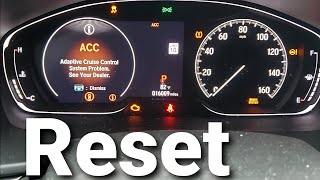
- After replacing the battery, a short drive is usually required for all the dashboard warning lights to turn off as systems re-initialize.
What's Unique About the 2017-2022 Honda CR-V
The 2017-2022 CR-V is known for having a sensitive electrical system and a battery that some owners feel is undersized. This generation uses an electronic brake booster (EBB), which is highly sensitive to voltage. A very common and specific symptom tied to U3003 is a noticeable kickback or pulsation from the brake pedal immediately after starting the engine. This happens because the low voltage during cranking causes the brake booster module to momentarily shut down and reset, a tell-tale sign that the battery is the root cause. Honda has acknowledged this symptom in service literature, directly linking it to a low state of charge in the battery.
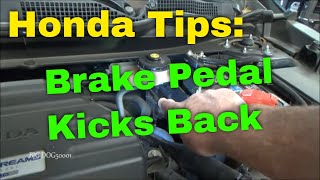
🎬 Watch: Honda service tip for brake pedal kickbackSymptoms You May Notice
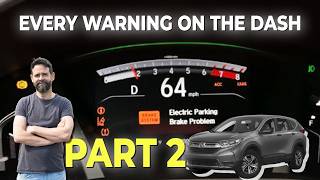
- A 'Christmas tree' effect of multiple, seemingly unrelated warning lights on the dashboard (e.g., Brake System, Power Steering, Emissions).
- Brake pedal kicks back or pulsates immediately upon engine start.
- Slow or hesitant engine cranking, especially in colder weather.
- Headlights and interior lights that are dim or flicker during startup.
- Problems with the electric parking brake system, such as a flashing 'BRAKE' light.
- Multiple 'Lost Communication' codes stored along with U3003.
- Complete no-start condition where the battery is dead.
- Gearshift slipping between neutral and drive, or the drive indicator failing to illuminate on the dashboard (as reported in NHTSA ODI #11656540).
- Unintended activation of the emergency brake system when no obstacles are present (reported in NHTSA ODI #11656540).
- Replacing the brake booster or other modules. The U3003 code is almost always a symptom of a power supply issue, not a failure of the module that stores the code. The brake pedal kickback, for example, is a direct result of low voltage causing the Electronic Brake Booster to reset, not a faulty booster itself.
Most Likely Causes
- Weak or Failing 12V Battery 🔴 High Probability → Shop Vehicle Battery The original equipment batteries in these CR-V models are often cited by owners as having a relatively short lifespan, sometimes failing in as little as 2-3 years. The vehicle's complex electronics, particularly the Electronic Brake Booster, are sensitive to even slight drops in voltage that a weakening battery can cause during startup.
How to confirm: Perform a professional load test on the battery using a device like a GR8 Diagnostic Station. A simple voltage check with a multimeter is not sufficient. Most auto parts stores can perform a proper load test for free. The voltage should not drop below 9.6V during cranking.
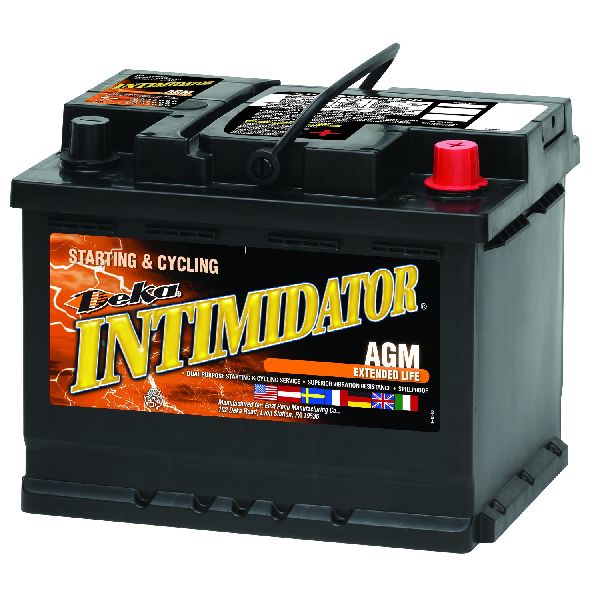
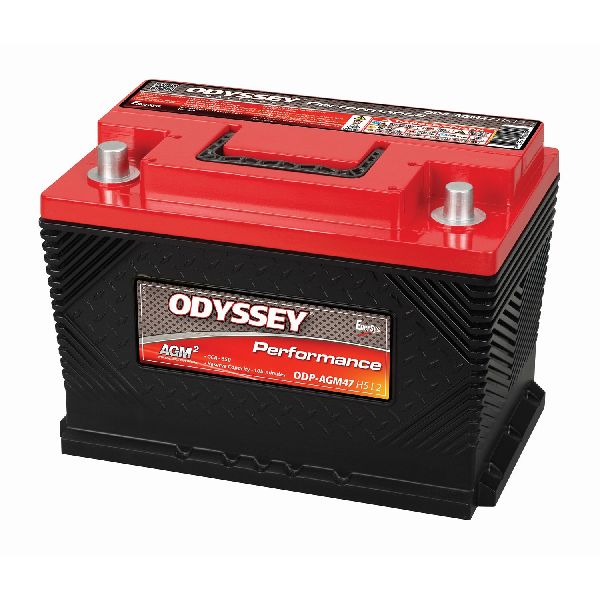
Typical fix: Replace the 12V battery. Many owners opt for a higher-quality Absorbent Glass Mat (AGM) battery in the correct group size (H5/47) for better longevity and performance, especially if the vehicle has an auto start-stop feature.
Est. part cost: $150-$350 - Loose or Corroded Battery Terminals 🟡 Medium Probability → Shop Vehicle Battery
How to confirm: Visually inspect the battery terminals for white or blue-green corrosion. Attempt to twist the terminals by hand; they should not move at all. Ensure the ground cable connection to the chassis is also clean and tight.
Typical fix: Disconnect the battery (negative terminal first) and clean the terminals and cable clamps with a wire brush and a baking soda/water solution. Reconnect securely (positive terminal first). Applying dielectric grease can help prevent future corrosion.
Est. part cost: $0-$10 - Failing Alternator ⚪ Low Probability → Shop Alternator
How to confirm: With the engine running, use a multimeter to measure the voltage across the battery terminals. A healthy alternator should produce a reading between approximately 13.5 and 14.8 volts. If the voltage is below this range or fluctuates wildly, the alternator may be failing.
Typical fix: Replace the alternator if it is not charging the battery correctly.
Est. part cost: $300-$600
Rare But Worth Checking
- Parasitic Drain: While less common than a simple bad battery, some 2017-2019 CR-V models were subject to a class-action lawsuit regarding parasitic battery drain. Honda issued TSB 19-039 for 2019 models, which addresses a software bug in the FI-ECU that could prevent the EVAP system from entering sleep mode, draining the battery. If new batteries repeatedly die, a parasitic draw test is necessary.
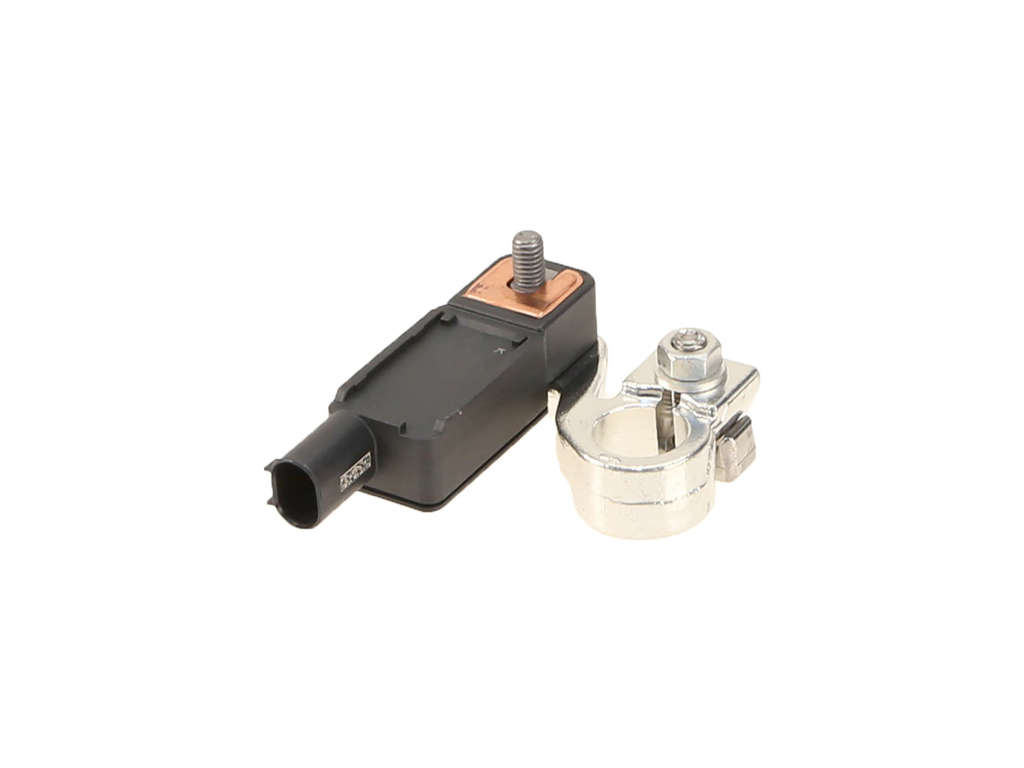
- Faulty Battery Management System (BMS) Sensor: → Shop Vehicle Battery The BMS sensor, located on the negative battery terminal, monitors the battery's state of charge, health, and current flow. A faulty sensor can misinterpret the battery's condition, leading to improper charging or erroneous low voltage warnings. If a new battery and a healthy alternator don't resolve the U3003 code, the BMS sensor itself may be the culprit.
Diagnosis Steps
- Scan the vehicle for all Diagnostic Trouble Codes (DTCs) and note which module(s) have stored the U3003 code, paying close attention to the Electric Brake Booster and EPS modules. NHTSA ODI #11348697 notes that U3003 may appear alongside P061B (ECM/PCM Internal Malfunction) and U0401-68.
- Thoroughly test the 12V battery using a professional-grade electronic load tester (e.g., Honda GR8). Check its state of health and cold cranking amps (CCA) rating against its specifications.
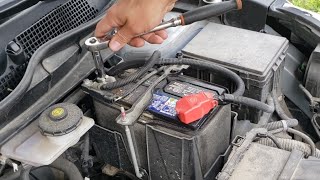
- If the battery tests weak or fails, replace it. Many owners upgrade to an AGM Group Size H5 (47) battery. After replacement, clear all codes. Note that many warning lights may illuminate after a battery change and will clear after a short drive as the systems re-initialize.
- If the battery tests good, inspect the battery terminals and main ground connections for tightness and corrosion. Clean and tighten as necessary.
- With the engine running, measure the alternator's output voltage at the battery terminals. It should be between 13.5V and 14.8V.
- If the battery and charging system are confirmed to be in good working order, a more advanced diagnosis for a parasitic draw may be needed. This involves using a multimeter in ammeter mode to check for current draw from the battery when the vehicle is off. For 2019 models, check if TSB 19-039 has been performed.
- If all else checks out, inspect the Battery Management System (BMS) sensor and its connector on the negative battery terminal for damage or corrosion.
Parts You'll Likely Need
- 12V Battery
(OEM #31500-TLA-A11 (Original EFB), 31500-TLA-EFB100M (Replacement EFB))— This is the most frequent cause of code U3003 on this vehicle, as the original batteries are known to weaken and cause voltage-related issues.
Trusted brands: Interstate (AGM H5/47), DieHard (AGM H5/47), Duralast (AGM H5/47), Bosch (AGM H5/47)
OEM price range: $200-$300
Aftermarket price range: $180-$280
Related Codes That Often Appear With This One
- U3003-16 — This is a common variant of the code, specifically pointing to low voltage detected by a module, often the Electric Servo Brake Control Unit or EPS control unit.
- U3003-S6 — Another variation of the voltage supply code seen in manufacturer diagnostics (NHTSA ODI #11348697).
- Multiple 'U' codes (e.g., U0100, U0122) — When system voltage is low, communication between various control modules can be lost, triggering a variety of 'Lost Communication' codes alongside the U3003.
Technical Service Bulletins (TSBs) & Recalls
- TSB 19-039: 'Product Update: 2019 CR-V PGM-FI Evaporative Emissions Software Update' - Addresses a software bug that can cause parasitic battery drain by preventing the EVAP system monitor from going into sleep mode.
- An unnumbered Honda service tip sheet (NHTSA ID: 10146362) from 2018 directly addresses 'Brake Pedal Kicks Back During Engine Start' on 2017-19 CR-Vs, identifying a low battery as the cause for the EBB control unit to reset.
Platform-Specific Known Issues
- A class-action lawsuit was filed for 2017-2019 CR-V models alleging issues with parasitic battery drain, which could cause the battery to die prematurely.
- A technical service bulletin (TSB 19-039) was issued for 2019 CR-V models to fix a software bug in the FI-ECU that could cause parasitic battery drain.
- Honda service literature specifically identifies the 'brake pedal kick back on startup' symptom as being linked to a low battery state of charge, often triggering DTC U3003-16 in the Electronic Brake Booster (EBB) system.
Mechanic-Grade Diagnostic Values
- Battery Resting Voltage (Engine Off) — expected: ~12.4–12.8 V. Failure: A reading below 12.4V indicates a discharged or failing battery.
- Charging System Voltage (Engine Running) — expected: ~13.5–14.8 V. Failure: Voltage below 13.5V or above 14.8V suggests a faulty alternator or voltage regulator.
- Cranking Voltage — expected: Should not drop below 9.6V. Failure: A drop below 9.6V during engine cranking indicates a weak battery unable to handle the load.
- EPS Fail-Safe Voltage Threshold — expected: System functions normally above 9.0V. Failure: The Electric Power Steering may enter a fail-safe mode if voltage drops below 9.0V, triggering codes.
Scan Tool Commands That Help
- Honda Diagnostic System (HDS) or i-HDS: DTC Reading & Clearing — Used to read the specific U3003-16 code from modules like the Electric Servo Brake Control Unit and clear it after repairs.
- Honda Diagnostic System (HDS) or i-HDS: Snapshot / Freeze Frame Data — To review the vehicle's operating conditions (voltage, etc.) at the exact moment the U3003-16 code was triggered.
- Honda Diagnostic System (HDS) or i-HDS: Data List Display — To monitor live battery voltage as seen by the various control modules to confirm if it matches the actual voltage measured at the battery.
- Advanced Bidirectional Scan Tool: VSA Sensor Neutral Position Memorization — This is a final resort if warning lights for Vehicle Stability Assist (VSA) do not clear after a battery replacement and a drive cycle. It forces the steering angle and other sensors to re-calibrate.
Wiring & Ground Locations
- Main Battery Ground — The main ground cable connects the negative battery terminal to the vehicle's chassis, often on the inner fender or strut tower near the battery.. A loose or corroded main ground is a common cause of high resistance, leading to a voltage drop across the entire vehicle and triggering U3003.
- Engine/Transmission Ground Strap — A braided cable connecting the engine block or transmission case to the vehicle's frame/chassis. On some CR-Vs, a ground point is located on the transmission.. This ground is critical for the alternator's performance. A poor connection here can impede the alternator's ability to charge the battery effectively, causing low system voltage.
- Battery Management System (BMS) Sensor — Integrated into the negative battery terminal clamp.. All negative current flow should pass through this sensor. Bypassing it with accessories connected directly to the battery post can cause the system to miscalculate the battery's state and lead to charging problems.
Real Owner Repair Stories
- BobIsTheOilGuy.com forum user 'parshisa' (2017 Honda Civic (similar electrical architecture)) — Flashing 'BRAKE' light on electric parking brake disengagement. Scan revealed DTC U3003-16 in the EPS module.
❌ Tried (didn't work) The user noted the car never failed to start, but a battery test two years prior had already recommended replacement.
✅ What actually fixed it The user acknowledged the 7-year-old original battery was the obvious culprit and was proceeding with replacement. The forum consensus confirmed this was the correct first step before any other diagnosis. - NHTSA ODI #11348697 — An owner reported that after their vehicle was towed to a dealer, diagnostics revealed U3003-S6 along with codes P061B, C1870-00, and U0401-68. The manufacturer (AHM) instructed the dealer to clear the codes and attempt to replicate the malfunction.
OEM Part Supersession History
31500-TLA-A11→31500-TLA-EFB100M or 31500-T6N-AGM100M— The original part, an Enhanced Flooded Battery (EFB), was superseded by another EFB part and also has an official AGM (Absorbent Glass Mat) replacement option.
Heads up: While the original was an EFB, many owners and shops upgrade to an AGM battery (Group Size H5/47) for better durability and performance in vehicles with Auto Start-Stop, which is a compatible and often recommended upgrade.
Model Year Variations Within This Range
- 2020-2022: The 2020 model year marked a mid-cycle refresh. While the 1.5L turbo engine remained the same for non-hybrid models, there were subtle exterior styling updates and the introduction of the CR-V Hybrid. The core electrical architecture and sensitivity to low voltage remained consistent, but the addition of a hybrid model introduced a different powertrain not covered by this guide. The standard Honda Sensing safety suite on later models (2021+) means more modules are dependent on stable voltage.
- 2017-2019: These earlier years of the 5th generation were the primary focus of a class-action lawsuit concerning parasitic battery drain, suggesting a higher potential for this issue compared to the refreshed 2020-2022 models.
Diagnostic Flowchart
Other Known Issues on This Vehicle
Issues unrelated to this code that are worth knowing about as an owner of this generation:
- Fuel Dilution of Engine Oil (1.5T Engine) 🔴 High — Common, especially on 2017-2018 models and vehicles used for short trips in cold climates. Honda extended the warranty on certain engine components to address this. (Ref: Honda issued multiple TSBs (e.g., 18-114, 19-038) for software updates to help the engine warm up faster and mitigate the issue.)
- Infotainment System Glitches 🟡 Low — Common on 2017-2019 models. Symptoms include the screen freezing, rebooting, or phantom touches. (Ref: Honda TSB A19-066 provides a software update to address these glitches.)
- 'Sticky' Steering at Highway Speeds 🟠 Medium — Affects some later models in this generation (2021-2022) and is more prominent on the next generation (2023+). It feels like the steering wheel momentarily gets stuck. (Ref: TSB 24-011 was issued for 2021-22 models, instructing dealers to replace the steering gearbox. A major recall (24V-744) was issued for later models.)
- Parasitic Battery Drain 🟠 Medium → Shop Vehicle Battery — Reported most frequently on 2017-2019 models, leading to a class-action lawsuit. (Ref: TSB 19-039 was released for 2019 models to fix a software bug causing drain from the EVAP system.)
- CVT Shudder or Hesitation 🟡 Low — Some owners of 2017-2019 models report shuddering during light acceleration. (Ref: Honda has issued service bulletins that involve a software update and a CVT fluid flush to address the symptom.)
Used vs. New Parts: Buying Guide for This Vehicle
When a used part is the smart pick: For this repair, which is almost always a battery replacement, buying a used battery is strongly discouraged. The cost savings are minimal compared to the risk of receiving a battery with a compromised lifespan, which would cause the U3003 code to return quickly.
What to inspect on the donor part:
- N/A - Do not buy a used battery.
OEM-only on this vehicle (don't cheap out):
- While not strictly OEM-only, it is critical to use a high-quality battery (OEM, or a reputable aftermarket brand). Avoid generic, no-name batteries.
Aftermarket brands forum-validated for this vehicle:
- Interstate
- DieHard
- Duralast
- Bosch
- East Penn / Deka
Brands owners have reported issues with on this vehicle:
- Avoid off-brand or uncertified batteries, as their CCA (Cold Cranking Amps) and reserve capacity may not meet the demands of the CR-V's sensitive electronics.
Real Owner Stories
Aggregated from forums and TSBs cited above. Mileages and costs reflect what owners reported in those sources.
2017 Honda CR-V — ~70000 miles
Symptoms: U3003-16 code stored and the electric parking brake light was flashing.
What fixed it: Replacement of the 7-year-old original equipment battery.
Source hint: BobIsTheOilGuy.com forum thread regarding U3003-16 and electric parking brake light
2018 Honda CR-V
Symptoms: Intermittent no-starts and a 'kick back' sensation from the brake pedal during startup.
What fixed it: Identified as a battery/electrical sensitivity issue requiring battery replacement.
Source hint: Car Talk Community thread from 2019 regarding 2018 CR-V intermittent no-starts
2018 Honda CR-V
Symptoms: An owner reported the gearshift was slipping between neutral and drive, and the drive indicator did not illuminate. The emergency brake system also activated randomly.
What fixed it: A mechanic retrieved codes U3003-16 and U04168.
Source hint: NHTSA ODI #11656540
2021 Honda CR-V
Symptoms: Confusion over the small OEM battery size (51R) and frequent battery-related electrical issues.
What fixed it: Upgrading to an AGM H5/47 aftermarket battery.
Source hint: Reddit (r/crv) thread titled '2021 CRV Battery Question'
Related OBD-II Codes
Frequently Asked Questions
Why does my 2017-2019 CR-V brake pedal kick back or pulsate as soon as I start the engine?
Is there a software update for the parasitic battery drain on my 2019 CR-V?
What battery upgrade is recommended for the 2017-2022 CR-V to prevent U3003 codes?
Will my dashboard lights clear automatically after I replace the battery to fix U3003?
Does the class-action lawsuit regarding battery drain apply to my 2017 CR-V?
How can I confirm if my battery is actually failing or if it's just a loose connection?
Helpful Videos
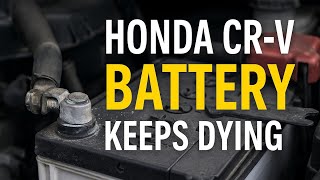
![How to [EASILY] Replace the Battery - Honda CR-V (2017-2022)](https://img.youtube.com/vi/TkIVHhmEtUs/mqdefault.jpg)
We Have This Part in Stock


The information in this article is provided for general reference and educational purposes only. Vehicle specifications, procedures, and part compatibility can vary by production date, trim level, and region. Always consult your vehicle's factory service manual and verify part numbers before purchasing or performing repairs. Safety-critical components such as airbags, seat belts, and braking systems should be installed by a qualified professional.
- Honda CR-V:
- 🧭 Diagnostic Flowchart
- 🎬 Helpful Videos
- 🛍️ Shop This Part
- What's Unique About the 2017-2022 Honda CR-V
- Symptoms You May Notice
- Most Likely Causes
- Rare But Worth Checking
- Diagnosis Steps
- Parts You'll Likely Need
- Related Codes That Often Appear With This One
- Technical Service Bulletins (TSBs) & Recalls
- Platform-Specific Known Issues
- Mechanic-Grade Diagnostic Values
- Scan Tool Commands That Help
- Wiring & Ground Locations
- Real Owner Repair Stories
- OEM Part Supersession History
- Model Year Variations Within This Range
- Other Known Issues on This Vehicle
- Used vs. New Parts: Buying Guide for This Vehicle
- Real Owner Stories
- 2017 Honda CR-V — ~70000 miles
- 2018 Honda CR-V
- 2018 Honda CR-V
- 2021 Honda CR-V
- Related OBD-II Codes
- Frequently Asked Questions
- 🎟️ Get 5% Off