

C0031 on 2016-2021 Honda Civic: Left Front Wheel Speed Sensor Fault Causes and Fixes
This code indicates a fault with the left front wheel speed sensor circuit. On the 10th generation Civic, the most common cause is a broken or corroded wire in the harness near the sensor, not the sensor itself. Expect to pay for 1-2 hours of diagnostic and repair labor.
- C0031 disables your ABS, traction control, and stability control systems, making the vehicle less safe in emergency situations.
- For the 2016-2021 Civic, the most likely cause is a broken wire in the harness, not a bad sensor.
- A thorough inspection of the wiring harness for the left front wheel speed sensor is the critical first diagnostic step. Peel back the protective loom to check for hidden breaks.
- Do not immediately replace the sensor; you may be wasting money on a part you don't need.
- Due to the safety-critical nature of the ABS system, professional diagnosis and repair are strongly recommended if you are not experienced with automotive electrical diagnostics.
What's Unique About the 2016-2021 Honda Civic
For the 10th generation (2016-2021) Honda Civic, this code is very frequently caused by a break in the wiring harness leading to the sensor, rather than a failure of the sensor itself. The wires in the wheel well are exposed to constant flexing from steering and suspension movement, as well as environmental stress, which can lead to internal breaks or corrosion. This often triggers the specific sub-code C0031-14 (Circuit Short to Ground or Open). Owners and technicians often find a damaged or broken wire within a few inches of the sensor connector 🎬 Watch: How to find and fix this common wiring break, sometimes hidden inside the protective sheathing. In other cases, wires can rub together, causing a short that may present as a 'malfunction' code rather than a simple open circuit.
Symptoms You May Notice
- ABS warning light is on
- Traction Control System (TCS) or Vehicle Stability Assist (VSA) warning light is on
- Brake system warning light is on
- Multiple warning messages on the driver information display (e.g., "Brake System Problem," "Vehicle Stability Assist Problem")
- Electric Parking Brake (EPB) warning light may also illuminate
- Replacing the wheel speed sensor when the actual problem is a broken wire in the harness. This is the most common misdiagnosis for this code on this vehicle, leading to wasted money and the problem persisting.
- Replacing the wheel speed sensor when the actual problem is a damaged or contaminated magnetic encoder ring on the wheel bearing.
Most Likely Causes
- Broken or Damaged Wiring Harness 🔴 High Probability The wiring harness in the wheel well is subject to stress from suspension travel and steering, and exposure to road debris and moisture. This can cause wires to break internally, chafe against each other causing a short, or corrode over time, often right near the connector.
How to confirm: Visually inspect the wiring harness from the sensor up into the wheel well. Peel back any protective tape or loom. Gently tug on the wires near the connector; a broken wire may stretch or feel disconnected. Look for spots where insulation has rubbed through. A multimeter can be used to check for continuity between the sensor connector and the ABS module connector.
Typical fix: Repairing the broken section of wire with a new piece of wire, solder, and heat-shrink tubing to ensure a durable, weather-proof connection. In severe cases, a pigtail connector or a section of the harness may need to be replaced.
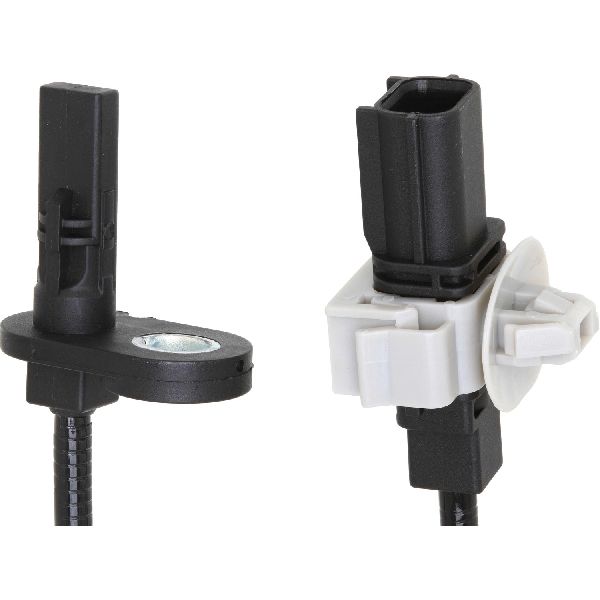
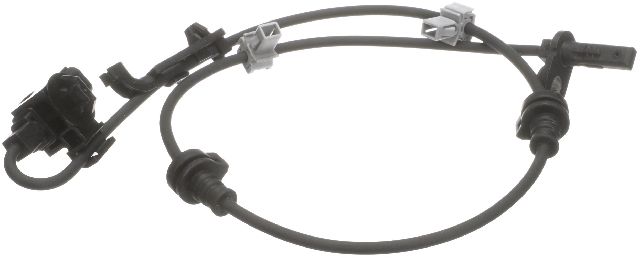
Est. part cost: $5-$35 - Failed Left Front Wheel Speed Sensor 🟡 Medium Probability → Shop ABS Wheel Speed Sensor Sensors are exposed to harsh conditions in the wheel well (water, salt, debris) and can fail electronically over time, though less frequently than the wiring on this specific platform.
How to confirm: After confirming the wiring is intact, test the sensor. The 10th gen Civic uses an active sensor, which cannot be tested with a resistance (Ohm) check. With the key on, check for supply voltage (typically 5V or 12V) at the harness-side connector. The definitive test uses an oscilloscope to monitor the sensor's output for a clean digital square wave signal while spinning the wheel. A lack of signal or a distorted waveform indicates a bad sensor.
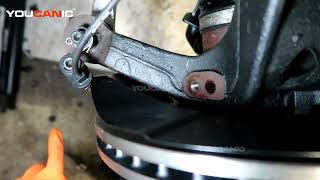
Typical fix: Replace the left front wheel speed sensor. This typically involves removing the wheel, unbolting the sensor from the knuckle 🎬 See this step-by-step guide for replacing the front ABS sensor, and disconnecting its electrical connector.
Est. part cost: $60-$150
Rare But Worth Checking
- Faulty ABS/VSA Modulator-Control Unit: → Shop ABS Control Module This is the least likely cause. Before condemning the expensive control unit, all wiring and sensor diagnostics must be exhaustively performed by a qualified technician.
- Damaged or Debris on Wheel Bearing Magnetic Encoder: The wheel speed sensor reads a magnetic ring (encoder) that is part of the wheel bearing assembly. If the bearing was recently replaced with a low-quality part or installed backwards, or if metallic debris has contaminated the area, it can cause a signal issue. This is often missed because the sensor and wiring may test good, but an oscilloscope will show a distorted or missing signal waveform.
- Blown ABS/VSA Fuse: A blown fuse for the ABS/VSA system can cause a loss of communication and trigger various codes. For the 10th gen Civic, check fuse #34 in the interior fuse box and fuses #4 and #5 in the under-hood multi-block fuse. It's a simple check to perform before more complex diagnostics.
Diagnosis Steps
- Connect an OBD-II scanner capable of reading ABS codes to confirm C0031 is present and check for any specific sub-codes (e.g., -14, -62, -92, -94).
- Visually inspect the entire length of the left front wheel speed sensor wiring harness for any signs of damage, chafing, or corrosion. Pay close attention to the area within 6 inches of the electrical connector, peeling back any protective sheathing.
- Perform a 'wiggle test' on the harness while monitoring live data on the scan tool (if possible) to see if the signal cuts out.
- If wiring appears intact, test the sensor circuit. With the key on, disconnect the sensor and use a multimeter to check for reference voltage (usually 5V or 12V) on the harness-side connector pins.
- For a definitive test, connect an oscilloscope to the sensor's signal wire. Spin the wheel and look for a clean, digital square wave. Gaps or distortions in the wave pattern point to a damaged magnetic encoder on the wheel bearing. A flat line indicates a dead sensor or wiring issue.
- Check the relevant fuses for the ABS/VSA system: Fuse #34 (interior) and Fuses #4 & #5 (under-hood multi-block fuse).
- If wiring, sensor, and fuses are confirmed to be good, the issue may lie with the wheel bearing's magnetic encoder or, rarely, the ABS/VSA control module itself.
Parts You'll Likely Need
- Front Wheel Speed Sensor
(OEM #57455-TBA-A03 (Sedan/Coupe, non-Si), 57455-TGG-A01 (Hatchback, non-Type R))— This is the second most likely component to fail after the wiring is checked. It is often replaced when it fails its diagnostic tests.
Trusted brands: Honda (OEM), Bosch, NTK, Delphi, Standard Motor Products
OEM price range: $30-$50
Aftermarket price range: $45-$150 - Wire Harness Pigtail Connector
(OEM #7283-2090 (Connector housing number, pigtails are often aftermarket))— If the wiring is damaged right at the connector, replacing the pigtail is the most effective repair.
Trusted brands: Honda (OEM), Dorman, Standard Motor Products, FindPigtails.com (A12A2)
OEM price range: $30-$50
Aftermarket price range: $15-$35
Related Codes That Often Appear With This One
- C0031-14 — This is a Honda-specific sub-code indicating an open or shorted circuit, which strongly points to a wiring problem.
- C0031-62 — This sub-code indicates a 'Signal Compare Failure,' meaning the signal from the left front sensor doesn't match the other wheels, which could be a faulty sensor, an intermittent wiring issue, or a problem with the wheel bearing's magnetic encoder.
- C0031-92 — Indicates an abnormal signal from the sensor, which could be caused by a damaged magnetic encoder ring on the wheel bearing or intermittent wiring shorts.
- C0031-94 — A general wheel speed sensor malfunction code that points to a failure in the sensor's ability to generate a proper signal.
Platform-Specific Known Issues
- Repair Story: Broken Wire Hidden in Harness: A user on a YouTube repair channel demonstrated a fix on a 10th gen Civic with code C0031. After an initial visual inspection showed nothing, he peeled back the black protective sheathing on the harness near the sensor. He found a green wire that was internally broken, with only the insulation holding it together. A gentle pull confirmed the break. The repair involved soldering in a new section of wire and sealing it, which resolved all the warning lights.
- Forum Discussion: Sensor vs. Wiring: On PakWheels Forums, a user with a Civic experiencing ABS lights and a C0031 code was advised by a mechanic to change the wheel bearing. Another forum member correctly advised that a broken sensor wire is a much more common experience and should be the first thing checked, before replacing the sensor or the more expensive bearing.
- Repair Story: Chafed Wires Causing Short: A technician diagnosing a Honda Civic with an ABS malfunction code found that two wires in the sensor harness (pink and another color) had rubbed together, wearing away the insulation. The exposed wires were making contact, causing a signal plausibility issue rather than a simple open circuit. Repairing the chafed sections and re-insulating the harness fixed the problem and cleared the code.
Mechanic-Grade Diagnostic Values
- Sensor Supply Voltage at Harness Connector — expected: 5V or 12V DC (with ignition ON, sensor disconnected). Failure: 0V or significantly low voltage indicates a wiring or ABS module issue, not a sensor issue.
- Sensor Signal Waveform (Oscilloscope) — expected: A clean digital square wave that switches between a low voltage (e.g., <1V) and a high voltage (e.g., 5V-12V) as the wheel is spun.. Failure: A flat line indicates a dead sensor or open wire. A distorted, noisy, or incomplete waveform (missing sections) points to a damaged magnetic encoder ring on the wheel bearing.
Hidden / Shadow Codes Worth Checking
- C0031-92: Abnormal Signal. Suggests the signal received is erratic or implausible, often pointing to issues with the magnetic encoder ring or intermittent shorts. (see via Honda HDS or equivalent professional ABS-capable scan tool.)
- C0031-94: Wheel Speed Sensor Malfunction. A more general sensor failure code indicating the sensor itself is not operating correctly. (see via Honda HDS or equivalent professional ABS-capable scan tool.)
Scan Tool Commands That Help
- Honda HDS (or advanced aftermarket): Live Data > Wheel Speed Sensors — To monitor the speed reading from all four wheels simultaneously while driving or spinning the wheel by hand. A reading of 0 or one that doesn't change from the left front sensor confirms a lack of signal.
- Autologic DrivePRO (example of pro tool): Service Functions > Pulser Test — This non-intrusive test checks the integrity of the magnetic encoder ring on the wheel bearing by counting pulses as the wheel is rotated, helping to differentiate a sensor/wiring fault from a bearing/encoder fault.
- Honda HDS: Clear DTCs — After a repair is completed, the official procedure may require using the HDS to clear the code. In many cases, the light will also turn off on its own after a few drive cycles where the system verifies a good signal.
Wiring & Ground Locations
- VSA Modulator-Control Unit — In the engine bay, on the driver's side, below the brake fluid reservoir.. This is the control module that receives the signal from the wheel speed sensor. The wiring harness from the sensor terminates here. The specific wires are labeled FR L ABS SNSR+ and FR L ABS SNSR-.
- Interior VSA/ABS Fuse — In the interior fuse box under the driver's side dash, position #34.. This fuse provides power to the VSA/ABS control unit. A blown fuse will disable the entire system and can set multiple codes.
- Under-hood VSA/ABS Fuses — In the under-hood fuse box, positions #4 (40A) and #5 (40A) within the multi-block fuse assembly #3.. These are the main power supply fuses for the VSA modulator motor and fail-safe relays. A failure here will cause a total loss of ABS/VSA function.
- Main Chassis Ground (Typical) — Commonly found on the driver's side A-pillar, behind the kick panel, bolted to bare metal.. A poor ground connection for the ABS module can cause a host of intermittent and difficult-to-diagnose electrical issues, including false sensor codes.
Real Owner Repair Stories
- YouTube video (Urdu/Hindi) (2018 Honda Civic) — ABS and traction control lights on, code C0031-14 stored.
✅ What actually fixed it Upon inspection, a wire in the left front sensor harness was found to be damaged/broken. The wire was repaired, and all fault codes were cleared successfully, resolving the issue. - YouTube video (Pine Hollow Auto Diagnostics) (Honda Civic (10th Gen)) — ABS, VSA, and other warning lights on. Code for 'ABS sensor malfunction'.
❌ Tried (didn't work) The new sensor had already been installed by another shop or the owner, which did not fix the problem.
✅ What actually fixed it A detailed inspection of the wiring harness revealed two wires (one pink) had rubbed together, wearing through the insulation and causing an intermittent short circuit. The technician separated the wires, repaired the damaged insulation with solder and heat shrink, and re-wrapped the harness. This restored the correct signal and fixed the problem. - NHTSA ODI #11496856 — While reported on a related Honda model, this record highlights how C0031-62 often appears alongside multiple other communication and sensor codes (such as C0034-62 and C003A-62), indicating a broader electrical system fault or shared circuit issue that triggers a cascade of warning lights.
OEM Part Supersession History
57455-TBA-A02→57455-TBA-A03— Standard part revision or supplier change.
Model Year Variations Within This Range
- 2019-2021: A mid-cycle refresh for the 2019 model year included revised front and rear styling, a new 'Sport' trim, and making the Honda Sensing safety suite standard on all trims. The infotainment system was also updated to include a physical volume knob. These changes do not fundamentally alter the cause or diagnosis of code C0031, as the ABS hardware and wiring routing remained consistent.
Diagnostic Flowchart
Other Known Issues on This Vehicle
Issues unrelated to this code that are worth knowing about as an owner of this generation:
- A/C Condenser Failure 🔴 High — Very common across all 2016-2020 models. The condenser can develop micro-leaks, causing the A/C to stop blowing cold. (Ref: Honda issued a warranty extension for the A/C condenser to 10 years/unlimited miles.)
- Engine Oil Dilution (1.5L Turbo) 🔴 High — Common on 2016-2018 models with the 1.5T engine, especially in cold climates or with frequent short trips. Fuel mixes with engine oil, raising the oil level and reducing lubrication. (Ref: Honda issued software updates and a warranty extension (6 years/unlimited miles) for certain components.)
- Failing A/C Compressor 🟠 Medium — Often occurs subsequent to or concurrently with condenser leaks. Loss of refrigerant and oil from a leak can damage the compressor. (Ref: Not officially covered by the condenser warranty extension, but some owners have successfully argued for coverage.)
- Electric Parking Brake (EPB) System Faults 🟠 Medium — Reported sporadically, can be caused by switch failure, wiring issues, or software glitches, leading to a 'Brake System Problem' message. (Ref: Recall issued for early 2016 models for an issue where the EPB might not engage right after ignition off.)
- Low-Pressure Fuel Pump Failure 🔴 High — Affects a wide range of Honda models including the 2019-2020 Civic as part of a large-scale recall. The pump can fail, causing the engine to stall. (Ref: NHTSA Recall 21V-215.)
Used vs. New Parts: Buying Guide for This Vehicle
When a used part is the smart pick: A used OEM wiring harness pigtail from a junkyard is a viable option if the connector housing is damaged and a new pigtail is unavailable or too expensive. A complete used sensor assembly is generally not recommended due to the high failure rate of the wiring and the unknown history of the part.
Donor-vehicle mileage cap: roughly under 60000 miles for the part to have meaningful remaining life.
What to inspect on the donor part:
- For a pigtail, inspect for any cracks in the connector housing.
- Ensure the locking tab is intact and functional.
- Check that the wires are flexible and show no signs of brittleness, cracking, or previous repairs.
OEM-only on this vehicle (don't cheap out):
- While not strictly 'OEM-only', community and technician feedback strongly advises against using cheap, unbranded aftermarket wheel speed sensors. They are known for high rates of out-of-the-box failure or premature failure within weeks or months.
Aftermarket brands forum-validated for this vehicle:
- NTK
- Bosch
- Delphi
- Standard Motor Products (SMP)
Brands owners have reported issues with on this vehicle:
- Unbranded 'eBay' or 'Amazon' sensors
- Store brands with poor lifetime warranty reviews (e.g., Duralast mentioned in some forums as hit-or-miss)
Real Owner Stories
Aggregated from forums and TSBs cited above. Mileages and costs reflect what owners reported in those sources.
2016-2021 Honda Civic
Symptoms: Code C0031 and all associated warning lights were on. A visual inspection initially showed nothing wrong.
What fixed it: The technician peeled back the protective sheathing on the harness and found a green wire that was broken internally. Soldering in a new section of wire and sealing the repair resolved all the warning lights.
Source hint: vehicle_specific_issues: Repair Story: Broken Wire Hidden in Harness
2016-2021 Honda Civic
Symptoms: ABS malfunction code was present.
What fixed it: A technician found two wires in the sensor harness had rubbed together, wearing away the insulation and causing a short. Repairing the chafed sections and re-insulating the wires fixed the problem.
Source hint: vehicle_specific_issues: Repair Story: Chafed Wires Causing Short
2016-2021 Honda Civic
Symptoms: ABS and VSA lights were on with a C0031 code.
What fixed it: A mechanic initially suggested replacing the wheel bearing, but the owner was advised by another forum member that the problem was much more likely to be a broken sensor wire, which should be checked first.
Source hint: PakWheels Forums
2016-2021 Honda Civic
Symptoms: Multiple warning lights including ABS and Tire Pressure monitoring system.
What fixed it: NHTSA ODI #11496856 describes a scenario where C0031-62 appeared alongside codes for other wheels (C0034-62, C003A-62) and communication errors (U0416-68, U0122-F1), suggesting that a single fault in the integrated driver support system can trigger widespread sensor failure codes.
Related OBD-II Codes
Frequently Asked Questions
My 2018 Civic has the ABS, VSA, and Brake System lights on. Is this one problem or multiple failures?
My mechanic wants to replace the wheel bearing to fix code C0031. Is that the right first step?
Where exactly does the wiring for the front wheel speed sensor tend to fail on these Civics?
Can I test the left front wheel speed sensor on my 10th gen Civic with a standard multimeter?
I've inspected the wiring and it looks perfect. What is the next most likely cause of a C0031 code?
My 2019 Honda CR-V has the same cluster of warning lights. Is the problem the same as on the Civic?
Helpful Videos
We Have This Part in Stock


The information in this article is provided for general reference and educational purposes only. Vehicle specifications, procedures, and part compatibility can vary by production date, trim level, and region. Always consult your vehicle's factory service manual and verify part numbers before purchasing or performing repairs. Safety-critical components such as airbags, seat belts, and braking systems should be installed by a qualified professional.
- Honda Civic:
- 🧭 Diagnostic Flowchart
- 🎬 Helpful Videos
- 🛍️ Shop This Part
- What's Unique About the 2016-2021 Honda Civic
- Symptoms You May Notice
- Most Likely Causes
- Rare But Worth Checking
- Diagnosis Steps
- Parts You'll Likely Need
- Related Codes That Often Appear With This One
- Platform-Specific Known Issues
- Mechanic-Grade Diagnostic Values
- Hidden / Shadow Codes Worth Checking
- Scan Tool Commands That Help
- Wiring & Ground Locations
- Real Owner Repair Stories
- OEM Part Supersession History
- Model Year Variations Within This Range
- Other Known Issues on This Vehicle
- Used vs. New Parts: Buying Guide for This Vehicle
- Real Owner Stories
- 2016-2021 Honda Civic
- 2016-2021 Honda Civic
- 2016-2021 Honda Civic
- 2016-2021 Honda Civic
- Related OBD-II Codes
- Frequently Asked Questions
- 🎟️ Get 5% Off