

C0045 on 2011-2024 Dodge Durango: Left Rear Wheel Speed Sensor Circuit Fixes
This code means there's a problem with the left rear wheel speed sensor circuit. Most often, the fix is replacing the sensor itself due to failure from exposure to the elements. Expect to pay $25-$60 for an aftermarket sensor and around $80 for an OEM part. Before replacing, check the wiring harness for damage, as it is also a common point of failure.
- C0045 on a Dodge Durango means a fault in the left rear wheel speed sensor circuit, which disables ABS and stability control.
- The most probable cause is a failed wheel speed sensor, which is a relatively simple and inexpensive DIY replacement.
- Before replacing parts, inspect the wiring harness and connector for damage or corrosion, as this is a common secondary cause.
- If a new sensor doesn't fix the problem, the issue is likely in the wiring or the wheel hub's magnetic ring.
What's Unique About the 2011-2024 Dodge Durango
For the third-generation (WD) Dodge Durango, the C0045 code is a straightforward chassis fault. The underlying cause is almost always a component failure at the wheel, rather than a complex electronic issue. The wheel speed sensor reads a magnetic encoder ring that is integrated into the wheel hub/bearing assembly. While the sensor itself is the most common failure point, damage to this ring on the hub can also trigger the code, requiring a hub replacement. The wiring harness pigtail leading to the sensor is also a known weak point, susceptible to corrosion and physical damage.
Generation note: The 2011-2024 model years all belong to the third generation (WD) of the Dodge Durango. While there have been facelifts and powertrain updates, the fundamental ABS and wheel speed sensor design related to this code has not significantly changed. The issue is also common on the platform-mate Jeep Grand Cherokee (WK2).
Symptoms You May Notice
- ABS warning light illuminated
- Traction Control or Electronic Stability Control (ESC) warning light illuminated
- Traction and stability control systems are disabled
- ABS system is disabled
- Cruise control may be disabled
- In rare cases with an erratic signal, the ABS may activate unnecessarily at low speeds.
- Replacing the ABS module first. The module is expensive and rarely the cause for a single-wheel fault. Always diagnose from the wheel inward.
- Replacing the wheel speed sensor without inspecting the wiring. A damaged wire or corroded connector can mimic a failed sensor, leading to the code returning after the repair.
Most Likely Causes
- Failed Left Rear Wheel Speed Sensor 🔴 High Probability → Shop ABS Wheel Speed Sensor The sensor is exposed to water, dirt, road salt, and vibration at the wheel hub, which leads to internal failure or corrosion over time. This is the most common point of failure for this code.
How to confirm: Using a scan tool that can read live ABS data, observe the wheel speed from the left rear sensor while driving. 🎬 Watch: How to use live data to troubleshoot C0045 codes. If it reads 0 mph or is erratic while other wheels read correctly, the sensor is likely bad. You can also test the sensor's internal resistance with a multimeter, which should typically be between 800-2000 ohms, though this varies by manufacturer.
Typical fix: Replace the left rear wheel speed sensor. It is typically held in by a single bolt and is a plug-and-play part. 🎬 See this step-by-step guide to replacing the wheel speed sensor.
Est. part cost: $25-$80 - Damaged Wiring or Corroded Connector 🟡 Medium Probability The wiring harness leading to the sensor is susceptible to damage from road debris, chafing against suspension components, or corrosion at the connector plug where it joins the main harness. Water intrusion into the connector is a frequent problem.
How to confirm: Visually inspect the wiring harness from the sensor to the main vehicle harness for any signs of breaks, chafing, or melted sections. Unplug the connector and check for green or white corrosion on the pins. A continuity test with a multimeter can confirm if there is a break in the wire.
Typical fix: Repair the damaged section of wire or replace the connector pigtail. Clean any corrosion from the connector pins using an electrical contact cleaner. Ensure the repaired harness is properly secured away from moving parts.
Est. part cost: $15-$40 for a pigtail connector - Damaged Wheel Hub/Bearing Assembly (Tone Ring) ⚪ Low Probability → Shop Hub Assembly The magnetic tone ring (or encoder) is integrated into the wheel hub assembly. Damage to the hub from impact or significant wear-and-tear can damage this ring, causing an incorrect signal. Rust can also build up and flake off, damaging the magnetic ring or accumulating metallic debris that interferes with the sensor reading.
How to confirm: After removing the wheel speed sensor, visually inspect the magnetic encoder ring on the hub for cracks, missing pieces, or heavy rust/debris. Spin the hub and check for excessive play or noise, which indicates a failing bearing.
Typical fix: Replace the entire rear wheel hub and bearing assembly. This is a more involved repair than replacing the sensor alone.
Est. part cost: $100-$250
Rare But Worth Checking
- Faulty ABS Control Module: → Shop ABS Control Module This is rare and should only be considered after all other possibilities (sensor, wiring, hub) have been thoroughly ruled out. An ABS module failure typically triggers multiple wheel speed sensor codes or communication codes, not just one for a single wheel.
- Software Glitches: While rare for this platform, some manufacturers have addressed C0045 through software updates. For example, NHTSA ODI #10382746 describes an instance where a dealer was instructed to erase codes including C0045 and re-program the software on a different manufacturer's vehicle.
Diagnosis Steps
- Connect an OBD-II scanner capable of reading ABS codes to confirm C0045 is the active code.
- Use the scanner's live data function to monitor the speeds of all four wheels while driving slowly (above 5-10 mph). Confirm that the Left Rear wheel speed reads 0 or is erratic compared to the other three.
- Safely raise and support the vehicle. Remove the left rear wheel.
- Visually inspect the wheel speed sensor and its wiring harness for any obvious damage, such as cuts, chafing, melting, or being improperly routed.
- Disconnect the sensor's electrical connector and inspect the pins for corrosion, moisture, or damage. Clean if necessary and apply dielectric grease upon reassembly.
- If the wiring appears intact, remove the single bolt (often a 10mm or Torx) holding the sensor in place and carefully remove the sensor. It may be seized and require gentle prying.
- Inspect the sensor tip for metallic debris or damage. Inspect the magnetic encoder ring on the wheel hub for cracks, rust jacking, or missing sections.
- If no visual faults are found, the most likely cause is an internally failed sensor. Replace the sensor with a new part. Owners often recommend using OEM Mopar parts to avoid premature failure of aftermarket alternatives.
- If replacing the sensor does not resolve the issue, perform a continuity test on the wiring harness between the sensor connector and the ABS module connector to rule out an open or short in the wiring.
- If the sensor and wiring are confirmed good, the wheel hub/bearing assembly is the next likely culprit.
- After any repair, clear the codes with the scanner and perform a test drive to ensure the warning lights do not return.
Parts You'll Likely Need
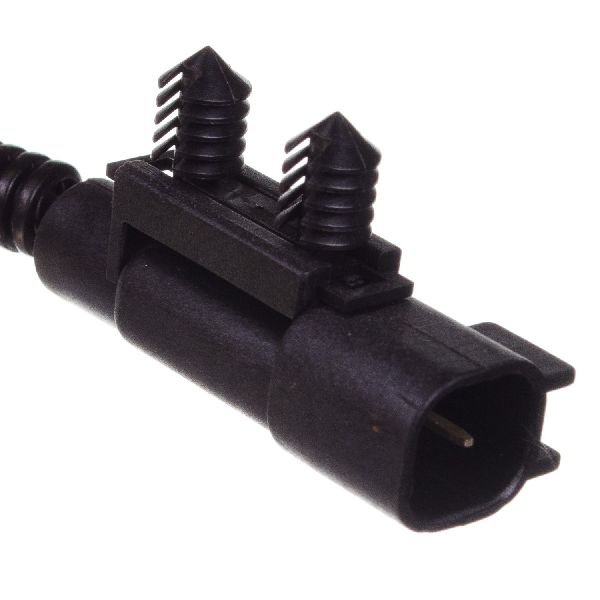
- Rear Wheel Speed Sensor
(OEM #68569550AA)— This is the most common failure point for a C0045 code. It is a relatively inexpensive and accessible part that fails due to its exposed location. The OEM part number 68569550AA supersedes previous part numbers including 5154230aa through 5154230af.
Trusted brands: Mopar, Delphi, Holstein, Standard Motor Products (SMP)
OEM price range: $70-$90
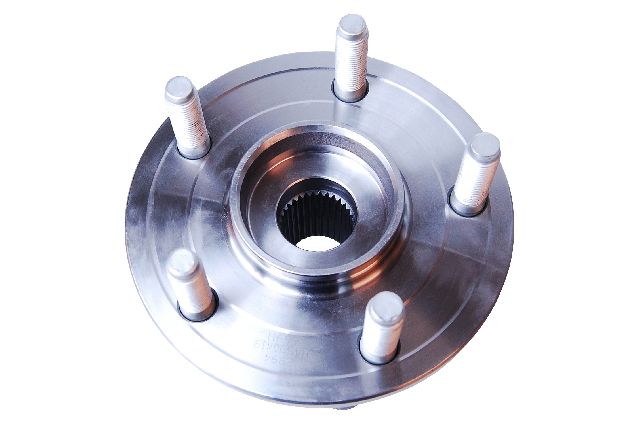
Aftermarket price range: $25-$60 - Rear Wheel Hub and Bearing Assembly
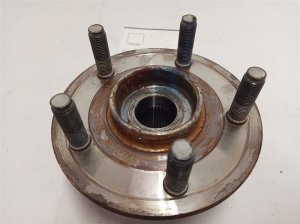
(OEM #68339336AB (AWD) or 68339337AB (RWD) - Note: Verify with VIN)— If the magnetic tone ring integrated into the hub is damaged, the entire hub must be replaced to restore the signal for the wheel speed sensor.
Trusted brands: Mopar, Timken, Moog, Dorman
OEM price range: $200-$300
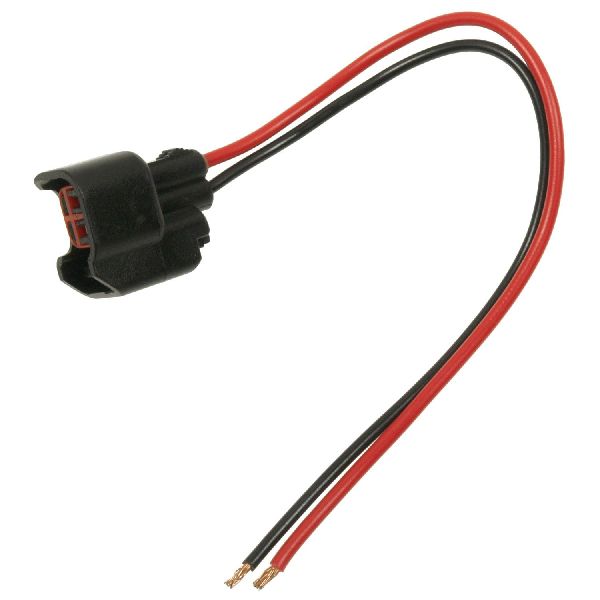
Aftermarket price range: $100-$180 - Wheel Speed Sensor Connector Pigtail — If the connector itself is corroded or the wires are broken near the plug, replacing the pigtail is the standard repair.
Trusted brands: Dorman, Standard Motor Products, Transtar
OEM price range: N/A
Aftermarket price range: $15-$40
Platform-Specific Known Issues
- Owner Experience: Replaced Sensor, Problem was Wiring: An owner on CorvetteForum with a similar system reported replacing the wheel hub/sensor assembly for a C0045 code, only for the code to return. The ultimate fix was cleaning a corroded main harness connector located elsewhere on the vehicle, highlighting the need to check the entire circuit.
- Owner Experience: Aftermarket Sensor Failure: Multiple owners across different platforms report that cheap aftermarket sensors can be dead-on-arrival or fail quickly. Many strongly recommend using OEM (Mopar/ACDelco) sensors to avoid having to do the job twice.
- Cross-Manufacturer Note on Related Codes: On some vehicle platforms, C0045 may appear alongside fuel system codes. NHTSA ODI #11399819 notes a case where C0045 was present with P0463 and P069E, though this is typically specific to certain GM electrical architectures.
Mechanic-Grade Diagnostic Values
- Wheel Speed Sensor Resistance — expected: 800 - 2,000 Ω (varies by manufacturer, check specific part). Failure: An open circuit (infinite resistance) or a short circuit (near zero resistance) indicates a failed sensor.
- Wheel Speed Sensor AC Voltage Output (Passive Sensor) — expected: At least 200mV (0.2V) AC when spinning the wheel at about one revolution every two seconds.. Failure: No voltage or significantly lower voltage while spinning the wheel indicates a failed sensor or a problem with the tone ring.
Hidden / Shadow Codes Worth Checking
- C0045 06: Left Rear Wheel Speed Sensor Circuit Low Voltage/Open. This points specifically to an open circuit, likely a broken wire or unplugged connector. (see via A professional-level scanner (like Chrysler's wiTECH) that can read symptom bytes/sub-codes.)
- C0045 0F: Left Rear Wheel Speed Sensor Circuit Signal Erratic. This suggests the sensor is providing a signal, but it's glitchy or inconsistent, often caused by a damaged tone ring or electrical interference. (see via A professional-level scanner that can read symptom bytes/sub-codes.)
- C0045 18: Left Rear Wheel Speed Sensor Circuit Low Signal Amplitude. This indicates the signal from the sensor is too weak. (see via A professional-level scanner that can read symptom bytes/sub-codes.)
- C0045 5A: Left Rear Wheel Speed Sensor Circuit Not Plausible. The signal from this sensor is illogical when compared to other vehicle data (like the other wheel speeds), pointing to a faulty sensor or hub issue. (see via A professional-level scanner that can read symptom bytes/sub-codes.)
Wiring & Ground Locations
- ABS Module Connector — Typically located on the ABS hydraulic control unit in the engine bay, often near the master cylinder or on the driver's side frame rail.. This is the termination point for the wheel speed sensor harness. A poor connection or corrosion here can cause a C0045 code. A wiggle test on this connector while monitoring live data can sometimes identify a poor pin fitment issue.
- Main Chassis Grounds — Key grounds are often located on the frame rail under the driver's side door, near the front body mounts, or directly near the ABS module itself.. While less common for a single-wheel code, a poor or corroded main ground for the ABS module can cause a variety of erratic electrical issues, including phantom sensor codes. Cleaning these grounds is a low-cost diagnostic step if other causes are ruled out.
Real Owner Repair Stories
- YouTube channel 'Making It Work' (Chevrolet Traverse (similar GM platform with integrated hub/sensor design)) — ABS and traction control lights on, C0045 code with 'plausibility failure'. Live data showed erratic, glitchy signal from left rear wheel speed sensor.
❌ Tried (didn't work) Initial diagnosis pointed to sensor, wiring, or hub.
✅ What actually fixed it The magnetic encoder ring, which is part of the wheel bearing/hub assembly, had disintegrated due to rust. A piece of the magnetized strip had broken off. Replacing the entire rear wheel hub assembly resolved the issue. - YouTube channel 'An_Auto _Addiction' (2007 GMC Yukon (similar GM platform)) — Intermittent ABS and traction control lights, codes C0045 and C0050 stored in history.
❌ Tried (didn't work) The front wheel bearings/sensors had already been replaced for a prior issue.
✅ What actually fixed it Replaced both rear wheel speed sensors (GM Part # 20938122). The repair was straightforward, involving a single T30 Torx bolt and unclipping the harness. This fixed the intermittent light issue. - NHTSA ODI #11219167 — An owner reported the ABS stability code (C0045) was caused by a broken left rear wheel speed sensor encoder ring. The repair required replacing both the speed sensor and the rear hub assembly.
- NHTSA ODI #11165895 — An owner noted that while a service center recommended replacing the L/R hub bearing assembly for code C0045, they observed that warning lights would sometimes extinguish after a few seconds or minutes, suggesting intermittent signal issues.
OEM Part Supersession History
5154230AA, 5154230AB, 5154230AC, 5154230AD, 5154230AE, 5154230AF→68569550AA— Standard part revision and consolidation by the manufacturer over the vehicle's production run.
Heads up: The latest part number (68569550AA) is the correct service replacement for all previous versions and fits both left and right rear positions.
Model Year Variations Within This Range
- 2018-2019, 2022: Certain Durango models within these years were subject to a recall for the ABS control module itself. A faulty module can incorrectly set wheel speed sensor codes. It is critical to check for open recalls using the vehicle's VIN before purchasing parts, as the module replacement may be a covered repair.
Diagnostic Flowchart
Other Known Issues on This Vehicle
Issues unrelated to this code that are worth knowing about as an owner of this generation:
- HEMI 5.7L/6.4L Lifter/Camshaft Failure ('Hemi Tick') 🔴 High — Common, especially on vehicles with the Multi-Displacement System (MDS). Can occur anywhere from 60,000 to 150,000+ miles. Often starts as a light ticking noise that becomes more pronounced. (Ref: Multiple TSBs exist for technicians regarding engine ticking noises, but no recall has been issued.)
- Totally Integrated Power Module (TIPM) Failure 🔴 High — Very common on 2011-2013 models. Can cause no-start conditions, fuel pump issues, battery drain, and other random electrical problems. (Ref: Class-action lawsuits were filed, but repairs are often out-of-pocket. Repair services exist to rebuild faulty TIPMs.)
- Uconnect 8.4-inch Screen Delamination 🟠 Medium — Widespread on models from approximately 2017 onwards. The screen develops bubbles and can lead to 'ghost touches' or complete unresponsiveness, affecting climate, audio, and backup camera controls. (Ref: NHTSA Communication 10223465 (S2108000130) acknowledges the issue but does not provide a free repair outside of warranty.)
- Water Leaks into Cabin 🟠 Medium — Reported across various model years. Leaks can originate from failed seals around the roof rack, windshield, or sunroof drains, often resulting in water on the floorboards or dripping from the headliner area.
- Rear Tail Light Assembly Water Intrusion 🟡 Low — Common on models with the 'racetrack' style tail light. A bad seal from the factory can allow water to collect inside the tail light assembly, causing condensation and eventual LED failure.
Used vs. New Parts: Buying Guide for This Vehicle
When a used part is the smart pick: For this repair, buying used parts is generally not recommended. The primary failure items (sensor, hub) are wear components. A used wiring harness pigtail from a junkyard could be a viable option if the connector is in excellent condition and you need to repair a damaged plug, but a new pigtail is inexpensive.
Donor-vehicle mileage cap: roughly under 50000 miles for the part to have meaningful remaining life.
What to inspect on the donor part:
- For a wiring pigtail: check for zero corrosion (no green or white powder), flexible and unbroken wire insulation, and an intact locking tab.
- Avoid parts from vehicles in the salt belt or areas with high humidity, as corrosion is the main enemy of these components.
OEM-only on this vehicle (don't cheap out):
- Wheel Speed Sensor: While not strictly 'OEM-only', many forum and professional accounts suggest that OEM Mopar sensors have a significantly lower failure rate than many cheaper aftermarket alternatives. Using OEM is strongly recommended to avoid repeat repairs.
Aftermarket brands forum-validated for this vehicle:
- Delphi
- Standard Motor Products (SMP)
- NTK
- Bosch
- Timken (for Hub Assemblies)
- Moog (for Hub Assemblies)
Brands owners have reported issues with on this vehicle:
- Unnamed, 'white-box' or exceptionally low-priced sensors from online marketplaces are frequently cited as being dead-on-arrival or failing prematurely.
Real Owner Stories
Aggregated from forums and TSBs cited above. Mileages and costs reflect what owners reported in those sources.
2011-2024 Dodge Durango
Symptoms: The owner replaced the wheel speed sensor but the C0045 code returned immediately.
What fixed it: Cleaning a corroded main harness connector located elsewhere on the vehicle.
Source hint: CorvetteForum thread titled 'Replaced Wheel Speed sensor and Still Getting C0045 code'
2011-2024 Dodge Durango
Symptoms: ABS warning light and Traction Control light illuminated; code C0045 present.
What fixed it: Replacing the left rear wheel speed sensor with an OEM Mopar part after aftermarket versions failed.
Source hint: Owner Experience: Aftermarket Sensor Failure
2011-2024 Dodge Durango
Symptoms: The C0045 code remained active even after a new sensor was installed.
What fixed it: Investigating the wiring or hub assembly for faults after the sensor replacement failed to clear the issue.
Source hint: Reddit r/AskMechanics thread 'C0045 code after changing speed sensor already?'
Related OBD-II Codes
Frequently Asked Questions
My 2014 Durango has the ABS and Traction Control lights on; should I use an aftermarket sensor to fix code C0045?
Does the C0045 code on my 2012 Durango mean I have to replace the whole wheel hub?
I replaced the sensor on my Durango but the C0045 code is still active. What else should I check?
Is the C0045 issue on the Dodge Durango shared with the Jeep Grand Cherokee?
Can a bad wheel speed sensor cause my Durango's cruise control to stop working?
Is there a TSB for the 'Hemi Tick' on my 2015 Durango 5.7L?
Helpful Videos
Used OEM Parts in Stock
New Aftermarket Parts Available


The information in this article is provided for general reference and educational purposes only. Vehicle specifications, procedures, and part compatibility can vary by production date, trim level, and region. Always consult your vehicle's factory service manual and verify part numbers before purchasing or performing repairs. Safety-critical components such as airbags, seat belts, and braking systems should be installed by a qualified professional.
- Dodge Durango:
- 🧭 Diagnostic Flowchart
- 🎬 Helpful Videos
- 🛍️ Shop This Part
- What's Unique About the 2011-2024 Dodge Durango
- Symptoms You May Notice
- Most Likely Causes
- Rare But Worth Checking
- Diagnosis Steps
- Parts You'll Likely Need
- Platform-Specific Known Issues
- Mechanic-Grade Diagnostic Values
- Hidden / Shadow Codes Worth Checking
- Wiring & Ground Locations
- Real Owner Repair Stories
- OEM Part Supersession History
- Model Year Variations Within This Range
- Other Known Issues on This Vehicle
- Used vs. New Parts: Buying Guide for This Vehicle
- Real Owner Stories
- 2011-2024 Dodge Durango
- 2011-2024 Dodge Durango
- 2011-2024 Dodge Durango
- Related OBD-II Codes
- Frequently Asked Questions
- 🎟️ Get 5% Off