

C0050 on 2011-2014 Hyundai Sonata: Right Rear Wheel Speed Sensor Fault Causes and Fixes
Code C0050 on a 2011-2014 Sonata means the Right Rear Wheel Speed Sensor circuit is faulty, disabling ABS and traction control. The most common fix is replacing the sensor itself (Part No. 59930-3Q000), which costs about $40-$100. If the magnetic ring on the wheel hub is damaged, the entire hub assembly (Part No. 52730-3S200) will need replacement. This issue is also common on the 2011-2015 Kia Optima.
- C0050 means your ABS and stability control are off. Drive carefully, especially in wet or loose conditions.
- The most likely culprit is a bad right rear wheel speed sensor. A DIY replacement is possible but involves removing the back seat.
- Use a scan tool that can read ABS live data to confirm the right rear sensor is the one failing before buying parts.
- If a new sensor doesn't fix it, the problem is likely debris on the wheel hub's magnetic ring or a damaged wire.
- If the magnetic ring is damaged, the entire rear wheel hub assembly must be replaced.
What's Unique About the 2011-2014 Hyundai Sonata
On the 2011-2014 (YF generation) Sonata, the magnetic tone ring that the ABS sensor reads is integrated into the wheel hub and bearing assembly's seal. This means that if the ring is damaged or contaminated with metallic debris—a common cause of erratic signals—the entire wheel hub assembly must be replaced, not just a separate ring. While the sensor itself is the most frequent failure point, mechanics often find that debris buildup on this integrated magnetic encoder is the root cause. The sensor is a simple magnetic pickup that reads the rotating teeth of the encoder.
Symptoms You May Notice
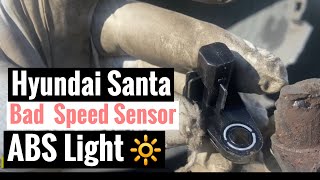
- ABS warning light is on
- Traction Control (TCS) or Electronic Stability Control (ESC) warning light is on
- ABS system does not activate during hard braking (wheels may lock up)
- Traction control does not activate on slippery surfaces
- Cruise control may be disabled
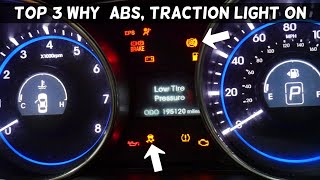
- Brake pedal may feel harder than usual during normal driving. 🎬 Watch: Top 3 reasons your ABS and traction lights are on.
- Replacing the wheel hub assembly when only the sensor has failed. Always use a scan tool to confirm the signal failure before replacing the more expensive hub.
- Replacing the sensor when the wiring is damaged. A visual and electrical test of the harness can prevent replacing a good part.
Most Likely Causes
- Failed Right Rear Wheel Speed Sensor 🔴 High Probability → Shop ABS Wheel Speed Sensor The sensor is exposed to road debris, water, and salt, leading to internal electronic failure or corrosion over time. It's the most common point of failure for this code.
How to confirm: Use an ABS-capable scan tool to monitor live data from all four wheels while driving. If the right rear sensor reads 0 MPH or shows an erratic signal while the others read correctly, the sensor is the primary suspect.
Typical fix: Replace the right rear wheel speed sensor. The connector is located inside the cabin, requiring removal of the rear seat bottom and side bolster trim to access.
Est. part cost: $40 - $110 - Damaged or Corroded Wiring/Connector 🟡 Medium Probability The wiring harness runs along the suspension and can be damaged by road debris, improper jacking, or corrosion at the connector pins. A user on Reddit reported their ABS light came on after hitting a chunk of ice, suggesting an impact-related wiring or sensor issue.
How to confirm: Visually inspect the wiring from the sensor to where it enters the body for any cuts, abrasions, or corrosion. Perform a continuity test on the wires between the sensor connector and the ABS module if a visual inspection is inconclusive.
Typical fix: Repair the damaged section of wire with solder and heat shrink or replace the connector pigtail.
Est. part cost: $15 - $40 - Debris on or Damage to the Magnetic Encoder Ring ⚪ Low Probability The magnetic encoder is integrated into the wheel hub's seal. Metallic debris from brakes or road grime can stick to it, causing an erratic signal that the sensor misinterprets.
How to confirm: After removing the speed sensor, use a light to inspect the magnetic ring inside the hub for metallic shavings or physical damage. Spin the hub to check the entire surface. If the signal is erratic and the sensor/wiring are good, the hub is the likely cause.
Typical fix: The encoder ring is not serviced separately. The entire rear wheel hub and bearing assembly must be replaced.
Est. part cost: $80 - $200
Rare But Worth Checking
- Failed ABS Control Module: → Shop ABS Control Module This is very rare and should only be considered after all other possibilities (sensor, wiring, hub) have been definitively ruled out. A failed module typically triggers multiple wheel speed sensor codes (e.g., C0045 and C0050 simultaneously) or communication errors, not just a single one.
Diagnosis Steps
- Connect an OBD-II scanner capable of reading ABS/Chassis codes.
- Confirm C0050 is the active code. Note any other codes present, especially C0045.
- Access the live data stream for all four wheel speed sensors.
- Safely test drive the vehicle (or raise the rear wheels and spin by hand). Observe the speed readings. Confirm that the Right Rear (RR) sensor reads 0 MPH or shows a signal that is erratic or inconsistent with the other three sensors.
- Raise and safely support the rear of the vehicle. Remove the right rear wheel.
- Visually inspect the wheel speed sensor for cracks, swelling, or physical damage. Inspect the wiring harness for any signs of damage, fraying, or corrosion near the connector and where it mounts to the suspension.
- If the visual inspection is clear, the next step is to replace the wheel speed sensor, as it is the most common failure point. The sensor is held by a single 10mm bolt.
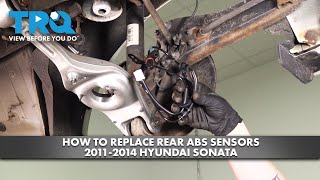
- To access the sensor's electrical connector, you will need to remove the rear seat bottom cushion and the passenger-side rear door scuff plate and lower B-pillar trim. 🎬 See this walkthrough for replacing the rear ABS sensors.
- If a new sensor does not fix the issue, inspect the magnetic encoder ring on the wheel hub assembly. Remove the sensor and look into the bore for metallic debris or cracks on the ring.
- If debris is found, try cleaning it off. If the ring is cracked or damaged, the entire wheel hub assembly must be replaced.
- If the sensor, wiring, and hub are all confirmed to be good, the final step would be to test the circuit continuity back to the ABS module and diagnose the module itself, which is best left to a professional.
Parts You'll Likely Need
- Right Rear ABS Wheel Speed Sensor
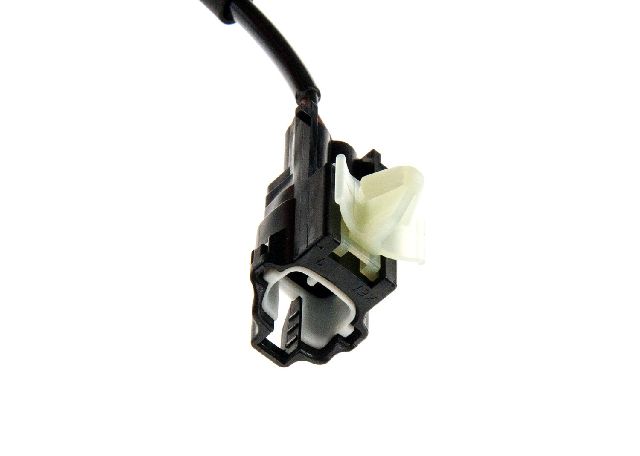
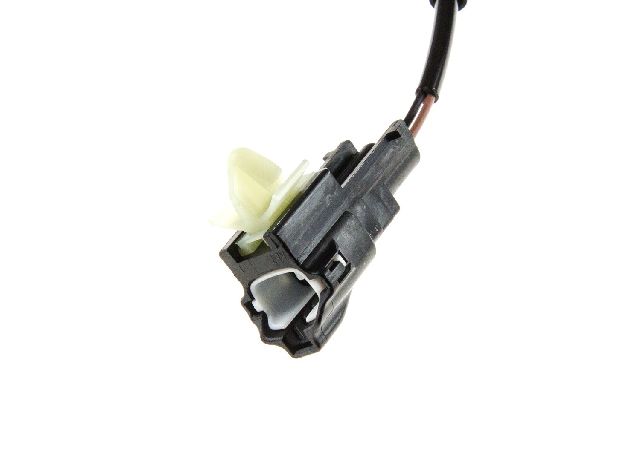
(OEM #59930-3Q000)— This is the most common component to fail for a C0050 code due to its exposed location and electronic nature.
Trusted brands: Hyundai (OEM), Mando, Duralast, TRQ, Standard Motor Products (SMP), SKP
OEM price range: $80-$120
Aftermarket price range: $40-$90 - Rear Wheel Hub and Bearing Assembly
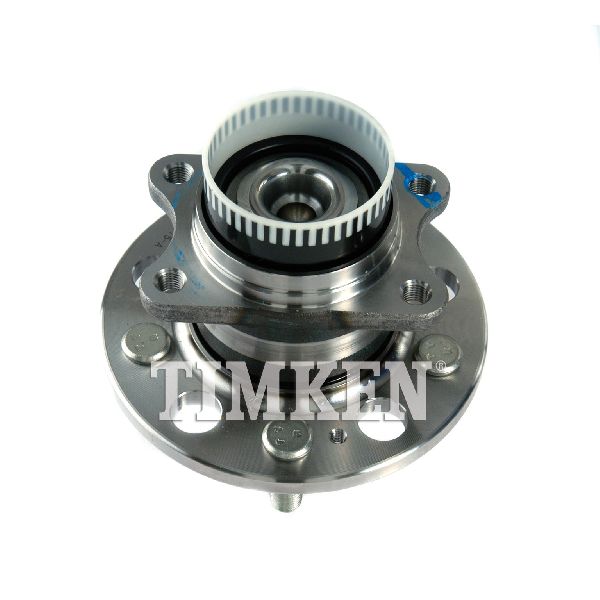
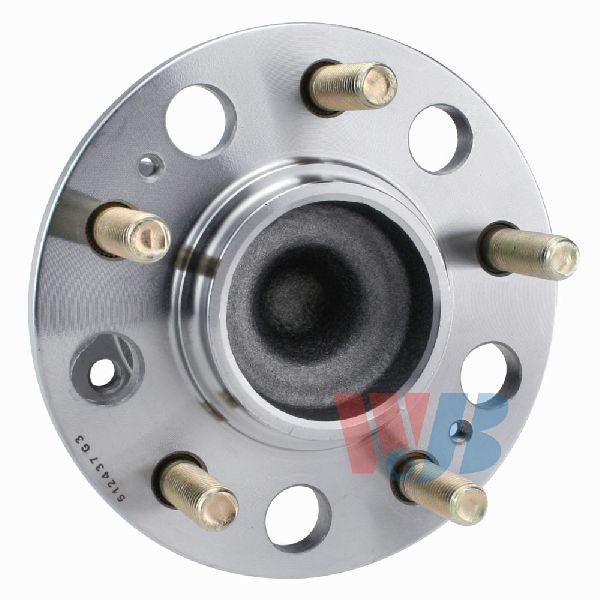
(OEM #52730-3S200)— Required if the integrated magnetic encoder ring is damaged or if the wheel bearing has excessive play, causing an erratic sensor signal. The encoder ring is not sold separately. 🎬 Watch: How to replace the rear wheel hub and bearing assembly.
Trusted brands: Hyundai (OEM), Timken, MOOG, TRQ, SKF, WJB
OEM price range: $150-$250
Aftermarket price range: $80-$150
Related Codes That Often Appear With This One
- U0415 — A U-code indicating 'Invalid Data Received From Anti-Lock Brake System Control Module' may be set in other modules (like power steering) because they rely on the wheel speed data that is now missing or implausible. NHTSA ODI #11228687 describes a case where C0050 appeared alongside U0415 and several other communication codes on a different manufacturer's vehicle, illustrating how this fault can trigger a cascade of related data errors.
- C0045 — Left Rear Wheel Speed Sensor Circuit fault. If both C0045 and C0050 appear together, it could point towards a common wiring issue affecting both rear sensors or a problem with the ABS module itself rather than two independent sensor failures.
Technical Service Bulletins (TSBs) & Recalls
- TSB #17-ST-002: Details the warranty extension and replacement procedure for the common steering coupler failure, a separate but prevalent issue on this platform.
Platform-Specific Known Issues
- There is an outstanding safety recall (NHTSA Campaign 24V204000, Hyundai Recall 251) for some 2011-2015 Sonata Hybrid models concerning a potential electrical short in the ABS module that can increase fire risk. While this does not directly cause code C0050, it highlights a known issue with the ABS module on this platform.
Documented NHTSA Reports
While C0050 is primarily a wheel speed sensor code on Hyundai vehicles, cross-manufacturer records show it can occasionally be associated with broader brake or steering system faults. For instance, NHTSA ODI #10763888 notes a case on a different make where C0050 was linked to a faulty power steering control module (PSCM) and the steering column. Additionally, NHTSA ODI #11649367 reports a scenario where the vehicle disabled the ABS and set code C0050 after brake service required extra fluid to return caliper piston contact to the brake pad.
Mechanic-Grade Diagnostic Values
- Wheel Speed Sensor Resistance — expected: Approximately 1.1 kΩ (1100 Ohms). This value is based on similar Hyundai models of the era; test the known good sensor on the other side to establish a baseline.. Failure: An open circuit (infinite resistance) or a short (near zero resistance) indicates a failed sensor.
- Wheel Speed Sensor AC Voltage Output — expected: A fluctuating AC voltage that increases in frequency and amplitude as the wheel is spun.. Failure: No voltage or an erratic, non-linear voltage signal when spinning the wheel indicates a faulty sensor or a problem with the magnetic encoder ring.
Hidden / Shadow Codes Worth Checking
- C0050 0F: Erratic Signal. The module detected a signal that is irregular or unstable. (see via A professional-grade scan tool (like Hyundai GDS) that can read manufacturer-specific symptom bytes.)
- C0050 18: Low Signal Amplitude. The signal from the sensor is too weak. (see via A professional-grade scan tool (like Hyundai GDS) that can read manufacturer-specific symptom bytes.)
- C0050 5A: Signal Not Plausible. The sensor's reading is illogical compared to other vehicle sensors (e.g., other wheel speeds). (see via A professional-grade scan tool (like Hyundai GDS) that can read manufacturer-specific symptom bytes.)
Scan Tool Commands That Help
- Hyundai GDS / Advanced OBD-II Scanner: Live Data Graphing - Wheel Speed Sensors — This is the primary diagnostic step. Graphing all four wheel speeds simultaneously while driving allows you to instantly see if the right rear sensor is dropping out, reading erratically, or not matching the others.
- Hyundai GDS (or equivalent): Variant Coding — This is required *after* replacing the ABS Control Module. The new module must be programmed with the vehicle's VIN and specific configuration (engine, suspension, etc.) to function correctly.
Wiring & Ground Locations
- ESC Control Module (ABS Module) — Located in the engine compartment, at the left rear, below the brake master cylinder.. This is the computer that receives the signal from the wheel speed sensor. The wiring harness from the sensor terminates here, making it the end-point for continuity testing.
- GE06 — A primary ground point located on the left side of the engine compartment.. A poor ground at this location can cause a variety of difficult-to-diagnose electrical issues within the ABS system, potentially triggering fault codes even with a good sensor and wiring.
- MM01 — A ground point shown in the main cabin harness ground distribution diagram.. While less likely to be the primary cause than an engine bay ground, issues with cabin grounds can affect module performance and communication.
Model Year Variations Within This Range
- 2011-2014 Hybrid Models: Sonata Hybrid models may use a different rear wheel speed sensor, part number 59930-3S000, especially for models built from mid-2012 onwards. Always verify the part number with the vehicle's VIN.
- 2011-2014: The ABS Control Module part number is highly specific and depends on the vehicle's engine (2.4L vs 2.0T), suspension type (standard vs. sport), and build date. A replacement module must be an exact match and requires 'variant coding' to the car's VIN.
- 2014: The 2014 model year received a cosmetic refresh with revised front and rear styling, but the underlying ABS hardware and common causes for C0050 remained the same as the 2011-2013 models.
Diagnostic Flowchart
Other Known Issues on This Vehicle
Issues unrelated to this code that are worth knowing about as an owner of this generation:
- Theta II Engine Seizure/Failure 🔴 High — Widespread issue affecting 2.0L Turbo and 2.4L GDI engines, leading to multiple class-action lawsuits and recalls. Failure can occur at various mileages, often preceded by knocking sounds. (Ref: Multiple recalls and a lifetime warranty extension for the engine short block for affected vehicles that have had the Knock Sensor Detection System (KSDS) software update installed.)
- Steering Coupler Wear 🟠 Medium — Very common. A flexible rubber coupler in the electronic power steering (MDPS) column wears out, causing a distinct clicking or clunking noise when turning the steering wheel. Typically noticed between 60,000 and 100,000 miles. (Ref: Hyundai TSB #17-ST-002 extended the warranty for this part to 10 years/100,000 miles. The replacement part is 56315-2K000-FFF.)
- Subframe Corrosion 🔴 High — Primarily affects vehicles operated in the 'Salt Belt' states. Road salt can cause premature and severe rusting of the front and/or rear subframes, potentially leading to suspension component failure. (Ref: Hyundai has issued recalls for older models (e.g., NHTSA 09V124000 for 1999-2004 Sonatas) and faced investigations for later models due to similar corrosion issues.)
Used vs. New Parts: Buying Guide for This Vehicle
When a used part is the smart pick: A used rear wheel hub assembly is a reasonable choice if it comes from a low-mileage vehicle that was not in a collision and is from a region without heavy road salt use. For electronic parts like the sensor or ABS module, new is strongly recommended.
Donor-vehicle mileage cap: roughly under 75000 miles for the part to have meaningful remaining life.
What to inspect on the donor part:
- For a used hub, inspect the mounting surface for flatness and ensure the bearing spins smoothly with no noise or play.
- Check the integrated magnetic encoder ring for any visible cracks, chips, or heavy rust.
- Ask for the VIN of the donor car to verify its mileage and check for a history of accidents.
OEM-only on this vehicle (don't cheap out):
- ABS Control Module: While aftermarket modules exist, the complexity of VIN-programming ('variant coding') makes using a new OEM part from a dealer the most reliable, albeit expensive, option to ensure compatibility.
Aftermarket brands forum-validated for this vehicle:
- Wheel Speed Sensor: Mando (often the OEM supplier), Bosch, Delphi, Standard Motor Products (SMP).
- Wheel Hub Assembly: Timken, MOOG, SKF, WJB.
Brands owners have reported issues with on this vehicle:
- Unbranded, 'white-box' electronic sensors and hub assemblies from online marketplaces often have high failure rates, leading to repeat repairs. It's better to pay slightly more for a reputable brand.
Real Owner Stories
Aggregated from forums and TSBs cited above. Mileages and costs reflect what owners reported in those sources.
2012 Hyundai Sonata Hybrid
Symptoms: ABS and ESC lights came on immediately after hitting a chunk of ice on the road.
What fixed it: The impact caused a short in a wheel speed sensor, requiring sensor replacement.
Source hint: Reddit - r/AskAMechanic - 'ABS and ESC light on Hyundai Sonata 2012 Hybrid'
2023 Jeep Grand Cherokee L (Cross-Manufacturer Reference)
Symptoms: Diagnostic showed DTC code C0050-00.
What fixed it: An owner reported that the rotors, rear brake pads, and adapter plate needed to be replaced to resolve the issue (NHTSA ODI #11693418).
Related OBD-II Codes
Frequently Asked Questions
Does the steering coupler TSB #17-ST-002 apply to my 2011-2014 Sonata if I have code C0050?
Is there a recall for the ABS system on my 2011-2014 Sonata Hybrid?
Where is the connector for the right rear wheel speed sensor located on this vehicle?
Can I just clean the sensor to fix C0050, or do I need to replace the whole hub?
Are there specific brands I should look for when replacing the sensor or hub?
Will the lifetime engine warranty extension cover my ABS light?
Helpful Videos

We Have This Part in Stock


The information in this article is provided for general reference and educational purposes only. Vehicle specifications, procedures, and part compatibility can vary by production date, trim level, and region. Always consult your vehicle's factory service manual and verify part numbers before purchasing or performing repairs. Safety-critical components such as airbags, seat belts, and braking systems should be installed by a qualified professional.
- Hyundai Sonata:
- 🧭 Diagnostic Flowchart
- 🎬 Helpful Videos
- 🛍️ Shop This Part
- What's Unique About the 2011-2014 Hyundai Sonata
- Symptoms You May Notice
- Most Likely Causes
- Rare But Worth Checking
- Diagnosis Steps
- Parts You'll Likely Need
- Related Codes That Often Appear With This One
- Technical Service Bulletins (TSBs) & Recalls
- Platform-Specific Known Issues
- Documented NHTSA Reports
- Mechanic-Grade Diagnostic Values
- Hidden / Shadow Codes Worth Checking
- Scan Tool Commands That Help
- Wiring & Ground Locations
- Model Year Variations Within This Range
- Other Known Issues on This Vehicle
- Used vs. New Parts: Buying Guide for This Vehicle
- Real Owner Stories
- 2012 Hyundai Sonata Hybrid
- 2023 Jeep Grand Cherokee L (Cross-Manufacturer Reference)
- Related OBD-II Codes
- Frequently Asked Questions
- 🎟️ Get 5% Off