

P0201 on 2008-2012 Ford Escape 3.0L: Injector Circuit Malfunction Causes and Fixes
Code P0201 on a 3.0L Ford Escape almost always indicates a failed fuel injector for cylinder #1. The main challenge is that cylinder #1 is on the rear bank against the firewall, requiring removal of the upper intake manifold to access. The injector part costs around $50-$120, but labor can be significant due to the location. A wiring issue is a secondary, but possible, cause.
- P0201 on this Escape points specifically to an electrical issue with the cylinder 1 fuel injector circuit.
- The most common cause is a failed fuel injector, not a spark plug or ignition coil.
- The biggest challenge of this repair is that cylinder #1 is on the rear bank, requiring the removal of the upper intake manifold for access.
- A definitive diagnosis can be made by swapping the cylinder 1 injector with another and seeing if the trouble code follows the injector.
- Due to the labor involved, it's wise to consider replacing all three rear injectors, the injector connector pigtails, and the intake gaskets at the same time.
What's Unique About the 2008-2012 Ford Escape
For the 2008-2012 Ford Escape with the 3.0L Duratec V6, the defining issue with a P0201 code is the physical location of cylinder #1. The engine is mounted transversely (sideways), and cylinder #1 is part of the rear cylinder bank (Bank 1), which is tucked against the firewall. This makes access for diagnosis and replacement significantly more difficult and labor-intensive than for the injectors on the front bank (cylinders 4, 5, 6), as the upper intake manifold must be removed.
Symptoms You May Notice
- Check Engine Light is on
- Rough or shaking idle
- Engine misfiring and hesitation during acceleration
- Noticeable loss of power
- Reduced fuel economy
- Engine may stall, especially when coming to a stop
- Replacing the spark plug or ignition coil for cylinder 1. While these parts can cause a misfire code (P0301), the P0201 code specifically points to an electrical fault in the fuel injector circuit, not the ignition system.
Most Likely Causes
- Failed Fuel Injector (Cylinder 1) 🔴 High Probability → Shop Fuel Injector Injectors are a common wear item. The internal electronic coil can fail due to heat cycles and age, creating an open circuit, which is a frequent cause for this code. Some owners report injectors failing when hot (heat-soak failure) but testing fine when cold.
How to confirm: Swap the cylinder 1 injector with another cylinder (e.g., cylinder 2). If the code changes to P0202, the injector is confirmed bad. Alternatively, measure the injector's resistance with a multimeter; it should be around 11-15 ohms. An open circuit (infinite resistance) or a shorted circuit (near zero ohms) indicates a bad injector.
Typical fix: Replace the failed fuel injector. It is often recommended to replace all three injectors on the rear bank (or all six) if they are high-mileage originals, given the labor required to access them.
Est. part cost: $50 - $120 - Wiring or Connector Issue 🟡 Medium Probability The engine wiring harness is exposed to constant heat and vibration, which can cause wires to become brittle, chafe, or break. A GM TSB for a similar engine design with injector codes notes specific chafe points on the harness near the fuel injector connector, which can cause shorts. Furthermore, manufacturer TSB #25-2569 notes that an illuminated MIL with P0201 may be due to the engine harness contacting a hose crimp end or spring clamp. The plastic locking tabs on the injector connectors also become very brittle with age and can break during removal.
How to confirm: Visually inspect the wiring harness and the connector for cylinder 1's injector. Check for any signs of damage, melting, or corrosion. Use a 'noid light' to confirm the PCM is sending a pulse signal to the connector. If the noid light flashes, the PCM and wiring up to that point are good. A continuity test from the injector connector pin back to the PCM connector pin is the most definitive test for the wiring itself.
Typical fix: Repair the damaged section of wire or replace the injector connector pigtail.
Est. part cost: $15 - $30
Rare But Worth Checking
- Powertrain Control Module (PCM) Failure: → Shop Engine Control Module (ECM) This is the least likely cause. The PCM contains internal transistors (drivers) that fire each injector. While rare, this internal driver circuit can fail for a single cylinder. This should only be considered after definitively ruling out the injector and the entire wiring circuit between the PCM and the injector.
Diagnosis Steps
- Verify the code with a scan tool. Note any other codes present, such as P0301.
- Locate cylinder #1. On the 3.0L Duratec V6, the cylinders are numbered 1-2-3 on the bank against the firewall (Bank 1) and 4-5-6 on the bank near the radiator (Bank 2). Cylinder 1 is on the firewall side, closest to the accessory drive belts (passenger side).
- Due to access constraints, a preliminary electrical check may be difficult. The most definitive test is an injector swap, which requires removing the upper intake manifold.
- To perform the injector swap: Relieve fuel pressure. Disconnect the battery. Remove the upper intake manifold. Swap the cylinder 1 injector with the cylinder 2 injector. Reassemble using new intake manifold gaskets. Clear the codes and run the engine. If the code returns as P0202 (Cylinder 2 Injector Circuit), the injector is faulty. If P0201 returns, the problem is in the wiring or PCM.
- While the manifold is off, it is the ideal time to test the wiring. Use a multimeter to check for continuity on the control wire from the injector #1 connector back to the PCM connector. Also check for shorts to ground or power.
- Use a noid light. If you suspect a wiring issue before removing the manifold, you can try to access the connector to plug in a noid light. Start the engine. The light should flash steadily. If it flashes, the wiring and PCM are likely sending the correct signal. If it is off or stays on solid, there is a problem with the wiring or the PCM driver.
- Test injector resistance. Disconnect the injector and use a multimeter set to ohms to measure the resistance between the two pins. A good injector should read around 11-15 ohms. A reading of infinity (OL) means it's open and bad. A reading near zero means it's shorted and bad.
Parts You'll Likely Need
- Fuel Injector
(OEM #5L8Z-9F593-AA)— This is the most common failure point for a P0201 code. The internal coil windings fail, causing an open circuit.
Trusted brands: Motorcraft, Bosch, Standard Motor Products (SMP)
OEM price range: $90 - $140
Aftermarket price range: $40 - $80 - Upper and Lower Intake Manifold Gasket Set — Required for re-sealing the intake manifold after removing it to access the rear fuel injectors. These are single-use gaskets and must be replaced to prevent vacuum leaks.
Trusted brands: Fel-Pro (P/N: MS97193), Mahle (P/N: MS19919), Motorcraft
OEM price range: $30 - $50
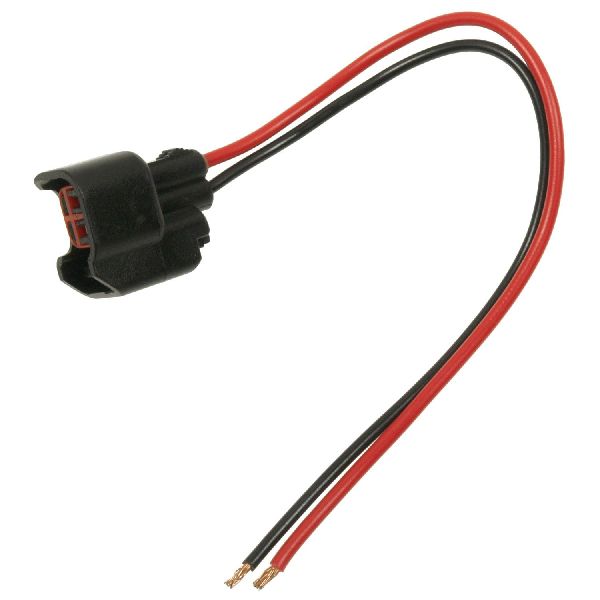
Aftermarket price range: $25 - $40 - Fuel Injector Connector Pigtail — The original plastic connectors become extremely brittle from heat and age. The locking tab will often break upon removal, preventing a secure connection. It's wise to have one on hand.
Trusted brands: Dorman, Standard Motor Products
OEM price range: $20 - $35
Aftermarket price range: $10 - $20
Related Codes That Often Appear With This One
- P0301 — P0301 means 'Cylinder 1 Misfire Detected.' Since the P0201 code indicates the injector isn't working, the cylinder can't fire properly, which logs a misfire code alongside the circuit code.
- P0316 — This code means 'Misfire Detected on Startup (First 1000 Revolutions).' It is often seen with a specific cylinder misfire on Ford vehicles. Manufacturer TSB #16-0163 notes that P0316 can appear intermittently alongside P0201-P0204 and various other drivability issues.
- P0171 — P0171 means 'System Too Lean (Bank 1)'. Because cylinder 1 is on Bank 1 (the rear bank), a non-functioning injector causes excess unburnt oxygen to be detected by the O2 sensor for that bank, leading to a lean code.
Technical Service Bulletins (TSBs) & Recalls
- While no TSB is specific to P0201 on this platform, GM TSB 21-NA-149 for a similar 3.0L engine details multiple wiring harness chafe points that can cause injector circuit codes (P0201-P0206). This highlights the importance of inspecting the harness, especially near the injector connectors and where the harness may contact brackets or the cylinder head.
- Manufacturer TSB #25-2569 describes a condition where the engine harness contacts a hose crimp end or spring clamp, resulting in P0201-P0206 and P0301-P0306 codes.
- Manufacturer TSB #16-0163 identifies an intermittent illuminated MIL with various drivability issues and codes including P0201 through P0204.
Platform-Specific Known Issues
- Intake Manifold Removal Pro-Tip: → Shop Engine Intake Manifold When removing the upper intake manifold, it is not necessary to drain the engine coolant. The throttle body, which has coolant lines attached, can be unbolted from the manifold and carefully moved aside without disconnecting the hoses, saving time and effort.
- Intake Manifold Torque Specification: → Shop Engine Intake Manifold The upper intake manifold bolts should be tightened in a specific sequence. The torque spec is 89 lb-in (10 Nm). Some sources for later models specify a torque-plus-angle procedure: tighten to 89 lb-in, then tighten an additional 45 degrees. Always follow the sequence shown in the service manual for your specific year.
Mechanic-Grade Diagnostic Values
- Fuel Injector Coil Resistance — expected: 11 - 15 Ohms. Failure: Infinite resistance (OL) indicates an open coil; near-zero resistance indicates a shorted coil. Both require injector replacement.
- Injector Connector Power Supply Voltage (KOEO) — expected: ~12V (Battery Voltage). Failure: Voltage significantly below battery voltage (e.g., <10V) or 0V points to a problem in the power supply (VPWR) wire, a bad fuse, or a faulty injector relay.
- Injector Control Circuit Waveform (Engine Running) — expected: A square wave pattern showing battery voltage, dropping to near 0V during the pulse, followed by a sharp inductive kick (voltage spike) of 35-50V when the injector closes.. Failure: A flat line at battery voltage indicates the PCM is not commanding the injector to fire or the injector coil is open, preventing the circuit from being pulled to ground. This missing pattern is a definitive sign of a circuit fault.
Scan Tool Commands That Help
- Ford IDS (or equivalent professional scanner): Power Balance Test — This is a highly effective functional test to use at the start of diagnosis. The command disables one cylinder at a time and graphs the RPM drop. If disabling cylinder 1 causes little or no change in RPM, it confirms that cylinder is not contributing power, validating the focus on that cylinder's fuel, spark, or compression.
- Ford IDS (or equivalent professional scanner): KOEO / KOER Self-Tests — Running the Key On, Engine Off (KOEO) and Key On, Engine Running (KOER) self-tests can help confirm if the P0201 code is hard-set or intermittent. The diagnostic trouble code chart from Ford's service manual begins with these tests.
Wiring & Ground Locations
- Cylinder 1 Injector Connector — On the fuel injector for cylinder 1, which is on the rear cylinder bank (against the firewall), on the passenger side of the engine.. This is the primary connection point to test. The power wire is typically Red (RD). The control wire (ground pulse from PCM) is typically Tan/White (TN/WH) for 2009+ models. Verify colors on a wiring diagram for your specific year.
- PCM Connector C175E — The Powertrain Control Module (PCM) is located on the firewall in the engine compartment.. This is the source of the injector control signal. For a 2010 3.0L, the Cylinder 1 injector control wire is Pin 59 (TN/WH wire). A continuity test should be performed between this pin and the corresponding pin at the injector connector to rule out a broken wire.
- G101 / G104 — For a 2010 3.0L, G101 is located near the battery, and G104 is on the left front of the engine compartment.. The PCM and other critical engine sensors rely on clean ground connections. A corroded or loose main engine ground can cause a variety of difficult-to-diagnose electrical issues, including erratic sensor readings or module behavior. While less likely to cause a single injector code, checking main grounds is good practice.
Real Owner Repair Stories
- YouTube video by 'Ron Ananian The Car Doctor' (2012 Ford Escape, 150,000 miles) — Check Engine Light with codes P0201 (Injector Circuit Open Cylinder 1) and P0301 (Cylinder 1 Misfire).
❌ Tried (didn't work) The diagnosis was methodical, so no parts were replaced unnecessarily. The technician immediately focused on the fuel system due to the P0201 code.
✅ What actually fixed it Diagnosis with a multimeter confirmed the cylinder 1 injector had an open circuit (infinite resistance), while other injectors tested at ~12 ohms. An oscilloscope confirmed the lack of a proper electrical pattern on cylinder 1. The final repair was to replace all six fuel injectors, a recommendation based on the vehicle's high mileage and the significant labor involved in accessing them. - NHTSA ODI #10405277 — An owner reported being forced to pull over on the highway when the vehicle threw codes P0201, P0202, P0203, and P0204. The dealer checked electrical connections and reassembled the components.
- NHTSA ODI #10944544 — A driver reported that the vehicle would turn over but not start, displaying codes P0201, P0202, and a code indicating an open circuit for every injector.
- NHTSA ODI #11551180 — An owner reported a P0301 misfire and P0201 fuel injector issue that resulted in a collision with a pole.
OEM Part Supersession History
5L8Z-9F593-AA (Motorcraft CM-5103)→For 2009-2012 models, the correct injector is often listed as Bosch P/N 0280158189 or Motorcraft CM-5130.— The 3.0L V6 engine was significantly updated for the 2009 model year, increasing horsepower from 200 to 240. This powertrain change included different fuel system components.
Heads up: Injectors for 2008 models are likely not compatible with 2009-2012 models due to the engine update. Always verify the part number against the vehicle's VIN. Using the wrong injector can lead to performance issues or fuel trim codes.
Model Year Variations Within This Range
- 2008 vs. 2009-2012: The 2008 model year was a transitional year; it featured the second-generation body style but carried over the 200hp 3.0L V6 and 4-speed automatic transmission from the first generation. For 2009, the 3.0L V6 was updated to 240hp and paired with a new 6-speed automatic transmission. This powertrain difference means that engine components, including fuel injectors, are not necessarily interchangeable between 2008 and 2009-2012 models.
Diagnostic Flowchart
Other Known Issues on This Vehicle
Issues unrelated to this code that are worth knowing about as an owner of this generation:
- Rear Shock Tower Rust 🔴 High — Very common in regions that use road salt ('Rust Belt'). The seam where the inner fender panels are spot-welded allows moisture to collect, causing the shock mount to rust completely through, detaching the shock from the body.
- 6F35 Transmission Failure 🔴 High — Commonly reported between 35,000 and 100,000 miles. Issues include harsh shifting, shift flares, slipping, or complete failure to engage in drive. Problems can stem from a leaking forward clutch piston, failed solenoids, or valve body issues.
- Electronic Throttle Body (ETB) Failure 🟠 Medium — Frequent issue, often occurring around 70,000 miles. Symptoms include stalling, surging, rough idle, and the 'wrench' light illuminating as the car enters limp mode. It is more common on the 3.0L V6 than the 2.5L I4. (Ref: While no specific recall for this generation, Ford has acknowledged ETB issues on other models with similar parts.)
- Leaking Driver's Side Axle Seal 🟠 Medium — A known issue for 2009-2012 models where the left front transaxle seal leaks transmission fluid. This can lead to low fluid levels and transmission damage if not addressed.
- Cracked Front ABS Tone Ring 🟡 Low — The metal tone ring on the front axle shafts can crack, causing the ABS and Traction Control lights to illuminate and the system to activate erratically at low speeds.
Used vs. New Parts: Buying Guide for This Vehicle
When a used part is the smart pick: A used part is generally not recommended for fuel injectors, as their internal condition and remaining lifespan are unknown. However, a used wiring harness pigtail from a low-mileage, non-damaged donor vehicle is a perfectly acceptable and cost-effective repair for a broken connector.
Donor-vehicle mileage cap: roughly under 100000 miles for the part to have meaningful remaining life.
What to inspect on the donor part:
- For a wiring pigtail, inspect for any signs of brittleness, cracking in the insulation, or corrosion on the pins.
- Ensure the plastic connector body and its locking tab are intact and not crumbling.
- Avoid any parts from vehicles with signs of engine fire or significant rodent damage.
OEM-only on this vehicle (don't cheap out):
- Powertrain Control Module (PCM) - A used PCM will have the incorrect VIN and security information, causing a no-start condition. Replacement requires a new or professionally reprogrammed unit specific to the vehicle.
Aftermarket brands forum-validated for this vehicle:
- Bosch (Often the Original Equipment Manufacturer)
- Standard Motor Products (SMP)
- Motorcraft (Ford's OEM brand)
Brands owners have reported issues with on this vehicle:
- Unnamed or generic 'no-brand' injectors from online marketplaces. These often have inconsistent flow rates, poor spray patterns, and high failure rates, which can lead to persistent performance issues or new trouble codes.
Real Owner Stories
Aggregated from forums and TSBs cited above. Mileages and costs reflect what owners reported in those sources.
2008-2012 Ford Escape 3.0L V6
Symptoms: The owner experienced a rough or shaking idle and a noticeable loss of power, with the engine occasionally stalling when coming to a stop.
What fixed it: Replacement of the fuel injector on the rear bank after confirming the internal electronic coil had failed due to heat cycles.
Source hint: https://www.escape-city.com/
2005 Ford Escape 3.0L V6
Symptoms: Poor power and symptoms similar to throttle position issues, but related to the fuel delivery system.
What fixed it: Diagnosis of the fuel system and injector circuit.
Source hint: https://www.scannydanner.com/forum/scannerdanner-forum/10-member-vehicle-repair-requests/10006-absolute-throttle-position-2005-ford-escape.html
Related OBD-II Codes
Frequently Asked Questions
Where is cylinder 1 located on the 2008-2012 Ford Escape 3.0L Duratec V6?
Do I need to drain the coolant to remove the intake manifold for an injector replacement?
What is the specific torque specification for the upper intake manifold bolts on this engine?
Is there a TSB for wiring harness issues causing P0201 on the Ford Escape?
Should I replace all the injectors if only the cylinder 1 injector is bad?
What resistance should I see when testing the cylinder 1 fuel injector?
Helpful Videos
We Have This Part in Stock


The information in this article is provided for general reference and educational purposes only. Vehicle specifications, procedures, and part compatibility can vary by production date, trim level, and region. Always consult your vehicle's factory service manual and verify part numbers before purchasing or performing repairs. Safety-critical components such as airbags, seat belts, and braking systems should be installed by a qualified professional.
- Ford Escape:
- 🧭 Diagnostic Flowchart
- 🎬 Helpful Videos
- 🛍️ Shop This Part
- What's Unique About the 2008-2012 Ford Escape
- Symptoms You May Notice
- Most Likely Causes
- Rare But Worth Checking
- Diagnosis Steps
- Parts You'll Likely Need
- Related Codes That Often Appear With This One
- Technical Service Bulletins (TSBs) & Recalls
- Platform-Specific Known Issues
- Mechanic-Grade Diagnostic Values
- Scan Tool Commands That Help
- Wiring & Ground Locations
- Real Owner Repair Stories
- OEM Part Supersession History
- Model Year Variations Within This Range
- Other Known Issues on This Vehicle
- Used vs. New Parts: Buying Guide for This Vehicle
- Real Owner Stories
- 2008-2012 Ford Escape 3.0L V6
- 2005 Ford Escape 3.0L V6
- Related OBD-II Codes
- Frequently Asked Questions
- 🎟️ Get 5% Off