

P0201 on 2019-2025 Genesis G70 3.3T: Injector Circuit Malfunction Causes and Fixes
P0201 on a Genesis G70 3.3T indicates an electrical fault with the cylinder 1 fuel injector. The main issue is that cylinder 1 is on the rear bank against the firewall, requiring intake manifold removal for access. This is a known issue on the G70 and its platform-mate, the Kia Stinger. The most likely cause is a failed injector or wiring. Due to the high labor cost (~4 hours), it's wise to replace all three rear bank injectors (cylinders 1, 3, 5) and the intake gaskets at the same time to preve
- P0201 is an electrical fault with the cylinder 1 injector circuit, not a fuel flow problem.
- The biggest challenge is that cylinder 1 is under the intake manifold, making it a labor-intensive repair (3-5 hours).
- The most likely causes are a bad fuel injector or a wiring issue near the injector.
- Due to the high labor cost, if you are removing the intake manifold, it is strongly recommended to replace all three rear bank injectors and the intake gaskets at the same time.
- A P0201 code will almost always appear with a P0301 (Cylinder 1 Misfire) code.
What's Unique About the 2019-2025 Genesis G70
The defining issue for a P0201 code on the Genesis G70 3.3T is the physical location of cylinder 1. The Lambda II V6 engine positions cylinders 1, 3, and 5 on the rear bank (driver's side in LHD vehicles), tucked against the firewall. To access the fuel injector, its connector, or the associated wiring for cylinder 1, the entire upper intake manifold must be removed. This turns a potentially simple electrical fix into a significant, labor-intensive job that can take a professional 3-4 hours, dramatically increasing the repair cost. This difficult access makes thorough diagnosis critical before starting the repair and is an identical issue on the Kia Stinger 3.3T.
Symptoms You May Notice
- Check Engine Light is on
- Engine runs rough, especially at idle
- Noticeable engine misfire (may feel like a shaking or stumbling)
- Hesitation or loss of power during acceleration
- Reduced fuel economy
- In some cases, the vehicle may enter 'limp mode' with reduced power.
- Engine may stall or be difficult to start.
- Replacing the spark plug or ignition coil for cylinder 1. While these parts can cause a P0301 misfire code, they will not cause a P0201 injector circuit code. P0201 is specifically an electrical fault in the injector circuit. It is crucial to read the specific code, as a P0301 misfire is more commonly a coil or plug, whereas P0201 points directly at the fuel injector circuit.
Most Likely Causes
- Faulty Cylinder 1 Fuel Injector 🔴 High Probability → Shop Fuel Injector The GDI (Gasoline Direct Injection) injectors operate under high stress. Some owner stories report injector failures, sometimes related to faulty seals. The high-heat environment at the rear of the engine contributes to component stress. In some forum discussions, owners experiencing misfires have had dealers replace the coil pack or injector to resolve the issue.
How to confirm: After removing the intake manifold, a technician can test the injector's resistance with a multimeter (comparing it to a known good injector) or send it for professional flow testing. The easiest confirmation for a DIYer is to swap the suspect injector with another one and see if the code follows the injector (e.g., P0201 becomes P0203 if swapped with cylinder 3).
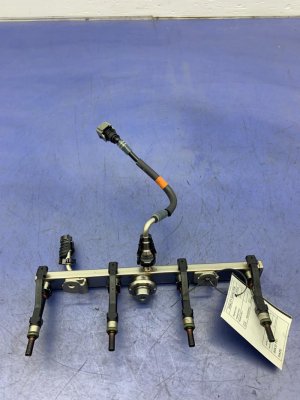
Typical fix: Replace the fuel injector. Due to the high labor cost, it is highly recommended to replace all three injectors on the rear bank (cylinders 1, 3, 5) at the same time. This is a common 'While You're In There' (WYAIT) recommendation.
Est. part cost: $70-$120 per injector - Wiring or Connector Issue 🟡 Medium Probability Engine bay heat can make wiring and connectors brittle over time. Rodent damage to the injector wiring harness has also been observed on this platform. The wiring harness for the rear bank is routed in a tight, hot area, increasing the risk of insulation breakdown.
How to confirm: Visually inspect the wiring harness leading to the cylinder 1 injector for any signs of damage, melting, or rodent chews. Check the connector for corrosion or loose pins. A technician would use a multimeter to check for continuity and voltage at the connector.
Typical fix: Repair the damaged section of wire or replace the connector pigtail. Ensure the repair is properly sealed against moisture.
Est. part cost: $10-$50 - Powertrain Control Module (PCM) Fault ⚪ Low Probability → Shop Engine Control Module (ECM) PCM failure is rare on most vehicles, including the G70. There are no widespread reports of PCM driver failures specific to this platform.
How to confirm: This is a last resort after the injector and wiring have been proven to be good. A technician can use an oscilloscope or advanced scan tool to verify if the PCM is sending the correct driver signal from the corresponding pin. This requires a wiring diagram and specialized tools.
Typical fix: The PCM would need to be repaired by a specialist or replaced and programmed by the dealership or a qualified shop.
Est. part cost: $600-$1500
Diagnosis Steps
- Confirm the presence of the P0201 code with an OBD-II scanner. Note any other codes, especially P0301.
- Acknowledge the location of Cylinder 1 on the rear bank (driver's side, against the firewall) and the necessity of removing the intake manifold for most physical tests.
- Before disassembly, a professional may test the circuit from the ECM connector to check for a signal and rule out a major wiring break. This requires specific pinout information from a service manual.
- Remove the strut tower braces, engine cover, and intake piping.
- Carefully remove the upper intake manifold, labeling all bolts and connections. It is required to replace the intake manifold gaskets during reassembly to prevent vacuum leaks.
- Once access is gained, perform a visual inspection of the injector wiring and connector for cylinder 1. Look for any obvious damage, such as melted plastic, chafed wires, or signs of rodents.
- Disconnect the injector and measure its resistance with a multimeter. Compare the reading to another injector on the same bank. A significant difference or an open/shorted circuit indicates a bad injector.
- A 'noid light' can be plugged into the injector connector to visually confirm if the ECM is sending a pulse signal. If the light flashes, the wiring and PCM driver are likely good, pointing to a bad injector.
- If the injector and wiring test good, the fault may lie within the PCM, which requires professional diagnosis.
- After replacing any parts, clear the codes and perform a test drive to ensure the issue is resolved.
Parts You'll Likely Need
- Fuel Injector
(OEM #35310-3L200)— This is the most probable cause of a P0201 code, assuming the wiring is intact. Due to the high labor cost, it's wise to replace all three rear bank injectors if one fails.
Trusted brands: Genuine Hyundai/Genesis
OEM price range: $80-$120
Aftermarket price range: $60-$90 - Upper Intake Manifold Gasket Set
(OEM #29215-3L100)— The intake manifold must be removed to access cylinder 1. The gaskets are considered a one-time-use item and must be replaced to prevent vacuum leaks.
Trusted brands: Genuine Hyundai/Genesis, Mahle, Fel-Pro
OEM price range: $40-$60
Aftermarket price range: $25-$40
Related Codes That Often Appear With This One
- P0301 — P0301 means 'Cylinder 1 Misfire Detected'. A P0201 circuit fault prevents the injector from delivering fuel correctly, which directly causes the cylinder to misfire. It is extremely common to see both codes together.
- P0300 — If the misfire is severe or intermittent, it might be logged as a 'Random/Multiple Cylinder Misfire' before being isolated to cylinder 1.
- P0303, P0305 — Misfire codes on the other rear-bank cylinders (3 and 5). If the root cause is a wiring harness issue affecting the entire bank, or if a technician recommends replacing all rear bank components, these codes may appear in the vehicle's history.
Platform-Specific Known Issues
- High-Pressure Fuel Pump (HPFP) Recall: Hyundai issued a recall (NHTSA 24V-528, Recall 262/023G) for some 2019-2023 Genesis G70s. The recall addresses premature wear in the fuel control valve plunger inside the HPFP, which can cause the engine to run rich and potentially lose power. While this typically causes fuel pressure codes (like P0191) rather than a P0201 circuit code, it is a critical fuel system issue owners should be aware of.
Mechanic-Grade Diagnostic Values
- Fuel Injector Resistance — expected: 12.5–13.5 Ohms. Failure: A reading outside this range, or an open/infinite reading, indicates a failed injector coil.
- Low-Side Fuel Pressure (at fuel rail) — expected: 40 to 60 psi. Failure: While not a direct cause for P0201, pressure outside this range indicates a problem with the in-tank fuel pump that should be addressed.
- High-Side Fuel Pressure (GDI System, under load) — expected: ~2,500-3,000 psi. Failure: Significantly low or fluctuating pressure can indicate a failing High-Pressure Fuel Pump (HPFP), though this typically sets other codes like P0088.
- Injector Pulse Width (at idle) — expected: Minimum 1.0 ms. Failure: This value gives insight into the ECM's fueling strategy. While not a direct failure indicator for a P0201 circuit fault, it helps understand overall engine health.
Scan Tool Commands That Help
- Genesis GDS (Global Diagnostic System): Live Data / Current Data -> Misfire Counter — Use this to view the raw, real-time misfire count for each cylinder. This is essential for confirming the misfire is isolated to cylinder 1 (accompanying a P0301) and to check for intermittent misfires on other cylinders that haven't yet triggered a code.
- Genesis GDS (Global Diagnostic System): Actuation Test -> Fuel Injector Balance/Activation — This bidirectional control allows a technician to command a specific injector to fire. By listening for the injector's click with a stethoscope or observing a drop in RPM, you can confirm if the ECM driver and wiring are capable of activating the injector. This helps differentiate a wiring/ECM issue from a mechanically failed (clogged) injector.
Wiring & Ground Locations
- Engine Control Module (ECM) — Located in the engine bay on the driver's side, just ahead of the brake fluid reservoir and next to the strut tower.. The ECM contains the injector driver circuits. All wiring for the fuel injectors originates from this module. A visual inspection of its connectors for corrosion or damage is a valid, though advanced, diagnostic step. A known chafe point for the engine harness exists near the ECM/TCM bracket.
OEM Part Supersession History
35310-3L210→35310-3L200— Part number consolidation or minor revision by the manufacturer. Functionality remains the same.
Heads up: An aftermarket seller notes that part number 35310-3L210 is a valid replacement for 35310-3L200, while an OEM parts dealer states that 35310-3L200 replaces 35310-3L210. The parts are likely interchangeable.
Model Year Variations Within This Range
- 2019-2021: These are pre-facelift models. While mechanically identical regarding this fault, they have different infotainment and exterior styling.
- 2022-2025: These post-facelift models feature new styling, a larger infotainment screen, and a variable exhaust system. However, the 3.3T engine, fuel system, and ignition components related to a P0201 code remain unchanged from earlier models.
- 2024-2025: The base 2.0T engine was replaced by a 2.5T. This does not affect the 3.3T V6 engine, which is the subject of this article.
Diagnostic Flowchart
Other Known Issues on This Vehicle
Issues unrelated to this code that are worth knowing about as an owner of this generation:
- Paint Peeling/Chipping 🟠 Medium — Commonly reported, especially on early model years. Often occurs around panel edges like wheel wells and bumpers. Owners report the paint is soft and chips easily.
- Electronic Wastegate Actuator Rattle 🟠 Medium — A noticeable rattle can develop from the turbo wastegate actuators. In some cases, the actuator needs replacement, which can be expensive as dealers may recommend replacing the entire turbocharger assembly.
- Premature Brake Rotor Warping / Shudder 🟡 Low — A common complaint on both the G70 and Kia Stinger is a vibration or shudder under braking, often attributed to warped rotors or uneven pad deposits on the stock Brembo brakes. Many owners upgrade to aftermarket pads and rotors to resolve the issue.
- Limited-Slip Differential (LSD) Whine/Failure 🟠 Medium — Some owners of LSD-equipped models have reported whining noises during low-speed turns or, in some cases, complete failure requiring a costly replacement. This is also a known issue on the Kia Stinger.
- Sunroof Rattle 🟡 Low — Owners have reported an intermittent rattling noise from the sunroof assembly, which can sometimes be fixed by lubricating the mechanism or adding foam padding.
- Harsh Transmission Downshifts 🟡 Low — Some owners, particularly of earlier models, note jerky or harsh downshifts from the 8-speed automatic transmission, especially when coming to a stop in traffic.
Used vs. New Parts: Buying Guide for This Vehicle
When a used part is the smart pick: For this specific repair, using used parts is generally not recommended. The primary failure part is the fuel injector, a high-precision component operating under extreme pressure and heat. The labor cost to access the rear bank injectors is very high, making the risk of installing a used part with unknown history and limited lifespan a poor economic choice. If a do-over is required, the labor costs will far exceed any initial savings on the part.
Donor-vehicle mileage cap: roughly under 20000 miles for the part to have meaningful remaining life.
What to inspect on the donor part:
- Verify the part number (35310-3L200) matches exactly.
- Inspect the electrical connector for any cracks, corrosion, or bent pins.
- Examine the injector tip for signs of heavy carbon buildup or physical damage.
- Ask for the donor vehicle's VIN to check for accident history; avoid parts from flood or fire-damaged vehicles.
OEM-only on this vehicle (don't cheap out):
- Fuel Injector (35310-3L200)
- Upper Intake Manifold Gasket Set (29215-3L100)
Brands owners have reported issues with on this vehicle:
- Unbranded, 'no-name' injectors from online marketplaces. An aftermarket seller notes that due to differences in atomization and flow, mixing aftermarket and OEM injectors is not recommended, and a full set should be replaced if going the aftermarket route.
Real Owner Stories
Aggregated from forums and TSBs cited above. Mileages and costs reflect what owners reported in those sources.
2019 Genesis G70 3.3T
Symptoms: Engine misfires and multiple cylinder misfire codes (P0301-P0306) along with other fuel system codes.
What fixed it: The owner suspected a failing High-Pressure Fuel Pump (HPFP).
Source hint: genesisg70forum.com / Reddit r/GenesisG70
2019-2025 Genesis G70 3.3T
Symptoms: Noticeable misfires; the dealer initially investigated the ignition system.
What fixed it: The dealer replaced the coil pack or injector to resolve the issue.
Source hint: forum discussions cited in context
2017-2023 Kia Stinger GT (3.3T)
Symptoms: Injector failure on the rear bank, which is difficult to access.
What fixed it: Replacement of the fuel injector; often recommended to replace all injectors on the bank (1, 3, 5) due to labor.
Source hint: Go-Parts.com
Related OBD-II Codes
Frequently Asked Questions
Where is Cylinder 1 located on the 3.3T Lambda II V6 engine?
Is there a recall for the fuel system on the 2019-2023 Genesis G70 that could be related to P0201?
Why is the labor cost so high for replacing a single injector on the G70 3.3T?
Should I replace all injectors on the bank if only Cylinder 1 is failing?
Can I swap injectors to troubleshoot the P0201 code on this engine?
Are there any specific wiring concerns for the G70's injector harness?
We Have This Part in Stock

The information in this article is provided for general reference and educational purposes only. Vehicle specifications, procedures, and part compatibility can vary by production date, trim level, and region. Always consult your vehicle's factory service manual and verify part numbers before purchasing or performing repairs. Safety-critical components such as airbags, seat belts, and braking systems should be installed by a qualified professional.
- Genesis G70:
- 🧭 Diagnostic Flowchart
- 🛍️ Shop This Part
- What's Unique About the 2019-2025 Genesis G70
- Symptoms You May Notice
- Most Likely Causes
- Diagnosis Steps
- Parts You'll Likely Need
- Related Codes That Often Appear With This One
- Platform-Specific Known Issues
- Mechanic-Grade Diagnostic Values
- Scan Tool Commands That Help
- Wiring & Ground Locations
- OEM Part Supersession History
- Model Year Variations Within This Range
- Other Known Issues on This Vehicle
- Used vs. New Parts: Buying Guide for This Vehicle
- Real Owner Stories
- 2019 Genesis G70 3.3T
- 2019-2025 Genesis G70 3.3T
- 2017-2023 Kia Stinger GT (3.3T)
- Related OBD-II Codes
- Frequently Asked Questions
- 🎟️ Get 5% Off