

P0201 on 2018-2023 Kia Stinger 3.3T: Injector Circuit Malfunction Causes and Fixes
On a 2018-2023 Kia Stinger 3.3T, code P0201 almost always indicates a failed fuel injector in cylinder 1 or a wiring issue. Cylinder 1 is easily accessible on the front passenger side of the engine, making this a straightforward repair. Expect to pay around $70-$150 for a new OEM injector.
- P0201 is an electrical fault for the cylinder 1 fuel injector, not a spark or mechanical issue.
- The most effective DIY diagnostic is to swap the injector from cylinder 1 with another one on the same (passenger side) bank to see if the fault code follows the injector.
- Cylinder 1 is at the front of the engine on the passenger side and is relatively easy to access, making this a manageable DIY repair.
- Always replace the Teflon injector seal and O-ring when reinstalling a GDI injector to prevent dangerous fuel leaks.
- Driving with this code can lead to costly damage to the catalytic converter, so it should be addressed promptly.
What's Unique About the 2018-2023 Kia Stinger
The Kia Stinger's 3.3T Lambda II is a twin-turbocharged Gasoline Direct Injection (GDI) engine. Its fuel injectors operate under extremely high pressure, which can contribute to eventual failure. Unlike a misfire on the rear bank of this engine, P0201 is for cylinder 1, which is located at the front of the engine on the passenger side. This makes it one of the easiest injectors to access, significantly reducing the labor time and cost typically associated with V6 engine repairs. The issue is also seen on its direct platform mate, the Genesis G70 3.3T.
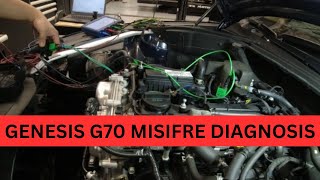
🎬 Watch: A detailed breakdown of the 3.3T engine layout.Symptoms You May Notice
- Check Engine Light (CEL) is on
- Rough or shaking idle
- Engine hesitation or stumbling on acceleration
- Noticeable loss of power
- Reduced fuel economy
- A flashing Check Engine Light if the misfire is severe
- Engine may go into 'limp mode' with drastically reduced power
- Smell of raw fuel from the exhaust
- Replacing the spark plug or ignition coil. While these parts cause misfires (P0301), P0201 is an electrical circuit code specific to the fuel injector. A bad coil or plug will not cause a P0201.
Most Likely Causes
- Failed Cylinder 1 Fuel Injector 🔴 High Probability → Shop Fuel Injector As a high-pressure GDI component, the injector's internal coil can fail electrically over time, creating an open circuit. This is the most common cause for a P0201 code. 🎬 See this video on what P0201 means and how to fix it.
How to confirm: The most definitive test is to swap the cylinder 1 fuel injector with another accessible injector (e.g., cylinder 3 or 5 on the same bank). Clear the codes and run the engine. If the code changes to P0203 or P0205, the injector is faulty. Alternatively, use a multimeter to check the resistance across the injector's two pins; if it reads as an open circuit (infinite resistance) or is outside of the manufacturer's specification (approx. 12.5-13.5 Ohms), it has failed.
Typical fix: Replace the faulty fuel injector and its associated seals.
Est. part cost: $70-$150 - Wiring Harness or Connector Damage 🟡 Medium Probability Engine bay heat and vibration can cause wires to become brittle and break over time. Rodent damage is also a possibility, as they can chew on the wire insulation. A loose or corroded connector at the injector can also interrupt the signal.
How to confirm: Visually inspect the wiring harness and connector going to the cylinder 1 fuel injector. Look for any signs of chafing, melting, corrosion, or breaks. Ensure the connector is fully seated and the locking tab is engaged. Use a multimeter to check for continuity on the two wires from the injector connector back to the PCM. A 'noid light' can be plugged into the injector connector to see if the PCM is sending a pulse; if it flashes, the wiring and PCM are good.
Typical fix: Repair the damaged section of the wiring harness or replace the connector pigtail. In cases of extensive damage, the injector harness may need replacement.
Est. part cost: $10-$60
Rare But Worth Checking
- Faulty Powertrain Control Module (PCM): → Shop Engine Control Module (ECM) This is the least likely cause. The internal driver circuit for the injector can fail within the PCM. This should only be considered after the injector and wiring have been definitively ruled out as the cause.
Diagnosis Steps
- Read the trouble codes with an OBD-II scanner to confirm P0201 and check for any other codes like P0301.
- Locate cylinder 1. On the 3.3T V6, this is the cylinder at the front of the engine on the passenger side.
- Carefully inspect the electrical connector and wiring harness leading to the cylinder 1 fuel injector. Look for loose connections, corrosion, or any signs of damage. Ensure the connector clicks into place.
- If the wiring appears intact, perform an injector swap. Disconnect the battery. Relieve fuel pressure. Swap the fuel injector from cylinder 1 with the injector from cylinder 3 (the middle cylinder on the passenger side).
- Reassemble, making sure to replace the Teflon seals and O-rings on both injectors. Reconnect the battery and start the engine. Let it run for a few minutes.
- Scan for codes again. If the code has changed to P0203 ('Injector Circuit/Open - Cylinder 3'), the fuel injector you moved is faulty and needs to be replaced.
- If the code P0201 returns, the problem is in the wiring harness or the PCM. Use a 'noid light' to test the cylinder 1 injector connector. If the light flashes while cranking, the wiring and PCM are likely okay, 🎬 Watch: Advanced misfire diagnosis using an oscilloscope. pointing back to an intermittent injector issue. If the noid light does not flash, perform continuity tests on the harness wires back to the PCM to find the break.
Parts You'll Likely Need
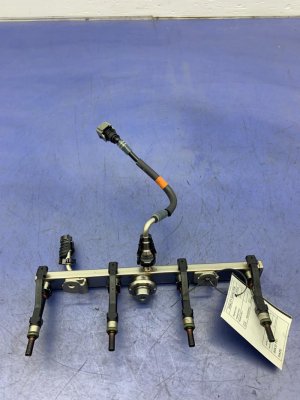
- Fuel Injector
(OEM #35310-3L000)— The internal coil of the high-pressure GDI injector is the most common failure point that triggers an electrical circuit fault like P0201.
Trusted brands: Kia/Hyundai (OEM)
OEM price range: $150-$225
Aftermarket price range: $50-$100 - Fuel Injector Seal Kit
(OEM #35312-2G750 (Injector O-Ring Kit))— The Teflon seal at the tip of the GDI injector and the upper O-ring must be replaced whenever an injector is removed and reinstalled to prevent high-pressure fuel and compression leaks. This is a critical safety step.
Trusted brands: Kia/Hyundai (OEM), AJUSA
OEM price range: $15-$25
Aftermarket price range: $10-$20
Related Codes That Often Appear With This One
- P0301 — This code means 'Cylinder 1 Misfire Detected'. Since P0201 indicates the injector circuit has failed, the cylinder isn't getting fuel, which directly causes it to misfire. P0201 is the cause, and P0301 is the effect.
- P0200 — This code for 'Injector Circuit/Open' is a general fault. It may appear with P0201 if the PCM detects a problem common to multiple injectors, like a blown fuse, a faulty relay, or a shared power/ground wire issue in the harness.
Platform-Specific Known Issues
- Real-World Forum Discussion: While specific threads for P0201 on the Stinger are not widespread, discussions on platform-mates like the Genesis G70 confirm that injector circuit codes (P020x) are typically resolved by replacing the specific injector or checking the wiring. The diagnostic process of swapping injectors is a community-accepted method.
Mechanic-Grade Diagnostic Values
- Fuel Injector Coil Resistance — expected: 12.5 – 13.5 Ohms at 68°F (20°C). Failure: A reading of infinity (open circuit), zero (short circuit), or a value significantly outside the expected range.
- Injector Connector Voltage (Power Wire) — expected: Battery Voltage (~12V) with Key On, Engine Off. Failure: No voltage or significantly low voltage suggests a problem with the power supply fuse, relay, or wiring.
- Low-Pressure Fuel System — expected: 50-80 PSI. Failure: Pressure below this range indicates a failing in-tank low-pressure fuel pump (LPFP) or a clogged filter, which can starve the high-pressure pump but won't directly cause P0201.
- High-Pressure Fuel System (at idle) — expected: Approximately 600 PSI. Failure: While not a direct cause of P0201, pressure far below the desired value on a scan tool points to a high-pressure fuel pump (HPFP) issue, which typically sets other codes like P0087.
Scan Tool Commands That Help
- Kia GDS (Global Diagnostic System): Actuation Test / Active Test — To individually disable or activate the cylinder 1 fuel injector while the engine is running. This helps confirm if the PCM driver is functional and allows for a power balance test to see if killing the injector changes the engine's idle quality. If there's no change, it confirms the injector was not working to begin with.
Wiring & Ground Locations
- Cylinder 1 Injector Connector — On top of the fuel injector for cylinder 1, which is the front-most cylinder on the passenger side of the engine.. This is the primary point for testing. A noid light can verify the PCM pulse signal, and a multimeter can check for power and injector resistance at this connector.
- Engine Control Module (ECM/PCM) — Located in the engine bay on the driver's side, near the strut tower and brake fluid reservoir.. The two wires from the cylinder 1 injector connector terminate here. A continuity test between the injector connector pins and the corresponding pins at the ECM connector can definitively rule out a wiring break.
- Engine Ground Strap — Main engine ground straps are typically thick black cables bolted from the engine block or cylinder head to the vehicle's chassis/frame rail.. While a poor engine ground usually causes multiple, widespread electrical issues and codes, a loose or corroded ground can introduce electrical noise and intermittent problems in various sensor and actuator circuits, including the injectors.
Real Owner Repair Stories
- GenesisG70.com forum user (Genesis G70 3.3T (platform mate)) — Check Engine Light with codes P0201 and P0301.
❌ Tried (didn't work) Initial diagnosis pointed towards the injector or wiring.
✅ What actually fixed it The owner swapped the cylinder 1 injector with the cylinder 3 injector. The code changed to P0203, confirming the injector was faulty. Replacing the bad fuel injector resolved the issue.
OEM Part Supersession History
35310-3L000→35310-3L050— Production revision or supplier change. Functionally interchangeable for this application.
Diagnostic Flowchart
Other Known Issues on This Vehicle
Issues unrelated to this code that are worth knowing about as an owner of this generation:
- Left Turbocharger Oil Feed Pipe Leak 🔴 High — Common enough to trigger a recall (NHTSA ID: 23V592000) for 2018-2023 models. The pipe and hose assembly can deteriorate and leak oil, posing a fire risk. (Ref: Recall SC278 / NHTSA 23V592000)
- Brake Judder / Warped Rotors 🟠 Medium — Frequently reported by owners, sometimes as early as 20,000-30,000 miles. The stock Brembo brake pads and rotors are known to cause vibration under braking.
- Tailgate Rattle 🟡 Low — Common on early 2018 models. A rattle noise from the rear hatch area when driving over bumps. (Ref: TSB SA322 (Rev 1))
- Sunset Yellow Paint Chipping 🟠 Medium — Affects only the 'Sunset Yellow' color on 2018 models. The paint had an adhesion issue causing it to chip easily. Kia offered a voluntary repaint program or buyback. (Ref: Voluntary Service Campaign / Recall)
- HECU (Hydraulic Electronic Control Unit) Fire Risk 🔴 High — Affects certain 2018-2021 models. An electrical short can occur within the HECU for the anti-lock brake system, potentially causing an engine compartment fire. (Ref: Recall SC206 / NHTSA 20V518000)
- High Pressure Fuel Pump (HPFP) Failure 🔴 High — A recall was issued for 2018-2021 models where the fuel control valve plunger could stick, causing over-pressurization and a loss of drive power. (Ref: Recall SC220 / NHTSA 21V449000)
Used vs. New Parts: Buying Guide for This Vehicle
When a used part is the smart pick: For this repair, a used part is only recommended for the wiring harness connector (pigtail) if the original is damaged. Due to the sensitive nature of GDI injectors, a used injector is not advised.
Donor-vehicle mileage cap: roughly under 60000 miles for the part to have meaningful remaining life.
What to inspect on the donor part:
- For a wiring pigtail, ensure the plastic is not brittle or cracked.
- Check that the locking tab is intact and functional.
- Inspect the wire insulation for any signs of melting, chafing, or previous repairs.
OEM-only on this vehicle (don't cheap out):
- Fuel Injector: OEM or a reputable OEM-equivalent is strongly recommended. Cheap aftermarket GDI injectors are known for inconsistent spray patterns and premature failure.
- Fuel Injector Seals: Always use new, high-quality seals for any GDI injector installation to prevent dangerous high-pressure fuel leaks.
Brands owners have reported issues with on this vehicle:
- Generic, unbranded injectors from online marketplaces should be avoided due to quality control concerns.
Real Owner Stories
Aggregated from forums and TSBs cited above. Mileages and costs reflect what owners reported in those sources.
2019 Genesis G70 3.3T
Symptoms: Cylinder 1 misfire accompanied by a P0201 code; the article confirms this is a common companion code on this platform.
What fixed it: Replacing the specific injector or checking the wiring; the diagnostic process of swapping injectors was used to confirm the fault.
Source hint: Go-Parts G70 P0301/P0201 Article
Related OBD-II Codes
Frequently Asked Questions
Is the P0201 code on my Kia Stinger 3.3T related to the High Pressure Fuel Pump recall?
Can I use a used fuel injector from a salvaged Genesis G70 to fix this code?
Where is Cylinder 1 located on the Stinger 3.3T V6 engine?
What is the correct resistance specification for the Stinger's 3.3T fuel injectors?
Does the Stinger share this injector issue with other vehicles?
Is there a TSB for the rattling sound I hear while diagnosing this engine code?
Helpful Videos

We Have This Part in Stock

The information in this article is provided for general reference and educational purposes only. Vehicle specifications, procedures, and part compatibility can vary by production date, trim level, and region. Always consult your vehicle's factory service manual and verify part numbers before purchasing or performing repairs. Safety-critical components such as airbags, seat belts, and braking systems should be installed by a qualified professional.
- Kia Stinger:
- 🧭 Diagnostic Flowchart
- 🎬 Helpful Videos
- 🛍️ Shop This Part
- What's Unique About the 2018-2023 Kia Stinger
- Symptoms You May Notice
- Most Likely Causes
- Rare But Worth Checking
- Diagnosis Steps
- Parts You'll Likely Need
- Related Codes That Often Appear With This One
- Platform-Specific Known Issues
- Mechanic-Grade Diagnostic Values
- Scan Tool Commands That Help
- Wiring & Ground Locations
- Real Owner Repair Stories
- OEM Part Supersession History
- Other Known Issues on This Vehicle
- Used vs. New Parts: Buying Guide for This Vehicle
- Real Owner Stories
- 2019 Genesis G70 3.3T
- Related OBD-II Codes
- Frequently Asked Questions
- 🎟️ Get 5% Off