

P0204 on 2012-2016 Chevrolet Impala 3.6L V6: Injector Circuit Fault Causes and Fixes
For a 2012-2016 Impala with the 3.6L LFX engine, code P0204 is most often caused by a failed fuel injector for cylinder 4 or a chafed wiring harness. A GM Technical Service Bulletin (PIP4924D) highlights the wiring harness issue as a known problem on this platform. Expect to pay $70-$180 for a new injector and inspect the harness near the intake plenum and cylinder head for damage before replacing parts.
- P0204 is an electrical fault for the cylinder 4 injector circuit, not a mechanical problem.
- The most likely cause on this specific engine is either a chafed wiring harness (per GM TSB #PIP4924D) or a failed fuel injector.
- Always perform a detailed visual inspection of the wiring harness before buying parts.
- Cylinder 4 is the middle cylinder on the engine bank closer to the radiator.
- Replacing the injector is a complex job (DIY Difficulty 4/5) as it requires removing the intake manifold and dealing with a high-pressure GDI fuel system.
What's Unique About the 2012-2016 Chevrolet Impala
The 2012-2016 Impala with the 3.6L LFX V6 is specifically mentioned in a GM Technical Service Bulletin (TSB #PIP4924D) for issues with the fuel injector wiring harness. The harness is known to rub against engine components like the intake plenum, sharp edges of the cylinder head, or fuel lines, leading to chafing and electrical faults that can trigger a P0204 code. This makes a wiring inspection a critical first step, as it's a more common issue on this platform than on many other vehicles.
Generation note: The 2012-2016 period covers two Impala generations. The 2012-2013 models are the end of the 9th generation (W-body). For 2014, Chevrolet sold both the new 10th generation model and a fleet version called the 'Impala Limited,' which was the 9th generation body style. The 2015-2016 models are all 10th generation. Both generations used the 3.6L LFX V6, and the causes and fixes for P0204 are applicable to both.
Symptoms You May Notice
- Check Engine Light is on
- Engine runs rough or idles poorly
- Noticeable engine misfire (may be accompanied by code P0304)
- Hesitation or stumbling during acceleration
- Reduced engine power and poor fuel economy
- Hard starting or extended cranking
- Replacing the spark plug or ignition coil for cylinder 4. While these parts can cause a misfire (code P0304), they will not cause an injector circuit code like P0204, which is specifically an electrical fault.
Most Likely Causes
- Damaged Fuel Injector Wiring Harness 🔴 High Probability → Shop Engine Wiring Harness GM TSB #PIP4924D specifically documents that the injector harness on the 3.6L LFX engine is prone to rubbing against the intake plenum, valve cover bolts, or the sharp edge of the cylinder head, causing wires to break or short out.
How to confirm: Perform a thorough visual inspection of the injector wiring harness, especially for Bank 2 (the bank closer to the radiator). Look for signs of rubbing, melting, or exposed copper wires. Wiggling the harness with the engine running may cause the misfire to change or worsen, confirming a wiring issue.
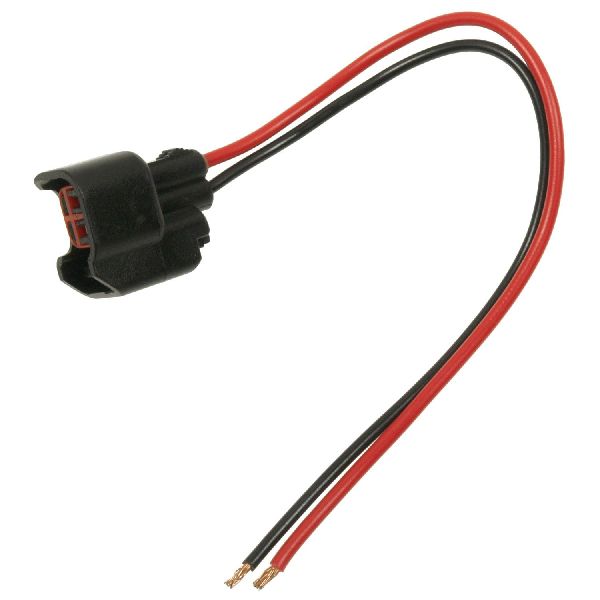
Typical fix: Repair the damaged section of wire using a solder and heat-shrink butt connector. If the damage is at the connector, replace the injector connector pigtail.
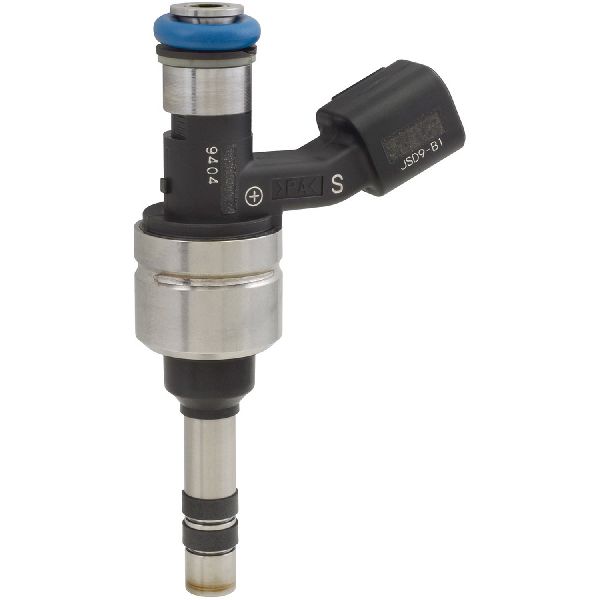
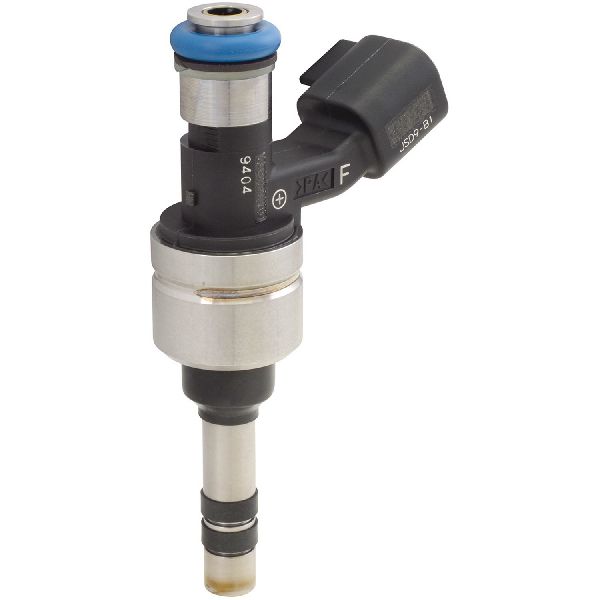
Est. part cost: $15-$40 - Failed Cylinder 4 Fuel Injector 🔴 High Probability → Shop Fuel Injector The LFX engine uses Gasoline Direct Injection (GDI), where injectors operate under high pressure and heat inside the cylinder, making them susceptible to internal electrical failure of the coil winding over time.
How to confirm: Swap the cylinder 4 injector with an adjacent one (e.g., cylinder 2 or 6). If the trouble code moves to the new cylinder (e.g., P0202 or P0206), the injector is bad. Alternatively, use a multimeter to check the injector's resistance. It should be between 1.2 and 1.8 ohms for this engine. A Reddit user with a 2012 Impala 3.6L reported all their injectors measured between 1.8 and 2.3 Ohms, which may represent a more realistic real-world range for used injectors. An infinite resistance reading (OL) means the injector coil is open and has failed.
Typical fix: Replace the faulty fuel injector. Since this requires removing the intake manifold, many technicians recommend replacing all three injectors on that bank at the same time. The high-pressure fuel line is a one-time use part and must also be replaced.
Est. part cost: $70-$180 - Loose or Corroded Injector Connector ⚪ Low Probability
How to confirm: Visually inspect the connector for cylinder 4. Check for corrosion on the pins, a broken locking tab, or a loose fit. Disconnect and reconnect it to ensure a solid connection. Check for backed-out pins within the connector housing.
Typical fix: Clean the connector terminals with electrical contact cleaner or replace the connector pigtail if it's damaged.
Est. part cost: $15-$40
Rare But Worth Checking
- Failed Powertrain Control Module (PCM): → Shop Engine Control Module (ECM) This is the least likely cause. The injector driver circuit within the PCM can fail, but this should only be considered after the injector and wiring have been thoroughly tested and confirmed to be good.
Diagnosis Steps
- Verify the code with an OBD-II scanner and check for any other pending codes.
- Locate Cylinder 4. On the transversely mounted LFX V6, the cylinders are arranged in two banks. Bank 2 is closer to the radiator and contains cylinders 2, 4, and 6 from left to right (passenger to driver side). Cylinder 4 is the middle cylinder on the front bank.
- Visually inspect the wiring harness leading to the Bank 2 injectors. Pay close attention to areas where it might rub against the intake manifold, cylinder head edges, and fuel lines, as noted in TSB #PIP4924D.
- Disconnect the electrical connector from the cylinder 4 injector. Use a noid light to test for a signal. The light should flash consistently when the engine is cranked or running. 🎬 Watch: A helpful guide on testing and fixing bad injectors If it flashes, the wiring and ECM are likely good, and the injector is the problem.
- If the noid light does not flash, check for power on one pin of the connector. With the key in the 'ON' position, one wire should have battery voltage (approx. 12V). The other wire is the control wire, which the ECM pulses to ground to fire the injector.
- Test the fuel injector itself. With the injector disconnected, use a multimeter set to Ohms (Ω) to measure the resistance between its two pins. 🎬 See how to test resistance and circuit design on this engine For the LFX engine, the specification is generally cited as 1.2 to 1.8 ohms, though some sources suggest a slightly wider range of 1.5 to 2.5 ohms is acceptable. A reading of infinite resistance (OL) or zero ohms means the injector is open or shorted and needs replacement.
- If the injector tests good but there is no signal at the connector, perform a continuity test on the two wires between the injector connector and the ECM connector to check for a break or short in the wiring.
- As a final confirmation, swap the cylinder 4 injector with another injector from the same bank (e.g., cylinder 2). Clear the codes and run the engine. If the code changes to P0202, the injector is confirmed to be faulty. If P0204 returns, the fault lies in the wiring or PCM.
Parts You'll Likely Need
- Fuel Injector
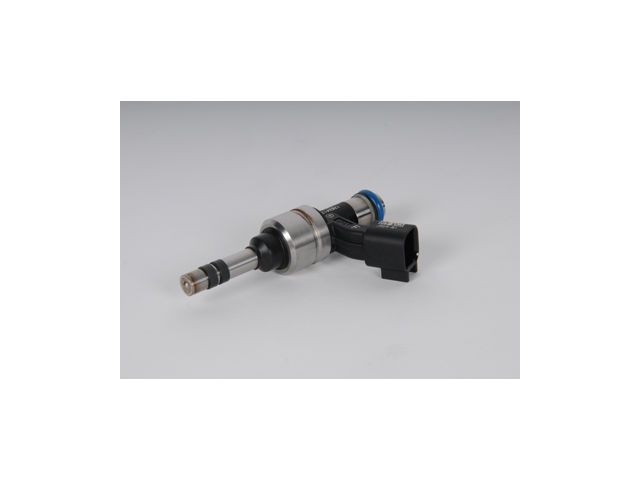
(OEM #12634123)— This is the most common failure part that causes a P0204 code when wiring is not the issue. The internal coil of the injector fails, creating an open circuit.
Trusted brands: ACDelco, Bosch, Hitachi, Standard Motor Products
OEM price range: $110-$185
Aftermarket price range: $70-$120 - Fuel Injector Connector Pigtail
(OEM #PT2160)— If the wiring is damaged right at the connector, or the connector itself is broken, replacing the pigtail is the standard repair. The connector type is a USCAR / EV6.
Trusted brands: ACDelco, Dorman
OEM price range: $25-$40
Aftermarket price range: $15-$30 - Upper and Lower Intake Manifold Gaskets
(OEM #ACDelco 12679529 (Upper Set), Fel-Pro MS97214 (Lower Set))— These must be replaced whenever the intake manifold is removed to access the fuel injectors on the LFX engine. They are not reusable.
Trusted brands: Fel-Pro, ACDelco, Mahle
OEM price range: $50-$80
Aftermarket price range: $30-$60 - High Pressure Fuel Line
(OEM #12639208)— This is a one-time use, torque-to-yield part that connects the high-pressure fuel pump to the fuel rail. It must be replaced anytime it is loosened or removed for injector service.
Trusted brands: ACDelco (GM Genuine)
OEM price range: $20-$35
Related Codes That Often Appear With This One
- P0304 — This code means 'Cylinder 4 Misfire Detected.' Since P0204 indicates a fault in the fuel delivery circuit for cylinder 4, a misfire is a direct and very common consequence.
- P0202, P0206 — If other injector codes for the same bank (Bank 2) appear, it strongly suggests a wiring harness problem common to all three cylinders, such as a chafed harness or a bad ground connection, as described in TSB #PIP4924D.
Technical Service Bulletins (TSBs) & Recalls
- PIP4924D: This bulletin addresses engine misfires and various injector circuit codes (P0201-P0206) caused by the fuel injector wiring harness rubbing against engine components like the intake plenum, cylinder head, or fuel lines. According to manufacturer TSB #PIP4924D, technicians may also find related codes such as P0261, P0264, P0267, P0270, P0273, P0276, P2146, P2149, P2152, or P2155 when this harness issue is present.
Platform-Specific Known Issues
- GM Technical Service Bulletin #PIP4924D explicitly calls out the fuel injector wiring harness for chafing issues on the 3.6L LFX engine, making it a primary suspect for any injector circuit code.
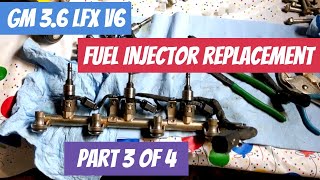
- A YouTube video by 'Certified Shadetree' titled '2012-2016 Impala/Limited (9th Gen) 3.6 LFX Upper Intake Manifold Reinstallation' documents the entire process of replacing injectors and cleaning intake valves, noting that the injector retaining clips are particularly difficult to work with.
Mechanic-Grade Diagnostic Values
- Fuel Injector Coil Resistance — expected: 1.2 to 1.8 Ohms (cold). Some sources and owner experiences suggest up to 2.5 Ohms can be seen on used injectors.. Failure: A reading of OL (infinite resistance) indicates an open coil. A reading near zero indicates a shorted coil. Any significant deviation from the other injectors on the engine warrants suspicion.
- Injector Power Supply Voltage (at connector) — expected: Battery Voltage (approx. 12.6V with Key On, Engine Off) on the power feed wire (typically Pink/Black).. Failure: Low or no voltage indicates a problem in the power supply circuit from the fuse block, not the injector or ECM driver.
- GDS2 Scan Tool 'Injector Balance' Test — expected: When an injector is disabled via the scan tool, the fuel rail pressure drop should be within 20% of the average of the other injectors.. Failure: A cylinder that shows a significantly smaller or larger pressure drop when its injector is pulsed indicates a flow problem (clogged or leaking). No change in engine operation when disabled points to a dead injector or circuit.
Scan Tool Commands That Help
- GM GDS2 / Tech2: Fuel Injector Balance Test (or Cylinder Power Balance) — This bidirectional command is used to isolate a faulty injector without disassembly. The tool commands the ECM to turn off each injector one by one. If disabling cylinder 4 causes no change in engine idle, while disabling others causes a noticeable stumble, it confirms the cylinder 4 injector circuit is inactive. It can also measure the fuel pressure drop for each injector pulse to identify flow issues.
Wiring & Ground Locations
- ECM Connector X1 (Blue) — On the Engine Control Module (ECM), which is typically mounted on or near the engine. The LFX ECM has three large connectors; X1 is the one with a Blue terminal position assurance lock.. The control circuit for the cylinder 4 injector originates here. Specifically, Pin 51 (Dark Blue/White wire) is the control wire for the cylinder 4 injector. The power feed wire (Pink/Black) for the Bank 2 injectors also runs to the ECM.
- G103 / G104 (Engine Block Grounds) — These are primary engine-to-chassis grounds. On the LFX and similar GM V6/V8s, they are typically found bolted to the front or rear of the cylinder heads. For example, G103 is often on the front of the passenger side cylinder head, and G104 on the rear of the driver's side head.. The ECM's injector drivers switch the ground side of the circuit to fire the injectors. A poor engine ground can create a voltage drop, causing erratic injector operation and potentially triggering circuit codes for multiple cylinders. Ensuring these are clean and tight is a critical step if multiple injector codes are present.
- Injector Harness Chafe Point — The most common chafe point described in TSB PIP4924D is where the Bank 2 (front) injector harness runs along the fuel rail and can rub against the sharp edge of the intake plenum or a metal fuel line bracket.. This specific location is a known failure point on the LFX engine platform. The constant vibration causes the harness to rub through, shorting or breaking the wire for the cylinder 4 injector, directly causing a P0204 code.
Real Owner Repair Stories
- acadiaforum.net user (2014 Chevrolet Traverse 3.6L LFX (platform mate)) — Check Engine Light with codes P0202, P0204, P0206 (all injectors on Bank 2).
❌ Tried (didn't work) Initial visual inspection did not reveal the fault.
✅ What actually fixed it A deeper inspection found the entire Bank 2 injector harness had chafed through on a sharp edge of the engine block. The damage was hidden from a top-down view. Repairing the multiple broken wires and protecting the harness with loom fixed all three codes. - traverseforum.com user (2011 Chevrolet Traverse 3.6L (LLT, similar architecture)) — Rough running, Check Engine Light with P0206 and P0306.
❌ Tried (didn't work) Replacing the fuel injector for cylinder 6.
✅ What actually fixed it The wire for the injector was broken internally right at the connector. It passed a visual inspection because the insulation was intact, but a continuity (wiggle) test revealed the open circuit. Repairing the wire at the connector solved the problem.
OEM Part Supersession History
12642125→12634123— Standard part number update/revision by GM.
Heads up: The parts are interchangeable. 12634123 is the current correct OEM part number for this application.12634123 (GM)→217-3445 (ACDelco)— This is the ACDelco service part number that corresponds to the GM OEM part number.
Heads up: ACDelco is the OEM supplier; these parts are identical.
Diagnostic Flowchart
Other Known Issues on This Vehicle
Issues unrelated to this code that are worth knowing about as an owner of this generation:
- Premature Timing Chain Stretch 🔴 High — Very common, often appearing between 70,000 and 120,000 miles. Can cause codes like P0008, P0016, P0017, P0019. (Ref: TSB #12-06-01-009F)
- Carbon Buildup on Intake Valves 🟠 Medium — Common to all GDI engines, including the LFX. Symptoms like rough idle or misfires (P0300) may appear after 60,000 miles. Requires intake manifold removal and walnut blasting to clean, costing $600-$1200.
- Faulty Camshaft Actuator Solenoids 🟠 Medium — A common failure part causing VVT-related codes like P0011 or P0014. Often caused by dirty oil. Relatively easy and inexpensive to replace. (Ref: TSB #PIP5096C)
- Clogged PCV Orifice 🟡 Low — The fixed orifice PCV system, especially on pre-2013 models, can become clogged or the orifice may be too small, increasing crankcase pressure and oil consumption. Some owners drill out the orifice to a larger size.
- Dirty Throttle Body 🟡 Low — Carbon and oil residue can build up in the throttle body, causing an unstable idle or hesitation. Cleaning is a simple maintenance item.
Used vs. New Parts: Buying Guide for This Vehicle
When a used part is the smart pick: A used wiring harness pigtail from a junkyard is an excellent, cost-effective choice if your connector is broken or wiring is damaged near the plug. A complete used injector harness is also a good option if yours has widespread damage, provided it's from a low-mileage, collision-damaged vehicle and not one scrapped for engine failure.
Donor-vehicle mileage cap: roughly under 80000 miles for the part to have meaningful remaining life.
What to inspect on the donor part:
- For a wiring harness, check for flexibility (not brittle), intact connector locking tabs, and no visible signs of chafing, melting, or previous repairs.
- For a fuel injector, check that the electrical connector pins are clean and straight. Avoid injectors from engines that show signs of heavy sludge or overheating. Always test the resistance of a used injector before installation; it should match the other injectors.
OEM-only on this vehicle (don't cheap out):
- High Pressure Fuel Line: This is a one-time-use, torque-to-yield part. It is critical for safety that you NEVER reuse this line. Always buy a new OEM part.
- Fuel Injector Seals: The Teflon seals on GDI injectors are also one-time use and must be replaced whenever an injector is removed. Do not reuse old seals or use a used injector with its old seals.
Aftermarket brands forum-validated for this vehicle:
- ACDelco (OEM)
- Bosch (Often the original manufacturer for GM)
- Hitachi
Brands owners have reported issues with on this vehicle:
- Unnamed, no-brand injector sets from online marketplaces are a significant risk. A YouTube user who documented their LFX injector replacement later noted the aftermarket injectors they purchased were 'junk' and recommended buying OEM from a reputable source like RockAuto instead.
Real Owner Stories
Aggregated from forums and TSBs cited above. Mileages and costs reflect what owners reported in those sources.
2012 Chevrolet Impala 3.6L LFX
Symptoms: The owner checked their injectors and found they all measured between 1.8 and 2.3 Ohms.
What fixed it: The owner used a multimeter to verify resistance across all injectors to identify if they were within a realistic real-world range.
Source hint: Reddit user cited in 'Failed Cylinder 4 Fuel Injector' section
2012-2016 Chevrolet Impala 3.6L LFX
Symptoms: Fault code on an injector; required removal of the upper intake manifold.
What fixed it: Replacement of the fuel injectors and harness, noting that the injector retaining clips were particularly difficult to work with.
Source hint: YouTube: '2012-2016 Impala/Limited (9th Gen) 3.6 LFX Upper Intake Manifold Reinstallation (Part 4 of 4)'
2008 GMC Acadia 3.6L (LLT engine)
Symptoms: The entire front bank of injectors (including the cylinder 4 position) would fail intermittently.
What fixed it: The issue was traced to a wiring harness fault, which is a known issue across this GM engine family.
Source hint: ScannerDanner Forum - 2008 GMC Acadia 3.6L P0202, P0204, P0206
Related OBD-II Codes
Frequently Asked Questions
Is there a specific technical service bulletin for injector circuit issues on the 3.6L LFX engine?
Where is Cylinder 4 located on my 2012-2016 Impala?
What is the correct resistance for a fuel injector on the Impala 3.6L LFX?
Do I need to replace any other parts if I have to change the Cylinder 4 injector?
Can I just repair the wiring instead of replacing the whole harness?
Helpful Videos
We Have This Part in Stock


The information in this article is provided for general reference and educational purposes only. Vehicle specifications, procedures, and part compatibility can vary by production date, trim level, and region. Always consult your vehicle's factory service manual and verify part numbers before purchasing or performing repairs. Safety-critical components such as airbags, seat belts, and braking systems should be installed by a qualified professional.
- Chevrolet Impala:
- 🧭 Diagnostic Flowchart
- 🎬 Helpful Videos
- 🛍️ Shop This Part
- What's Unique About the 2012-2016 Chevrolet Impala
- Symptoms You May Notice
- Most Likely Causes
- Rare But Worth Checking
- Diagnosis Steps
- Parts You'll Likely Need
- Related Codes That Often Appear With This One
- Technical Service Bulletins (TSBs) & Recalls
- Platform-Specific Known Issues
- Mechanic-Grade Diagnostic Values
- Scan Tool Commands That Help
- Wiring & Ground Locations
- Real Owner Repair Stories
- OEM Part Supersession History
- Other Known Issues on This Vehicle
- Used vs. New Parts: Buying Guide for This Vehicle
- Real Owner Stories
- 2012 Chevrolet Impala 3.6L LFX
- 2012-2016 Chevrolet Impala 3.6L LFX
- 2008 GMC Acadia 3.6L (LLT engine)
- Related OBD-II Codes
- Frequently Asked Questions
- 🎟️ Get 5% Off