

P0204 on 2003-2011 Saab 9-3 2.0T: Injector Circuit Fault Causes and Fixes
On a 2003-2011 Saab 9-3 2.0T, code P0204 is very often caused by a failed Engine Control Module (ECM), not the fuel injector itself. The Trionic 8 ECM's location leads to heat and vibration damage, causing internal solder joints to fail. Expect to pay $100-$500 for an ECM repair or cloning service, which is the most common and recommended fix.
- For a P0204 code on a 2003-2011 Saab 9-3, the Engine Control Module (ECM) is the most likely culprit, not the injector.
- The failure is due to cracked solder joints on the ECM's internal processor caused by heat and vibration.
- A simple diagnostic test is to swap the cylinder 4 injector with another cylinder's injector to see if the fault code follows the part.
- If the ECM is faulty, the most cost-effective solution is to have it repaired or cloned by a specialist for $100-$500, which avoids expensive dealer programming.
- Do not drive the vehicle with this fault, as it can cause a severe misfire and potentially damage other components like the catalytic converter.
What's Unique About the 2003-2011 Saab 9-3
Unlike many vehicles where an injector code points to a bad injector, the 2003-2011 Saab 9-3 with the 2.0L turbo engine has a widely documented history of ECM failure. The Trionic 8 (T8) ECM is mounted directly on the engine, subjecting it to significant heat and vibration. This environment causes the solder balls on the internal BGA (Ball Grid Array) processor chips to develop cracks over time, interrupting the electrical connections that control the injectors. This internal failure often manifests as one or more injector circuit codes (P0201-P0204), making a faulty ECM a primary suspect, often more likely than the injector itself.
Symptoms You May Notice
- Check Engine Light is on (may be flashing)
- Engine running very rough or shaking (misfire)
- Limp Home Mode activated (reduced engine power)
- Strong smell of unburnt gasoline from the exhaust
- White or black smoke from the exhaust on startup or while driving
- Engine may be hard to start or stall
- Noticeable loss of acceleration and power
- Replacing the fuel injector when the ECM is the actual cause. Due to the high failure rate of the ECM on this platform, it should be considered a primary suspect early in the diagnosis, especially if multiple injector codes are present.
- Replacing spark plugs and ignition coils to chase the resulting misfire (P0304) without addressing the root fuel delivery circuit fault.
Most Likely Causes
- Failed Engine Control Module (ECM) 🔴 High Probability → Shop Engine Control Module (ECM) The Trionic 8 ECM used in these models is known to fail due to its mounting location, where heat and vibration cause internal solder joint connections on the BGA processor to crack. This interrupts the signal to the injector driver circuits.
How to confirm: After confirming the injector and wiring are good (via an injector swap and noid light test), the ECM is the likely culprit. This is especially true if multiple injector codes (e.g., P0201, P0202, P0203, P0204) appear together 🎬 Watch: Diagnosing multiple injector codes and ECM failure symptoms. or with ECM-specific codes like P0606 or P0687. The definitive test is to send the ECM to a specialist for bench testing and repair.
Typical fix: Send the original ECM to a specialized service (e.g., Nick's Electronics Repair, Your Parts Source) for repair (re-balling the processor) or cloning to a donor unit. This is a plug-and-play solution that doesn't require dealer programming (Tech2 marriage).
Est. part cost: $100-$500 for repair/cloning service - Faulty Fuel Injector 🟡 Medium Probability → Shop Fuel Injector While less common than ECM failure for this code, injectors can still fail due to age, clogging, or internal electrical faults.
How to confirm: Swap the cylinder 4 fuel injector with one from another cylinder (e.g., cylinder 3). Clear the codes and run the engine. If the code changes to P0203, the injector is faulty. If P0204 returns, the problem is elsewhere. You can also test the injector's resistance with a multimeter; it should be between 12-17 ohms. A reading outside this range indicates a bad injector.
Typical fix: Replace the faulty fuel injector. It is often recommended to replace them as a set if they are original and high-mileage. The OEM part is typically made by Bosch.
Est. part cost: $40-$120 per injector - Wiring Harness or Connector Issue ⚪ Low Probability The engine harness is subjected to the same heat as the ECM, which can make wires brittle and connectors fragile over time.
How to confirm: Visually inspect the wiring harness going to the cylinder 4 injector for any signs of chafing, melting, or corrosion. Check the connector for a secure fit and clean contacts. Use a noid light to test for a pulse signal at the injector connector; no pulse points to a wiring or ECM issue. If no pulse is present, check for continuity on the two wires between the ECM connector and the injector connector.
Typical fix: Repair the damaged section of wire or replace the injector connector pigtail.
Est. part cost: $10-$30
Diagnosis Steps
- Read all fault codes with an OBD-II scanner. Note if other injector (P0201-P0203) or ECM-related codes (P0606, P0687, P0245) are present, as this heavily points to the ECM.
- Inspect the wiring and connector at the cylinder 4 fuel injector (it's the one on the far right when facing the engine). Look for any obvious damage, corrosion, or loose connections.
- Perform an injector swap. Label and swap the fuel injector from cylinder 4 with the one from cylinder 3. Clear the codes and start the engine. If the code returns as P0203, the injector is bad. If P0204 returns, the injector is good and the problem lies elsewhere.
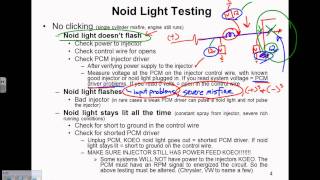
- If the code did not follow the injector, test the circuit. Disconnect the injector and connect a 'noid light' to the connector. Crank the engine. A flashing light indicates the ECM is sending a signal, and the wiring is likely okay. No light or a steady light points to a problem with the wiring or the ECM's driver.
- If the noid light test fails, check for continuity in the two wires between the ECM connector and the injector connector to rule out a wire break. Check for shorts to ground or power.
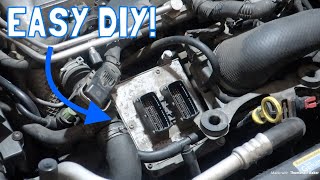
- If the injector and wiring have been confirmed to be good, the ECM is the most probable cause of the fault. The next step is to remove the ECM and send it to a reputable 🎬 Watch: A quick guide to removing and replacing your Saab ECU. repair service for testing and rebuilding.
Parts You'll Likely Need
- Engine Control Module (ECM/ECU) Repair Service
(OEM #55353231, 55567225, 55352571 (multiple are compatible))— This is the most common failure point for a P0204 code on this specific vehicle due to a known design vulnerability. Repair is more cost-effective than replacement.
Trusted brands: N/A (Repair Service), Your Parts Source (YPS-USA), Nick's Electronics Repair, SaabTuning
OEM price range: N/A
Aftermarket price range: $100-$500 - Fuel Injector
(OEM #Bosch 0280156023)— If the injector itself fails the diagnostic swap test, it will need to be replaced.
Trusted brands: Bosch, Delphi
OEM price range: $100-$180
Aftermarket price range: $40-$120
Related Codes That Often Appear With This One
- P0201, P0202, P0203 — When multiple or all four injector circuit codes are present, it strongly suggests a systemic failure, pointing directly to a faulty ECM that controls all injectors.
- P0304 — P0304 is 'Cylinder 4 Misfire Detected'. This code is a direct result of the P0204 fault, as the lack of fuel from the injector circuit malfunction causes the cylinder to misfire.
- P0606, P0686, P0687 — These codes indicate an 'ECM/PCM Processor Fault' or 'ECM/PCM Power Relay Control Circuit' issue. They can sometimes accompany injector codes and are a definitive sign that the ECM itself has an internal failure and requires repair or replacement.
- P0245, P0246 — These codes relate to the 'Turbocharger Wastegate Solenoid A'. The driver chip for this solenoid is also located within the Trionic 8 ECM and can fail concurrently with the injector drivers, further pointing to a faulty ECM.
Platform-Specific Known Issues
- The Trionic 8 ECM is highly susceptible to failure from cracked solder joints on its internal processors, leading to injector circuit faults. This is a well-documented issue in the Saab community.
- A common repair story involves a 2005 9-3 with codes P0201-P0204 and P0245. After confirming the injectors had correct resistance, the owner sent the ECM to 'Your Parts Source' for repair. The service found a defective injector and turbo control chip, repaired it, and the car ran perfectly after reinstallation with no further codes.
- Some repair shops recommend an 'ECU Relocation Kit' after repair to move the sensitive electronics away from the engine's heat and vibration to prevent a recurrence of the failure.
Mechanic-Grade Diagnostic Values
- Fuel Injector Resistance — expected: 12 Ohms. Failure: A reading significantly higher or lower than 12 Ohms, or an open circuit (infinite resistance), indicates a failed injector coil.
- Injector Control Signal at ECM — expected: The ECM grounds this pin to fire the injector. A noid light connected to the injector harness should flash while cranking. A voltage test on the control wire should show B+ voltage when disconnected and the key is on, and a pulsing ground signal when connected and running.. Failure: No flashing from a noid light, or a steady light, points to a wiring or ECM driver fault. No pulsing ground signal during a voltage test confirms an ECM or wiring issue.
Hidden / Shadow Codes Worth Checking
- Mode $06, Test ID $53 (example): While not a specific 'shadow code', Mode $06 data can reveal misfire counts per cylinder before they are high enough to set a P0304 trouble code. This allows a technician to see if the cylinder 4 misfire count is increasing, confirming the impact of the P0204 fault even if the P0304 code is not yet present. (see via A professional scan tool capable of displaying Mode $06 data. The specific Test ID (TID) and Component ID (CID) for misfire data can vary by year and software.)
Scan Tool Commands That Help
- Saab Tech 2: Fuel Injector Balance Test — This function allows the technician to individually command each fuel injector to pulse for a set duration. By monitoring the fuel pressure drop on a gauge during each pulse, you can confirm if an injector is clogged (smaller pressure drop) or leaking, without having to physically remove or swap injectors.
- Saab Tech 2: Fuel Pump Relay ON/OFF — Used to prime the fuel system and verify fuel pump operation and pressure before performing other fuel system tests, such as the injector balance test.
Wiring & Ground Locations
- ECM Connector B, Pin 50 — On the Trionic 8 ECM, which is mounted on the front of the engine block under a plastic cover. Connector B is the larger of the two main connectors.. This is the specific pin that the ECM uses to ground and control the fuel injector for cylinder 4. Testing for a pulsing ground signal at this pin can definitively isolate the fault to the ECM if the wiring to the injector is confirmed to be good.
- Injector Connector, Pin 1 — At the fuel injector for cylinder 4 (far right side of the engine when facing it).. This pin supplies ignition voltage (B+) to the fuel injector from the main relay. Verifying battery voltage at this pin with the key on is the first step in diagnosing the circuit.
- G7 — Located on the top right attachment lug of the Trionic 8 ECM itself.. This is a primary ground point for the engine control module. A loose or corroded G7 ground can cause a host of erratic issues, including injector circuit faults. It should be removed, cleaned, and secured during diagnosis.
- G2 — On the side of the left-hand structural member in the engine bay, near the battery and a large connector bracket.. This is a main chassis ground point. While less likely to cause a single injector fault, ensuring it is clean and tight is good practice for any electrical diagnosis.
Real Owner Repair Stories
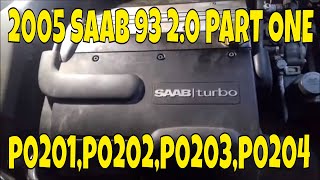
- YouTube channel 'Hoopties Garage' (2005 Saab 9-3 2.0T) — Codes P0201, P0202, P0203, P0204, and P0245. Engine running rough, smoking, and strong smell of fuel, indicating injectors were stuck open.
❌ Tried (didn't work) Initial diagnosis pointed away from injectors since all four failed at once, making a systemic issue more likely.
✅ What actually fixed it The ECM was removed and sent to a repair service ('Your Parts Source'). The service found a 'defective injector and turbo control chip' inside the ECM and repaired it. After reinstalling the repaired original ECM, the car ran smoothly with no codes, confirming the ECM was the root cause. - Reddit user on r/saab (2006 Saab 9-3 2.0T) — Codes P0201-P0204, P0245, P0246. Rough running in limp home mode, white smoke, and strong gasoline smell.
❌ Tried (didn't work) The owner suspected the turbo boost control solenoid based on some of the codes.
✅ What actually fixed it Forum members immediately identified the combination of all four injector codes plus the turbo control code as a classic symptom of ECM failure. The final resolution cited by the original poster was that the ECU had to be replaced.
OEM Part Supersession History
55352571, 55352688, 55353231→55565020, 55567225, 55569738 (and others)— Standard part revisions and updates by the manufacturer over the production run.
Heads up: For repair/cloning, any Trionic 8 ECM from a Front-Wheel Drive (FWD) B207 engine is compatible as a donor, regardless of the specific part number. However, a direct swap of a used unit without cloning requires an exact part number match and still needs programming (marriage) with a Tech 2.Bosch 0280156023 (for 2003-2006 models)→Saab/Denso 55559397 (for 2007-2012 models)— Change in supplier/design for the mid-generation facelift.
Heads up: The later 55559397 injectors have a higher flow rate. They can be used as a performance upgrade on 2003-2006 models, but this requires a corresponding ECU software tune to adjust for the different flow rate. They are not a direct plug-and-play replacement on earlier models.
Model Year Variations Within This Range
- 2007-2011: For the 2007 model year, the 9-3 received a significant interior update, including a new dashboard, instrument cluster (with integrated SID), and climate controls. The fiber-optic audio system was replaced with a standard copper-wire system, making stereo upgrades easier. The fuel injectors were also changed to a different part number (55559397).
- 2008-2011: The 2008 model year introduced a major exterior facelift, giving the car a new front-end design inspired by the Aero-X concept car. All-Wheel Drive (XWD) also became an option.
Diagnostic Flowchart
Used vs. New Parts: Buying Guide for This Vehicle
When a used part is the smart pick: A used Engine Control Module (ECM) is an excellent choice, but ONLY as a core to be sent to a specialist for repair or cloning. A direct swap of a used ECM will not work as it is 'married' to the original vehicle's security system. A cloning service transfers your original ECM's data to the used donor unit, making it plug-and-play.
Donor-vehicle mileage cap: roughly under 150000 miles for the part to have meaningful remaining life.
What to inspect on the donor part:
- For a donor ECM, ensure the casing is not cracked or physically damaged.
- Check that the connectors are clean, with no bent or corroded pins.
- Verify it came from a Front-Wheel Drive (FWD) model with the B207 engine; any part number from a FWD car will work as a clone target.
OEM-only on this vehicle (don't cheap out):
- Engine Control Module (ECM): There are no aftermarket ECMs. The only viable solutions are a new OEM unit (very expensive), or having your original unit repaired or its data cloned to a used OEM donor unit.
Aftermarket brands forum-validated for this vehicle:
- Bosch (for fuel injectors - they are the original OEM supplier)
- Delphi (for fuel injectors)
Brands owners have reported issues with on this vehicle:
- Unnamed, no-brand fuel injectors from online marketplaces are a gamble and may have inconsistent flow rates or poor spray patterns, leading to persistent performance issues.
Real Owner Stories
Aggregated from forums and TSBs cited above. Mileages and costs reflect what owners reported in those sources.
2006 Saab 9-3 2.0T
Symptoms: Car starts but is 'running very roughly, in limp home mode'. Also observed 'a bit of white smoke' and the car running 'very rich -- opening the door, all I can smell is gasoline'.
What fixed it: The owner did not report a final fix, but noted that a forum thread with similar issues pointed to a faulty ECU: 'at the end of that thread, the poster stated their ECU had to be replaced.'
Source hint: Reddit r/saab
2005 Saab 9-3
Symptoms: The vehicle presented with multiple fault codes, including P0201, P0202, P0203, P0204, and P0245.
What fixed it: The owner sent the ECM to 'Your Parts Source' for repair. The service identified and repaired a defective injector and turbo control chip within the ECM, which resolved all codes and running issues.
Source hint: A common repair story documented in the Saab community, cited in vehicle_specific_issues.
Related OBD-II Codes
Frequently Asked Questions
My Saab 9-3 has P0204 along with P0201, P0202, and P0203. Does this mean all my injectors are bad?
Why is the ECM such a common failure point for the P0204 code on the 2003-2011 Saab 9-3?
If I confirm my ECM is faulty, do I need to take it to a Saab dealer for programming?
How can I definitively test if my fuel injector is bad before blaming the ECM?
What is a 'noid light' and how is it used to diagnose P0204 on my 9-3?
Is there a way to prevent the ECM from failing again after I get it repaired?
Are there other cars that use the same engine and have this specific ECM failure issue?
Helpful Videos
We Have This Part in Stock


The information in this article is provided for general reference and educational purposes only. Vehicle specifications, procedures, and part compatibility can vary by production date, trim level, and region. Always consult your vehicle's factory service manual and verify part numbers before purchasing or performing repairs. Safety-critical components such as airbags, seat belts, and braking systems should be installed by a qualified professional.
- Saab 9-3:
- 🧭 Diagnostic Flowchart
- 🎬 Helpful Videos
- 🛍️ Shop This Part
- What's Unique About the 2003-2011 Saab 9-3
- Symptoms You May Notice
- Most Likely Causes
- Diagnosis Steps
- Parts You'll Likely Need
- Related Codes That Often Appear With This One
- Platform-Specific Known Issues
- Mechanic-Grade Diagnostic Values
- Hidden / Shadow Codes Worth Checking
- Scan Tool Commands That Help
- Wiring & Ground Locations
- Real Owner Repair Stories
- OEM Part Supersession History
- Model Year Variations Within This Range
- Used vs. New Parts: Buying Guide for This Vehicle
- Real Owner Stories
- 2006 Saab 9-3 2.0T
- 2005 Saab 9-3
- Related OBD-II Codes
- Frequently Asked Questions
- 🎟️ Get 5% Off