

P0234 on 2009-2012 Audi A4 2.0T: Turbo Overboost Causes and Fixes
For a B8 Audi A4, P0234 is almost always caused by a faulty N75 boost control valve, a bad diverter valve, or a sticking turbo wastegate. The most common fix is replacing the N75 valve, which costs about $50-$150 for the part and is a straightforward DIY job. A loose wastegate actuator rod is also a very common cause, often fixed with a cheap OEM clip.
- P0234 on a 2009-2012 Audi A4 2.0T indicates the turbo is creating too much pressure, forcing the car into a protective 'limp mode'.
- Do not immediately assume the turbo has failed. The most common causes are much cheaper and easier to fix: the N75 valve, the diverter valve, or a loose wastegate rod.
- Start your diagnosis with the N75 valve (Part #06F906283F), as it is the most frequent culprit and relatively easy to replace.
- If you hear a rattling noise, install the wastegate actuator clip (Part #06J145220A) as a first step.
- Always replace a failed diverter valve with the upgraded 'Revision D' piston-style part (Part #06H145710D) to prevent repeat failures.
What's Unique About the 2009-2012 Audi A4
The 2009-2012 Audi A4 (B8 generation) with the 2.0T TFSI engine (typically the CAEB variant) is well-known for specific issues in its boost regulation system. Unlike on other vehicles where P0234 can have a wide range of causes, on this platform the problem is almost always isolated to a few key parts: the N75 boost control valve, the diverter valve, or the turbocharger's wastegate. Audi has issued a Technical Service Bulletin (TPI 2031245) about excessive wastegate linkage play causing boost deviation faults, highlighting it as a known issue on this engine and its platform mates.
Symptoms You May Notice
- Sudden and severe loss of engine power as the car enters 'limp mode'.
- Check Engine Light and/or a flashing Electronic Power Control (EPC) light on the dashboard.
- Power loss can often be temporarily reset by turning the car off and on again.
- Jerky or inconsistent power delivery during acceleration, sometimes described as hesitation or stumbling.
- Audible 'whooshing' or surging sounds from the engine bay.
- A rattling noise from the engine area, typically between 1800-3000 RPM, indicating a loose wastegate actuator rod.
- Immediately replacing the entire turbocharger. The cause is most often a cheaper, external component like the N75 valve, diverter valve, or wastegate clip. Always diagnose these components first.
- Replacing the N75 valve and assuming the problem is fixed. In some cases, a new N75 valve can temporarily mask an underlying wastegate actuator or diverter valve issue, with the code returning days later.
Most Likely Causes
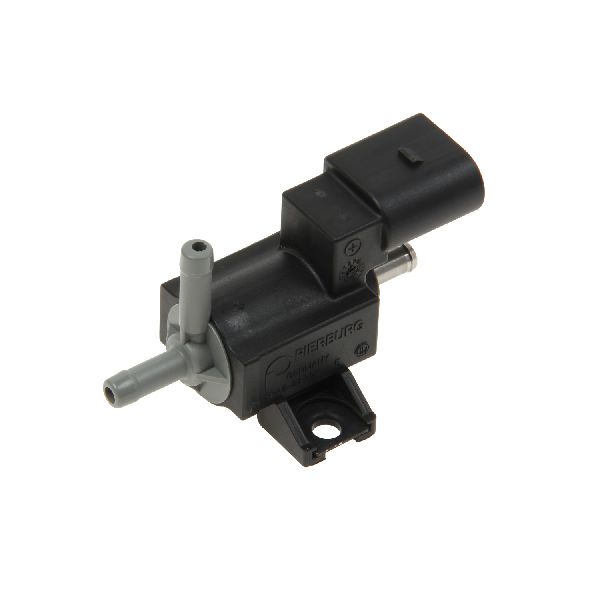
- Faulty N75 Boost Pressure Control Valve (Solenoid) 🔴 High Probability → Shop Turbocharger The N75 valve is an electronic solenoid that operates under high frequency and heat, making it prone to electrical or mechanical failure over time. It's a very common failure point on the 2.0T EA888 engine, getting stuck and failing to regulate the wastegate.
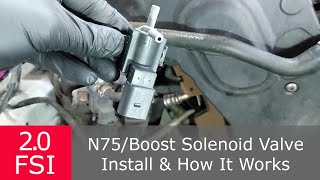
How to confirm: Test the solenoid's resistance with a multimeter; it should be between 25-35 ohms when cold. A scan tool like VCDS can perform an output test; you should hear it clicking. 🎬 Watch: How to test and install the N75 valve A physical test involves removing the valve and blowing air into the bottom port; if air escapes the long side port (to the intake), it has failed internally.
Typical fix: Replacement of the N75 valve. It is located on a bracket on the turbocharger and is secured by a simple bracket and electrical connector, making it a common DIY job.
Est. part cost: $50-$150 - Sticking or Failed Turbocharger Wastegate Actuator / Loose Rod 🔴 High Probability → Shop Turbocharger The actuator rod can seize, or the internal diaphragm can fail. More commonly, the linkage between the actuator rod and the wastegate arm develops excessive play, preventing the wastegate from opening correctly to bleed off boost. This is a well-documented issue covered by Audi TPI 2031245, which was initially for underboost (P0299) but points to the same mechanical failure.
How to confirm: Visually inspect the wastegate actuator arm for movement while applying vacuum with a handheld pump; the rod should move smoothly and hold vacuum. Check for excessive play or rattling at the linkage point; there should be very little. If the arm doesn't move smoothly or is very loose, it's faulty.
Typical fix: If the rod is simply loose and rattling, a special retaining clip (OEM Part #06J145220A) can be installed to tighten the linkage. This is a very common and inexpensive fix. If the actuator itself has failed (e.g., ruptured diaphragm), it may require turbocharger replacement as it is often considered an integral part of the turbo assembly.
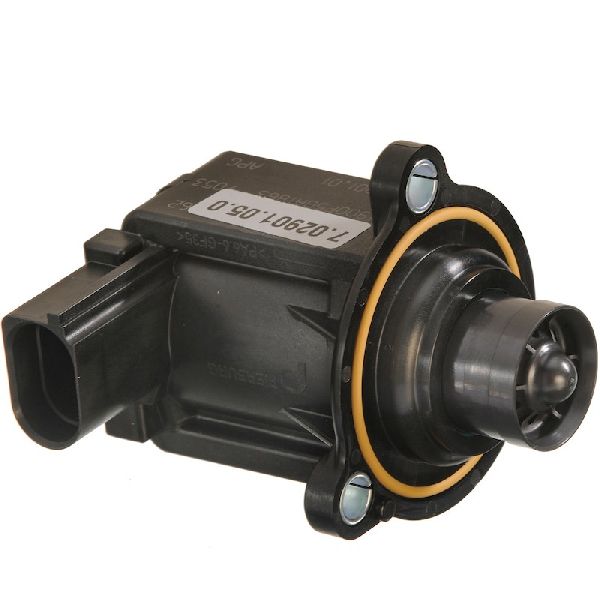
Est. part cost: $15 for clip, $1000+ for turbo replacement - Failed Diverter Valve (DV) 🟡 Medium Probability → Shop Turbocharger The original factory diverter valve uses a rubber diaphragm that is known to tear with age and heat cycles, especially on tuned vehicles. This causes a boost leak that can confuse the boost control system, leading to erratic behavior and overboost spikes.
How to confirm: Remove the three bolts holding the DV to the turbo compressor housing and inspect the rubber diaphragm for tears or rips. If it's an older revision (e.g., part number ending in 'C' or earlier), it's suspect regardless of visible damage.
Typical fix: Replace the old diaphragm-style valve with the upgraded piston-style 'Revision D' valve (OEM Part #06H145710D). This is a direct bolt-on upgrade that is much more durable.
Est. part cost: $80-$150 - Leaking or Blocked Vacuum Hoses 🟡 Medium Probability → Shop Vacuum Hose The small rubber hoses controlling the N75 valve and wastegate actuator become brittle and crack from constant exposure to engine heat, leading to a loss of control over the wastegate.
How to confirm: Visually inspect all vacuum lines connected to the turbo system. Perform a smoke test to reveal leaks that are not visible to the naked eye.
Typical fix: Replace the cracked or broken sections of vacuum hose. It is often recommended to replace all related lines at once due to similar age and wear.
Est. part cost: $10-$30
Rare But Worth Checking
- Faulty Boost Pressure Sensor (G31/MAP): While less common than mechanical failures, a faulty sensor can send incorrect pressure readings to the ECM, triggering P0234. It might read atmospheric pressure correctly at idle but fail under boost. Oil and carbon buildup can also foul the sensor.
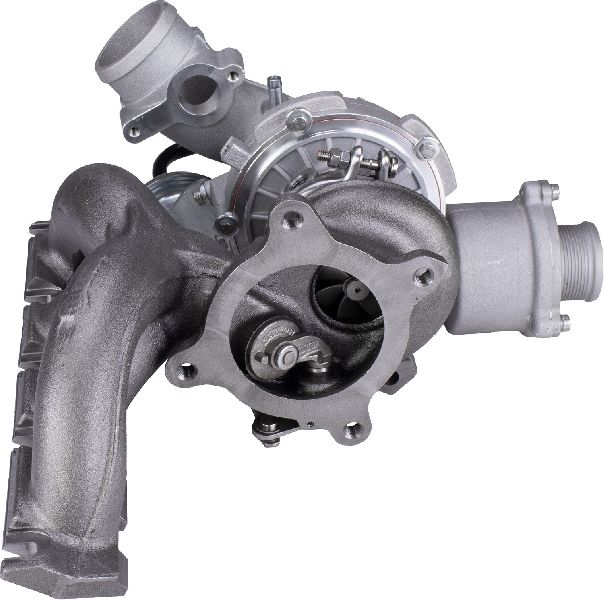
- Sticking Internal Turbocharger Wastegate Flap: → Shop Turbocharger Carbon buildup inside the turbo's exhaust housing can cause the wastegate flap itself to stick closed. This is a serious issue that typically requires removing and either cleaning or replacing the entire turbocharger assembly. This has been documented by owners as the root cause after all external components were replaced.
- Aggressive ECU Tune: An aftermarket ECU tune that requests boost levels that are too high or has overly aggressive ramp rates can lead to an overboost code, even with a mechanically sound system. If the code appeared shortly after a reflash, the tune is the likely culprit.
Diagnosis Steps
- Scan the vehicle for all fault codes. Note if P0234 appears with other codes like P0299 or P0243.
- Using a scan tool with live data (like VCDS), log 'requested boost pressure' versus 'actual boost pressure' (e.g., Measuring Block 115) during a test drive under load. A large, sustained deviation where actual far exceeds requested confirms a real overboost condition.
- Visually inspect all vacuum lines running to and from the N75 valve and turbocharger wastegate actuator for cracks, breaks, or disconnections. A smoke test is highly recommended.
- Inspect and test the N75 valve. Check its resistance (should be 25-35 ohms) and use a scan tool to perform an output test to verify it clicks.
- Remove and inspect the diverter valve (three bolts on the turbo). Look for tears in the diaphragm. If it's not the updated 'Revision D' part (06H145710D), consider replacing it preventatively.
- With a vacuum pump, test the turbocharger wastegate actuator. Ensure the rod moves freely and holds a vacuum. Check the linkage for excessive play or rattling. If it's loose, install the OEM wastegate clip (06J145220A).
- If all external components check out, the issue may be a faulty boost pressure (MAP) sensor or an internal failure of the turbocharger (sticking wastegate flap).
Parts You'll Likely Need
- Turbocharger Boost Control Valve (N75 Valve)
(OEM #06F906283F)— This is the most common failure point for P0234 on this engine. It directly controls the wastegate and is a frequent and inexpensive fix.
Trusted brands: Bosch, Pierburg (OEM), Hamburg-Technic
OEM price range: $100-$150
Aftermarket price range: $50-$90 - Turbocharger Diverter Valve (Piston-Style Upgrade)
(OEM #06H145710D)— The original diaphragm-style valve is a known weak point that tears, causing boost regulation issues. The 'Revision D' is a mandatory upgrade for reliability.
Trusted brands: Pierburg (OEM), Go Fast Bits (GFB DV+), UroTuning
OEM price range: $80-$150
Aftermarket price range: $70-$130 - Turbocharger Wastegate Actuator Rattle Clip
(OEM #06J145220A)— Specifically designed by Audi to fix excessive play in the wastegate linkage, which is a very common cause of boost control faults like P0234 on this engine.
Trusted brands: Genuine VW/Audi
OEM price range: $15-$30
Related Codes That Often Appear With This One
- P0299 — This code for 'Underboost Condition' can appear if the boost control system is behaving erratically, causing both spikes (P0234) and drops (P0299) in pressure due to a faulty N75, torn DV, or sticking/loose wastegate.
- P0243 — Indicates a malfunction in the wastegate solenoid 'A' circuit, pointing directly to an electrical problem with the N75 valve or its wiring, which is a primary cause of P0234.
- P2015 — This code for 'Intake Manifold Runner Position Sensor' can sometimes appear with P0234. While not directly causal, some owners have noted they appear together. One possible explanation is that the N75 valve and the intake runner control valve (N316) share a common 12v power supply, suggesting a potential wiring harness issue.
Technical Service Bulletins (TSBs) & Recalls
- TPI 2031245 - Addresses rattling noise and excessive play from the turbocharger wastegate actuator rod, fixed by installing clip 06J145220A. This play can lead to boost control issues like P0234.
- TSB Bulletin #01133020270825 - Confirms that DTC P0234 (Turbo/Super Charger Overboost Condition) can be stored in the engine control module (J623) as a standalone fault without other DTCs present.
Platform-Specific Known Issues
- A Technical Service Bulletin (TPI 2031245) addresses excessive wastegate linkage play on the IHI turbochargers used in these engines, which can cause boost control faults. The fix is the installation of a simple retaining clip.
Mechanic-Grade Diagnostic Values
- N75 Valve (Boost Pressure Control Solenoid) Coil Resistance — expected: 25-35 Ohms (when cold). Failure: A reading significantly outside this range, or an open/short circuit, indicates a faulty internal coil.
- G31 (Boost Pressure Sensor) Supply Voltage — expected: 4.5V - 5.0V. Failure: Lack of proper voltage points to a wiring or ECU problem, not a sensor failure.
- G31 (Boost Pressure Sensor) Signal Voltage at KOEO (Key On, Engine Off) — expected: ~0.5V at atmospheric pressure. Failure: A reading that doesn't correlate with atmospheric pressure or is significantly outside the 0.4-2.0V range suggests a faulty sensor or wiring.
- Wastegate Actuator Vacuum Test — expected: Actuator arm should move smoothly through its full range and hold vacuum (e.g., 20 inHg) for at least 30 seconds.. Failure: Vacuum level drops, or the arm binds/fails to move. This indicates a ruptured diaphragm or seized actuator.
- VCDS Live Data: Requested vs. Actual Boost — expected: During a 3rd gear pull, 'Charge air pressure: actual value' should closely track 'Charge air pressure: specified value'.. Failure: Actual pressure consistently exceeds specified pressure by more than ~2.9-4.0 PSI, triggering the fault.
Hidden / Shadow Codes Worth Checking
- P0234 00: This is the extended fault code format provided by VCDS. While not a 'shadow code,' the additional data and text 'Limit Exceeded (Overboost Condition)' provide more specific information than a generic OBD-II reader, confirming the nature of the fault. (see via VCDS (VAG-COM) Diagnostic System or other professional VAG-specific scan tools.)
Scan Tool Commands That Help
- VCDS (VAG-COM): Output Test: N75 - Charge Pressure Control Solenoid Valve — Use this in 'Basic Settings' or 'Output Tests' to cycle the N75 valve on and off. You should hear an audible clicking, which confirms the solenoid is mechanically and electrically responding to commands. A lack of clicking points to a failed valve or a wiring issue.
- VCDS (VAG-COM): Live Data Logging: Measuring Block 115 (or Advanced Measuring Values) — Log 'Charge air pressure: specified value' and 'Charge air pressure: actual value' during a test drive (e.g., a 3rd gear pull). This is the definitive way to confirm if a real overboost condition is occurring, by comparing what the ECU wants to what the sensor is reading.
Wiring & Ground Locations
- SB6 Fuse — Fuse 6 (typically 10A or 15A) on fuse holder B, located in the engine compartment electronics box.. This fuse provides power to the N75 Charge Pressure Control Solenoid Valve. A blown fuse will cause a complete loss of boost control, potentially leading to an overboost fault.
- G12 / G18 Ground Points — G12 is at the left rear of the engine compartment. G18 is a specific engine block ground on the left rear of the 2.0L engine.. A poor engine ground can cause erratic behavior in various sensors and solenoids, including the N75 valve and G31 boost sensor, leading to incorrect readings or operation.
- N75 Connector — Electrical connector on the N75 valve, which is mounted on a bracket on the turbocharger assembly.. The wiring and connector are exposed to high heat and can become brittle or corroded, leading to an open or short in the N75 circuit. This would cause a P0243 and result in a P0234 due to lack of wastegate control.
Real Owner Repair Stories
- AudiWorld Forums user discussion (2009 Audi A4) — P0234 (Overboost) and P2015 (Intake Runner Flap) codes appearing at the same time during acceleration.
❌ Tried (didn't work) Replaced the N75 valve, but the codes returned together.
✅ What actually fixed it The user noted that the N75 (boost control), N249 (diverter valve), and N316 (intake runner control) all share a common 12v power supply line. The simultaneous faults pointed to a likely wiring harness issue affecting the shared power supply, rather than individual component failures. - Go-Parts article citing a YouTube diagnostic (2012 Audi Q5 2.0T (same CAEB engine and turbo setup)) — P0299 (Underboost), but the root cause is relevant to wastegate failure causing boost issues in general.
❌ Tried (didn't work) Replaced diverter valve., Pressure tested intake system., Tested N75 valve resistance (was OK)., Applied vacuum to wastegate actuator (it moved correctly).
✅ What actually fixed it The entire turbocharger was replaced. The wastegate flap on the original turbo was found to be excessively loose, preventing it from sealing properly. This highlights that even if the external actuator tests fine, the internal flap can be the point of failure.
"I Checked Everything" — The Actual Cause
- In several documented cases on forums and diagnostic articles, owners have replaced the N75, Diverter Valve, and MAP sensor, and confirmed no vacuum or boost leaks with a smoke test, yet the P0234 code persists. The final resolution in many of these situations was replacing the entire turbocharger assembly due to an internally sticking or seized wastegate flap caused by carbon buildup, which is not detectable by external tests.
When the Usual Fixes Don't Work
- While the vast majority of P0234 faults on this platform are caused by the N75 valve, diverter valve, or wastegate actuator, there are numerous documented cases where replacing all three did not solve the problem. In these instances, the root cause was often traced back to a more fundamental mechanical failure within the turbocharger itself, such as a wastegate flap sticking due to carbon buildup or a cracked turbine housing. This serves as a critical reminder that if the common, inexpensive external parts are confirmed to be good, the turbocharger assembly itself must be considered the next likely point of failure before suspecting the ECU or complex wiring faults.
OEM Part Supersession History
06H145710C (and earlier revisions like B, G)→06H145710D— The original parts used a rubber diaphragm that was prone to tearing, causing boost leaks and erratic operation. The 'Revision D' part is a redesigned piston-style valve that is significantly more durable and reliable.
Heads up: Not incompatible, but it is highly recommended to upgrade to the 'D' revision if the vehicle still has an older diaphragm style, even if it hasn't failed yet.N/A→Go Fast Bits (GFB) DV+ (e.g., T9351)— This is a popular aftermarket solution that retains the factory electronic solenoid but replaces the failure-prone plastic piston and housing of the OEM valve with durable metal components for improved reliability and throttle response.
Heads up: This is an alternative to the OEM 'Rev D' valve, not a direct supersession. It is known to be a reliable upgrade, especially for tuned vehicles.
Model Year Variations Within This Range
- 2009-2012: These model years predominantly use the EA888 Gen 1/2 engine with the 'CAEB' engine code. The causes and fixes for P0234 are highly consistent across this range.
- 2013+: Later B8.5 generation A4s (2013+) introduced different engine codes (e.g., CAED, CPMA, CPMB) which, while similar, have differences such as a revised intake manifold and different sensors. While the boost control principles are the same, some part numbers and procedures may vary slightly from the 2009-2012 models.
Diagnostic Flowchart
Used vs. New Parts: Buying Guide for This Vehicle
When a used part is the smart pick: A complete used turbocharger assembly from a low-mileage donor car can be a cost-effective option if your turbo has failed internally (e.g., seized wastegate). However, it is critical to inspect the used part thoroughly.
Donor-vehicle mileage cap: roughly under 70000 miles for the part to have meaningful remaining life.
What to inspect on the donor part:
- Check the wastegate actuator arm for smooth, non-binding movement using a hand vacuum pump.
- Manually wiggle the wastegate linkage to ensure there is minimal play. Avoid any unit with a 'rattle'.
- Inspect the turbine wheel for any signs of scoring, chipping, or contact with the housing.
- Check for excessive in-and-out (axial) or up-and-down (radial) play in the turbo shaft.
OEM-only on this vehicle (don't cheap out):
- Wastegate Actuator Rattle Clip (06J145220A) - This is a specific, inexpensive OEM fix; aftermarket versions are not common or recommended.
- Boost Pressure Sensor (G31/MAP) - Given its critical role in engine management, using a non-OEM sensor is risky and can cause persistent diagnostic issues.
Aftermarket brands forum-validated for this vehicle:
- Pierburg: OEM supplier for the N75 valve and Diverter Valve. A Pierburg-branded part is equivalent to Genuine Audi at a lower cost.
- Bosch: A reliable alternative for the N75 valve.
- Go Fast Bits (GFB): The DV+ is a widely respected aftermarket upgrade for the diverter valve, known for its durability.
Brands owners have reported issues with on this vehicle:
- Unbranded, generic 'eBay special' N75 valves and diverter valves. These often have high failure rates and can cause more diagnostic headaches than they solve.
Real Owner Stories
Aggregated from forums and TSBs cited above. Mileages and costs reflect what owners reported in those sources.
Volkswagen GTI MK6 2.0T
Symptoms: The owner was repeatedly getting a P0234 code accompanied by jerking during acceleration, even after replacing the N75 solenoid and the diverter valve.
What fixed it: Another user reported that replacing the G31 Boost Pressure (MAP) sensor resolved identical symptoms on their vehicle.
Source hint: VW GTI MKVI Forum thread titled 'P0234/ BOOST OVERLOAD'
Related OBD-II Codes
Frequently Asked Questions
My 2010 A4 is making a rattling noise from the engine between 1800-3000 RPM and I have a P0234 code. Is there a specific fix for this?
Does the Audi Technical Service Bulletin TPI 2031245 apply to the P0234 overboost code?
My mechanic says my diverter valve is an old style but isn't torn. Should I replace it anyway to fix my P0234 code?
Is the N75 valve a common failure on the 2.0T engine in the 2009-2012 A4?
My A4 goes into limp mode with the EPC light on, but it drives normally again after I restart the car. What does this indicate?
If my wastegate actuator has failed, do I have to replace the entire turbocharger?
How can I test the N75 valve myself?
Helpful Videos
We Have This Part in Stock


The information in this article is provided for general reference and educational purposes only. Vehicle specifications, procedures, and part compatibility can vary by production date, trim level, and region. Always consult your vehicle's factory service manual and verify part numbers before purchasing or performing repairs. Safety-critical components such as airbags, seat belts, and braking systems should be installed by a qualified professional.
- Audi A4:
- 🧭 Diagnostic Flowchart
- 🎬 Helpful Videos
- 🛍️ Shop This Part
- What's Unique About the 2009-2012 Audi A4
- Symptoms You May Notice
- Most Likely Causes
- Rare But Worth Checking
- Diagnosis Steps
- Parts You'll Likely Need
- Related Codes That Often Appear With This One
- Technical Service Bulletins (TSBs) & Recalls
- Platform-Specific Known Issues
- Mechanic-Grade Diagnostic Values
- Hidden / Shadow Codes Worth Checking
- Scan Tool Commands That Help
- Wiring & Ground Locations
- Real Owner Repair Stories
- "I Checked Everything" — The Actual Cause
- When the Usual Fixes Don't Work
- OEM Part Supersession History
- Model Year Variations Within This Range
- Used vs. New Parts: Buying Guide for This Vehicle
- Real Owner Stories
- Volkswagen GTI MK6 2.0T
- Related OBD-II Codes
- Frequently Asked Questions
- 🎟️ Get 5% Off