

P0245 on 2013-2019 Cadillac ATS 2.0L Turbo: Wastegate Solenoid 'A' Low Circuit Fixes
The P0245 code on a Cadillac ATS 2.0L Turbo most often points to a failed turbocharger wastegate solenoid. This is an electrical fault indicating low voltage in the control circuit. Replacing this solenoid is the most common fix. Expect to pay around $50-$100 for an OEM replacement part, with DIY difficulty being moderate (2/5).
- P0245 on your ATS 2.0L Turbo means there's a low voltage problem in the turbo wastegate solenoid circuit.
- The most likely cause is a failed solenoid itself, which is a relatively inexpensive and accessible part to replace. The current OEM part number is 12684242.
- Before replacing parts, always check the wiring and connectors near the turbo for heat damage, as this is also a common point of failure.
- Your car will drive with this code, but with significantly reduced power. It's best to get it fixed promptly to avoid stress on other components.
- A buzzing or whining noise for a few seconds after turning the car off is normal for this engine and not a cause for concern, as confirmed by a GM TSB.
What's Unique About the 2013-2019 Cadillac ATS
The LTG 2.0L Turbo engine in the Cadillac ATS relies on precise electronic control of its turbocharger to deliver power smoothly. While the P0245 code is a generic electrical fault, on this platform it often points directly to the solenoid itself failing due to heat exposure in the engine bay. Owners should also be aware of a normal characteristic of this engine: a hoot, whine, or buzz noise from the wastegate solenoid area for a few seconds after engine shutdown is considered normal by GM, as described in TSB 18-NA-085, and is not indicative of a fault.
Symptoms You May Notice
- Check Engine Light is illuminated
- Significant loss of engine power and sluggish acceleration
- Vehicle enters 'limp mode,' limiting performance
- Poor throttle response
- Abnormal turbocharger noises, such as a whine or hiss during operation
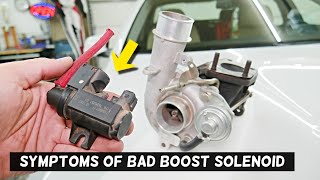
- Audible whistling or hissing from the turbo area during acceleration 🎬 Watch: Common symptoms of a bad turbo boost solenoid
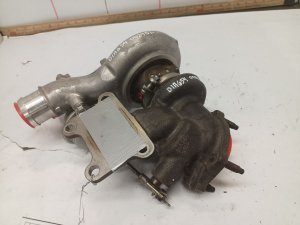
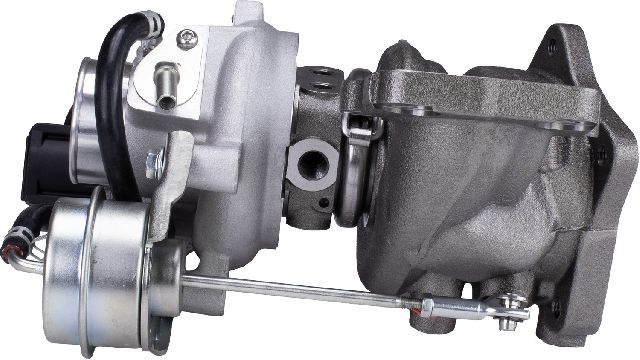
- Replacing the entire turbocharger. The P0245 code points to an electrical circuit fault, not a mechanical failure of the turbo itself. The solenoid is a separate, externally mounted, and much less expensive component.
Most Likely Causes
- Failed Turbocharger Wastegate Solenoid 🔴 High Probability → Shop Turbocharger The solenoid is an electro-mechanical part mounted directly on or near the hot turbocharger assembly, and repeated heat cycles can cause the internal coil windings to short out or fail, leading to a 'low circuit' condition.
How to confirm: Test the solenoid's internal resistance with a multimeter; it should be within the manufacturer's specified range (typically 8-15 ohms). An open circuit (infinite resistance) or a direct short (near zero resistance) indicates a failed solenoid. You can also use a capable scan tool to command the solenoid on and off to check for an audible click.
Typical fix: Replace the turbocharger wastegate solenoid. This is often called a 'regulator valve' by GM.
Est. part cost: $50-$100 - Wiring Harness or Connector Damage 🟡 Medium Probability The wiring pigtail leading to the wastegate solenoid is in a high-heat area. Over time, the plastic connector can become brittle and the wire insulation can melt or crack, leading to a short circuit to ground.
How to confirm: Visually inspect the wiring harness and the two-pin connector leading to the wastegate solenoid for any signs of melting, chafing, or breaks. Wiggle the connector and harness with the engine running to see if it triggers the fault. Perform a voltage and ground test at the connector; you should see a 12V reference on one pin and a pulsing ground signal from the ECM on the other when the engine is running.
Typical fix: Repair the damaged section of the wiring harness or replace the connector pigtail.
Est. part cost: $15-$50
Rare But Worth Checking
- Faulty Powertrain Control Module (PCM): → Shop Engine Control Module (ECM) This is a very uncommon cause. The PCM's internal driver for the solenoid circuit can fail, but this should only be considered after thoroughly testing and confirming the solenoid and its entire circuit are in good condition. A PCM failure would typically be accompanied by other trouble codes.
Diagnosis Steps
- Read the trouble codes with an OBD-II scanner and confirm P0245 is present. Note any other codes and freeze-frame data.
- Perform a thorough visual inspection of the turbocharger wastegate solenoid and its wiring harness/pigtail connector. Look for obvious signs of heat damage, such as melted plastic, brittle wires, or a loose connection.
- Disconnect the solenoid connector. With the key on, engine off, use a multimeter to check for 12-volt reference power on one pin of the harness-side connector.
- Test the internal resistance of the wastegate solenoid itself using a multimeter across its two pins. Compare the reading to the manufacturer's specification (typically 8-15 ohms). An open circuit (infinite resistance) or a short (very low resistance) indicates a failed solenoid.
- If the solenoid and power supply are good, check the control wire (the non-power wire) for a short to ground. There should be no continuity to ground with the solenoid disconnected.
- If a capable scan tool is available, command the solenoid to activate and listen for a click. This confirms the solenoid is mechanically responding to the command.
- For advanced diagnosis, use an oscilloscope to check for the PWM signal on the control wire from the ECM while the engine is running. A lack of signal could point towards a wiring issue or a faulty ECM driver.
- If the solenoid and wiring are confirmed to be good, the issue may lie with the PCM, but this is rare and should be the last consideration.
Parts You'll Likely Need
- Turbocharger Wastegate Solenoid
(OEM #12684242 (supersedes 12649146))— This solenoid is the most common failure point for a P0245 code due to its electronic nature and exposure to extreme engine heat.
Trusted brands: ACDelco (GM Genuine), Dorman
OEM price range: $50-$100
Aftermarket price range: $40-$80
Related Codes That Often Appear With This One
- P0243 — This code indicates a general malfunction in the wastegate solenoid circuit and can appear alongside the more specific 'low circuit' fault of P0245.
- P0299 — This code indicates a turbocharger underboost condition. If the wastegate solenoid circuit fails, the ECM cannot command the wastegate to close properly to build boost, which often triggers P0299.
- P2261 — This code relates to the turbocharger bypass valve performance. A user on cadillacforums.com reported this code appearing alongside P0245, indicating a broader issue within the boost control system that was resolved by replacing the wastegate solenoid.
Technical Service Bulletins (TSBs) & Recalls
- TSB 18-NA-085: Information on Turbocharger Coolant Pump and Wastegate Actuator Operation and Normal Characteristics. This bulletin explicitly states that a buzz, whine, or hoot noise from the turbocharger area for up to 10 seconds after engine shutdown is a normal characteristic of the system and no repairs should be attempted for this noise.
Platform-Specific Known Issues
- A post-shutdown 'hoot' or 'buzz' noise from the turbo area is considered normal by GM and is caused by the vacuum system equalizing. This is not a sign of a failing solenoid and is documented in GM TSB 18-NA-085.
Mechanic-Grade Diagnostic Values
- Turbocharger Wastegate Solenoid internal resistance — expected: 8 to 13 Ohms. Failure: A reading of infinite resistance (Open Loop), near zero (short), or a very high reading indicates a failed solenoid.
- Voltage at solenoid connector (Power feed pin) — expected: Battery Voltage (approx. 12V) with Key On, Engine Off.. Failure: Voltage significantly below 12V points to a problem in the power supply circuit, potentially a fuse or wiring issue upstream.
Scan Tool Commands That Help
- GDS2 (or equivalent professional scan tool): Wastegate Actuator Relearn / Calibration — This function may be required after replacing the turbocharger wastegate actuator or solenoid to ensure the ECM learns the new component's position and operating range.
Wiring & Ground Locations
- Solenoid Connector — The two-wire electrical connector plugged directly into the turbocharger wastegate solenoid, located near the turbocharger assembly.. This is the primary point for electrical testing. One pin is the 12V power feed, and the other is the Pulse-Width Modulated (PWM) ground control from the ECM. Damage here from heat or vibration is a common cause of the code.
- G110 — On the upper rear of the cylinder head (for the 2.0L LTG).. This is a critical engine ground. A loose or corroded connection at G110 can cause a variety of sensor and actuator faults, including erratic signals that could potentially trigger a P0245 code.
- G102 — Located at the left rear of the engine.. This ground point serves multiple ignition coils. While not directly tied to the wastegate solenoid circuit, a poor ground here can create electrical noise and voltage stability issues that can affect overall engine management and diagnostics.
Real Owner Repair Stories
- Reddit user FattiusBootius in r/Cadillac (2016 Cadillac ATS 2.0L Turbo) — Reduced Engine Power message, multiple codes including P0243 and P0245.
❌ Tried (didn't work) Replaced the wastegate solenoid., Replaced the turbo solenoid., Replaced an oil pressure switch.
✅ What actually fixed it The issue was not resolved by replacing the common parts. The user took the vehicle to a dealer, who then recommended a $3,300 repair involving the fuel injector and the oil pump flow control valve. The final outcome was not posted, but this story serves as a critical example of when P0245 is a symptom of a more complex issue rather than the root cause.
When the Usual Fixes Don't Work
- While the wastegate solenoid is the most common cause of P0245, it is not the only one. In one documented case involving a 2016 ATS 2.0T, a technician replaced the wastegate solenoid, another turbo-related solenoid, and an oil pressure switch, but the P0245 code and limp mode persisted. The dealer's subsequent diagnosis pointed towards deeper issues with the fuel injection and oil pump flow control systems, suggesting that in some instances, the P0245 code can be a secondary symptom of a larger problem causing system-wide faults, rather than an isolated circuit failure.
OEM Part Supersession History
12649146→12684242— Standard part revision by the manufacturer, likely for improved durability or material changes.
Model Year Variations Within This Range
- 2013-2015: Early LTG engines in this range had a known issue with faulty piston casting and ring gaps, which could lead to catastrophic failure. For the 2016 model year, the piston design was updated, largely resolving this issue. While not directly related to the P0245 electrical code, it is a critical distinction when assessing the overall health of an engine from this period.
Diagnostic Flowchart
Other Known Issues on This Vehicle
Issues unrelated to this code that are worth knowing about as an owner of this generation:
- Cracked Pistons 🔴 High — More common on early 2013-2015 models, but can occur on later years. Often happens on cylinder #3. Can occur on stock vehicles but is more frequent on tuned engines. (Ref: GM PI1178E (and subsequent revisions) addresses this issue, recommending replacement of all 4 piston assemblies if one is found to be cracked.)
- CUE Infotainment Screen Failure 🟠 Medium — Extremely common across 2013-2018 models. The screen delaminates, causing bubbling, cracking, and unresponsive or 'ghost' touches. (Ref: GM offered a special reimbursement program for out-of-warranty repairs (N182182310), but it has since expired for most owners.)
- Rear Differential Whine/Failure 🟠 Medium — A notable number of owners report grinding, humming, or whining noises from the rear differential, sometimes requiring complete replacement.
- PCV System Issues & Oil Consumption 🟡 Low — The stock PCV system design can lead to higher-than-normal oil consumption and oil getting into the intake system, which can foul spark plugs over time.
Used vs. New Parts: Buying Guide for This Vehicle
When a used part is the smart pick: For this specific repair, a used part is NOT recommended. The solenoid is an electro-mechanical part that is relatively inexpensive to buy new (under $100 for an OEM part) and is subjected to extreme heat cycles, which cause it to fail in the first place. The risk of a used part failing soon after installation is high.
Donor-vehicle mileage cap: roughly under 40000 miles for the part to have meaningful remaining life.
What to inspect on the donor part:
- If buying used is unavoidable, source from a vehicle with the lowest possible mileage.
- Inspect the plastic connector housing for any signs of cracking, brittleness, or melting.
- Ensure the vacuum nipples are intact and not cracked.
- Test the resistance with a multimeter before purchase; it should fall within the 8-13 Ohm range.
OEM-only on this vehicle (don't cheap out):
- Turbocharger Wastegate Solenoid - Given the critical function of boost control and the high-heat environment, using an OEM (ACDelco) or a reputable OE-equivalent brand is strongly advised to ensure reliability and proper performance.
Aftermarket brands forum-validated for this vehicle:
- ACDelco (GM Genuine)
- Dorman (often offers a lifetime warranty)
Brands owners have reported issues with on this vehicle:
- No-name, unbranded parts from online marketplaces should be avoided, as their internal coil quality and durability are unverified.
Real Owner Stories
Aggregated from forums and TSBs cited above. Mileages and costs reflect what owners reported in those sources.
2014 Cadillac ATS 2.0L Turbo
Symptoms: Experienced multiple codes including P0299, P0245, P0243, and P2261 along with reduced engine power.
What fixed it: The dealer diagnosed and replaced the 'turbo wastegate regulator solenoid valve,' which resolved all codes and restored performance.
Source hint: cadillacforums.com - Thread: 'P0299, P0245, P0243 and P2261'
2016 Cadillac ATS 2.0T
Symptoms: Received a P0245 code along with other related codes and a 'reduced engine power' message.
What fixed it: Replacement of the wastegate solenoid (confirmed as a common failure point for the platform).
Source hint: Reddit r/Cadillac
Related OBD-II Codes
Frequently Asked Questions
I hear a 'hoot' or 'buzz' noise for about 10 seconds after I turn off my ATS 2.0T; is this the P0245 solenoid failing?
Can I use a used wastegate solenoid from a salvage yard to fix my P0245 code?
Is the P0245 code related to the cracked piston issue common on 2013-2015 Cadillac ATS models?
My 2016 ATS 2.0T is in 'limp mode' with a P0245; what is the most likely cause?
What should the resistance be when testing the wastegate solenoid on my LTG engine?
Does the P0245 code affect other Cadillac-platform vehicles like the Chevy Camaro?
Helpful Videos
Used OEM Parts in Stock
New Aftermarket Parts Available

The information in this article is provided for general reference and educational purposes only. Vehicle specifications, procedures, and part compatibility can vary by production date, trim level, and region. Always consult your vehicle's factory service manual and verify part numbers before purchasing or performing repairs. Safety-critical components such as airbags, seat belts, and braking systems should be installed by a qualified professional.
- Cadillac ATS:
- 🧭 Diagnostic Flowchart
- 🎬 Helpful Videos
- 🛍️ Shop This Part
- What's Unique About the 2013-2019 Cadillac ATS
- Symptoms You May Notice
- Most Likely Causes
- Rare But Worth Checking
- Diagnosis Steps
- Parts You'll Likely Need
- Related Codes That Often Appear With This One
- Technical Service Bulletins (TSBs) & Recalls
- Platform-Specific Known Issues
- Mechanic-Grade Diagnostic Values
- Scan Tool Commands That Help
- Wiring & Ground Locations
- Real Owner Repair Stories
- When the Usual Fixes Don't Work
- OEM Part Supersession History
- Model Year Variations Within This Range
- Other Known Issues on This Vehicle
- Used vs. New Parts: Buying Guide for This Vehicle
- Real Owner Stories
- 2014 Cadillac ATS 2.0L Turbo
- 2016 Cadillac ATS 2.0T
- Related OBD-II Codes
- Frequently Asked Questions
- 🎟️ Get 5% Off