

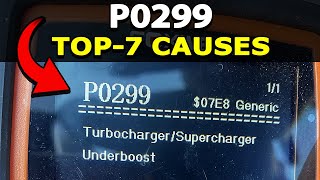
P0299 on 2019-2023 Genesis G70 3.3T: Turbo Underboost Causes and Fixes
On the G70 3.3T, P0299 almost always points to a failing electronic wastegate actuator (EWGA) on the passenger-side turbo, often signaled by a squeak or rattle when you shut the engine off. This is a well-documented pattern failure shared with its platform-mate, the Kia Stinger. A smoke test for boost leaks is a mandatory first diagnostic step before replacing the expensive actuator or turbo.
- P0299 on the G70 3.3T means the passenger-side turbo isn't making enough boost, causing a major loss of power.
- The most likely cause is a failing electronic wastegate actuator (EWGA), often identified by a rattle or squeak when you turn the engine off.
- Before any expensive repairs, a smoke test is mandatory to rule out simple boost leaks from hoses or the intercooler.
- This is a difficult, labor-intensive repair best left to a professional mechanic familiar with this platform.
- Check that the critical safety recall (NHTSA 24V-191) for the driver-side turbo oil line has been performed to prevent a fire risk.
What's Unique About the 2019-2023 Genesis G70
The Genesis G70 and its corporate cousin, the Kia Stinger GT, share the Lambda II 3.3T engine and are well-known for a specific pattern failure causing P0299. The electronic wastegate actuators (EWGA) are a common weak point due to their position in a high-heat, high-vibration environment. Owners frequently report a unique squeaking or rattling noise from the engine bay during shutdown that precedes the code, making this a key platform-specific symptom. This actuator failure is a much more common cause for P0299 than a complete turbocharger failure on this specific platform.
Symptoms You May Notice
- Significant loss of engine power and acceleration
- Check Engine Light is on
- Vehicle enters 'limp mode,' limiting engine RPM and speed
- Squeaking or rattling noise from the engine bay when the engine is shut off
- Turbo boost gauge on the digital cluster reads zero or very low during acceleration
- Unusual whooshing or hissing sounds from the engine bay if a boost leak is present
- Audible noise from the wastegate area when coming to a stop or accelerating from a stop
- Replacing the entire turbocharger assembly without first performing a smoke test. A simple, inexpensive boost leak is often overlooked, leading to an unnecessarily expensive repair.
- Replacing the turbocharger for a wastegate actuator noise without understanding that the noise may return. Some owners have temporarily quieted the noise by applying high-temperature grease to the actuator arm pivot point.
Most Likely Causes
- Failing Electronic Wastegate Actuator (EWGA) 🔴 High Probability → Shop Turbocharger This is a well-documented pattern failure on the 3.3T engine platform due to heat and vibration causing the internal motor, electronics, or linkage to fail, preventing the wastegate from closing properly. The issue is so common that some owners report the noise returning even after a full turbo replacement.
How to confirm: A squeaking or rattling noise on engine shutdown is the classic symptom. A technician can use a scan tool to monitor desired vs. actual wastegate position. A key diagnostic check is to measure the EWGA voltage; a healthy actuator should read between 3.9V and 4.1V. The motor coil resistance should be between 10-20 Ohms.
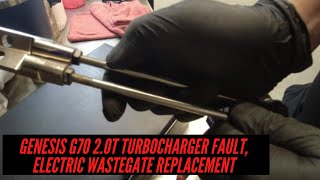
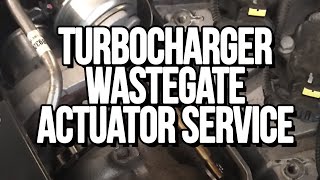
Typical fix: Replace the Bank 1 (passenger side) electronic wastegate actuator. Dealers only sell this as part of the complete turbocharger assembly. Aftermarket actuators are available from brands like Eturbotec, allowing for actuator-only replacement by independent shops or skilled DIYers.
Est. part cost: $150-$400 (actuator only), $1500-$2500 (full turbo assembly) - Boost Leak (Charge Pipes, Hoses, Intercooler) 🟡 Medium Probability The charge system operates under high pressure. Over time, plastic or rubber components can crack, and hose clamps can loosen, causing leaks.
How to confirm: Perform a smoke test on the entire intake and charge air system. The smoke will visibly escape from any leak points.
Typical fix: Tighten loose clamps or replace the cracked hose, pipe, or intercooler.
Est. part cost: $5-$500 - Faulty Boost Pressure Sensor (MAP Sensor) ⚪ Low Probability The MAP sensor is a known, but less common, failure point on the 3.3T engine across multiple Hyundai/Kia/Genesis platforms.
How to confirm: Monitor the sensor's readings on a scan tool to see if they are erratic or implausible. Compare its reading to the barometric pressure sensor with the engine off. With Key On, Engine Off (KOEO), the voltage should be around 4.0-4.5V at sea level.
Typical fix: Replace the boost pressure sensor (OEM P/N 39300-3L000).
Est. part cost: $40-$100 - Faulty Diverter / Bypass Valve ⚪ Low Probability
How to confirm: Inspect the valve for tears in its diaphragm or listen for leaks. A vacuum pump can be used to test if it holds vacuum. This can sometimes be accompanied by code P2261.
Typical fix: Replace the faulty valve. Many owners upgrade to more durable aftermarket units.
Est. part cost: $60-$150
Rare But Worth Checking
- Complete Turbocharger Mechanical Failure: → Shop Turbocharger While the actuator is the most common failure point, the turbo itself can fail from issues like oil starvation, potentially caused by a cracking oil feed line (see TSBs). This is a much more severe and expensive repair.
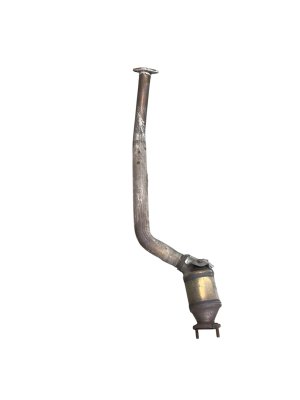
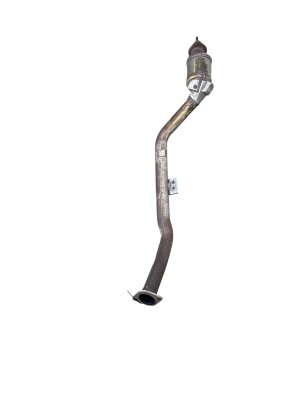
- Clogged Catalytic Converter: → Shop Catalytic Converter In rare cases, if a turbo has previously failed, debris can be sent downstream, clogging the catalytic converter. This creates backpressure that prevents the new turbo from spooling correctly, which can trigger a P0299 code even after the turbo has been replaced.
Diagnosis Steps
- Check for any other stored DTCs that could provide more clues, such as P0234 (overboost) or P2563 (wastegate position sensor).
- Listen carefully for a squeak or rattle from the passenger side of the engine bay when shutting the vehicle off. This strongly indicates a failing wastegate actuator.
- Perform a thorough visual inspection of all intake air ducts, vacuum lines, and charge pipes between the turbo, intercooler, and throttle body. Look for obvious cracks, loose connections, or disconnected hoses.
- Perform a smoke test on the entire charge air system to identify any pressure leaks that are not visually apparent. This is a critical step before condemning expensive parts.
- Using a capable scan tool, monitor desired boost pressure versus actual boost pressure while driving to confirm the underboost condition.
- If no leaks are found, the primary suspect becomes the electronic wastegate actuator (EWGA). Use the scan tool to command the actuator and monitor its position. Check the actuator's closed-position voltage; it should be between 3.9V and 4.1V.
- If the actuator is confirmed faulty, replacement is the fix. Dealers will replace the entire turbocharger assembly. An independent shop may be willing to replace only the actuator if one can be sourced.
Parts You'll Likely Need
- Electronic Wastegate Actuator (Bank 1)
(OEM #K6T52674 or K6T52673 (Actuator No.))— This is the most common failure point on the 3.3T engine that causes code P0299. It fails due to heat and vibration.
Trusted brands: Genuine Genesis/Hyundai (as part of turbo), Eturbotec
OEM price range: $1500-$2500 (as part of turbo assembly)
Aftermarket price range: $120-$400 (actuator only) - Turbocharger Assembly (Bank 1 / Passenger Side)
(OEM #28231-3L110)— Required if the wastegate actuator is not sold separately by the dealer or if the turbocharger itself has failed mechanically. This is the RH (passenger side) turbo.
Trusted brands: Garrett (OEM Manufacturer), Genuine Genesis/Hyundai
OEM price range: $1500-$2500
Aftermarket price range: $800-$1500 (remanufactured)
Related Codes That Often Appear With This One
- P0234 — This is an overboost code. Seeing both P0299 and P0234 suggests an erratic wastegate actuator that is sometimes sticking open (underboost) and other times sticking closed (overboost).
- P2563 / P2565 — These codes point directly to a fault in the wastegate actuator's position sensor circuit or its performance, making an actuator failure highly likely when seen with P0299.
Technical Service Bulletins (TSBs) & Recalls
- NHTSA 24V-191 (Genesis Recall 019G): Addresses a cracking left-side (Bank 2) turbo oil feed pipe that can leak oil and cause a fire. The remedy involves replacing the original pipe with one made of more durable stainless steel. This recall expands and replaces a previous recall (19V538).
- TSB 18-01-005-G: Addresses brake pulsation/judder on 2019 models with Brembo brakes by recommending a rotor burnishing procedure.
Platform-Specific Known Issues
- A recurring squeak or rattle from the wastegate actuator on engine shutdown is a very common precursor to the P0299 code. Some owners have had the full turbo replaced under warranty only for the noise to return a week later.
- There is a critical safety recall (NHTSA 24V-191 / Genesis Recall 019G) for the *driver's side* (Bank 2) turbo oil feed pipe on 2019-2022 models. It can crack, leak oil onto the exhaust manifold, and cause a fire. While not the direct cause of a Bank 1 underboost, it highlights the high-stress nature of the turbo system and can lead to turbo failure from oil starvation.
Mechanic-Grade Diagnostic Values
- Electronic Wastegate Actuator (EWGA) Position Sensor Voltage — expected: 3.9V - 4.1V at KOEO (Key On, Engine Off) with wastegate commanded closed.. Failure: A reading outside the target range, especially 4.5V or higher, indicates a failed, misadjusted, or binding actuator.
- Electronic Wastegate Actuator (EWGA) Motor Resistance — expected: 10 - 20 Ohms between the two motor pins.. Failure: An open circuit (infinite resistance) or a short (near-zero resistance) indicates the internal motor has failed.
- Boost Pressure Sensor (MAP/BPS) Voltage — expected: Approx. 4.0V - 4.5V at sea level with Key On, Engine Off (KOEO), corresponding to atmospheric pressure.. Failure: A voltage that is irrational (e.g., stuck low) or does not match the current barometric pressure suggests a faulty sensor.
Scan Tool Commands That Help
- Hyundai GDS (Global Diagnostic System) or equivalent: Actuation Test -> EWGA (Electronic Waste Gate Actuator) — This is the primary bidirectional test to confirm a suspected wastegate actuator failure. It commands the actuator through its full range of motion, allowing a technician to check for smooth movement, listen for binding/noise, and verify the position sensor voltage changes accordingly.
- Hyundai GDS (Global Diagnostic System) or equivalent: Wastegate Actuator Adaptation / Relearn / Voltage Adjustment — This procedure is mandatory after replacing the electronic wastegate actuator or manually adjusting the actuator rod. The ECU must learn the new closed-position voltage to ensure proper boost control.
Wiring & Ground Locations
- EWGA Connector — Directly on the electronic wastegate actuator on the Bank 1 (passenger side) turbocharger assembly.. This 6-pin connector is the primary test point. The two motor pins can be checked for resistance, and the position sensor pins can be back-probed to check live voltage without removing the component.
- ECM Connector (Bank 1 EWGA Circuit) — In the engine bay, typically located near the driver's side firewall and strut tower.. Allows for testing the electrical circuit from the ECU to the actuator to rule out a wiring harness fault. For example, on some models, Pin 39 (Green wire) is the EWGA Motor (+) and Pin 1 (Black wire) is a ground.
- Main Engine/Chassis Grounds — Key ground points (e.g., G101) are located on the engine block and inner fenders within the engine bay.. A poor main ground connection for the ECM can cause a host of erratic electronic issues, including incorrect sensor readings and faulty actuator control. Verifying grounds are clean and tight is a crucial step in diagnosing any complex electronic fault.
Real Owner Repair Stories
- YouTube technician video on Hyundai/Kia 3.3T with EWGA system (Hyundai/Kia with 3.3T engine (mechanically identical to G70)) — Check Engine Light with code P2563 (Turbocharger Boost Control Position Sensor Range/Performance), which is directly related to P0299.
❌ Tried (didn't work) Initial diagnosis confirmed the wastegate position sensor voltage was out of spec (reading 4.6V instead of the target 3.9-4.1V), leading to the assumption that the actuator or turbo needed replacement.
✅ What actually fixed it The technician manually adjusted the length of the wastegate actuator rod by shortening it. This brought the closed-position voltage back into the specified 3.9V-4.1V range, resolving the code without replacing any parts.
"I Checked Everything" — The Actual Cause
- In many cases on the 3.3T platform where a smoke test passes with no leaks found, the P0299 code is ultimately caused by the electronic wastegate actuator (EWGA) itself. A low-pressure smoke test only checks for static leaks in the charge piping and intercooler; it cannot test the dynamic function of the wastegate under load. If the actuator's internal motor is weak or the linkage is binding, it will fail to command the wastegate fully closed during a boost request, causing pressure to bleed off and triggering the code, even with a perfectly sealed intake system.
Model Year Variations Within This Range
- 2019-2023: The Genesis G70 received a significant facelift for the 2022 model year, which included revised styling and interior technology. However, the Lambda II 3.3T powertrain, including the turbochargers and electronic wastegate actuators that are the primary cause of P0299, remained mechanically consistent across the 2019-2023 range.
Diagnostic Flowchart
Other Known Issues on This Vehicle
Issues unrelated to this code that are worth knowing about as an owner of this generation:
- Rear Differential Whine/Grinding 🟠 Medium — Commonly reported, especially on 2022-2023 models, at low speeds while turning. Often appears within 20,000 miles. (Ref: A TSB exists for GV70/G80 models with the same differential; dealers apply a similar procedure to the G70. The common fix is a differential fluid change with a proper friction modifier, though some cases require full replacement under warranty.)
- Paint Peeling / Clear Coat Failure 🟡 Low — Numerous owner complaints of paint peeling, especially at the seam between the rear bumper and quarter panel, and clear coat issues on wheels. Often occurs early in the vehicle's life. (Ref: Covered under the 3-year/36,000-mile paint warranty, but owners report dealers can be reluctant, sometimes requiring escalation with the BBB to get it covered.)
- Brake Judder / Vibration (Brembo Brakes) 🟠 Medium — A very common complaint from owners of 3.3T models equipped with Brembo brakes. It's typically caused by uneven brake pad deposits on the rotors, not warped rotors. (Ref: TSB 18-01-005-G was issued for 2019 models to address the issue by burnishing or resurfacing the rotors.)
- High-Pressure Fuel Pump (HPFP) Failure 🔴 High — A recall was issued for potential failure, which can cause a sudden loss of power. (Ref: NHTSA Recall 24V528 / Genesis Campaign 023G.)
- Oxidizing Window Trim 🟡 Low — Common for the chrome or dark chrome window surround trim to develop a milky, hazy, or oxidized appearance. (Ref: A known issue that is often replaced under warranty.)
Used vs. New Parts: Buying Guide for This Vehicle
When a used part is the smart pick: For this repair, buying a used complete turbocharger assembly from a low-mileage, reputable donor vehicle can be a cost-effective alternative to a new OEM unit, especially since the main failure is often electronic, not mechanical wear. However, it carries risk.
Donor-vehicle mileage cap: roughly under 50000 miles for the part to have meaningful remaining life.
What to inspect on the donor part:
- Verify the donor vehicle's VIN to confirm it's from a 2019 or newer model to get the most recent revisions.
- Inspect the turbocharger for any signs of oil leakage around the seals or housing.
- Manually check the turbine wheel for excessive shaft play (in-and-out or side-to-side movement); a small amount is normal, but significant wobble indicates a worn bearing.
- If possible, test the resistance of the electronic wastegate actuator's motor pins (should be 10-20 ohms) before purchase.
OEM-only on this vehicle (don't cheap out):
- Turbocharger Assembly: While used is an option, if buying new, sticking with the Genuine Genesis/Hyundai part (Garrett is the OEM manufacturer) is strongly recommended to ensure compatibility and avoid issues with remanufactured units of unknown quality.
Aftermarket brands forum-validated for this vehicle:
- Eturbotec: This brand is frequently mentioned in forums as a source for standalone electronic wastegate actuators (EWGA), allowing for a much cheaper repair than replacing the entire turbo assembly.
Brands owners have reported issues with on this vehicle:
- Unbranded, no-name turbocharger assemblies from online marketplaces. The complex electronics and tight tolerances of modern turbos make these a high-risk purchase.
Real Owner Stories
Aggregated from forums and TSBs cited above. Mileages and costs reflect what owners reported in those sources.
2019 Genesis G70 3.3T
Symptoms: A distinct rattle or squeak was heard from the passenger side of the engine bay specifically when shutting the vehicle off.
What fixed it: Replacement of the Bank 1 electronic wastegate actuator (EWGA).
Source hint: GenesisG70.com / g70.genesis-forums.com
2018-2023 Kia Stinger GT 3.3T
Symptoms: The car entered 'limp mode,' limiting engine RPM and speed, accompanied by a P0299 code and a shutdown squeal.
What fixed it: Replacement of the electronic wastegate actuator (EWGA); some owners utilized aftermarket solutions to avoid full turbo replacement.
Source hint: Kia Stinger Forums (stingerforum.org)
2019-2022 Genesis G70 3.3T
Symptoms: Significant loss of engine power and acceleration with the turbo boost gauge reading zero on the digital cluster.
What fixed it: Technician identified a boost leak in the charge pipe system and tightened loose clamps.
Source hint: vehicle_specific_issues
Related OBD-II Codes
Frequently Asked Questions
I hear a squeaking noise from my 3.3T engine when I turn it off. Is this related to the P0299 code?
Does the turbo oil feed pipe recall (NHTSA 24V-191) cause the P0299 underboost code?
Can I replace just the wastegate actuator on my G70, or do I need a whole new turbo?
What voltage should a healthy wastegate actuator show on a diagnostic tool?
Is the P0299 issue common on other Genesis models besides the G70?
My G70 has brake vibration; is this related to the turbo system?
Helpful Videos

We Have This Part in Stock

The information in this article is provided for general reference and educational purposes only. Vehicle specifications, procedures, and part compatibility can vary by production date, trim level, and region. Always consult your vehicle's factory service manual and verify part numbers before purchasing or performing repairs. Safety-critical components such as airbags, seat belts, and braking systems should be installed by a qualified professional.
- Genesis G70:
- 🧭 Diagnostic Flowchart
- 🎬 Helpful Videos
- 🛍️ Shop This Part
- What's Unique About the 2019-2023 Genesis G70
- Symptoms You May Notice
- Most Likely Causes
- Rare But Worth Checking
- Diagnosis Steps
- Parts You'll Likely Need
- Related Codes That Often Appear With This One
- Technical Service Bulletins (TSBs) & Recalls
- Platform-Specific Known Issues
- Mechanic-Grade Diagnostic Values
- Scan Tool Commands That Help
- Wiring & Ground Locations
- Real Owner Repair Stories
- "I Checked Everything" — The Actual Cause
- Model Year Variations Within This Range
- Other Known Issues on This Vehicle
- Used vs. New Parts: Buying Guide for This Vehicle
- Real Owner Stories
- 2019 Genesis G70 3.3T
- 2018-2023 Kia Stinger GT 3.3T
- 2019-2022 Genesis G70 3.3T
- Related OBD-II Codes
- Frequently Asked Questions
- 🎟️ Get 5% Off