

P0700 on 2008-2017 Mitsubishi Lancer: Transmission Control System Fault Guide
P0700 on a Mitsubishi Lancer is a general transmission fault alert. The actual problem is usually low CVT fluid pressure (code P0868) due to old fluid or clogged filters. A fluid and filter service (~$150-$250 DIY) is the first step, but if this doesn't work, a costly CVT repair may be needed.
- P0700 is not the real problem; you must scan the TCM for specific codes like P0868 or P0741.
- The most likely cause of transmission problems on a Lancer CVT is old, degraded fluid and clogged filters.
- When servicing the transmission, it is absolutely critical to replace BOTH the pan filter and the separate CVT cooler filter.
- Use only CVT fluid that meets Mitsubishi's specifications (e.g., J4). Using the wrong fluid can damage the transmission.
- If a fluid and filter service does not fix the issue, especially if code P0868 returns, prepare for a more expensive repair like a valve body or a full transmission replacement.
What's Unique About the 2008-2017 Mitsubishi Lancer
Most 2008-2017 Lancers use a Jatco-sourced Continuously Variable Transmission (CVT), specifically the JF011E (pre-2015/16) or JF016E/CVT-8 (2016-2017). When a Lancer shows a P0700, it's frequently accompanied by code P0868 (Transmission Fluid Pressure Low). This is often caused by degraded CVT fluid and, critically, a clogged secondary CVT cooler filter—a paper cartridge part many owners and shops overlook. Ignoring this can quickly lead to severe hesitation, limp mode, and complete failure of the expensive CVT unit.
Symptoms You May Notice
- Check Engine Light is on
- "Transmission Service Required" or "Slow Down" message on the dashboard information display
- Vehicle enters 'limp mode' with significantly reduced acceleration
- Hesitation or shuddering when accelerating from a stop
- Slipping or erratic gear ratio changes
- A whining or humming noise from the transmission area, especially during acceleration
- Delay in engagement when shifting from Park to Drive or Reverse
- Replacing only the transmission fluid without changing the filters, especially the external cooler filter.
- Assuming the entire transmission has failed without first checking for the simpler and cheaper fluid/filter issues.
- Clearing the codes and hoping the problem goes away without performing a proper diagnosis of the underlying TCM codes.
- Replacing the transmission without addressing a faulty pressure sensor or wiring, causing the code to return.
Most Likely Causes
- Low or Degraded CVT Fluid 🔴 High Probability CVT fluid degrades with heat and mileage, and many transmissions are never serviced, leading to low levels or poor fluid quality which causes overheating and loss of hydraulic pressure.
How to confirm: Check the CVT fluid level and condition using the dipstick (if equipped) or the fill plug procedure. The fluid should be translucent and not dark brown, black, or have a burnt smell. Note that some later models may not have a dipstick.
Typical fix: Perform a CVT fluid drain and fill using the correct specification fluid (e.g., Mitsubishi Diamond Queen CVT Fluid J4).
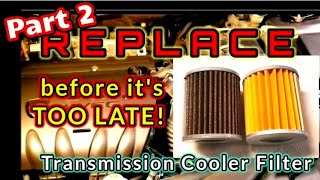
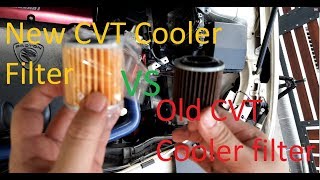
Est. part cost: $60-$120 - Clogged CVT Fluid Filters 🔴 High Probability The Lancer CVT has two filters: one in the pan and a paper cartridge filter for the cooler (2824A006). The cooler filter, located near the driver-side wheel well 🎬 See this walkthrough for replacing the external cooler filter under the battery tray, is often forgotten during service, gets clogged with debris, and restricts flow, causing low pressure (P0868).
How to confirm: Inspect the filters during a fluid service. The cooler filter, in particular, will often be dark and saturated if it's the original.
Typical fix: Replace both the internal pan filter and the external cooler filter during a CVT fluid service. The O-ring for the cooler filter housing (2920A096) should also be replaced.
Est. part cost: $40-$80 - Failing CVT Step Motor 🟡 Medium Probability The Jatco JF011E CVT uses a step motor to control the pulley ratio. This component is a known failure point and can malfunction electrically or mechanically, causing erratic shifting, hesitation, or inability to change ratios. This failure often triggers code P1777.
How to confirm: This is diagnosed when code P1777 or P1778 is present along with P0700. A scan tool can monitor the step motor's commanded vs. actual position. The motor is located on the valve body inside the transmission.
Typical fix: Replacement of the step motor, which requires removing the transmission oil pan and valve body.
Est. part cost: $100-$200 - Failing CVT Valve Body or Solenoids 🟡 Medium Probability → Shop Transmission Valve Body Debris from normal wear or degraded fluid can cause pressure control solenoids within the valve body to stick or fail, leading to incorrect fluid pressures.
How to confirm: This is diagnosed when specific solenoid codes (like P0776) are present along with P0700, and fluid/filter changes do not resolve the issue. A mechanic can perform electronic tests on the solenoids.
Typical fix: Replacement of the specific solenoid or the entire valve body assembly.
Est. part cost: $300-$900 - Internal CVT Failure (e.g., Fluid Pump) ⚪ Low Probability If driven for an extended period with low fluid pressure, the CVT's internal components, like the high-pressure pump or belt/pulley assembly, can fail permanently.
How to confirm: This is often the diagnosis when code P0868 persists after fluid, filters, and the valve body have been addressed. The transmission pan may contain excessive metallic debris.
Typical fix: Complete replacement or rebuild of the CVT assembly.
Est. part cost: $2500-$5000
Diagnosis Steps
- Use an OBD-II scanner capable of accessing the Transmission Control Module (TCM) to read the specific transmission codes. Do not stop at P0700.
- Record all codes (e.g., P0868, P1777, P0776) and freeze-frame data.
- Check the CVT fluid level and condition. The fluid should be at the correct level and should not be dark, burnt, or contain excessive metal particles.
- If the fluid is low or degraded, perform a fluid service. CRITICAL: Replace both the internal pan filter (2824A007) 🎬 Watch: How to change both CVT filters on a Lancer and the external CVT cooler filter (2824A006).
- After the service, clear the codes. Use a capable scan tool to reset the 'CVT Fluid Degradation Counter' or perform the adaptation learn procedure.
- Perform a drive cycle to see if the codes return.
- If codes for specific solenoids (e.g., P0776) or the step motor (P1777) return, further diagnosis of the valve body and its electrical circuits is needed.
- If code P0868 returns after a fluid and filter service, it strongly suggests a failing CVT fluid pump or other major internal failure, likely requiring transmission replacement.
Parts You'll Likely Need
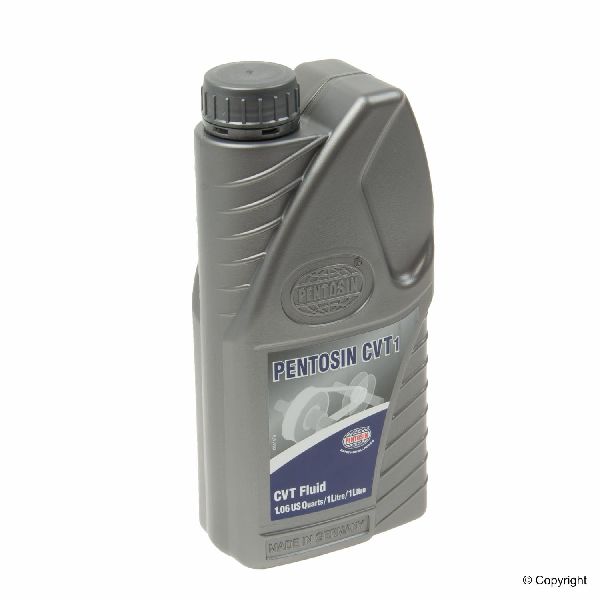
- CVT Fluid (J4 Specification) — The correct fluid is essential for CVT operation. Degraded fluid is a primary cause of pressure and performance issues.
Trusted brands: Mitsubishi Diamond Queen, Idemitsu, ENEOS
OEM price range: $20-$30 per quart
Aftermarket price range: $15-$25 per quart - CVT Cooler Filter (Paper Cartridge)
(OEM #2824A006)— This filter is a common failure point. It clogs with debris and causes low fluid pressure, triggering code P0868.
Trusted brands: Mitsubishi OE, Wix, Beck/Arnley, NIPPARTS
OEM price range: $25-$40
Aftermarket price range: $10-$25 - CVT Pan Filter / Strainer
(OEM #2824A007)— This is the primary filter inside the transmission pan. It should be replaced during any fluid service.
Trusted brands: Mitsubishi OE, ATP, Fram
OEM price range: $30-$50
Aftermarket price range: $15-$30 - CVT Cooler Filter Housing O-Ring
(OEM #2920A096)— This seal for the cooler filter housing cover is critical to replace during a filter change to prevent leaks. It often comes with aftermarket filter kits.
Trusted brands: Mitsubishi OE
OEM price range: $5-$10
Aftermarket price range: $2-$5 - CVT Step Motor (Ratio Control Motor)
(OEM #JF011E-SM (General part number))— A common electrical failure point on the Jatco JF011E CVT, causing ratio control problems and code P1777.
Trusted brands: Jatco (OEM), Rostra
OEM price range: $150-$250
Aftermarket price range: $80-$150
Related Codes That Often Appear With This One
- P0868 — This is the most common partner to P0700 on a Lancer CVT. It means 'Transmission Fluid Pressure Low' and is a critical warning that damage is occurring or the sensor has failed.
- P1777 — Indicates a malfunction in the CVT's step motor circuit. This is a very common failure on the Jatco JF011E and points directly to a faulty step motor 🎬 Watch: Diagnosing the P1777 step motor failure on the valve body.
- P0741 — Indicates a problem with the torque converter clutch, often a stuck solenoid or internal torque converter issue. It can be triggered by hydraulic problems within the CVT.
- P0776 — Points to a fault with the 'Pressure Control Solenoid B'. This is a specific component in the valve body that has failed or is stuck, directly causing pressure regulation problems.
Technical Service Bulletins (TSBs) & Recalls
- TSB-22-23-001REV: Addresses a potential shudder or surge condition in 2016-2017 Lancers with the CVT-8 transmission, which can cause DTCs like P0776, P0730, P0741, P084A, P0969, and P2719 due to hydraulic circuit issues. The fix may involve inspection and, if instructed by Techline, replacement of the valve body or entire CVT assembly.
Platform-Specific Known Issues
- A known issue with the Jatco CVT-8 transmission used in 2016-2017 Lancers can cause a shudder or surge, leading to codes like P0776 and P0741. Mitsubishi issued Technical Service Bulletin TSB-20-23-001REV3 which outlines diagnostic procedures, including a specific test drive to duplicate the condition and potentially reprogramming the CVT ECU or replacing the control valve body.
Mechanic-Grade Diagnostic Values
- JF011E Stepper Motor Winding Resistance — expected: Approximately 15 Ohms between the center pin (2 or 5) and each outer pin (1, 3 or 4, 6), and 30 Ohms between the two outer pins (1-3 or 4-6).. Failure: Readings that are open (infinite resistance) or significantly different (more than 5 ohms variance) from the specification indicate a failed motor winding.
- JF011E TCC Control Solenoid Resistance — expected: 3 to 9 Ohms.. Failure: Resistance outside this range indicates a faulty solenoid coil.
- JF011E Lockup Select Switch Solenoid Resistance — expected: 15 to 30 Ohms.. Failure: Resistance outside this range indicates a faulty solenoid coil.
- JF011E Pressure Control Solenoid (A or B) Resistance — expected: 3.0 to 7.0 Ohms.. Failure: Resistance outside this range points to a failed solenoid.
- JF011E CVT Fluid Temperature Sensor Resistance — expected: Approx. 6.5 kOhms at 20°C (68°F) or 0.9 kOhms at 80°C (176°F).. Failure: Readings that deviate significantly suggest a faulty temperature sensor, which can affect pressure control and shift logic.
Scan Tool Commands That Help
- Mitsubishi MUT-III / MUT-III SE: CVT oil degradation level reset — This function is mandatory after performing a CVT fluid change. It resets the counter that the TCM uses to estimate fluid life. Failure to reset this can result in incorrect pressure adjustments and premature warnings.
- Mitsubishi MUT-III / MUT-III SE: Write calibration value (Saved calibration value writing) — This is used when replacing the TCM. It writes the vehicle-specific calibration data (saved from the old TCM) to the new module.
- Mitsubishi MUT-III / MUT-III SE: Calibration value reset — This procedure is required after replacing the entire CVT assembly or the valve body to initialize the new components with the TCM.
- Mitsubishi MUT-III / MUT-III SE: Drive Recorder — For intermittent issues like the shudder described in TSB-20-23-001REV3, this function allows a technician to record live data during a test drive and trigger a snapshot when the symptom occurs for later analysis.
Wiring & Ground Locations
- B-118 / B-08 — The main CVT assembly connector on the transmission case.. This is the primary connection point for all transmission sensors and solenoids, including the step motor. A poor connection or corrosion here can cause various transmission codes, including P1777.
- C-33 / C-40 — The main connector for the Transmission Control Module (TCM).. When diagnosing specific codes like P1777, technicians must check for continuity and shorts between the pins at this connector and the corresponding pins at the transmission connector (B-118/B-08) to rule out wiring harness issues.
Real Owner Repair Stories
- YouTube video by 'shak' (Mitsubishi Lancer (year not specified, but within the generation)) — No check engine light, but a scan revealed code P1778 (functionally similar to P1777), indicating a step motor problem.
✅ What actually fixed it The problem was solved by replacing the CVT step motor. The repair involved dropping the transmission pan and valve body to access and replace the motor. - YouTube video by 'siu automotive' (Jatco JF011E CVT (used in Lancer)) — General CVT failure symptoms requiring a full teardown and rebuild.
✅ What actually fixed it A full rebuild was performed. The video highlights the importance of replacing seals, including a critical O-ring between the valve body and transmission case, and another for the oil pump. Forgetting these seals is a common mistake that will cause pressure loss and immediate failure after reassembly.
OEM Part Supersession History
2824A025→2824A006— Part number consolidation and potential minor design update by Mitsubishi.
Model Year Variations Within This Range
- 2008-2015/2016: These models primarily use the Jatco JF011E (Mitsubishi F1CJA/W1CJA) CVT. Common failures are well-documented and often relate to the step motor (P1777), fluid pressure (P0868) from clogged filters, and general wear.
- 2016-2017: These later models transitioned to the Jatco JF016E, also known as the CVT-8 (Mitsubishi F1CJC/W1CJC). These units are subject to a specific shudder or surge condition addressed by Mitsubishi TSB-20-23-001REV3. The fix may involve a CVT ECU software update or replacement of the control valve body, and is often associated with codes like P0776 and P0741 rather than the classic P1777 step motor code.
Diagnostic Flowchart
Other Known Issues on This Vehicle
Issues unrelated to this code that are worth knowing about as an owner of this generation:
- Peeling Clear Coat Paint 🟠 Medium — Very common, especially on darker colors like red and black. Often begins as white spots on horizontal surfaces (roof, trunk) and progresses to large-scale peeling. (Ref: No official recall, but widespread owner complaints exist. Some owners have had limited success with dealer goodwill repairs out of warranty.)
- Seized Front Wheel Bearings 🔴 High — Common in regions that use road salt. The bearing, hub, and axle can seize together, making replacement extremely difficult and labor-intensive, often requiring heat and heavy-duty pullers and sometimes destroying the ABS sensor in the process.
- ETACS Module Failure 🟠 Medium — Can occur intermittently, causing a wide range of bizarre electrical issues like non-functional turn signals, wipers, power locks, or radio. A recall was issued for 2009-2010 models due to a manufacturing defect that could cause loss of headlights or wipers. (Ref: Safety Recall for 2009-2010 models.)
- Drive Belt Automatic Tensioner Failure 🔴 High — Affects vehicles with the 4B11 or 4B12 engine. The tensioner flange can crack, causing the accessory drive belt to detach, leading to a loss of power steering and alternator function. (Ref: Recall no. 18V220000)
- CVT Hesitation / Acceleration Delay 🟠 Medium — Affects 2015-2016 models. Under certain conditions, the CVT may cause a delay in acceleration, posing a safety risk. (Ref: Recall no. 16V458000)
Used vs. New Parts: Buying Guide for This Vehicle
When a used part is the smart pick: For this vehicle, buying a complete used CVT assembly is a major gamble and generally not recommended due to the high failure rate and sensitivity to maintenance history. However, external components like sensors or the cooler assembly could be sourced from a low-mileage donor vehicle.
Donor-vehicle mileage cap: roughly under 70000 miles for the part to have meaningful remaining life.
What to inspect on the donor part:
- Verify the donor vehicle's mileage if possible.
- Ask for any available service history, specifically looking for regular CVT fluid changes.
- When buying a complete used CVT, check the fluid on the dipstick. If it's dark black, has a burnt smell, or contains visible metal flakes, avoid it.
- Inspect the transmission case for any cracks or signs of heavy impact.
OEM-only on this vehicle (don't cheap out):
- CVT Fluid (use only Mitsubishi J4 or a fully-compliant equivalent like Idemitsu or ENEOS)
- CVT Assembly (A remanufactured unit from a reputable supplier is a much safer bet than a junkyard part)
- Transmission Control Module (TCM)
Aftermarket brands forum-validated for this vehicle:
- Rostra (for step motors)
- Sonnax (for valve body repair kits and individual components)
- Wix, Beck/Arnley (for CVT filters)
Brands owners have reported issues with on this vehicle:
- Unbranded, no-name CVT fluid.
- Extremely cheap, unverified aftermarket sensors and solenoids from online marketplaces, as their calibration and longevity can be questionable.
Real Owner Stories
Aggregated from forums and TSBs cited above. Mileages and costs reflect what owners reported in those sources.
2008-2015 Mitsubishi Lancer
Symptoms: Received 'Transmission Service Required' light and P0868 code; vehicle experienced hesitation.
What fixed it: A complete fluid and filter service using both the pan and cooler filters along with correct J4 fluid.
Source hint: evolutionm.net & lancerforums.com threads regarding P0700/P0868 combination
2016-2017 Mitsubishi Lancer CVT-8
Symptoms: Vehicle experienced a shudder or surge condition while driving, triggering codes P0776 and P0741.
What fixed it: Diagnostic test drive and inspection as per TSB-20-23-001REV3, resulting in either a valve body replacement or CVT ECU reprogramming.
Source hint: TSB-22-23-001REV / TSB-20-23-001REV3
2008-2017 Mitsubishi Lancer
Symptoms: Frustrating experience with electrical issues where a replacement part sparked and damaged the ECM; struggled with part compatibility and programming without dealer tools.
What fixed it: Attempted replacement of a faulty ETACS module, though the story highlights the complexity of needing MUT-III tools for proper programming.
Source hint: mitsubishi-forum.com - 'ETACS and ECU problems. Help is appreciated'
Related OBD-II Codes
Frequently Asked Questions
My 2017 Lancer is shuddering and showing P0776; is there a specific bulletin for this?
Which CVT filters do I need to replace on my Lancer to clear a P0868 or P0700 code?
What specific transmission fluid should I use for my 2008-2017 Lancer CVT?
My Lancer is throwing P1777 along with P0700. What part is likely failing?
Is there a specific maintenance step required after changing the CVT fluid to keep the light off?
Can a clogged filter cause the 'Transmission Service Required' message on my dashboard?
Helpful Videos


We Have This Part in Stock

The information in this article is provided for general reference and educational purposes only. Vehicle specifications, procedures, and part compatibility can vary by production date, trim level, and region. Always consult your vehicle's factory service manual and verify part numbers before purchasing or performing repairs. Safety-critical components such as airbags, seat belts, and braking systems should be installed by a qualified professional.
- Mitsubishi Lancer:
- 🧭 Diagnostic Flowchart
- 🎬 Helpful Videos
- 🛍️ Shop This Part
- What's Unique About the 2008-2017 Mitsubishi Lancer
- Symptoms You May Notice
- Most Likely Causes
- Diagnosis Steps
- Parts You'll Likely Need
- Related Codes That Often Appear With This One
- Technical Service Bulletins (TSBs) & Recalls
- Platform-Specific Known Issues
- Mechanic-Grade Diagnostic Values
- Scan Tool Commands That Help
- Wiring & Ground Locations
- Real Owner Repair Stories
- OEM Part Supersession History
- Model Year Variations Within This Range
- Other Known Issues on This Vehicle
- Used vs. New Parts: Buying Guide for This Vehicle
- Real Owner Stories
- 2008-2015 Mitsubishi Lancer
- 2016-2017 Mitsubishi Lancer CVT-8
- 2008-2017 Mitsubishi Lancer
- Related OBD-II Codes
- Frequently Asked Questions
- 🎟️ Get 5% Off