

P0706 on 2013-2016 Mazda CX-5: Transmission Range Sensor Fault Causes and Fixes
On a 2013-2016 Mazda CX-5, code P0706 is almost always caused by a failed internal Transmission Range Sensor. This sensor is part of the Transmission Control Module (TCM) inside the transmission, requiring professional replacement of the entire TCM/valve body assembly, which can cost over $1,000. The issue is common to other Mazda models sharing the SKYACTIV-Drive FW6A-EL transmission.
- P0706 on a 2013-2016 CX-5 points to a problem with the Transmission Range Sensor.
- Unlike many cars, this sensor is inside the transmission and part of the control module (TCM), making it a complex and expensive repair.
- This is not a DIY-friendly job. Professional diagnosis with an advanced scan tool is required to confirm the failure before committing to the costly repair.
- Symptoms include no-start conditions, erratic shifting, a shifter stuck in Park, and the AT warning light illuminating.
What's Unique About the 2013-2016 Mazda CX-5
On the 2013-2016 Mazda CX-5 equipped with the SKYACTIV-Drive automatic transmission (FW6A-EL) 🎬 Watch: An overview of the Skyactiv FW6A-EL transmission, the Transmission Range Sensor is not a simple, external bolt-on part like on many other vehicles. Instead, it is integrated directly into the Transmission Control Module (TCM), which is located inside the transmission oil pan and attached to the valve body. This design was part of Mazda's effort to create a more compact, efficient transmission that combined features of conventional automatics, CVTs, and dual-clutch transmissions. However, this integration means that a simple sensor swap is impossible; the entire TCM/valve body assembly must typically be replaced to fix the issue, making the repair significantly more complex and costly.
Symptoms You May Notice
- Check Engine Light is on
- AT (Automatic Transmission) warning light is on
- Vehicle may not start
- Engine only starts in Neutral, not Park (or vice-versa)
- Shifter may be stuck in Park, requiring use of the manual override
- Harsh or delayed gear engagement
- Transmission may be stuck in one gear (limp mode)
- Gear indicator on the dashboard may be incorrect or blank
- Replacing the external transmission wiring harness without confirming an internal TCM fault.
- Assuming it's a simple external neutral safety switch. On this vehicle, it is internal.
Most Likely Causes
- Internal Transmission Range Sensor Failure 🔴 High Probability → Shop Transmission Assembly The range sensor is an electronic component integrated within the Transmission Control Module (TCM) inside the transmission. This internal placement exposes it to heat and transmission fluid, and its failure requires replacing the entire module. This is a confirmed issue on SKYACTIV-Drive transmissions.
How to confirm: A professional technician will use a high-end scan tool to monitor the live data from the transmission range sensor while moving the gear selector. If the data is erratic, incorrect, or does not change, it confirms the sensor's failure. A real-world example from a Mazda 3 owner with the same transmission showed codes P0706 and P0780, leading to a diagnosis of a failed TCM.
Typical fix: Replace the Transmission Control Module / Valve Body assembly located inside the transmission and reprogram the new module.
Est. part cost: $600-$1200 for a remanufactured TCM/valve body assembly - Wiring or Connector Issues ⚪ Low Probability While less common than internal failure, the wiring harness leading to the transmission can be damaged by road debris or corrosion. Given the sensor is internal, this would relate to the main connector at the transmission case.
How to confirm: Visually inspect the external transmission wiring harness and connectors for damage, corrosion, or loose pins. A technician can perform a continuity and resistance test on the wiring from the TCM connector to the main harness.
Typical fix: Repair the damaged section of the wiring harness or replace the affected connector.
Est. part cost: $20-$200
Rare But Worth Checking
- Low or Contaminated Transmission Fluid: → Shop Transmission Assembly While unlikely to be the primary cause of a P0706, very low or dirty fluid can cause erratic transmission behavior and should be checked as a basic step. The SKYACTIV-Drive transmission requires a specific fluid, ATF-FZ (blue in color), and is considered 'filled for life' by Mazda, though checking it is still a valid diagnostic step.
- Misadjusted Shifter Cable: If the shifter cable is out of adjustment, the manual valve in the transmission may not perfectly align with the detent for each gear, potentially causing a mismatch with what the sensor reports. This is less common than sensor failure.
Diagnosis Steps
- Verify the code with a professional OBD-II scanner capable of reading transmission-specific data.
- Check the transmission fluid level and condition. Ensure it is the correct type (ATF-FZ) and at the correct level.
- Inspect the external transmission wiring harness and connectors for any visible damage, corrosion, or loose connections.
- Using a scan tool, monitor the live data stream for the Transmission Range Sensor. Observe the output as you move the gear selector through each position (P, R, N, D).
- If the scanner shows erratic or incorrect gear positions that don't match the shifter, the internal range sensor (part of the TCM) has likely failed.
- If the sensor data appears normal, the issue may be intermittent or in the wiring. A wiggle test on the harness while monitoring data can help identify this.
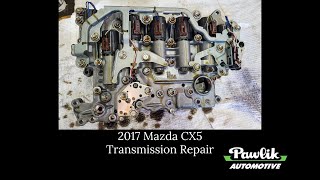
- If the sensor is confirmed to be faulty, the next step is to drop the transmission pan to access and replace the TCM/valve body assembly. 🎬 See this step-by-step transmission repair walkthrough
- After replacement, the new TCM must be programmed to the vehicle and an initial learning procedure must be performed.
Parts You'll Likely Need
- Transmission Control Module / Valve Body Assembly
(OEM #FZ01-21-100 (example, verify by VIN))— The Transmission Range Sensor is integrated into this assembly on the CX-5's SKYACTIV transmission. Failure of the sensor requires replacement of the entire unit.
Trusted brands: Mazda (OEM), ZZHCAR (Remanufactured), HQPART (Remanufactured)
OEM price range: $1200-$1800
Aftermarket price range: $600-$1200 (Remanufactured)
Related Codes That Often Appear With This One
- P0705 — This code indicates a general malfunction in the Transmission Range Sensor circuit, and often appears alongside P0706 as it points to a general failure of the same component.
- P0700 — This is a generic transmission system fault code requested by the TCM. It acts as a general alert that the transmission has a problem, and it is usually accompanied by a more specific code like P0706.
- P0780 — Indicates a 'Shift Malfunction'. This can be triggered alongside P0706 as the faulty range sensor data prevents the TCM from commanding shifts correctly. One owner of a Mazda 3 with the same transmission reported P0780 along with P0706.
Technical Service Bulletins (TSBs) & Recalls
- TSB 05-004/18: Addresses DTCs P0842, P0847, P0872, P0877, P0780, P1738 due to internal contamination sticking oil pressure switches.
- TSB 05-002/15: Precursor to 05-004/18, also discusses internal transmission faults and outlines TCM reprogramming and parts replacement procedures.
Platform-Specific Known Issues
- While no TSB explicitly names code P0706 for this model, several TSBs for the FW6A-EL transmission address related internal failures. TSB 05-004/18 and 05-002/15 discuss other DTCs (like P0842, P0877, P0780) caused by contamination leading to stuck oil pressure switches within the valve body. These bulletins suggest a pattern of internal hydraulic/electronic issues within this transmission family, for which the repair often involves TCM reprogramming or valve body component replacement, mirroring the fix for P0706.
Mechanic-Grade Diagnostic Values
- Transmission Range Sensor 'A' Circuit Voltage — expected: Varies by gear, typically 0.5V to 4.5V. Example values could be: Park ≈ 0V, Reverse ≈ 5V, Neutral ≈ 2.5V, Drive ≈ 4V. The key is a distinct, stable voltage for each gear position.. Failure: Voltage does not change when the shifter is moved, the reading is erratic, or it falls outside the expected 0.5V-4.5V range. A high input (P0708) or low input (P0707) code may accompany P0706.
Scan Tool Commands That Help
- Mazda M-MDS or equivalent professional scanner: TCM/PCM Reprogramming — This is required after replacing the TCM/valve body assembly. The new module must be programmed with the vehicle's VIN and the correct calibration data to function.
- Mazda M-MDS or equivalent professional scanner: Initial Learning / Adaptive Memory Reset — After a new TCM is installed and programmed, a relearn procedure must be performed. This allows the TCM to learn the specific hydraulic and electronic characteristics of the new hardware and driving style. This can sometimes be initiated by a specific sequence of actions without a scan tool, but a scan tool is the most reliable method.
Wiring & Ground Locations
- C-15 Connector — Connector joining the driver's side door harness and the rear harness, located in the front pillar area.. While not directly for the transmission, Mazda TSB 09-008/16 identifies this connector as a point of water intrusion and corrosion on 2016 CX-5 models. Widespread corrosion here can cause numerous, seemingly unrelated electrical faults and communication errors between modules. While a long shot for P0706, if other strange electrical symptoms are present (power window failure, keyless entry issues), this connector should be inspected for corrosion as a potential source of network-wide data corruption affecting the TCM.
Real Owner Repair Stories
- Reddit user in r/mazda3 (2016 Mazda 3 2.0L (uses same FW6A-EL transmission)) — Not specified in detail, but required a full transmission replacement.
❌ Tried (didn't work) Initial diagnosis was unclear.
✅ What actually fixed it The user replaced the entire transmission with a used unit from another Mazda 3. After installation, no system flash (reprogramming) was necessary as the calibration was the same. They performed a drive cycle to get the fluid to temperature and then initiated a re-initialization/relearn procedure. The car then ran 'smooth as silk'.
OEM Part Supersession History
FZ01-21-100 (and subsequent revisions like FZ0121100C)→Varies by production date and specific failure. Part numbers like FZ2121100H, FZ2121100J, and FZ3A-21-100 have been used for the FW6A-EL valve body/TCM assembly.— Mazda has made multiple mass production changes to the FW6A-EL internals to reduce contamination and improve diagnostic logic for various faults.
Heads up: It is absolutely critical to verify the correct part number using the vehicle's VIN. Installing a TCM with the wrong calibration file, even if it physically fits, will result in a no-start condition or severe drivability problems. Some remanufactured units are sold 'pre-programmed' but this should be verified.
Model Year Variations Within This Range
- 2016: The 2016 model year was a facelift for the CX-5. While the core FW6A-EL transmission remained the same as in 2013-2015 models, the interior and infotainment systems were updated (Mazda Connect with commander switch). This also introduced a 'Sport Mode' button which alters the TCM's shift logic. While this doesn't change the root cause of P0706, it's a key difference in the vehicle's features and may affect diagnostic paths for other transmission-related complaints.
Diagnostic Flowchart
Other Known Issues on This Vehicle
Issues unrelated to this code that are worth knowing about as an owner of this generation:
- Leaking Drive Belt Hydraulic Tensioner 🟠 Medium — Very common on 2013-2019 models. Often fails before 100,000 miles, causing rattling/squealing noises from the engine bay. (Ref: TSB 01-019/19)
- Electronic Parking Brake (EPB) Malfunction 🟠 Medium — Common complaints of 'EPB Malfunction' warnings. On 2016 models specifically, this was often due to out-of-tolerance rear calipers causing brake drag. (Ref: TSB R052/16C (for 2016 model rear calipers))
- SKYACTIV-G Intake Valve Carbon Buildup 🟡 Low — A long-term consequence of direct injection engines. Buildup can occur over 50,000-100,000+ miles and may eventually lead to a rough idle or misfires. Not as severe as on some other brands.
- LED Daytime Running Light (DRL) Failure 🟡 Low — Primarily affects 2016 models. The LED strip in one or both headlights flickers or fails completely. Repair requires replacing the entire expensive headlamp assembly. (Ref: Safety Recall 4320A)
- Easily Cracked Windshields 🟡 Low — Numerous owner reports across multiple forums and complaint sites about windshields being unusually prone to cracking from small impacts or even temperature changes.
Used vs. New Parts: Buying Guide for This Vehicle
When a used part is the smart pick: A used TCM/valve body assembly is a high-risk but potentially cost-saving option. It makes the most sense if the donor part is from an identical year/model/engine vehicle to minimize programming issues, and if it comes from a low-mileage, accident-damaged vehicle (indicating the transmission was likely functional before the crash).
Donor-vehicle mileage cap: roughly under 60000 miles for the part to have meaningful remaining life.
What to inspect on the donor part:
- Verify the VIN of the donor car to ensure compatibility.
- Ask for a history of the donor vehicle if possible (e.g., front-end collision vs. transmission-related write-off).
- Inspect the electrical connector pins for any signs of corrosion, damage, or fluid intrusion.
- If possible, get a warranty or return period from the seller (e.g., junkyard, eBay seller).
OEM-only on this vehicle (don't cheap out):
- Transmission Control Module / Valve Body Assembly. While remanufactured units exist, the safest (though most expensive) option is a new OEM part programmed by a Mazda dealer. A used part is a gamble on compatibility and lifespan.
Aftermarket brands forum-validated for this vehicle:
- Remanufactured units from sellers like 'TorqPro' or those found on AliExpress are available, but quality and programming can be inconsistent. They are a viable option for those willing to accept the risk for a lower price point.
Brands owners have reported issues with on this vehicle:
- No specific brands are consistently cited as 'bad,' but any unverified, non-warrantied used or remanufactured electronic module carries significant risk of being dead-on-arrival or having incorrect programming.
Real Owner Stories
Aggregated from forums and TSBs cited above. Mileages and costs reflect what owners reported in those sources.
2015 Mazda 3 (SKYACTIV-Drive)
Symptoms: AT, check engine, and traction lights came on. The vehicle would only start in Neutral and the shifter became stuck in Park.
What fixed it: Full replacement of the internal Transmission Control Module (TCM).
Source hint: Reddit: Mazda 3 P0706 error
2013-2019 Mazda CX-5 — ~95000 miles
Symptoms: Rattling and squealing noises coming from the engine bay.
What fixed it: Replacement of the leaking drive belt hydraulic tensioner.
Source hint: TSB 01-019/19
Related OBD-II Codes
Frequently Asked Questions
Does TSB 05-004/18 apply to my Mazda CX-5 if I have transmission codes?
Can I just replace the range sensor on my 2014 CX-5?
Why does my CX-5 only start in Neutral but not in Park?
Is there a recall for the LED daytime running lights on the 2016 CX-5?
What kind of transmission fluid should be used after a TCM replacement on a 2013-2016 CX-5?
My CX-5 has an 'EPB Malfunction' light; is this related to P0706?
Helpful Videos


We Have This Part in Stock

The information in this article is provided for general reference and educational purposes only. Vehicle specifications, procedures, and part compatibility can vary by production date, trim level, and region. Always consult your vehicle's factory service manual and verify part numbers before purchasing or performing repairs. Safety-critical components such as airbags, seat belts, and braking systems should be installed by a qualified professional.
- Mazda CX-5:
- 🧭 Diagnostic Flowchart
- 🎬 Helpful Videos
- 🛍️ Shop This Part
- What's Unique About the 2013-2016 Mazda CX-5
- Symptoms You May Notice
- Most Likely Causes
- Rare But Worth Checking
- Diagnosis Steps
- Parts You'll Likely Need
- Related Codes That Often Appear With This One
- Technical Service Bulletins (TSBs) & Recalls
- Platform-Specific Known Issues
- Mechanic-Grade Diagnostic Values
- Scan Tool Commands That Help
- Wiring & Ground Locations
- Real Owner Repair Stories
- OEM Part Supersession History
- Model Year Variations Within This Range
- Other Known Issues on This Vehicle
- Used vs. New Parts: Buying Guide for This Vehicle
- Real Owner Stories
- 2015 Mazda 3 (SKYACTIV-Drive)
- 2013-2019 Mazda CX-5 — ~95000 miles
- Related OBD-II Codes
- Frequently Asked Questions
- 🎟️ Get 5% Off