

P0710 on 2007-2009 Toyota Tundra 4.7L V8: Transmission Temp Sensor Circuit Causes and Fixes
For a 2007-2009 Tundra with the 4.7L V8, code P0710 almost always points to a failed transmission fluid temperature sensor. This sensor is located inside the transmission oil pan, so replacement involves draining the fluid and dropping the pan. Expect to pay $40-$80 for the part.
- P0710 on a 2007-2009 Tundra 4.7L indicates a problem with the transmission fluid temperature sensor circuit.
- Symptoms include a Check Engine Light, harsh shifting, and potentially the transmission going into 'limp mode'.
- The most likely cause is a failed sensor, which is part of the internal transmission wire harness.
- Repair is moderately difficult for a DIYer as it requires removing the transmission oil pan.
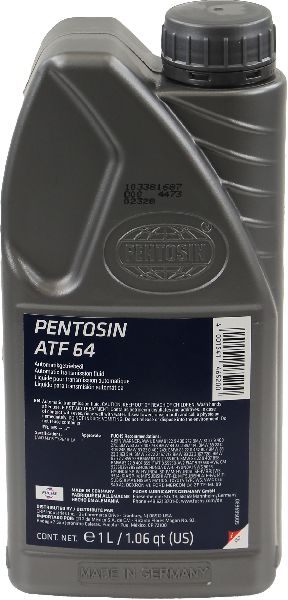
- Always use Toyota World Standard (WS) ATF when refilling the transmission after the repair.
What's Unique About the 2007-2013 Toyota Tundra
The user-specified year range of 2007-2013 for the Tundra spans the entire second generation. However, the 2UZ-FE 4.7L V8 engine was only offered in this truck from 2007 to 2009, paired with the A750E (2WD) or A750F (4WD) 5-speed automatic transmission. Tundras from 2010-2013 used different engines (4.6L and 5.7L V8s) with different transmission configurations. This guide is specific to the 2007-2009 models with the 4.7L V8. On this platform, the TFT sensor is integrated into the main transmission wire harness (also called the valve body harness) inside the oil pan, making it a more involved repair than an external sensor.
Generation note: The 2007-2013 Tundra is all part of the second generation (XK50). However, this guide specifically applies to the 2007-2009 model years which were equipped with the 2UZ-FE 4.7L V8 engine and A750 series transmission.
Symptoms You May Notice
- Check Engine Light is on
- Harsh, erratic, or delayed gear shifts
- Transmission may feel like it's slipping
- Vehicle may enter 'limp mode', refusing to shift out of a low gear
- Reduced fuel economy
- Erratic operation of the torque converter clutch
- Transmission temperature warning light may be illuminated
- Replacing the entire transmission when only the internal sensor/harness is needed.
- Replacing the ECM without thoroughly testing the wiring and sensor first.
Most Likely Causes
- Failed Transmission Fluid Temperature (TFT) Sensor 🔴 High Probability → Shop Transmission Assembly The sensor operates in a harsh environment of hot transmission fluid and can fail electrically over time. It is the most common point of failure for this code. The sensor itself is a simple thermistor, but it is integrated into a larger wire harness within the transmission.
How to confirm: With a scan tool, observe the live data for the transmission fluid temperature. If it's an illogical value (e.g., -40°F or over 300°F) when the truck is cold or at normal operating temp, the sensor or its circuit is faulty. According to Toyota's service manual, the ECM will trigger P0713 (open circuit) if resistance is over 156 kOhms and P0712 (short circuit) if resistance is below 79 Ohms. Final confirmation requires testing the sensor's resistance directly with a multimeter after removing the transmission pan.
Typical fix: Replace the transmission fluid temperature sensor. Since it is part of the transmission wire harness assembly inside the pan, the entire harness is typically replaced. 🎬 Watch: Step-by-step A750 transmission harness replacement guide This requires draining the fluid, dropping the pan, replacing the harness, installing a new pan gasket, and refilling with the correct Toyota WS (World Standard) ATF.
Est. part cost: $40-$100 for the sensor/harness assembly - Damaged Wiring or Connector 🟡 Medium Probability The external wiring harness leading to the transmission is exposed to road debris, heat, and moisture, which can cause corrosion or physical damage over time. The connector pins can also become corroded or pushed out.
How to confirm: Visually inspect the main wiring harness connector at the transmission case for corrosion, pushed-out pins, or broken wires. Perform a continuity test on the wires from the ECM to the transmission connector if the external inspection is inconclusive.
Typical fix: Repair the damaged section of the wiring harness or clean/replace the corroded connector.
Est. part cost: $10-$50 for wiring repair supplies or a new connector pigtail - Low or Degraded Transmission Fluid ⚪ Low Probability → Shop Transmission Assembly While less common to directly cause a P0710, extremely low or burnt fluid can cause the transmission to overheat, which the sensor will report. If the overheating is severe, it could potentially damage the sensor itself.
How to confirm: Check the transmission fluid level and condition. Note: The 2nd Gen Tundra does not have a traditional dipstick; the level must be checked via a specific procedure involving overflow and check plugs on the transmission pan at a specific fluid temperature. 🎬 Watch: How to check fluid levels on sealed Toyota transmissions
Typical fix: Perform a transmission fluid drain-and-fill or a full fluid exchange with the correct Toyota WS ATF. If the fluid is burnt, further diagnosis for internal transmission issues is needed.
Est. part cost: $80-$150 for fluid
Rare But Worth Checking
- Faulty Engine Control Module (ECM): → Shop Engine Control Module (ECM) This is extremely rare. The ECM should only be considered after all other possibilities—sensor, wiring, and fluid—have been definitively ruled out.
Diagnosis Steps
- Connect an OBD-II scanner and confirm P0710 is the primary code. Check for other related codes like P0712 or P0713.
- Using the scanner's live data function, monitor the 'Transmission Fluid Temperature' reading.
- With the engine cold, compare the TFT reading to the 'Ambient Air Temp' and 'Engine Coolant Temp' readings. They should all be within a few degrees of each other.
- If the TFT reading is stuck at a very low number (like -40°F) or a very high number (like 300°F+), a circuit fault is highly likely.
- Visually inspect the main electrical connector and wiring harness going to the transmission case for any obvious signs of damage, corrosion, or loose connections.
- If wiring appears okay, the next step is to test the sensor itself. This requires draining the transmission fluid and removing the oil pan to access the sensor/harness.
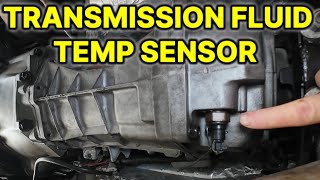
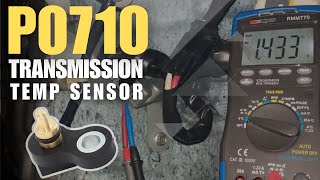
- Once accessed, disconnect the sensor and measure its resistance with a multimeter. Compare the reading to the specifications in the factory service manual for a given temperature. A reading of infinite resistance (open) or zero resistance (short) confirms a bad sensor. 🎬 See how to test and replace the temperature sensor
- If the sensor tests good, you must test the wiring for continuity from the transmission connector back to the ECM.
Parts You'll Likely Need
- Transmission Valve Body Wire Harness (includes TFT Sensor)
(OEM #82125-0C010)— This is the most common failure point. The sensor is integrated into this harness inside the transmission pan.
Trusted brands: Toyota (OEM), ATP Automotive (Part # JW-10), Rostra
OEM price range: $150-$250
Aftermarket price range: $40-$100 - Transmission Pan Gasket
(OEM #35168-60010)— The gasket must be replaced anytime the transmission pan is removed to prevent leaks. Some owners prefer using FIPG (Form-in-Place Gasket) like Toyota Black or Permatex The Right Stuff instead of a pre-formed gasket.
Trusted brands: Toyota (OEM), Fel-Pro, Mahle
OEM price range: $30-$50
Aftermarket price range: $15-$30 - Toyota WS Automatic Transmission Fluid
(OEM #00289-ATFWS)— You will need to replace the fluid that is drained to perform the repair. Using the correct OEM fluid is critical for Toyota transmissions. A pan drop requires approximately 4-5 quarts.
Trusted brands: Toyota
OEM price range: $12-$20 per quart (approx. 4-5 quarts needed for a pan drop)
Related Codes That Often Appear With This One
- P0712 — This code indicates 'TFT Sensor Circuit Low Input' (a short circuit), which is a specific type of failure that triggers the general P0710.
- P0713 — This code indicates 'TFT Sensor Circuit High Input' (an open circuit), another specific failure that also triggers P0710.
- P0711 — This code for 'TFT Sensor Circuit Range/Performance' indicates the sensor's reading is not rational over time, but not a hard open or short. It can also accompany P0710.
Platform-Specific Known Issues
- Sealed Transmission Fluid Check Procedure: → Shop Transmission Assembly The A750 transmission does not have a dipstick. Checking the fluid level involves removing a 'check plug' on the pan while the transmission fluid is within a specific temperature range (typically 99-111°F). This is a cumbersome process for DIYers and a critical step to get right to avoid transmission damage.
Mechanic-Grade Diagnostic Values
- TFT Sensor Resistance vs. Temperature — expected: Approx. 6.5 kΩ at 10°C (50°F); Approx. 200-300 Ω at 110°C (230°F).. Failure: A resistance below 79 Ω (indicates short, reads as >302°F) or above 156 kΩ (indicates open, reads as -40°F).
- Voltage at ECM Connector — expected: Varies with temperature. The ECM supplies a reference voltage and reads the return.. Failure: An unchanging or out-of-range voltage reading between the THO1 terminal and ground at the ECM, when compared to the expected resistance of the sensor at a known temperature.
Scan Tool Commands That Help
- Toyota Techstream: Data List Monitoring — Use this to view live data for 'ATF Temperature Sensor No. 1'. Compare this reading to ambient and engine coolant temperatures on a cold start. A significant deviation points to a sensor or circuit fault.
- Toyota Techstream: Active Test — While Techstream has extensive active tests for solenoids, there is no specific active test to command a value for the TFT sensor itself. Diagnosis relies on observing the live Data List values.
- Toyota Techstream: RESET MEMORY (AT initialization) — This function should be performed after replacing major transmission components or the ECM. It is not typically required for just a sensor/harness replacement, but can be used to clear learned values if shifting issues persist after repair. Note that simply disconnecting the battery does not perform a full reset.
Wiring & Ground Locations
- THO1 — This is the terminal pin at the ECM that receives the signal from the transmission fluid temperature sensor.. This is the primary test point at the ECM for checking the entire circuit's integrity back from the transmission. A continuity test from the transmission connector to this pin can isolate a wiring fault from a sensor fault.
- Engine/Transmission Ground Points — Key ground points for the 2UZ-FE are typically located on the cylinder heads, the engine block near the starter, and on the chassis frame rail in the engine bay.. A poor engine-to-chassis ground can cause floating voltages and erratic sensor readings throughout the powertrain management system. While not a direct cause, verifying clean and tight main grounds is a crucial step in diagnosing any electronic fault code.
Real Owner Repair Stories
- Tundras.com forum user (2007 Toyota Tundra 4.7L V8) — Check Engine Light with code P0710, accompanied by harsh shifting.
❌ Tried (didn't work) Initial diagnosis was straightforward, no parts were tried that didn't work.
✅ What actually fixed it The owner replaced the internal transmission wire harness (Toyota P/N 82125-0C010) and the transmission pan gasket. This resolved both the trouble code and the harsh shifting symptoms.
OEM Part Supersession History
82125-33060→82125-08010, 82125-48010— These part numbers appear in succession for various Toyota models using similar transmissions. However, for the 2007-2009 Tundra 4.7L, 82125-0C010 is the most commonly cited and correct part.
Heads up: Using a harness from a different application, even if the connector fits, may result in incorrect sensor readings or pinout mismatches. It is critical to use the specific part number for the Tundra (82125-0C010) to ensure compatibility.
Diagnostic Flowchart
Other Known Issues on This Vehicle
Issues unrelated to this code that are worth knowing about as an owner of this generation:
- Secondary Air Injection System (SAIS) Failure 🔴 High — Extremely common, especially on trucks over 80,000 miles. Moisture enters the air pumps/valves, causing them to seize. Often triggers codes like P2440, P2442, and forces the vehicle into 'limp mode'. (Ref: Toyota issued a Warranty Enhancement Program (ZE7 for Tundra/Sequoia) extending coverage for this specific issue to 10 years or 150,000 miles. Many vehicles are now outside this window. Aftermarket bypass kits are a popular, more permanent fix.)
- Frame Rust Perforation 🔴 High — Very common, particularly in 'Salt Belt' regions. The 2007-2008 Tundra was part of a massive class-action lawsuit. (Ref: A $3.4 billion settlement led to a frame inspection and replacement program. Vehicles were inspected and either had their frames replaced (at a cost of ~$15,000 to Toyota) or treated with a rust-preventative compound. This program has since expired for most vehicles.)
- Cracked Exhaust Manifolds 🟠 Medium — Common across all 2UZ-FE applications. The thin, tubular design, combined with the weight of integrated catalytic converters, leads to stress cracks over time. (Ref: No recall, but it is a widely acknowledged issue. The primary symptom is a ticking noise from the engine bay, especially when cold, that may disappear as the engine warms up and the metal expands. Replacement with OEM parts can be expensive, leading many owners to opt for aftermarket headers.)
- Water Pump Failure 🟠 Medium — The 2UZ-FE is an interference engine with a timing belt that drives the water pump. While the pumps are generally robust, they can leak. It is standard practice to replace the water pump, tensioner, and idlers whenever the timing belt is replaced (every ~90,000 miles).
Used vs. New Parts: Buying Guide for This Vehicle
When a used part is the smart pick: For this specific repair, purchasing a used internal transmission wire harness is NOT recommended. It is an electronic component that lives in a harsh environment of hot, circulating fluid. The risk of a used part failing soon after installation is high, and the labor involved in dropping the pan makes doing the job twice very costly.
What to inspect on the donor part:
- Not applicable, as a used part is not advised for this repair.
OEM-only on this vehicle (don't cheap out):
- Toyota World Standard (WS) Automatic Transmission Fluid (ATF). Using any other fluid can lead to shift problems and long-term damage. The cost savings of aftermarket fluid are not worth the risk to the A750 transmission.
Aftermarket brands forum-validated for this vehicle:
- Rostra
- ATP Automotive
Brands owners have reported issues with on this vehicle:
- Unnamed, no-brand electronics from online marketplaces should be avoided due to a high likelihood of premature failure or incorrect resistance values out of the box.
Real Owner Stories
Aggregated from forums and TSBs cited above. Mileages and costs reflect what owners reported in those sources.
2007 Toyota Tundra 4.7L V8
Symptoms: Check engine light illuminated accompanied by harsh shifting.
What fixed it: Replacement of the internal wire harness (part # 82125-0C010) and the transmission pan gasket.
Source hint: Tundras.com - 'P0710 Transmission Fluid Temperature Sensor "A" Circuit'
2003-2009 Lexus GX470 4.7L V8
Symptoms: Experienced the P0710 code; forum members identified it as a sensor/circuit issue rather than a mechanical transmission failure.
What fixed it: Replacing the internal transmission harness.
Source hint: ClubLexus - 'Help Code P0710'
Related OBD-II Codes
Frequently Asked Questions
Can I check the transmission fluid level on my 2007-2013 Tundra with a dipstick?
What is the specific part number for the internal harness needed to fix P0710?
Is there a warranty extension for the Secondary Air Injection System on my Tundra?
What kind of transmission fluid should I use for my 4.7L V8 Tundra?
How can I tell if the P0710 code is a sensor failure or a wiring short?
Is the frame rust issue related to the P0710 code?
Helpful Videos
We Have This Part in Stock

The information in this article is provided for general reference and educational purposes only. Vehicle specifications, procedures, and part compatibility can vary by production date, trim level, and region. Always consult your vehicle's factory service manual and verify part numbers before purchasing or performing repairs. Safety-critical components such as airbags, seat belts, and braking systems should be installed by a qualified professional.
- Toyota Tundra:
- 🧭 Diagnostic Flowchart
- 🎬 Helpful Videos
- 🛍️ Shop This Part
- What's Unique About the 2007-2013 Toyota Tundra
- Symptoms You May Notice
- Most Likely Causes
- Rare But Worth Checking
- Diagnosis Steps
- Parts You'll Likely Need
- Related Codes That Often Appear With This One
- Platform-Specific Known Issues
- Mechanic-Grade Diagnostic Values
- Scan Tool Commands That Help
- Wiring & Ground Locations
- Real Owner Repair Stories
- OEM Part Supersession History
- Other Known Issues on This Vehicle
- Used vs. New Parts: Buying Guide for This Vehicle
- Real Owner Stories
- 2007 Toyota Tundra 4.7L V8
- 2003-2009 Lexus GX470 4.7L V8
- Related OBD-II Codes
- Frequently Asked Questions
- 🎟️ Get 5% Off