

P0732 on 2011-2016 Hyundai Elantra: Gear 2 Incorrect Ratio Causes and Fixes
P0732 on a 2011-2016 Elantra means the transmission is slipping in 2nd gear. The most common causes are low or dirty transmission fluid, a faulty transmission fluid temperature sensor, or failing shift solenoids within the valve body. Checking the fluid is the first step, but this code on the A6GF1 transmission often points to internal issues that may require transmission replacement as outlined in Hyundai's TSBs.
- P0732 on your Elantra means the transmission is slipping in second gear.
- Always start by checking the transmission fluid level and condition. This is the simplest and most common fix.
- If the fluid is fine, the issue is likely a failed shift solenoid, a bad speed sensor, or an internal transmission problem.
- Due to the complexity and potential for severe damage, this code is best diagnosed and repaired by a professional mechanic.
- Hyundai has a TSB for this issue which may ultimately recommend replacing the entire transmission if simpler fixes fail.
What's Unique About the 2011-2016 Hyundai Elantra
The 2011-2016 Hyundai Elantra (generation MD/UD) uses a 6-speed A6GF1 automatic transmission that is known to be sensitive to fluid condition, level, and temperature. These models do not have a traditional transmission dipstick, making fluid level checks more complex. A common failure point leading to P0732 is the transmission fluid temperature sensor, which is integrated into the internal wiring harness. A faulty sensor can cause incorrect line pressure calculations by the TCM, leading to slippage. Hyundai has issued Technical Service Bulletins (TSBs), like 24-AT-002H, for incorrect gear ratio codes, which often lead technicians to recommend a full transmission replacement if initial checks don't resolve the issue.
Symptoms You May Notice
- Check Engine Light is on
- Transmission slipping or hesitating when shifting into 2nd gear
- Harsh, jerky, or delayed shifting, especially the 1-2 shift
- Vehicle enters 'limp-home' mode (stuck in a single gear, usually 3rd)
- Poor acceleration
- Increased fuel consumption
- Engine RPMs flare up without an increase in vehicle speed
- Replacing the entire transmission without first checking fluid level/condition, the transmission temperature sensor, solenoids, or speed sensors.
- Blaming the TCM when the issue is a simple wiring problem or a less expensive component like a sensor.
- Replacing individual solenoids when the actual issue is clogged passages or worn bores in the valve body, or a failing temperature sensor causing incorrect pressure commands.
Most Likely Causes
- Low or Dirty Automatic Transmission Fluid (ATF) 🔴 High Probability → Shop Transmission Assembly The A6GF1 transmission is very sensitive to fluid quality and level. Since there is no dipstick, leaks can go unnoticed, and the fluid level can only be checked via a plug on the side of the transmission case, which is an involved process.
How to confirm: The vehicle must be level and at operating temperature (typically 50-60°C or 122-140°F). Remove the fill/level check plug on the side of the transmission. A small, steady stream of fluid should come out. If nothing comes out, the fluid is low. The fluid should be bright red (not brown or black) and not smell burnt. This is best performed by a professional.
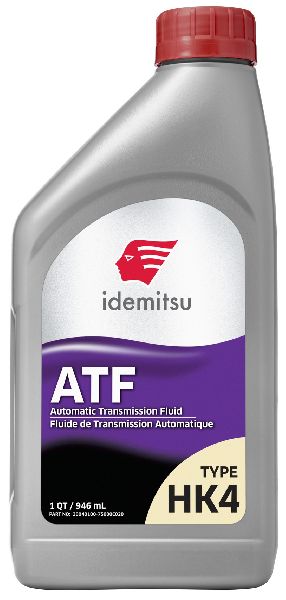
Typical fix: Perform a transmission fluid drain-and-fill or a complete fluid flush using only Hyundai/Kia SP-IV specification fluid. A simple drain and fill replaces about 4-5 quarts.
Est. part cost: $60-$150 - Faulty Transmission Fluid Temperature Sensor 🔴 High Probability → Shop Transmission Assembly This is a very common failure point on the A6GF1 transmission. The sensor provides critical data to the TCM for calculating shift pressures. An incorrect temperature reading leads to incorrect pressure and slippage. The sensor is part of the internal transmission wiring harness.
How to confirm: An advanced scan tool can monitor the transmission fluid temperature reading. If the reading is erratic, stuck at an extreme value (e.g., -40°F), or doesn't change as the vehicle warms up, the sensor is likely faulty. A normal reading is approximately 3.2 Volts at 104°F (40°C).
Typical fix: Replace the internal transmission wiring harness which contains the integrated temperature sensor. 🎬 See how to replace the temperature sensor and harness This requires draining the fluid and removing the transmission valve body to access the harness.
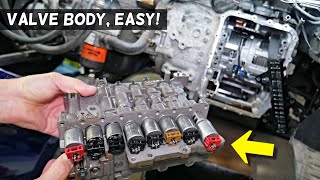
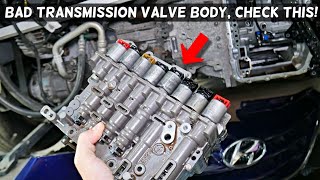
Est. part cost: $150-$250 - Faulty Shift Solenoid or Valve Body 🟡 Medium Probability → Shop Transmission Valve Body Solenoids are electronic valves that control fluid flow. They can fail electrically or, more commonly, become clogged with debris from old fluid, causing them to stick. This prevents proper hydraulic pressure from being applied to the 2nd gear clutch pack.
How to confirm: A diagnostic scan tool can command the solenoids on and off to test function. Resistance can also be checked with a multimeter. The Variable Force Solenoids (VFS) should measure 5.1-5.3 Ohms, and the on/off shift solenoids should measure 10-11 Ohms. This requires removing the transmission oil pan and sometimes the valve body.
Typical fix: Replace the faulty shift solenoid or the entire valve body assembly. 🎬 Watch: Symptoms of a bad transmission valve body Solenoids are often serviced as a complete pack on the valve body.
Est. part cost: $200-$600 - Faulty Input or Output Speed Sensor ⚪ Low Probability These sensors provide the crucial speed data to the TCM. If one provides an incorrect reading, the TCM will calculate an incorrect gear ratio. This is less common than fluid or solenoid issues for this specific code.
How to confirm: Use a scan tool to monitor the live data from both sensors while driving. Any erratic readings or dropouts indicate a problem. Often, a failing sensor will trigger its own specific trouble code (e.g., P0717, P0722).
Typical fix: Replace the faulty speed sensor. These are typically mounted externally on the transmission case.
Est. part cost: $40-$120 - Internal Transmission Failure ⚪ Low Probability → Shop Transmission Assembly If fluid, sensors, and solenoids are all good, the problem is likely mechanical. This can include worn-out clutch packs (specifically the underdrive or 2/6 brake clutches), a failing torque converter, or worn reducing valve bores in the valve body.
How to confirm: This is a diagnosis of elimination. After confirming all external and easily-serviced components are working, the issue is diagnosed as internal. A transmission pressure test can help confirm internal hydraulic leaks. Shredded metal in the pan is a definitive sign.
Typical fix: The transmission will need to be removed from the vehicle for a rebuild or replaced with a remanufactured or new unit. This is the final step recommended in Hyundai's TSB if other diagnostics fail.
Est. part cost: $2000-$4500+
Rare But Worth Checking
- Faulty Transmission Control Module (TCM): → Shop Transmission Assembly While rare, a software glitch or hardware failure in the TCM can cause it to misinterpret data and set a P0732 code. This should only be considered after all other possibilities have been exhausted. Sometimes a software update from the dealer can resolve issues.
- Wiring Issues: Damaged wires or corroded connectors between the TCM and the transmission's sensors or solenoids can disrupt signals and lead to this code. A visual inspection of the harness is a good idea, especially where it may rub against the chassis or engine components.
Diagnosis Steps
- Check the automatic transmission fluid (ATF) level and condition. This must be done by a qualified mechanic as the vehicle has no dipstick. Top off or replace as necessary with Hyundai-specific SP-IV fluid.
- Use an advanced OBD-II scanner to check for any other pending or stored trouble codes, especially those related to speed or temperature sensors.
- With the scan tool, monitor live data. Check the transmission fluid temperature reading for rationality. Monitor the input and output speed sensors to ensure they are providing plausible and consistent readings while driving.
- Inspect the wiring harness and connectors going to the transmission for any visible damage, corrosion, or loose connections.
- If temperature and speed sensor data appear correct, test the operation of the shift solenoids. This may involve using a scan tool to command them or checking their resistance with a multimeter.
- If the temperature sensor is suspect, the next step is often to replace the internal transmission harness which contains the sensor.
- If all external components, wiring, and the valve body check out, a transmission pressure test may be performed to check for internal hydraulic issues.
- If pressure is low or other tests are inconclusive, the problem is likely internal to the transmission, requiring removal for inspection and repair, as per TSB 24-AT-002H.
Parts You'll Likely Need
- Automatic Transmission Fluid
(OEM #00232-19045 (SP-IV))— The most common and first-line fix is ensuring the fluid is clean and at the correct level. - Internal Transmission Wiring Harness (with Temp Sensor)
(OEM #46307-3B650)— This part contains the transmission fluid temperature sensor, a very common failure point on the A6GF1 transmission that directly causes shifting issues. - Transmission Valve Body
(OEM #46210-26000)— If the fluid and temperature sensor are good, the next most likely cause is a sticking solenoid or worn valve bore within the valve body assembly.
Related Codes That Often Appear With This One
- P0731 — Incorrect ratio in 1st gear. If seen with P0732, it points more strongly to a systemic issue like low fluid, a failing valve body, a faulty temperature sensor, or a faulty input/output sensor.
- P0733 — Incorrect ratio in 3rd gear. Seeing multiple gear ratio codes together (e.g., P0732, P0733, P0734) often indicates a widespread problem like low fluid pressure or a failing torque converter, rather than a single gear's clutch pack.
- P0711, P0712, P0713 — These codes relate to the transmission fluid temperature sensor. Since a faulty temperature sensor is a very common cause of P0732 on this platform, seeing one of these codes alongside it is a strong indicator of the root cause.
Technical Service Bulletins (TSBs) & Recalls
- 24-AT-002H: AUTOMATIC TRANSMISSION INCORRECT RATIO DTC P0731, P0732, P0733, P0734, P0735, P0736, P0729, P076F & P0730. This TSB provides diagnostic steps for incorrect gear ratio codes and points to transmission replacement if other causes are ruled out. It applies to the 2011-2016 Elantra (MD/UD).
Platform-Specific Known Issues
- Hyundai has issued TSB 24-AT-002H (superseding earlier versions) which addresses incorrect gear ratio DTCs, including P0732, for a wide range of models including the 2011-2016 Elantra. The TSB provides diagnostic procedures and, if no other cause is found, recommends replacing the transmission assembly.
- A faulty transmission fluid temperature sensor, which is part of the internal wiring harness (Part # 46307-3B650), is a very common culprit for this code on the A6GF1 transmission, and is often a better starting point than individual solenoids.
Mechanic-Grade Diagnostic Values
- Variable Force Solenoid (VFS) / Linear Solenoid Resistance — expected: 5.1 - 5.3 Ohms. Failure: A reading significantly outside this range (open circuit or short) indicates a failed solenoid coil.
- On/Off Shift Solenoid Resistance — expected: 10 - 11 Ohms. Failure: A reading significantly outside this range indicates a failed solenoid coil.
- Transmission Fluid Temperature Sensor Voltage — expected: ~3.2 Volts @ 104°F (40°C). Failure: A reading stuck at an extreme (e.g., showing -40°F on a scan tool) or a voltage that doesn't correspond to the actual fluid temperature indicates a failed sensor.
Scan Tool Commands That Help
- Hyundai GDS (Global Diagnostic System): Resetting Auto T/A values — This function must be used after replacing the transmission, valve body, TCM, or reprogramming the TCM. It erases the old adaptive learning values to prevent continued poor shift quality.
- Hyundai GDS (Global Diagnostic System) or equivalent advanced scanner: AT Adaptation / Drive Relearn Procedure — After resetting the adaptive values, a specific drive cycle must be performed to allow the TCM to relearn the hydraulic characteristics and shift points of the new or repaired components. This typically involves accelerating gently through all gears multiple times.
Wiring & Ground Locations
- TCM (Transmission Control Module) — Located in the left rear of the engine compartment.. This is the computer that receives all sensor data and controls the solenoids. Knowing its location is key for checking power, grounds, and connector integrity during advanced diagnosis.
- Main Engine Bay Grounds — Check ground points on the strut towers and chassis frame rails in the engine bay.. While not specific to P0732, 2011-2012 Elantras are noted to have grounding issues that can cause various intermittent electrical problems. Poor grounds can affect sensor readings and module operation. Cleaning the paint from under the ground lugs to ensure a good metal-to-metal connection is a known preventative fix for electrical gremlins on this platform.
Real Owner Repair Stories
- AliExpress Review / Mechanic Report (2012 Hyundai Sonata GLS with 142,000 miles (uses similar A6-family transmission)) — Violent hesitation when shifting from 1st to 2nd gear around 25 mph. P0732 was set consistently.
❌ Tried (didn't work) An independent transmission shop performed diagnostics, checked pressure readings, and confirmed input/output sensor signals were within spec. No electrical faults were found.
✅ What actually fixed it The shop concluded the hydraulic control circuit inside the valve body was failing. Replacing the entire valve body assembly resolved the issue and restored smooth shifting.
OEM Part Supersession History
46307-3B610, 46307-3B620→46307-3B650— Revision and consolidation of the internal wiring harness which includes the transmission fluid temperature sensor.
Heads up: These part numbers are generally interchangeable for the A6GF1/A6MF1, but it is always best to verify with a VIN.
Model Year Variations Within This Range
- 2011-2016: There are 'Gen 1' and 'Gen 2' versions of the A6GF1 valve body. While they may look similar, they are not always interchangeable. When ordering a replacement valve body, it is critical to confirm which generation the vehicle requires.
- 2011-2016: The A6GF1 (used in 1.8L Elantras) and A6MF1 (used in 2.0L models) transmissions are NOT directly interchangeable despite being in the same family. A mechanic on a forum noted that while an A6MF1 can be physically bolted to a 1.8L engine, the shifter cable bracket and a transmission mount bolt do not line up. More importantly, another user warned that differences in the bellhousing, torque converter, and internal gear ratios can cause severe operational problems like harsh lock-up and limp mode, even if modified to fit.
Diagnostic Flowchart
Other Known Issues on This Vehicle
Issues unrelated to this code that are worth knowing about as an owner of this generation:
- Engine Ticking / Piston Slap (1.8L Nu Engine) 🔴 High — Widespread issue, can occur at various mileages. Led to a class-action lawsuit (Brown v. Hyundai Motor America). (Ref: A lawsuit settlement extended the powertrain warranty to 10 years/120,000 miles for the engine short block for qualifying conditions.)
- Failing Steering Coupler 🟠 Medium — Extremely common. Owners report a clicking or clunking noise in the steering wheel when turning, usually starting after 50,000 miles. (Ref: TSB #17-ST-002 and Warranty Extension TXX7 (10 years/100,000 miles) were issued for this part (P/N 56315-2K000-FFF).)
- Premature Brake Wear 🟡 Low — Some owners report faster-than-expected wear on brake pads and rotors.
- Front Coil Spring Corrosion/Fracture 🔴 High — Primarily affects vehicles in salt-belt regions. A fractured spring can puncture the tire. (Ref: NHTSA Recall 15V-629 was issued for some 2011-2013 models to address this.)
- Engine Stalling or Hesitation 🟠 Medium — Can be caused by faulty crankshaft position sensors or carbon buildup in the throttle body.
Used vs. New Parts: Buying Guide for This Vehicle
When a used part is the smart pick: A complete used transmission assembly can be a cost-effective option ONLY if the donor vehicle's VIN is available to confirm an exact part number match and it has low mileage. Used external sensors (input/output speed) are also generally safe bets from a reputable salvage yard.
Donor-vehicle mileage cap: roughly under 80000 miles for the part to have meaningful remaining life.
What to inspect on the donor part:
- For a complete transmission, check the fluid color and smell from the donor car if possible. It should be reddish, not dark brown or burnt-smelling.
- Look for a donor vehicle that was taken off the road due to collision damage, not powertrain failure.
- Verify the transmission model code (e.g., A6GF1) is physically stamped on the case and matches the original.
OEM-only on this vehicle (don't cheap out):
- Internal Wiring Harness / Temperature Sensor: This is a high-failure, critical-data part. Given the labor to access it (dropping the valve body), using a new OEM part (Hyundai/Kia P/N 46307-3B650) is strongly recommended to avoid repeat repairs.
Aftermarket brands forum-validated for this vehicle:
- TransGo (SK A6MF): For valve body issues, their shift kit is well-regarded for addressing the root cause of wear in valve bores, though it requires specialized tools to install.
- Sonnax: Similar to TransGo, Sonnax provides high-quality valve body repair components and tools for transmission specialists.
Brands owners have reported issues with on this vehicle:
- Unbranded or 'white box' solenoids and valve bodies from online marketplaces can be a gamble. While some may work, failure rates are higher, and they may not have the correct calibration, leading to persistent shift quality issues.
Real Owner Stories
Aggregated from forums and TSBs cited above. Mileages and costs reflect what owners reported in those sources.
2013 Hyundai Elantra GLS
Symptoms: The owner experienced P0732 and P0733 codes simultaneously, indicating issues with multiple gear ratios.
What fixed it: The diagnostic process began with a transmission fluid change to address the gear ratio errors.
Source hint: hyundai-forums.com thread titled '2013-elantra-gls-p0732-and-p0733'
2011-2016 Hyundai Elantra
Symptoms: Multiple owners reported the Check Engine Light coming on with P0732, often leading to significant drivability issues.
What fixed it: In many cases reported by owners, the eventual resolution was a full transmission replacement.
Source hint: aboutautomobile.com collection of owner complaints related to P0732
Related OBD-II Codes
Frequently Asked Questions
Does Hyundai TSB 24-AT-002H apply to my 2011-2016 Elantra for code P0732?
How can I check the transmission fluid level on my Elantra since there is no dipstick?
Is there a specific part number for the temperature sensor that often fails on this model?
What type of transmission fluid should I use for my 2013 Elantra to fix shifting issues?
Can a faulty speed sensor cause the P0732 code on my Elantra?
What are the resistance specs for the shift solenoids in the Elantra's A6GF1 transmission?
Helpful Videos
We Have This Part in Stock





The information in this article is provided for general reference and educational purposes only. Vehicle specifications, procedures, and part compatibility can vary by production date, trim level, and region. Always consult your vehicle's factory service manual and verify part numbers before purchasing or performing repairs. Safety-critical components such as airbags, seat belts, and braking systems should be installed by a qualified professional.
- Hyundai Elantra:
- 🧭 Diagnostic Flowchart
- 🎬 Helpful Videos
- 🛍️ Shop This Part
- What's Unique About the 2011-2016 Hyundai Elantra
- Symptoms You May Notice
- Most Likely Causes
- Rare But Worth Checking
- Diagnosis Steps
- Parts You'll Likely Need
- Related Codes That Often Appear With This One
- Technical Service Bulletins (TSBs) & Recalls
- Platform-Specific Known Issues
- Mechanic-Grade Diagnostic Values
- Scan Tool Commands That Help
- Wiring & Ground Locations
- Real Owner Repair Stories
- OEM Part Supersession History
- Model Year Variations Within This Range
- Other Known Issues on This Vehicle
- Used vs. New Parts: Buying Guide for This Vehicle
- Real Owner Stories
- 2013 Hyundai Elantra GLS
- 2011-2016 Hyundai Elantra
- Related OBD-II Codes
- Frequently Asked Questions
- 🎟️ Get 5% Off