

P0732 on 2005-2014 Hyundai Santa Fe: Incorrect 2nd Gear Ratio Causes and Fixes
P0732 means the transmission is slipping in 2nd gear. The most common causes are low or burnt transmission fluid, a faulty speed sensor, or a failing valve body. On many later models, a Hyundai TSB recommends transmission replacement if fluid and sensors are not the issue.
- P0732 indicates a 2nd gear slip, which is a serious issue that should be addressed immediately to prevent further damage.
- Always start diagnosis by checking the transmission fluid level and condition; this is the simplest and a very common cause.
- Be aware of your Santa Fe's generation, as the location of the speed sensors (external vs. internal) dramatically changes the difficulty of the repair.
- If fluid and sensors are not the cause, the problem is likely a faulty valve body or internal mechanical failure.
- Due to an official Hyundai TSB, dealers will often recommend a full transmission replacement for this code, making it a potentially very expensive repair.
What's Unique About the 2005-2014 Hyundai Santa Fe
The 2005-2014 Santa Fe spans three vehicle generations (SM, CM, DM) with different 4-speed, 5-speed, and 6-speed automatic transmissions. Earlier models (2005-2009) may have externally accessible input and output speed sensors on the transmission case, making diagnosis simpler. Later models, particularly those with the 6-speed A6MF1/2 transmission (from ~2010 onwards), have the speed sensors integrated into an internal wire harness, which requires removing the transmission pan and valve body for access. Critically, Hyundai has issued technical service bulletins (TSB 20-AT-001H, superseded by 24-AT-002H) that apply to this range of Santa Fe models. These TSBs instruct technicians that if an incorrect ratio DTC like P0732 is present without any accompanying solenoid codes, the recommended repair is to replace the entire transmission assembly due to internal clutch slippage.
Generation note: The 2005-2014 period covers the first (SM: 2005-2006), second (CM: 2007-2012), and third (DM: 2013-2014) Santa Fe generations. A key difference is the location of the input/output speed sensors. Earlier models often have externally mounted sensors on the top of the transmission case, while later 6-speed models integrate them inside the transmission, making them much harder to service. The specific transmission fluid also changes, from SP-III for older 4/5-speeds to SP-IV or SP4-M for the 6-speeds, and using the wrong fluid can cause these issues.
Symptoms You May Notice
- Check Engine Light is on
- Harsh, delayed, or failed shifting into 2nd gear
- Transmission slipping (engine RPMs flare up without an increase in speed)
- Vehicle stuck in 'limp mode', usually locked in 3rd gear
- A 'pop' sound followed by loss of forward drive, while reverse may still work
- Shuddering when shifting between gears
- Increased fuel consumption
- Replacing only one speed sensor when the other has failed or when the issue is mechanical.
- Assuming the transmission is bad before thoroughly checking the fluid level and condition, which is the simplest and most common fix.
- Replacing the valve body when the issue is a worn internal clutch pack, which is the ultimate diagnosis in the relevant Hyundai TSB.
Most Likely Causes
- Low or Dirty Transmission Fluid 🔴 High Probability → Shop Transmission Assembly Transmissions are sealed but can develop leaks over time. Fluid also degrades, losing its hydraulic properties and clogging passages or the filter. Using the incorrect fluid type is a common error that causes shifting problems.
How to confirm: Check the transmission fluid level and condition using the dipstick (if equipped). The fluid should be at the correct level, pink/red in color, and not smell burnt. Dark, brown, or burnt-smelling fluid indicates a problem. Verify the correct fluid type is being used (e.g., SP-III vs SP-IV).
Typical fix: If low, top off with the correct Hyundai-specific ATF. If dirty or burnt, perform a transmission fluid drain and fill or flush. 🎬 Watch: Step-by-step transmission fluid change guide Ensure the correct fluid is used for the specific transmission.
Est. part cost: $50-$150 for fluid - Faulty Input or Output Speed Sensors 🟡 Medium Probability Sensors can fail with age and heat cycles. On later 6-speed models, their internal location makes them susceptible to contamination from degraded fluid and requires significant labor to replace.
How to confirm: Use a scan tool to monitor live data from both sensors while driving. A sensor that drops out, reads 0 RPM, or shows erratic readings is faulty. On external sensors, check the wiring for damage. Resistance for these sensors should be between 500-1000 ohms.
Typical fix: Replace the faulty sensor. On earlier models, this is an external part on the transmission case. On later 6-speed models, the transmission pan and valve body must be removed to access the internal wire harness which contains the sensors.
Est. part cost: $40-$120 for sensors - Faulty Transmission Valve Body or Shift Solenoids 🟡 Medium Probability → Shop Transmission Valve Body Solenoids within the valve body can stick or fail electronically, preventing correct hydraulic pressure from being routed to engage 2nd gear. Debris from degraded fluid can clog the small passages within the valve body.
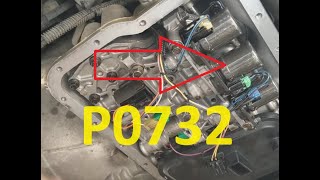
How to confirm: This is difficult to confirm without specialized testing. A mechanic can perform a pressure test at the 2nd gear port. Often diagnosed by eliminating other causes first. If other gear-related codes (P0731, P0733, etc.) are present, it points more strongly to a valve body or fluid issue.
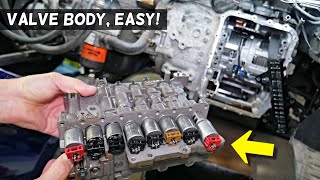
Typical fix: Replace the individual solenoid or the entire valve body assembly. This requires removing the transmission pan. 🎬 Watch: How to remove and replace the valve body
Est. part cost: $200-$700 for a valve body assembly - Internal Transmission Failure ⚪ Low Probability → Shop Transmission Assembly This code indicates clutch slippage, which can be caused by a worn-out 2nd gear clutch pack or other internal mechanical damage.
How to confirm: This is the diagnosis after all other possibilities (fluid, sensors, valve body) have been ruled out. Hyundai TSB 24-AT-002H (which supersedes 20-AT-001H) directs dealers to this conclusion if P0732 is present without other solenoid codes.
Typical fix: Replace the entire transmission assembly with a new or remanufactured unit, as per Hyundai's TSB.
Est. part cost: $2000-$4500+
Rare But Worth Checking
- Faulty Transmission Control Module (TCM): → Shop Transmission Assembly While rare, a software glitch or internal failure in the TCM can cause it to misinterpret sensor data and set this code. Sometimes a software update from the dealer is required.
- Damaged Wiring Harness: Corrosion or damage to the wiring between the speed sensors and the TCM can cause signal loss, leading to the P0732 code.
Diagnosis Steps
- Check the transmission fluid level and condition. Top up or replace if necessary. Use only Hyundai-specified fluid (SP-III for 4/5-speed, SP-IV/SP4-M for 6-speed).
- Use an OBD-II scanner to check for any other transmission-related codes. Solenoid or sensor circuit codes can pinpoint the problem.
- If possible, clear the codes and perform a test drive to see if the code returns immediately.
- Connect a professional scan tool and monitor the Input Speed Sensor and Output Speed Sensor data in real-time during a 1-2 shift. Look for any dropouts or erratic signals.
- Inspect the external wiring harness and connectors leading to the transmission for any visible damage, corrosion, or loose connections.
- If fluid and sensors appear okay, the next step is to inspect the valve body and its solenoids. This requires draining the fluid and removing the transmission pan.
- If the valve body and solenoids are confirmed to be working, and the speed sensors on internal models are replaced without fixing the issue, the problem is likely a major internal mechanical failure (e.g., clutch pack).
- Consult Hyundai TSB 24-AT-002H or 20-AT-001H, which state that if P0732 is present without other solenoid codes, the transmission should be replaced.
Parts You'll Likely Need
- Automatic Transmission Fluid (ATF) — Low or degraded fluid is a primary cause of slipping and incorrect gear ratios.
Trusted brands: Hyundai Genuine SP-III (for 4/5-speed), Hyundai Genuine SP-IV / SP4-M (for 6-speed)
OEM price range: $15-$25 per quart
Aftermarket price range: $10-$20 per quart - Input/Output Speed Sensor
(OEM #46517-39500 (example for external type), Internal sensors are part of wire harness assembly (e.g., 46307-3B650))— These sensors provide the data the TCM uses to detect slippage. A faulty sensor will trigger this code. Location varies by generation.
Trusted brands: Hyundai OE, Delphi, NGK/NTK
OEM price range: $70-$150
Aftermarket price range: $40-$100 - Transmission Valve Body — A faulty valve body or sticking shift solenoid is a common cause of hydraulic pressure loss to the 2nd gear clutch.
Trusted brands: Hyundai OE
OEM price range: $500-$1200
Aftermarket price range: $300-$800 (remanufactured)
Related Codes That Often Appear With This One
- P0731 — Incorrect Ratio in 1st Gear. These codes often appear together as they point to a common underlying issue like low fluid, a failing valve body, or failing speed sensors affecting multiple gears.
- P0733 — Incorrect Ratio in 3rd Gear. Similar to P0731, its presence alongside P0732 suggests a systemic problem rather than a single gear failure.
- P0700 — Transmission Control System Malfunction. This is a generic code indicating that the TCM has stored a fault, such as P0732.
Technical Service Bulletins (TSBs) & Recalls
- TSB 24-AT-002H / 20-AT-001H: Automatic Transmission Incorrect Ratio DTC: → Shop Transmission Assembly This TSB, which covers multiple Hyundai models including the 2007-2012 (CM) and 2013-2018 (DM) Santa Fe, provides the diagnostic procedure for incorrect ratio codes (P0731-P0736). The key instruction is that if one of these codes is found without any accompanying solenoid fault codes, the transmission assembly should be replaced due to internal clutch slip.
Platform-Specific Known Issues
- Hyundai Technical Service Bulletin (TSB) 24-AT-002H (and its predecessors) covers this code for the Santa Fe (CM, AN, NC models). The bulletin's procedure is to check for solenoid DTCs. If none are found, the recommended repair is to replace the entire transmission assembly.
Mechanic-Grade Diagnostic Values
- A6MF1/A6LF1 Linear Solenoid Resistance — expected: 5.1 Ohms. Failure: Reading significantly higher or lower than 5.1 Ohms.
- A6MF1/A6LF1 On/Off Solenoid Resistance — expected: 10-11 Ohms. Failure: Reading outside of the 10-11 Ohm range.
- DTC P0732 Threshold Value (Slip Detection) — expected: The difference between (Input Speed / 2nd Gear Ratio) and Output Speed should be less than 200 RPM.. Failure: A calculated difference of 200 RPM or more will trigger the code.
- Stall Test Specification (CM Santa Fe) — expected: 2000-2700 RPM. Failure: If the engine RPM exceeds 2700 RPM during a stall test in 2nd gear, it indicates slippage in the 2nd brake system.
Scan Tool Commands That Help
- Hyundai GDS (Global Diagnostic System): Resetting Auto T/A values — This function must be used after replacing the transmission, valve body, or TCM to clear learned shift adaptations. Failure to do so can result in poor shift quality even with new parts.
- Hyundai GDS (Global Diagnostic System): Flight Record — For intermittent shifting problems, the Flight Record function can capture data leading up to a fault, even if the fault doesn't set a code immediately. This can reveal historical data or sensor glitches that a standard scan would miss.
- Hyundai GDS (Global Diagnostic System): Actuation Test — To individually command shift solenoids on and off to verify their mechanical and electrical operation without a test drive. This helps isolate a single faulty solenoid in the valve body.
- Hyundai GDS (Global Diagnostic System): DTC Guide — The GDS software includes a built-in diagnostic guide for each fault code, providing step-by-step troubleshooting procedures, component locations, and specifications directly on the scan tool.
Wiring & Ground Locations
- Engine Harness Chafe Point 1 — On CM Santa Fe (2007-2012), the engine wiring harness may chafe against the ECM/TCM bracket in the engine bay.. Chafing can damage wires for the speed sensors or solenoids, causing intermittent signals or shorts that can trigger a P0732 code.
- Engine Harness Chafe Point 2 — On CM Santa Fe (2007-2012), the harness can rub against the upper control arm or the shock tower bolt in the driver's side wheel well area.. Damage in this area can affect circuits running to the transmission, leading to incorrect ratio codes. A visual inspection with the wheelhouse liner removed is necessary.
- Main Fuse Box — Located in the engine compartment on the left side for the CM generation (2007-2012).. This box contains the primary power feeds and relays for the TCM. Corrosion or a poor connection at the main positive cable terminal can cause voltage drops to the TCM, leading to erratic behavior and fault codes.
Real Owner Repair Stories
- AliExpress User Review (2012 Hyundai Sonata GLS with 142,000 miles (shares A6MF transmission with Santa Fe)) — Violent hesitation when shifting from 1st to 2nd gear around 25 mph. P0732 code set consistently after two weeks.
❌ Tried (didn't work) An independent transmission shop confirmed fluid level was correct and input/output sensor signals were within spec.
✅ What actually fixed it The shop concluded the hydraulic control circuit inside the valve body was failing. The ultimate fix was replacing the valve body assembly.
OEM Part Supersession History
46307-3B610, 46307-3B620→46307-3B650— Updated internal transmission wire harness assembly which includes the input and output speed sensors for the 6-speed A6MF1/2 transmissions.
Heads up: The older part numbers have been replaced by 46307-3B650. While they may physically connect, using the latest revision is critical for durability and correct sensor readings.
Model Year Variations Within This Range
- 2007-2009 (CM Generation): These models primarily used 5-speed (A5HF1) or 4-speed transmissions. Diagnostic procedures, like the stall test, and fluid specifications (SP-III) are different from the later 6-speed models.
- 2010-2014 (CM/DM Generations): These models predominantly use the 6-speed A6MF1/2 transmission. This is the version where the speed sensors are internal to the transmission as part of the wire harness (PN 46307-3B650) and are covered by TSB 24-AT-002H, which often recommends transmission replacement.
Diagnostic Flowchart
Other Known Issues on This Vehicle
Issues unrelated to this code that are worth knowing about as an owner of this generation:
- Theta II Engine Failure 🔴 High — Widespread on 2.0L Turbo and 2.4L GDI engines, particularly in 2011-2014 models. Can occur at any mileage but is a known manufacturing defect. (Ref: Multiple recalls and a class-action lawsuit settlement resulted in lifetime warranty extensions for the engine block for certain model years.)
- Subframe and Rear Trailing Arm Corrosion 🔴 High — Common on earlier models (2001-2012), especially in 'Salt Belt' states. Can lead to structural failure. (Ref: Recalls (e.g., NHTSA Campaign 09V121000, Service Campaign T37) were issued for inspection and replacement/rust-proofing.)
- Faulty Crankshaft Position Sensor 🟠 Medium — A common failure part across many model years, causing engine stalling or no-start conditions.
- Paint Peeling/Delamination 🟡 Low — Widespread complaints, especially on white-painted vehicles, where large sheets of paint peel off the factory e-coat. (Ref: No recall, but numerous TSBs related to paint repairs exist. A class-action lawsuit was filed regarding this issue.)
- Faulty Fuel Level Sensor 🟠 Medium — Common on 2007-2009 models, causing inaccurate fuel gauge readings and the Check Engine Light to illuminate.
Used vs. New Parts: Buying Guide for This Vehicle
When a used part is the smart pick: For a complete transmission replacement, a low-mileage used unit from a reputable salvage yard can be a cost-effective alternative to a new or remanufactured one, especially on older, higher-mileage vehicles where the repair cost might approach the vehicle's value.
Donor-vehicle mileage cap: roughly under 80000 miles for the part to have meaningful remaining life.
What to inspect on the donor part:
- Ask for the VIN of the donor vehicle to verify its year, model, and mileage.
- Inspect the transmission fluid. If it's dark, burnt, or contains metal particles, reject the part.
- Check all electrical connectors for cracks, melting, or corrosion. A damaged connector can render the unit unusable.
- Ensure the unit comes with a warranty (typically 30-90 days) from the salvage yard.
- Avoid parts from vehicles with flood or fire damage, as this can cause hidden, delayed failures.
OEM-only on this vehicle (don't cheap out):
- Transmission Control Module (TCM)
- Internal Wire Harness (including speed sensors)
- Valve Body Assembly
Aftermarket brands forum-validated for this vehicle:
- For valve body issues, Sonnax and TransGo offer repair kits that can fix specific known wear points in the original valve body, which can be an alternative to full replacement.
Brands owners have reported issues with on this vehicle:
- Unbranded, no-name electrical sensors or solenoids from online marketplaces are a significant risk. Failure of these cheap components can lead to repeat labor costs that far exceed the initial savings.
Real Owner Stories
Aggregated from forums and TSBs cited above. Mileages and costs reflect what owners reported in those sources.
2011 Hyundai Santa Fe — 115000 miles
Symptoms: The vehicle triggered multiple incorrect gear ratio codes including P0732, P0733, P0734, and P0735.
What fixed it: The dealer diagnosed internal transmission failure and recommended a full transmission replacement.
Cost: $4,200-$4,200
Source hint: Hyundai-Forums: P0732, P0733, P0734, P0735 on 2011 Santa Fe
2014 Hyundai Santa Fe
Symptoms: Code P0732 (Second Gear Incorrect Ratio) present; owner seeking TCM and sensor locations for diagnosis.
What fixed it: Technician suggested a weak input sensor as a common cause and provided diagrams for the internal speed sensor locations.
Source hint: 2CarPros Forum: 2014 Santa Fe P0732 Diagnosis
Related OBD-II Codes
Frequently Asked Questions
My 2011 Santa Fe has code P0732 along with P0733 and P0734. Does Hyundai have a specific procedure for this?
What specific transmission fluid should I use for my 2013 Santa Fe 6-speed to avoid P0732 shifting issues?
I have a 2014 Santa Fe with P0732; where are the speed sensors located if I want to check them?
Can a faulty speed sensor cause my Santa Fe to get stuck in a single gear?
Is the P0732 code related to the Theta II engine recalls on the 2011-2014 Santa Fe?
What is the resistance specification for the external speed sensors on earlier Santa Fe models?
Helpful Videos

We Have This Part in Stock

The information in this article is provided for general reference and educational purposes only. Vehicle specifications, procedures, and part compatibility can vary by production date, trim level, and region. Always consult your vehicle's factory service manual and verify part numbers before purchasing or performing repairs. Safety-critical components such as airbags, seat belts, and braking systems should be installed by a qualified professional.
- Hyundai Santa Fe:
- 🧭 Diagnostic Flowchart
- 🎬 Helpful Videos
- 🛍️ Shop This Part
- What's Unique About the 2005-2014 Hyundai Santa Fe
- Symptoms You May Notice
- Most Likely Causes
- Rare But Worth Checking
- Diagnosis Steps
- Parts You'll Likely Need
- Related Codes That Often Appear With This One
- Technical Service Bulletins (TSBs) & Recalls
- Platform-Specific Known Issues
- Mechanic-Grade Diagnostic Values
- Scan Tool Commands That Help
- Wiring & Ground Locations
- Real Owner Repair Stories
- OEM Part Supersession History
- Model Year Variations Within This Range
- Other Known Issues on This Vehicle
- Used vs. New Parts: Buying Guide for This Vehicle
- Real Owner Stories
- 2011 Hyundai Santa Fe — 115000 miles
- 2014 Hyundai Santa Fe
- Related OBD-II Codes
- Frequently Asked Questions
- 🎟️ Get 5% Off