

P0733 on 2002-2010 Mercury Mountaineer: Gear 3 Incorrect Ratio Causes and Fixes
On a 2002-2010 Mercury Mountaineer, P0733 almost always indicates a serious internal transmission problem, not a simple sensor failure. For the common 5R55S/W transmission, the cause is typically a broken intermediate (3rd gear) band or worn servo bores. Expect a costly repair involving transmission removal, often costing $2,000-$4,000+.
- P0733 on a 2002-2010 Mountaineer is a serious code that almost always indicates a major internal transmission failure, not a simple sensor issue.
- The most common cause, especially on the widely used 5R55S/W transmission, is a broken intermediate (3rd gear) band, often resulting from worn servo bores in the transmission case.
- A definitive diagnostic step is to drop the transmission pan and look for broken metal parts.
- Repair is expensive and not DIY-friendly, typically requiring a complete transmission rebuild or replacement.
- Do not continue to drive the vehicle, as this can cause more extensive and costly damage.
What's Unique About the 2002-2010 Mercury Mountaineer
The 2002-2010 Mountaineer, a twin to the Ford Explorer, primarily uses the Ford 5R55W/S transmission. This specific transmission family is widely known for a design weakness where the aluminum bores in the case for the intermediate and overdrive servos wear out over time. This wear causes a loss of hydraulic pressure, leading to band slippage, and eventually, a broken intermediate (3rd gear) band. As a result, P0733 on this platform is very frequently a sign of this specific mechanical failure, rather than a simple electronic fault.
Generation note: This range covers two Mountaineer generations. The 2nd generation (2002-2005) used the 5R55W/S transmission. The 3rd generation (2006-2010) used the 5R55S on V6 models and the heavier-duty 6R60 on V8 models. While the 5R55S shares the common servo bore and band failure points, the 6R60 has different potential issues, often related to its mechatronic/valve body.
Symptoms You May Notice
- Check Engine Light is on
- Flashing Overdrive (O/D) light on the gear selector
- Slipping or engine revving high between 2nd and 3rd gear (shift flare)
- Harsh or delayed shifting into third gear
- Vehicle enters 'limp mode' (may get stuck in one gear)
- Complete loss of third gear
- Violent bucking at highway speeds
- Finding broken metal parts in the transmission pan during a fluid service
- Replacing only the speed sensors. While sensors can fail, the root cause for P0733 on the 5R55S/W is almost always a major internal mechanical or hydraulic issue.
- Replacing just the solenoid block when the servo bores are worn. A new solenoid block cannot overcome the pressure loss from a worn case, and the problem will persist.
- Performing a transmission fluid flush. A flush will not fix mechanical damage and can sometimes dislodge debris that makes the problem worse.
Most Likely Causes
- Broken Intermediate (3rd Gear) Band 🔴 High Probability This is a very common failure on the 5R55W/S transmission. It is often a consequence of worn servo bores causing poor band apply pressure, leading to fatigue and breakage.
How to confirm: The most definitive way is to drop the transmission pan and inspect for broken pieces of the band. The pieces are often found lying in the bottom of the pan. Owners on forums confirm finding these parts as the tell-tale sign of this failure.
Typical fix: Requires complete transmission removal and disassembly to replace the broken band and often other related damaged parts. A full rebuild is standard practice.
Est. part cost: $250-$500 for a master rebuild kit - Worn Servo Bores in Transmission Case 🔴 High Probability → Shop Transmission Assembly This is a well-documented design flaw in the 5R55 transmission family. The aluminum case wears, allowing hydraulic fluid to leak past the servo piston, causing low pressure to the band. This issue is so common that specialized repair kits are widely available.
How to confirm: This is difficult to confirm without transmission disassembly. A pressure test may show low line pressure, but visual inspection of the bores after removal is the only certain method. The wear is often worse on one side of the bore.
Typical fix: The transmission must be removed. A specialty tool is used to ream the worn bores and install durable steel or brass sleeves, providing a long-term repair. This is typically done during a full rebuild. Sonnax is a well-known manufacturer of these repair kits.
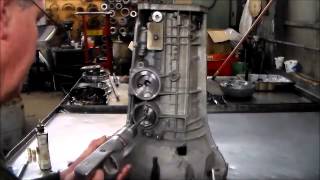
Est. part cost: $50-$150 for a servo bore repair kit (e.g., Sonnax 56361-01K) 🎬 Watch: How to repair worn servo bores with a sleeve kit.
- Faulty Transmission Solenoid Block 🟡 Medium Probability → Shop Transmission Assembly The solenoid block controls all shifting. Over time, solenoids can fail electrically or mechanically, causing pressure and shifting issues. While a common replacement part, it often fails due to debris from other internal damage.
How to confirm: A professional scan tool can command individual solenoids and monitor their response. Resistance checks can also be performed on the solenoid pins at the main connector.
Typical fix: Replace the solenoid block. This can be done by removing the transmission pan, without removing the entire transmission. 🎬 See this walkthrough on how to replace the solenoid block. However, if other internal damage exists, this will not solve the problem.
Est. part cost: $200-$400 for an aftermarket solenoid block (e.g., Dorman 609-000) or $400-$600 for the Motorcraft OEM part (e.g., 5L2Z-7G391-AA). - Low or Burnt Transmission Fluid ⚪ Low Probability → Shop Transmission Assembly
How to confirm: Check the transmission fluid dipstick (if equipped) for level and condition. The fluid should be bright red and not smell burnt. If it's low, dark, or contains metal particles, there is a problem. Some later models do not have a dipstick and require a special procedure to check the level.
Typical fix: If the fluid is simply low, top it off with the correct type (Motorcraft MERCON V) and check for leaks. If it's burnt or dirty, a fluid and filter change is needed, but this is unlikely to fix a P0733 code if internal damage has already occurred.
Est. part cost: $60-$120 for fluid and a filter kit
Rare But Worth Checking
- Torn Valve Body Gaskets: → Shop Transmission Valve Body The separator plate gaskets between the valve body halves can tear or blow out, causing internal pressure leaks that can mimic other failures. This is often discovered during a rebuild. It is a known common issue on the 5R55 family.
- Faulty Transmission Speed Sensors: → Shop Transmission Assembly While a faulty input or output speed sensor can theoretically cause this code, it is very uncommon on this platform. Usually, a sensor failure would also set a specific code for that sensor (e.g., P0722).
Diagnosis Steps
- Check the transmission fluid level and condition. Note if it is low, dark brown/black, or smells burnt.
- Scan for other transmission-related trouble codes to get a more complete picture of the failure.
- Drop the transmission oil pan.
- Carefully inspect the fluid in the pan and the pan magnet for metal shavings or larger pieces of debris. Finding chunks of a broken band is a definitive diagnosis.
- If no debris is found, the next steps involve testing the solenoid block and performing hydraulic pressure tests. This requires specialized equipment and knowledge.
- If pressure tests indicate leaks, or if a broken band is found, the transmission must be removed for inspection and repair.
Parts You'll Likely Need
- Transmission Rebuild Kit — Required to replace a broken intermediate band and all necessary seals, gaskets, and clutches during a transmission overhaul.
Trusted brands: Transtar, Pioneer, Sealed Power
Aftermarket price range: $250-$500 - Transmission Solenoid Block/Pack
(OEM #5L2Z-7G391-AA (Motorcraft))— A common point of failure that causes shifting and pressure problems. Often replaced as a unit.
Trusted brands: Motorcraft, Dorman, Rostra
OEM price range: $400-$600
Aftermarket price range: $200-$400 - Servo Bore Repair Kit
(OEM #56361-01K (Sonnax))— Used to repair the common issue of worn servo bores in the transmission case, providing a permanent fix for the hydraulic leak.
Trusted brands: Sonnax
Aftermarket price range: $50-$150 - Transmission Fluid and Filter Kit
(OEM #FT-140 (Motorcraft Filter Kit))— Necessary for any transmission service. The 5R55S/W requires MERCON V fluid.
Trusted brands: Motorcraft, Valvoline, Castrol
OEM price range: $100-$150
Aftermarket price range: $60-$100
Related Codes That Often Appear With This One
- P0732 — Stands for 'Gear 2 Incorrect Ratio'. The 2nd gear band and servo system can suffer from similar wear and failure issues.
- P0735 — Stands for 'Gear 5 Incorrect Ratio'. The overdrive band is also controlled by a servo that is prone to the same bore wear issue.
- P0745 — Stands for 'Pressure Control Solenoid 'A' Malfunction'. This code is commonly associated with worn servo bores or a broken band, as the computer blames the solenoid for being unable to control pressure in the circuit.
Technical Service Bulletins (TSBs) & Recalls
- TSB 04-15-4: Addresses a rattle noise from the primary timing chain drive area between 2000-3000 RPM on the 4.0L SOHC engine, a common issue for this platform.
Platform-Specific Known Issues
- Owner Experience with P0733: An owner of a 2005 Ford Explorer with a 5R55S transmission reported that while driving at 25 mph, the RPMs suddenly revved to 4000, the transmission warning light came on, and the O/D light started flashing. The vehicle then began to buck violently at 45 mph. A transmission shop diagnosed code P0733 and recommended a full replacement.
- The Inevitable Failure: On forums, experienced members consistently warn owners that P0733 on this platform is not a simple fix. One user stated, "You may be driving it now, but trust me its going to blow soon... Right now the pieces coming off of third gear have made their way into other parts and are accellerating wear on them."
Mechanic-Grade Diagnostic Values
- Shift Solenoid (A, B, C, D) Resistance — expected: 16 - 45 Ohms. Failure: A reading outside this range indicates a faulty solenoid, requiring replacement of the solenoid block assembly.
- Pressure Control (PC) Solenoid (A, B, C) Resistance — expected: 3.5 - 7.5 Ohms. Failure: A reading outside this range points to a failure in the variable force solenoid, necessitating a new solenoid block.
- Line Pressure at Idle (All Gears) — expected: 55-75 PSI. Failure: Pressure below this specification at idle can indicate a worn pump, internal leaks from worn servo bores, or a faulty pressure control solenoid.
- Line Pressure at Stall (WOT) — expected: 160-180 PSI (Drive), 240-280 PSI (Reverse). Failure: Low pressure during a stall test is a strong indicator of major internal hydraulic leaks or a weak pump. This test should not be performed if idle pressure is already low.
- Intermediate Servo Identification — expected: The servo is marked with letters like 'ZC' (Zebra Charlie).. Failure: This is for identification purposes when ordering replacement parts.
Hidden / Shadow Codes Worth Checking
- P0745 (Pressure Control Solenoid 'A' Malfunction): While not a hidden code, it frequently appears alongside P0733. Technicians note that basic handheld scanners may only show the solenoid code, leading to the incorrect assumption that only the solenoid pack is bad. A more advanced scanner often reveals the underlying P0733 ratio code, pointing to the true mechanical failure (broken band) that is causing the pressure control fault. (see via Professional scan tool (like Ford's IDS) that can read all manufacturer-specific transmission codes.)
Scan Tool Commands That Help
- Ford IDS (or equivalent professional scanner): Solenoid State On/Off Commands — To individually command each shift and pressure control solenoid to verify electrical operation. This helps differentiate between a failed solenoid pack and an internal hydraulic or mechanical issue. If a solenoid clicks when commanded but the pressure doesn't build, the problem is likely a leak (e.g., servo bore) or blockage.
- Ford IDS (or equivalent professional scanner): Live Data Monitoring (TSS, OSS, Gear Ratio) — To monitor the Input Shaft Speed (TSS) and Output Shaft Speed (OSS) in real-time during a test drive. When third gear is commanded, a technician can watch for the ratio to deviate from the specified 1.54:1, confirming the slip that sets P0733.
Wiring & Ground Locations
- Transmission Main Connector (16-pin) — On the driver's side of the transmission case.. This is the primary connection point for all solenoids and sensors within the transmission. Technicians can perform resistance checks for all solenoids directly from this connector's pins without dropping the pan, allowing for a quick electrical health check. For example, Shift Solenoid C can be tested between pins 3 and 6.
- PCM Connector — Typically located in the engine bay, near the firewall on the passenger side.. If resistance checks at the transmission connector are good, a technician may check resistance again at the PCM connector to rule out a wiring harness issue between the PCM and the transmission.
Real Owner Repair Stories
- Bucks Garage on YouTube (2003 Ford Explorer (5R55S Transmission)) — Wife reported the transmission was slipping. During a test drive, the 'check transmission' and flashing O/D light came on. Codes P0733 and a solenoid code (P0745) were present.
❌ Tried (didn't work) The owner suspected a rebuild would be necessary from the start and did not attempt smaller repairs.
✅ What actually fixed it Upon dropping the transmission pan, the owner found a broken piece of the intermediate (third gear) band and the band's anchor pin lying in the bottom of the pan. This provided a definitive diagnosis that the transmission required removal and a full rebuild to replace the broken band. - Automatic Transmission on YouTube (video on 5R55E) (2000 Ford Explorer (5R55E, precursor to W/S with similar design)) — P0733 (Gear Ratio Error in 3rd), no second gear, flare shift into third, and slipping in reverse.
❌ Tried (didn't work) The video is a teardown analysis, not a story of failed attempts. The narrator warns that just replacing the gaskets is not a real fix.
✅ What actually fixed it Teardown revealed multiple failures: a torn valve body separator plate gasket causing pressure loss, a burnt second gear band, and burnt direct clutch frictions. The root cause was identified as widespread internal wear requiring a complete overhaul, not just a single part replacement.
Documented NHTSA Reports
- NHTSA ODI #10994286: An owner reported the "Check Transmission" light was on and the vehicle was seeing higher RPMs but not shifting hard. After checking the fluids and finding them okay, the transmission was found to have codes P0723 and P0733 for slipping issues. The transmission required a rebuild at 68,769 miles.
OEM Part Supersession History
Unknown early versions→5L2Z-7G391-AA (Motorcraft Solenoid Block)— Solenoid designs are often updated over a vehicle's life to improve reliability and performance. Later revisions may have improved materials or coil windings to resist failure from heat and contaminated fluid.
Heads up: While various aftermarket solenoid blocks are available, forums and technicians often report the highest long-term success with the OEM Motorcraft part, as some aftermarket units can have slightly different pressure control characteristics.
Model Year Variations Within This Range
- 2002-2005: These models could have either the 5R55W ('W' for wide ratio) or 5R55S ('S' for synchronous) transmission. While internally very similar and sharing the same common failures, they have slightly different gear ratios for 2nd and 5th gears. The transmission code 'V' on the driver's door jamb sticker indicates a 5R55S, while 'R' indicates a 5R55W.
- 2006-2010: V6 models continued to use the 5R55S. However, V8 models were upgraded to the heavier-duty 6R60 6-speed automatic transmission. The 6R60 has a completely different design (based on a ZF) and does not suffer from the same band/servo bore issues. P0733 on a V8 from this era would point to different causes, likely related to its internal clutch packs or mechatronic (valve body/TCM) unit.
Diagnostic Flowchart
Other Known Issues on This Vehicle
Issues unrelated to this code that are worth knowing about as an owner of this generation:
- Cracked Rear Liftgate Panel 🟠 Medium — Extremely common across 2002-2010 models. The plastic applique below the rear window cracks, typically starting around the emblem. (Ref: No recall was issued, but the issue was widespread enough to trigger class-action lawsuits for the 2002-2005 models.)
- 4.0L SOHC Timing Chain Rattle 🔴 High — Very common on the 4.0L SOHC V6. A rattling noise, especially on cold starts or around 2500 RPM, indicates wear on the timing chain guides and tensioners. Failure can be catastrophic to the engine. (Ref: Ford issued TSB 04-15-4 for a rattle noise between 2000-3000 RPM, recommending replacement of the tensioner, guide, and sprockets.)
- Heater Stuck On Hottest Setting 🟡 Low — A common complaint where the heater blend door actuator fails, resulting in a loss of temperature control.
- Cracked Plastic Intake Manifold (V8) 🟠 Medium — The plastic intake manifold on the 4.6L V8 engines can crack, typically near the thermostat housing, causing coolant leaks.
Used vs. New Parts: Buying Guide for This Vehicle
When a used part is the smart pick: For this specific failure (P0733), purchasing a used transmission from a junkyard is an extremely high-risk, low-reward strategy. The primary causes are inherent design flaws (worn servo bores) that are mileage and time-dependent. A used unit is highly likely to have the same wear or will develop it soon. A used transmission only makes sense if it comes with verifiable documentation of being professionally rebuilt with updated parts (like servo bore sleeves).
Donor-vehicle mileage cap: roughly under 40000 miles for the part to have meaningful remaining life.
What to inspect on the donor part:
- Ask for service history; a transmission that has had regular fluid changes is a slightly better bet.
- Inspect the fluid from the donor unit. If it's dark, burnt, or contains any metal, reject it immediately.
- Look for external signs of leaks around the pan, seals, and electrical connector.
- Ideally, source from a vehicle that was taken off the road due to collision damage, not mechanical failure.
OEM-only on this vehicle (don't cheap out):
- Transmission Solenoid Block: While cheaper aftermarket options exist, many professional rebuilders and forum users strongly recommend using the Motorcraft OEM solenoid pack (5L2Z-7G391-AA) for best performance and longevity.
- Valve Body Separator Plate: If replacing due to torn gaskets, the updated Ford plate with bonded gaskets is superior to using loose gaskets.
Aftermarket brands forum-validated for this vehicle:
- Sonnax: Universally recognized as the go-to brand for high-quality, durable solutions to the 5R55's inherent flaws, especially their servo bore sleeve kits and updated servo pistons.
Brands owners have reported issues with on this vehicle:
- Unbranded, no-name solenoid packs from online marketplaces. These often have poor quality control and can cause immediate shifting problems or fail prematurely.
Real Owner Stories
Aggregated from forums and TSBs cited above. Mileages and costs reflect what owners reported in those sources.
2005 Ford Explorer
Symptoms: While driving at 25 mph, the RPMs suddenly revved to 4000, the transmission warning light came on, and the O/D light started flashing. The vehicle then began to buck violently at 45 mph.
What fixed it: A transmission shop diagnosed code P0733 and recommended a full replacement.
Source hint: https://www.explorerforum.com/forums/threads/p0733-code-in-05-ford-explorer.375339/
2000 Ford Explorer
Symptoms: Vehicle will not move.
What fixed it: Replacing the solenoids did not fix the issue; the problem was confirmed to be a more severe internal failure.
Source hint: https://www.2carpros.com/questions/2000-ford-explorer-code-po733-vehicle-will-not-move
Lincoln Aviator — 55000 miles
Symptoms: Flashing O/D light and intermittent hard shifts.
What fixed it: The source describes the beginning of the failure due to worn servo bores, which typically requires a transmission rebuild with sleeved bores to fix.
Source hint: https://www.ford-trucks.com/forums/1110594-welcome-to-the-5r55-worn-servo-bore-club.html
Mercury Sable Owner Report
Symptoms: An owner reported the "Check Transmission" light was on and the vehicle was seeing higher RPMs but not shifting hard. Fluids were checked and found to be okay.
What fixed it: Diagnostic codes P0723 and P0733 were present, indicating slipping issues. The transmission required a full rebuild at 68,769 miles (NHTSA ODI #10994286).
Related OBD-II Codes
Frequently Asked Questions
How can I know for sure if the 3rd gear band is broken in my Mountaineer without a full teardown?
I've heard the servo bores are a design flaw on this transmission. Is there a permanent fix for the P0733 code they cause?
Can I fix a P0733 code on my 2002-2010 Mountaineer by just replacing the solenoid block?
What type of transmission fluid should I use when checking the level on my Mountaineer for a P0733 diagnosis?
My O/D light is flashing and I have a P0733 code. How serious is this?
Is P0733 usually an easy or inexpensive fix on this platform?
Helpful Videos

We Have This Part in Stock

The information in this article is provided for general reference and educational purposes only. Vehicle specifications, procedures, and part compatibility can vary by production date, trim level, and region. Always consult your vehicle's factory service manual and verify part numbers before purchasing or performing repairs. Safety-critical components such as airbags, seat belts, and braking systems should be installed by a qualified professional.
- Mercury Mountaineer:
- 🧭 Diagnostic Flowchart
- 🎬 Helpful Videos
- 🛍️ Shop This Part
- What's Unique About the 2002-2010 Mercury Mountaineer
- Symptoms You May Notice
- Most Likely Causes
- Rare But Worth Checking
- Diagnosis Steps
- Parts You'll Likely Need
- Related Codes That Often Appear With This One
- Technical Service Bulletins (TSBs) & Recalls
- Platform-Specific Known Issues
- Mechanic-Grade Diagnostic Values
- Hidden / Shadow Codes Worth Checking
- Scan Tool Commands That Help
- Wiring & Ground Locations
- Real Owner Repair Stories
- Documented NHTSA Reports
- OEM Part Supersession History
- Model Year Variations Within This Range
- Other Known Issues on This Vehicle
- Used vs. New Parts: Buying Guide for This Vehicle
- Real Owner Stories
- 2005 Ford Explorer
- 2000 Ford Explorer
- Lincoln Aviator — 55000 miles
- Mercury Sable Owner Report
- Related OBD-II Codes
- Frequently Asked Questions
- 🎟️ Get 5% Off