

P0733 on 2003-2011 Saab 9-3: Gear 3 Incorrect Ratio Causes and Fixes
On a 2003-2011 Saab 9-3, code P0733 is most often caused by low or degraded transmission fluid, or a failing valve body. Start by checking the fluid; a fluid and filter service costs around $150-$250 and may resolve the issue if caught early.
- P0733 on your Saab 9-3 means the transmission is slipping in third gear.
- DO NOT continue to drive with this issue, as it can quickly destroy the transmission.
- The first and most important step is to check the transmission fluid level and condition. A fluid and filter change is the cheapest and most likely first fix.
- If new fluid doesn't solve it, the problem is very likely the transmission valve body, a known issue with these cars.
- Only consider a full transmission replacement after fluid and valve body issues have been professionally ruled out.
What's Unique About the 2003-2011 Saab 9-3
The 2003-2011 Saab 9-3 uses Aisin-Warner automatic transmissions: the 5-speed AW55-50SN (approx. 2003-2006) and the 6-speed TF-80SC (approx. 2006-2011). Saab, like Volvo, marketed these as 'sealed for life,' which led many owners to neglect fluid changes. Over time, the fluid degrades, losing its lubricating and hydraulic properties. These specific Aisin transmissions are also notoriously prone to issues with the hydraulic valve body, where solenoid bores wear out, causing internal pressure leaks that prevent clutches from engaging properly, leading directly to gear ratio codes like P0733.
Generation note: The 2003-2011 year range covers the second generation (YS3F) of the Saab 9-3. These models were equipped with either a 5-speed Aisin AW55-50SN (primarily 2003-2006) or a 6-speed Aisin TF-80SC (primarily 2006-2011, especially on V6/Aero models). The causes and symptoms for P0733, particularly valve body failure, are common and well-documented for both transmissions used within this generation.
Symptoms You May Notice
- "CHECK GEARBOX" warning light or message in the display.
- Transmission enters limp-home mode (may feel stuck in one gear).
- Harsh or jerky shifting, especially a noticeable 'bang' or 'bump' during the 2-3 upshift or when downshifting.
- Engine RPMs flare up during the 2-3 shift without a corresponding increase in vehicle speed (slipping).
- Delayed or hesitant engagement when shifting into Drive or Reverse.
- Reduced fuel economy due to transmission slippage.
- Immediately replacing the entire transmission without first checking the fluid condition or inspecting/replacing the valve body. A simple fluid service or valve body replacement is often the correct fix and is significantly cheaper.
Most Likely Causes
- Low or Degraded Transmission Fluid 🔴 High Probability → Shop Transmission Assembly These transmissions were often marketed as 'sealed for life,' meaning fluid services were frequently skipped. Degraded fluid loses its hydraulic properties, causing slippage and solenoid issues.
How to confirm: Check the transmission fluid level and condition. This requires the vehicle to be at a specific temperature. The fluid should be reddish and clear, not dark brown, black, or smelling burnt.
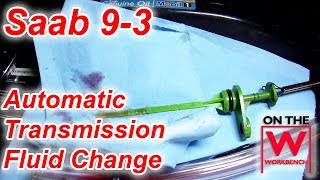
Typical fix: Perform one or more transmission fluid drain-and-fills using the correct fluid type. 🎬 Watch: Step-by-step guide to changing your Saab 9-3 transmission fluid. A single drain only replaces about 3.5-4 quarts of the total ~7-8 quarts. Replacing the filter is also recommended if the pan is dropped.
Est. part cost: $70-$150 for manufacturer-specified fluid (Mobil ATF 3309 for the 5-speed AW55-50SN, or a fluid meeting the JWS 3309 spec; Mobil ATF 3324 or equivalent meeting the AW-1 spec for the 6-speed TF-80SC). - Faulty Transmission Valve Body or Shift Solenoids Very high Probability → Shop Transmission Valve Body This is the most notorious weak point of these Aisin transmissions. Wear in the solenoid bores inside the aluminum valve body causes pressure loss, leading to shift flares, harsh engagement, and gear ratio codes. It is a widely discussed failure across all brands that use these gearboxes.
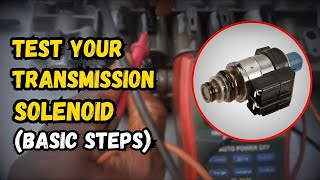
How to confirm: This requires professional diagnosis. A technician can use a scan tool to monitor solenoid commands and check pressures. The valve body is inspected by removing the transmission oil pan. Solenoids can also be tested for correct resistance (ohms). 🎬 Watch: A quick guide on how to test transmission solenoids.
Typical fix: Replace the entire valve body assembly with an updated, remanufactured unit. Companies like Sonnax offer valve body repair kits (e.g., Sonnax Zip Kit AW55-50SN-ZIP or SK TF80SC) that address the common wear points.
Est. part cost: $150-$400 for a single solenoid, $500-$1200 for a remanufactured valve body. 🎬 See this walkthrough on removing and replacing your transmission solenoids. A Sonnax Zip Kit costs around $150-$250. - Internal Mechanical Failure ⚪ Low Probability This is typically a secondary failure caused by driving too long with low/bad fluid or a faulty valve body. The resulting slippage overheats and burns out the 3rd gear clutch pack.
How to confirm: Diagnosed after ruling out fluid and valve body issues. Burnt, dark fluid with a strong odor and visible metal shavings in the pan is a strong indicator of internal damage. A transmission pressure test may also confirm internal leaks.
Typical fix: The transmission must be removed and either rebuilt with new clutches and seals or replaced with a used or remanufactured unit.
Est. part cost: $1800-$4000 for a remanufactured transmission.
Rare But Worth Checking
- Faulty Input/Output Speed Sensors: While less common than valve body failure, a failing speed sensor can provide incorrect data to the TCM, causing it to miscalculate the gear ratio and set a P0733 code.
- TCM Software Issues: In some cases, particularly on earlier models, updated software from Saab was released to address harsh shifting complaints. This is less likely to be the root cause if the problem appeared suddenly.
Diagnosis Steps
- Scan for all DTCs in the TCM to see if other codes related to solenoids or sensors are present.
- With the engine running and warm (fluid at operating temperature, typically checked via scan tool), carefully check the transmission fluid level and condition. On these 'sealed' units, this involves removing a level plug, not a dipstick.
- If the fluid is low, top it off with the correct type (JWS 3309 for 5-speed, AW-1 for 6-speed), clear the codes, and test drive to see if the problem persists.
- If the fluid is old and degraded, perform a series of drain-and-fill services. A full fluid 'exchange' or 'flush' at a shop is highly recommended to replace all the old fluid.
- If the issue remains, the next step is to inspect the valve body. This involves removing the transmission pan to access and test the shift solenoids for proper resistance (ohms) and inspect the valve body for wear. Consider installing a valve body repair kit from a reputable brand like Sonnax or TransGo.
- If the valve body and solenoids are confirmed to be working correctly, the issue is likely internal mechanical wear (e.g., worn clutches), which requires a transmission rebuild or replacement.
Parts You'll Likely Need
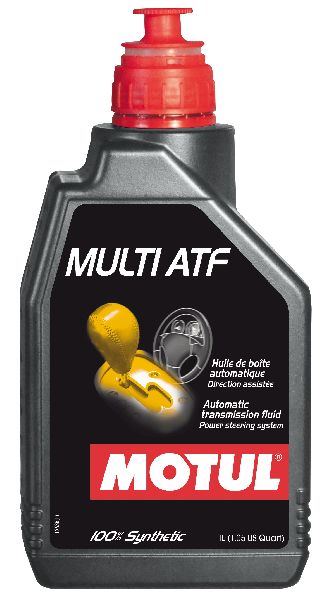
- Automatic Transmission Fluid — The most common starting point is degraded fluid. Use a fluid meeting the JWS 3309 specification for the 5-speed AW55-50SN, and AW-1 specification for the 6-speed TF-80SC.
Trusted brands: Mobil (3309 / 3324), Aisin (ATF-0T4 / ATF-0WS), Idemitsu
OEM price range: $12-$20 per quart
Aftermarket price range: $8-$15 per quart - Transmission Valve Body
(OEM #AW55-50SN (e.g., 30713189 for Volvo); TF-80SC (e.g., 31259596 for Volvo, or GM AF40-6). Part numbers vary.)— This is the most common failure point on the Aisin transmissions used in these cars, causing hydraulic pressure loss and slipping.
Trusted brands: Genuine Aisin (OEM), Rostra, Sonnax (offers repair kits), TransGo (offers repair kits)
OEM price range: $1000-$1500
Aftermarket price range: $500-$1200 (Remanufactured) - Transmission Filter Kit — Should be replaced whenever the transmission pan is removed for a fluid service or valve body work.
Trusted brands: Pro Parts Sweden, Meyle, ACDelco
OEM price range: $40-$70
Aftermarket price range: $20-$50
Related Codes That Often Appear With This One
- P0730 — This is a general 'Incorrect Gear Ratio' code. Seeing it with P0733 confirms a significant slipping event that the TCM has flagged at a general level in addition to the specific gear.
- P0731, P0732, P0734, P0735 — These are incorrect ratio codes for other gears. If multiple gear ratio codes are present, it strongly points to a systemic issue like low fluid, a clogged filter, or a failing valve body affecting multiple hydraulic circuits.
- P0780 — This code indicates a 'Shift Malfunction'. It is a general code that often accompanies specific gear ratio codes like P0733 when the TCM detects improper shifting patterns.
Technical Service Bulletins (TSBs) & Recalls
- While no specific TSB number for P0733 is widely publicized, Saab and GM did issue several software updates for the TCM to address shift quality concerns on the AW55-50SN and TF-80SC transmissions. A dealer or specialist with a Tech 2 scanner can check if the latest software is installed.
Platform-Specific Known Issues
- A well-documented issue for 2003-2011 models is harsh shifting and slipping, often attributable to either TCM software needing an update or, more commonly, a failing valve body.
- Owners on forums frequently report that a series of 3-4 drain-and-fills with the correct fluid can sometimes improve or resolve minor shifting issues before they become severe enough to require valve body replacement.
Mechanic-Grade Diagnostic Values
- AW55-50SN On/Off Shift Solenoids (S1-S5) Resistance — expected: 11 to 16 Ohms at 20°C (68°F).. Failure: A reading outside this range indicates a faulty solenoid coil (open or shorted).
- AW55-50SN Linear Solenoids (SLT, SLU, SLS) Resistance — expected: 5.0 to 5.6 Ohms at 20°C (68°F).. Failure: A reading outside this range points to a failing linear solenoid.
- TF-80SC All Solenoids Resistance — expected: 5 to 7 Ohms between the pins. A more specific source states 5.6 Ohms for the C3 clutch linear solenoid.. Failure: Resistance outside the specified range, or any continuity between a pin and the solenoid body, indicates a failed solenoid.
- AW55-50SN Line Pressure (SLT) Solenoid Pressure — expected: Should start at 5 PSI in Drive and increase with throttle/load to a maximum of 80 PSI.. Failure: Incorrect pressure modulation can indicate a faulty SLT solenoid or a worn valve body.
- AW55-50SN C1 Clutch Pressure — expected: In Drive, pressure should quickly step to 25 PSI, then 50 PSI, and remain there until acceleration.. Failure: If pressure immediately jumps to 160-200 PSI upon selecting Drive, the TCM may be in a failsafe mode, causing harsh engagement.
Scan Tool Commands That Help
- Saab Tech 2: Reset Adaptations (Automatic Transmission -> Adjustments -> Reset) — This must be performed after replacing the transmission, valve body, or TCM, or after a TCM software update. It erases the learned shift values stored in the TCM's memory.
- Saab Tech 2: Adaptation Drive Cycle Procedure — After resetting adaptations, a specific drive cycle is required for the TCM to relearn shift pressures and timing. This involves a series of controlled accelerations and decelerations to a specific speed and throttle percentage, as well as garage shifts (N-D, N-R). Failure to perform this can result in prolonged poor shift quality.
Wiring & Ground Locations
- TCM Location (TF-80SC) — For the 6-speed TF-80SC, the TCM is mounted directly on top of the gearbox.. Its location exposes it to engine bay heat and vibration. The 22-pin connector to the gearbox is a critical point for checking continuity to sensors and solenoids. The gear selector position sensor integrated into it can be affected by strong magnetic fields.
- G2 Ground Point — Located on the side of the left-hand structural member/strut tower by the connector bracket in the engine bay.. This is a primary chassis ground point. The main battery ground cable connects here. A poor connection at G2 can cause a host of unpredictable electronic issues, including erratic TCM behavior.
- G25 Ground Point (Early Models) — For early models (approx. 2003), a main 25mm² battery cable goes directly to the left-hand engine mounting, designated G25. Later models ground the transmission via a cable to the starter motor bolt or other locations.. This is the main ground path for the transmission case itself. Corrosion or a loose connection here can create a poor ground for the entire transmission assembly, affecting sensor and solenoid operation.
Real Owner Repair Stories
- Reddit user on r/saab (2008 Saab 9-3 2.0T, 87k miles) — Slamming into 4th gear while accelerating.
❌ Tried (didn't work) Initial diagnosis pointed towards a potential mechanical failure.
✅ What actually fixed it A Saab specialist performed a Transmission Control Module (TCM) software update. The user reported the problem was resolved immediately, though the shift feel became smoother and slightly slower.
OEM Part Supersession History
Varies by year/model→GM Part 55577385 (for TF-80SC)— Valve body designs were updated to improve durability and address shift quality issues.
Heads up: Gen 1 and Gen 2 valve bodies may not be interchangeable without software changes. It is critical to match the replacement part to the vehicle's specific year and model.
Model Year Variations Within This Range
- 2003-2006 (approx.): These years primarily used the 5-speed AW55-50SN. Valve bodies for this unit are identified by casting stamps ('A' for early, 'B' or 'C' for late) and the type of S2 solenoid (domed top for Saab/GM). Some 2005+ models also added a B5 control valve spring, which must be verified by VIN before ordering a replacement valve body.
- 2006-2011 (approx.): These years, especially V6/Aero models, used the 6-speed TF-80SC (also called AF40). This transmission has its own distinct valve body design, which also went through a Gen 1 to Gen 2 update around 2009-2010. The TCM is also physically located on top of the transmission case itself.
Diagnostic Flowchart
Other Known Issues on This Vehicle
Issues unrelated to this code that are worth knowing about as an owner of this generation:
- Column Integrated Module (CIM) Failure 🔴 High — Very common across the generation. Symptoms include horn, steering wheel controls, and turn signals not working, plus 'Steering Lock Malfunction' or 'Airbag Failure' messages.
- Fuel Level Sender Failure 🟠 Medium — Extremely common. The fuel gauge will read empty after filling the tank or fluctuate erratically. The sender contacts wear out. (Ref: Recall for some 2010-2011 models for a related fuel pump issue, but not the sender itself.)
- Broken Rear Coil Springs 🟠 Medium — A frequent issue where the rear coil springs corrode and snap, often at the bottom coil. This can cause a clunking noise and an uneven stance.
- Automatic Transmission Valve Body Failure 🔴 High → Shop Transmission Valve Body — This is the primary cause of P0733 and other shift quality issues. It is a well-documented weak point on both the 5-speed and 6-speed Aisin transmissions used in the 9-3.
- ABS/Traction Control Module Errors 🟠 Medium — Often caused by corroded wiring at the front wheel speed sensor connectors, leading to persistent ABS and traction control warning lights.
Used vs. New Parts: Buying Guide for This Vehicle
When a used part is the smart pick: A complete used transmission from a low-mileage, rear-ended donor car can be a cost-effective alternative to a full rebuild, especially if internal mechanical damage is confirmed. A used valve body is risky unless it's from a specialized rebuilder who has tested and updated it.
Donor-vehicle mileage cap: roughly under 80000 miles for the part to have meaningful remaining life.
What to inspect on the donor part:
- Verify the donor vehicle's mileage and check its history for accidents or flood damage.
- Ask the seller to drain a small sample of the transmission fluid. It should be reddish/brown and clear, not black, burnt-smelling, or containing glittery metal particles.
- For a complete transmission, inspect the exterior for cracks in the case and check that all electrical connectors are intact.
- For a valve body, ensure it comes from the exact same transmission model (AW55-50SN vs. TF-80SC) and, if possible, the same model year range to avoid compatibility issues.
OEM-only on this vehicle (don't cheap out):
- Transmission Control Module (TCM): Used TCMs may be locked to the donor car's VIN and require specialist programming with a Tech 2 to work in a different vehicle.
Aftermarket brands forum-validated for this vehicle:
- Sonnax (for valve body repair kits and remanufactured valve bodies).
- TransGo (for valve body shift kits).
- Rostra (for individual solenoids).
Brands owners have reported issues with on this vehicle:
- Unbranded, no-name valve bodies or solenoids from online marketplaces can have high failure rates and may not be properly calibrated, leading to persistent shifting problems.
Real Owner Stories
Aggregated from forums and TSBs cited above. Mileages and costs reflect what owners reported in those sources.
2003-2011 Saab 9-3
Symptoms: Transmission problem with codes P0733, P0734, P0735, and P0780 stored.
What fixed it: The owner first tried multiple drain-and-fills with Mobil 3309 fluid. When that did not resolve the issue, the consensus pointed to replacing the valve body.
Source hint: SaabCentral.com: 'P0733, P0734, P0735, P0780 - Transmission Problem' on saabcentral.com.
2003-2011 Saab 9-3
Symptoms: Shifting problems confirmed to be caused by the prevalent valve body failure issue.
What fixed it: The repair involved sourcing a remanufactured valve body or using a Sonnax kit for an in-place repair.
Source hint: Saablink.net
2003-2011 Saab 9-3
Symptoms: Transmission slipping, which is described as a common problem.
What fixed it: A series of fluid drain-and-fills was performed as a first diagnostic step, which sometimes resolves the issue on its own.
Source hint: Reddit (r/saab)
2003-2011 Saab 9-3
Symptoms: Minor shifting issues before they became severe.
What fixed it: A series of 3-4 drain-and-fills with the correct fluid improved or resolved the problem, preventing the need for an immediate valve body replacement.
Source hint: vehicle_specific_issues
Related OBD-II Codes
Frequently Asked Questions
My mechanic says my 2007 Saab 9-3 transmission is 'sealed for life'. Should I still change the fluid to fix P0733?
What specific transmission fluid should I use for my 2005 Saab 9-3?
If changing the fluid doesn't fix the harsh 2-3 shift, what is the most likely problem on my 9-3?
Are there any software updates from Saab that could fix my P0733 code?
I'm considering a DIY repair for the valve body. Are there kits available?
My Volvo S60 has the same P0733 code and symptoms. Is it the same issue as the Saab 9-3?
Helpful Videos
We Have This Part in Stock



The information in this article is provided for general reference and educational purposes only. Vehicle specifications, procedures, and part compatibility can vary by production date, trim level, and region. Always consult your vehicle's factory service manual and verify part numbers before purchasing or performing repairs. Safety-critical components such as airbags, seat belts, and braking systems should be installed by a qualified professional.
- Saab 9-3:
- 🧭 Diagnostic Flowchart
- 🎬 Helpful Videos
- 🛍️ Shop This Part
- What's Unique About the 2003-2011 Saab 9-3
- Symptoms You May Notice
- Most Likely Causes
- Rare But Worth Checking
- Diagnosis Steps
- Parts You'll Likely Need
- Related Codes That Often Appear With This One
- Technical Service Bulletins (TSBs) & Recalls
- Platform-Specific Known Issues
- Mechanic-Grade Diagnostic Values
- Scan Tool Commands That Help
- Wiring & Ground Locations
- Real Owner Repair Stories
- OEM Part Supersession History
- Model Year Variations Within This Range
- Other Known Issues on This Vehicle
- Used vs. New Parts: Buying Guide for This Vehicle
- Real Owner Stories
- 2003-2011 Saab 9-3
- 2003-2011 Saab 9-3
- 2003-2011 Saab 9-3
- 2003-2011 Saab 9-3
- Related OBD-II Codes
- Frequently Asked Questions
- 🎟️ Get 5% Off