

P0740 on 2006-2010 Ford Explorer: Torque Converter Clutch Circuit Malfunction Guide
P0740 on a 2006-2010 Ford Explorer indicates an electrical fault in the torque converter clutch (TCC) circuit. For the 4.0L V6 with the 5R55S transmission, the most common cause is a failed solenoid block. For the 4.6L V8 with the 6R60, it's often a faulty TCC solenoid. Both repairs require removing the transmission pan.
- P0740 on a 2006-2010 Explorer points to an electrical problem in the torque converter clutch circuit, not a mechanical slip.
- The most likely culprit is a failed TCC solenoid located inside the transmission.
- Always check the transmission fluid level and condition first, as low or dirty fluid can cause a variety of issues.
- Repairing this code almost always requires removing the transmission pan, making it a job best suited for a professional or experienced DIYer.
- Do not immediately assume the torque converter or transmission computer is bad; these are the least likely causes.
What's Unique About the 2006-2010 Ford Explorer
The 2006-2010 Explorer used two primary automatic transmissions: the 5-speed 5R55S with the 4.0L V6 and the 6-speed 6R60 with the 4.6L V8. While P0740 points to the same fundamental issue, the repair is different. For the 5R55S, the TCC solenoid is integrated into a larger solenoid block assembly which is a very common failure point; the entire block is typically replaced to resolve the issue. For the 6R60, the TCC solenoid is a separate, individually replaceable component. Therefore, identifying the correct transmission is critical for sourcing the right parts.
Symptoms You May Notice
- Check Engine Light is on
- Transmission may not shift into the highest gear
- Shuddering or vibration at highway speeds
- Engine RPMs are higher than usual at cruising speed
- Decreased fuel economy
- Vehicle may stall when coming to a stop
- Harsh or delayed gear shifts
- Replacing the entire torque converter when only the TCC solenoid or solenoid block has failed.
- Replacing the PCM/TCM before thoroughly testing the wiring and the solenoid itself.
- On a 5R55S, attempting to replace an individual TCC solenoid instead of the entire solenoid block assembly, which is the standard and more reliable repair.
Most Likely Causes
- Faulty Transmission Solenoid Block (5R55S) or TCC Solenoid (6R60) 🔴 High Probability → Shop Transmission Valve Body On the 5R55S (4.0L V6), the entire solenoid block is a known high-failure item due to internal electrical faults and heat cycles. Updated designs have been released to improve reliability. On the 6R60 (4.6L V8), individual solenoids can fail electrically.
How to confirm: A technician will test the solenoid circuit's resistance with a multimeter from the PCM connector. If the circuit tests open or shorted, the transmission pan is removed for direct testing of the solenoid or solenoid block.
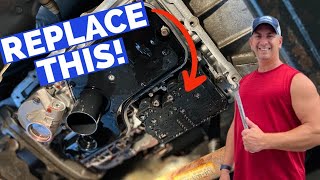
Typical fix: For the 5R55S, replace the entire solenoid block assembly. 🎬 See how to swap the 5R55S solenoid block yourself. For the 6R60, replace the individual TCC solenoid.
Est. part cost: $150-$350 for a 5R55S solenoid block, $80-$150 for a 6R60 TCC solenoid. - Low or Contaminated Transmission Fluid 🟡 Medium Probability → Shop Transmission Assembly Leaks can develop over time, and fluid degrades, losing its hydraulic properties and picking up debris that can clog solenoid passages or cause erratic operation.
How to confirm: Check the transmission fluid level and condition using the dipstick (if equipped) or check plug. The fluid should be at the correct level, pink/red in color, and not smell burnt. Burnt fluid or metal shavings in the pan indicate a more serious mechanical issue.
Typical fix: If low, top off the fluid and check for leaks. If the fluid is dirty or burnt, perform a transmission fluid and filter change. This is required when replacing the solenoid anyway.
Est. part cost: $50-$200 - Damaged Wiring or Connectors 🟡 Medium Probability The wiring harness to the transmission is exposed to heat, moisture, and road debris, which can cause corrosion, chafing, or loose connections over time, especially at the main transmission connector.
How to confirm: Visually inspect the external transmission wiring harness and connectors for damage. Test for continuity and shorts in the TCC solenoid circuit from the TCM to the transmission connector.
Typical fix: Repair or replace the damaged section of the wiring harness or the connector.
Est. part cost: $20-$100
Rare But Worth Checking
- Faulty Powertrain Control Module (PCM) or Transmission Control Module (TCM): → Shop Engine Control Module (ECM) This is rare. The PCM/TCM should only be considered after all other possibilities (solenoid, wiring, fluid) have been exhaustively ruled out. A failed driver circuit within the module can prevent it from properly commanding the solenoid. In some documented cases, a failed PCM was the ultimate cause after other parts were replaced.
- Internal Transmission Mechanical Failure: → Shop Transmission Assembly A more severe internal issue, such as a worn stator support bushing in the torque converter, a failing torque converter, or a sticking valve in the valve body, can sometimes trigger this electrical code. This is less common than a direct solenoid or wiring fault.
Diagnosis Steps
- Verify the presence of the P0740 code with an OBD-II scanner.
- Check the transmission fluid level and condition. Top off or change the fluid and filter if necessary.
- Inspect the external transmission wiring harness and connectors for any visible damage, corrosion, or loose connections.
- Using a wiring diagram, test the TCC solenoid circuit for continuity, shorts, and proper resistance from the TCM connector to the transmission.
- If the external wiring is good, drop the transmission pan to access the internal components.
- For a 5R55S transmission, inspect the solenoid block. It's common to replace the entire block as a unit. For a 6R60, test the TCC solenoid directly with a multimeter for correct resistance.
- If the solenoid/block tests bad, replace it.
- While the pan is off, inspect for excessive metal debris, which would indicate a more serious mechanical failure.
- If the solenoid and wiring are good, the issue may be with the valve body or, in rare cases, the TCM itself.
Parts You'll Likely Need
- Transmission Solenoid Block (5R55S)
(OEM #9L2Z-7G391-A)— For the 4.0L V6 with the 5R55S, this entire assembly is the most common failure point for P0740. It contains all the shift and pressure control solenoids, including the TCC function.
Trusted brands: Motorcraft, Bosch, Rostra
OEM price range: $250-$350
Aftermarket price range: $150-$250 - Torque Converter Clutch (TCC) Solenoid (6R60)
(OEM #AL3Z-7G383-U)— For the 4.6L V8 with the 6R60, this individual solenoid is the likely culprit. It is often brown and identified with a '#4' band.
Trusted brands: Motorcraft
OEM price range: $80-$150
Aftermarket price range: $50-$100 - Transmission Filter and Gasket Kit — Required whenever the transmission pan is removed to service internal components. It's essential to replace the filter and fluid at the same time.
Trusted brands: Motorcraft, Wix, ATP
OEM price range: $40-$70
Aftermarket price range: $20-$40 - MERCON V or MERCON LV Automatic Transmission Fluid — The correct type of transmission fluid is required to refill the transmission after service. Check your owner's manual for the specific fluid type (MERCON V for the 5R55S, MERCON LV for the 6R60). Using the wrong fluid can cause damage.
Trusted brands: Motorcraft, Valvoline, Castrol
OEM price range: $10-$15 per quart
Aftermarket price range: $7-$12 per quart
Related Codes That Often Appear With This One
- P0741 — P0741 indicates a performance issue (TCC stuck off), while P0740 is an electrical circuit fault. They can appear together if an electrical issue leads to a performance problem, or if a mechanical issue like a sticking valve body causes both.
- P0743 — This code indicates an electrical issue (short circuit) in the TCC solenoid circuit, which is a more specific version of the general circuit malfunction indicated by P0740. Seeing both may point more strongly to an electrical failure.
- P1740 — This is a Ford-specific code that often relates to TCC performance issues, similar to P0741. It can be seen alongside P0740, indicating both an electrical fault and a resulting performance problem.
- U0101 — This code means 'Lost Communication with TCM'. On this platform, a failing ignition coil can create enough radio frequency interference (RFI) to disrupt the communication between the PCM and the transmission controls, causing a wrench light and various transmission faults. This is a critical, non-obvious related code.
Technical Service Bulletins (TSBs) & Recalls
- While not a formal TSB, multiple parts suppliers note that the OEM solenoid block for the 5R55S transmission (Part No. 9L2Z-7G391-A) is an updated, improved design that replaces previous versions with high failure rates.
- Manufacturer TSB Bulletin #SSM 46719 notes that vehicles may exhibit an illuminated MIL with DTCs P0740 or P0743 stored in the PCM memory; it advises technicians to check pin 14 in connector c168 for correct fitment prior to replacing components.
Platform-Specific Known Issues
- 5R55S Solenoid Block Failure: The solenoid block in the 5R55S transmission is a notoriously common failure point. Over time, heat and vibration can cause internal cracks in the circuit board or failure of individual solenoid coils, leading to various codes, including P0740. An updated Motorcraft part (9L2Z-7G391-A) is recommended over older versions or some aftermarket units.
- Real-World Repair: Solenoid Block Replacement: A YouTube video by 'Big E's Auto' documents the process of replacing the solenoid block on a 2006 Ford Explorer with the 4.0L engine to fix shifting issues. The repair involves removing a crossmember, draining the fluid, dropping the pan, and carefully unbolting the solenoid block. A key challenge noted is removing the 10mm bolt for the main electrical connector, which has very tight access.
Mechanic-Grade Diagnostic Values
- TCC Solenoid Resistance (for 4.0L V6 with 5R55S) — expected: 9 - 16 Ohms. Failure: A reading of 0 Ohms (short circuit) or infinite/OL (open circuit).
- TCC Solenoid Resistance (for 4.6L V8 with 6R60) — expected: 4.8 - 5.6 Ohms. Failure: A reading outside of this specific range indicates a faulty solenoid coil.
- Scan Tool Live Data: 'Torque Converter Clutch Slip' — expected: Near 0 RPM when TCC is commanded to 100% lockup at cruising speed.. Failure: Consistently high slip RPM (e.g., 50-200 RPM) when lockup is commanded indicates a mechanical failure of the torque converter clutch lining, not an electrical fault.
- TCC Solenoid Circuit Voltage (at transmission connector) — expected: Greater than 10 volts on the power feed pin with key on.. Failure: Low or no voltage indicates a problem with the power supply to the transmission, not the solenoid itself.
Hidden / Shadow Codes Worth Checking
- U0101: Lost Communication with TCM (Transmission Control Module). This is not a direct P0740 sub-code but is a critical related code. It indicates the PCM cannot communicate with the transmission's internal controller. (see via A professional-grade OBD-II scanner capable of reading network (U-prefix) codes. This code may set a wrench light instead of a check engine light and may be cleared when the ignition is cycled.)
Scan Tool Commands That Help
- Ford IDS (or equivalent professional scanner): Output State Control (OSC) / Solenoid Functional Test — After verifying the wiring is intact, this command allows a technician to manually turn the TCC solenoid ON and OFF. This can be done with the engine off to listen for an audible 'click' from the solenoid, confirming it's not mechanically stuck. It can also be used during a road test to see if manually commanding the TCC affects transmission behavior, helping to isolate the fault.
Wiring & Ground Locations
- PCM Connector C175B — The Powertrain Control Module (PCM) is located in the engine bay, typically on the passenger side firewall. C175B is one of the main multi-pin connectors plugged into it.. This connector contains the control wires running from the PCM to the transmission solenoids, making it a key location for testing circuits without having to access the transmission itself.
- TCC Solenoid Circuit (4.0L V6 / 5R55S) — At the PCM, the TCC solenoid control wire is likely a Violet/Yellow wire at Pin 54 of the 104-pin connector block.. Testing for continuity and shorts to ground on this specific pin can confirm if the wiring from the PCM to the transmission is intact.
- TCC Solenoid Circuit (4.6L V8 / 6R60) — At the PCM, the TCC control wire is likely a Brown/Orange wire at Pin 14 of the smallest PCM connector.. This is the specific wire and pin to test for circuit integrity when diagnosing a P0740 on the V8 model.
- Transmission Harness Connector (C1472 for 5R55S) — The main 16-pin electrical connector on the passenger side of the transmission case.. This is the primary external connection point for all transmission electronics. For the 5R55S, the TCC solenoid circuit can be tested between Pin 1 (Power) and Pin 2 (TCC Control). It is a common spot for corrosion and damage.
Real Owner Repair Stories
- YouTube channel 'FordTechMakuloco' (2006-2010 Ford Explorer (platform specific)) — Wrench light on the dash, harsh shifting, and transmission performance issues, accompanied by code U0101 (Lost Communication with TCM).
❌ Tried (didn't work) Initial diagnosis focused on the transmission itself, checking for internal faults.
✅ What actually fixed it The root cause was a failing ignition coil on cylinder #2. The coil was producing excessive Radio Frequency Interference (RFI/EMI), which disrupted the CAN bus communication network and prevented the PCM from talking to the transmission controller. Replacing the faulty ignition coil resolved all transmission symptoms and cleared the U0101 code. - YouTube channel 'The Eight Nine Garage' (2000 Ford Explorer (with 5R55E, a direct predecessor to the 5R55S with a nearly identical repair process)) — Flashing Overdrive (O/D) light, hard/delayed shifts, stalling at stops.
❌ Tried (didn't work) The user went straight for the most likely cause based on symptoms.
✅ What actually fixed it The Torque Converter Clutch (TCC) solenoid was faulty. The owner dropped the transmission pan, unbolted and replaced the individual TCC solenoid (on this older model, it was separate from the main block), replaced the filter and fluid, and the flashing O/D light and all shifting problems were resolved. - NHTSA ODI #10191579 (Ford Windstar - Cross-Manufacturer Reference) — An owner reported a persistent P0740 code accompanied by a rough ride and stalling. While this report was for a different model, it highlights the commonality of this code across Ford platforms and its association with drivability issues.
"I Checked Everything" — The Actual Cause
- In cases involving transmission communication codes (like U0101) alongside P0740 or general shifting problems, a standard diagnostic path focusing on the transmission may find no faults. The actual cause can be a failing ignition coil producing electrical noise that interferes with the vehicle's data network. The fix is to identify and replace the faulty coil, not any transmission part.
When the Usual Fixes Don't Work
- While P0740 is defined as a circuit code, it does not always mean the solenoid or wiring is bad. A scan tool showing high 'TCC Slip RPM' while the solenoid is commanded on points directly to a worn-out mechanical clutch inside the torque converter, which requires converter replacement, not electrical repair. Furthermore, a completely unrelated component, like a failing ignition coil, can create enough electrical interference to set transmission communication codes and cause P0740-like symptoms, making the true root cause external to the transmission system entirely.
OEM Part Supersession History
4L2Z-7G391-AA→9L2Z-7G391-A— This is the updated Motorcraft part for the 5R55S solenoid block assembly. The newer part has design improvements to increase reliability and prevent the common internal electrical failures of the original.
Heads up: While some aftermarket parts exist, using the genuine updated Motorcraft (or OEM Bosch) part is highly recommended for longevity.
Diagnostic Flowchart
Real Owner Stories
Aggregated from forums and TSBs cited above. Mileages and costs reflect what owners reported in those sources.
2010 Ford Explorer — 180000 miles
Symptoms: Initially had a P0741 code. A transmission flush temporarily cleared the light, but it returned (implicitly with P0740) only when accelerating to 70mph on the highway. No issues were noticed on small town trips.
What fixed it: No fix was reported in the thread, but the owner was advised it could be a stuck TCC valve in the valve body or a bad TCC solenoid.
Source hint: Reddit r/Ford
2006 Ford Explorer (4.0L V6)
Symptoms: Experienced shifting issues related to the transmission.
What fixed it: Replaced the solenoid block. The repair involved removing a crossmember, draining the fluid, dropping the pan, and carefully unbolting the solenoid block.
Source hint: YouTube video by 'Big E's Auto'
2006 Mercury Mountaineer
Symptoms: Codes P0740 and P0743 kept returning immediately after being cleared.
What fixed it: Replaced the PCM. After extensive testing of the wiring and solenoid circuit integrity, the technician concluded the PCM itself was faulty.
Source hint: YouTube: PCM Failure on 2006 Mountaineer with P0740/P0743
2008 Ford Explorer
Symptoms: Experienced codes P1740 and P0741, prompting the owner to wonder if the torque converter itself was failing.
What fixed it: Not explicitly stated, but highlights that related performance codes often appear alongside electrical TCC codes.
Source hint: Reddit: P1740 and P0741 on a 2008 Explorer
Related OBD-II Codes
Frequently Asked Questions
Is there an updated part for the 5R55S transmission solenoid block on my 2006-2010 Explorer?
I have a 4.6L V8 Explorer. Does it have the same solenoid block issue as the 4.0L V6?
Can low transmission fluid cause the P0740 code on my Explorer?
What is the most difficult part of replacing the solenoid block on the 4.0L Explorer?
Are there other vehicles that share this exact transmission issue?
Could a bad PCM cause the P0740 code on this platform?
Helpful Videos
We Have This Part in Stock

The information in this article is provided for general reference and educational purposes only. Vehicle specifications, procedures, and part compatibility can vary by production date, trim level, and region. Always consult your vehicle's factory service manual and verify part numbers before purchasing or performing repairs. Safety-critical components such as airbags, seat belts, and braking systems should be installed by a qualified professional.
- Ford Explorer:
- 🧭 Diagnostic Flowchart
- 🎬 Helpful Videos
- 🛍️ Shop This Part
- What's Unique About the 2006-2010 Ford Explorer
- Symptoms You May Notice
- Most Likely Causes
- Rare But Worth Checking
- Diagnosis Steps
- Parts You'll Likely Need
- Related Codes That Often Appear With This One
- Technical Service Bulletins (TSBs) & Recalls
- Platform-Specific Known Issues
- Mechanic-Grade Diagnostic Values
- Hidden / Shadow Codes Worth Checking
- Scan Tool Commands That Help
- Wiring & Ground Locations
- Real Owner Repair Stories
- "I Checked Everything" — The Actual Cause
- When the Usual Fixes Don't Work
- OEM Part Supersession History
- Real Owner Stories
- 2010 Ford Explorer — 180000 miles
- 2006 Ford Explorer (4.0L V6)
- 2006 Mercury Mountaineer
- 2008 Ford Explorer
- Related OBD-II Codes
- Frequently Asked Questions
- 🎟️ Get 5% Off