

P0740 on 1998-2001 Jeep Cherokee: Torque Converter Clutch Circuit Causes and Fixes
On a 1998-2001 Jeep Cherokee, P0740 usually means the torque converter clutch isn't locking up, causing high RPMs at highway speeds. The most common fix is replacing the TCC lock-up solenoid inside the transmission oil pan, which is often done along with a fluid and filter change. Expect to pay $50-$100 for the parts.
- P0740 on a '98-'01 Cherokee means the torque converter isn't locking up, causing high RPMs and poor fuel economy.
- Before buying parts, check the transmission fluid level and condition. Old or low fluid is a common cause.
- The most likely failed part is the TCC (lock-up) solenoid inside the transmission oil pan. It's a good idea to replace all three solenoids while the pan is off.
- Always check the simple things first: ensure your brake lights aren't stuck on, as a bad brake switch can also cause this code.
- This repair is manageable for an experienced DIYer, but involves draining fluid and can be messy.
What's Unique About the 1998-2001 Jeep Cherokee
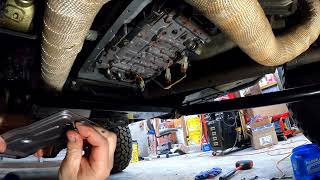
The 1998-2001 Jeep Cherokee (XJ) uses the famously durable Aisin-Warner AW4 transmission. For this specific vehicle, code P0740 is a very common and well-documented issue in owner forums. While the code definition points to a 'circuit' issue, the problem is very frequently the TCC solenoid itself (Solenoid #3), which is a relatively simple component to replace 🎬 Watch this step-by-step walkthrough of the solenoid replacement process. after dropping the transmission pan. Unlike some other vehicles where this code points to a major internal failure, on the XJ Cherokee, it's often a manageable DIY repair that doesn't require transmission removal. The 1998-2001 models specifically use an Input Speed Sensor (ISS) and a 4-pulse Output Speed Sensor (OSS) to detect this fault, a change from prior years.
Symptoms You May Notice
- Check Engine Light is on
- Engine RPMs are higher than usual at highway speeds (e.g., above 3,000 RPM at 65 MPH)
- A feeling that the transmission is not shifting into its final overdrive gear
- Reduced fuel economy
- Code P0700 (General Transmission Fault) may also be present
- Transmission may feel like it's slipping or shuddering at highway speeds
- In some cases, lock-up works when the transmission is cold but stops working once it warms up
- Immediately replacing the torque converter. This is an expensive and labor-intensive job that should only be done after confirming the solenoids, wiring, and fluid are all in good condition.
- Rebuilding the entire transmission. Unless there are other signs of major failure like slipping gears or significant metal in the pan, a full rebuild is usually not necessary for just a P0740 code.
Most Likely Causes
- Faulty Torque Converter Clutch (TCC) Solenoid 🔴 High Probability → Shop Automatic Transmission Torque Converter The TCC solenoid (also known as solenoid #3 or Solenoid 'C') is a very common failure point on the AW4 transmission due to age, heat cycles, and contamination from old fluid.
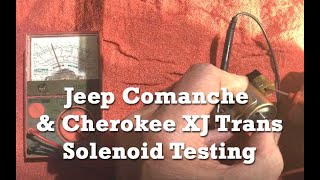
How to confirm: Test the solenoid's resistance. It should be between 11 and 15 ohms. This can be done by unplugging the Transmission Control Module (TCM) under the dash and testing between pin C11 and ground (pin 24), or by dropping the pan and testing the solenoid directly. A reading outside this range confirms failure. 🎬 See how to properly remove and test your AW4 solenoids.
Typical fix: Replace the TCC solenoid. It is located inside the transmission oil pan. Many owners choose to replace all three solenoids (TCC, Shift #1, Shift #2) at the same time as a preventative measure.
Est. part cost: $40-$80 for a single solenoid, $70-$150 for a set of three. - Low, Dirty, or Incorrect Transmission Fluid 🟡 Medium Probability → Shop Transmission Assembly Older vehicles are often neglected, and incorrect fluid type (anything other than Dexron/Mercon) or degraded, burnt fluid can cause solenoids to stick or hydraulic pressure issues. ATF+4 should NOT be used.
How to confirm: Check the transmission fluid dipstick. The fluid should be at the correct level, pinkish-red in color, and not smell burnt. Dark, brown, or burnt-smelling fluid indicates a problem.
Typical fix: Perform a transmission fluid and filter change. Use Dexron III/Mercon fluid. For high-mileage transmissions with dirty fluid, several drain-and-fill cycles are often preferred over a high-pressure flush to avoid dislodging sludge.
Est. part cost: $40-$70 for fluid and a filter kit. - Faulty Brake Light Switch ⚪ Low Probability The brake switch signals the computer to disengage the TCC when the brakes are applied. If it fails or is misadjusted, it can send a constant 'brakes on' signal, preventing lock-up from ever occurring.
How to confirm: Check if your brake lights are stuck on. Even if they aren't, the switch can be faulty. The switch can be tested with a multimeter for proper operation at the TCM connector (pin C13). It should show continuity when the pedal is released and an open circuit when depressed.
Typical fix: Replace or adjust the brake light switch located at the top of the brake pedal arm.
Est. part cost: $15-$30 - Damaged Wiring or Connectors ⚪ Low Probability
How to confirm: Visually inspect the wiring harness leading to the transmission for any signs of damage, corrosion, or loose connections, especially where it is clamped to the side of the transmission. A user on Cherokee Forum found that cleaning the two large black and gray connectors near the dipstick tube solved their intermittent lock-up issue.
Typical fix: Repair or replace the damaged section of the wiring harness. Clean connectors with electrical contact cleaner.
Est. part cost: $10-$50 for wiring repair supplies.
Rare But Worth Checking
- Failed Torque Converter: → Shop Automatic Transmission Torque Converter While less common than a solenoid failure, the internal lock-up clutch within the torque converter can wear out completely. This is a major repair that requires removing the entire transmission. This is usually the last resort after all electrical and hydraulic causes are ruled out. A manufacturer service bulletin, TSB Bulletin #9004009, notes that if the TCC solenoid operation is confirmed as okay, the P0740 code is indicative of a torque converter failure and the unit should be replaced.
- Faulty Throttle Position Sensor (TPS): A bad TPS can send incorrect data about throttle angle to the transmission computer, affecting shift points and TCC lock-up commands. This usually presents with other drivability issues as well, but has been a confirmed fix for P0740 in some forum cases.
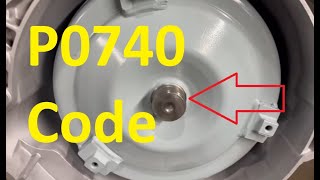
- Failed Powertrain Control Module (PCM) or Transmission Control Module (TCM): → Shop Engine Control Module (ECM) In very rare cases, the driver circuit within the control module that controls 🎬 Watch this guide on diagnosing P0740 circuit and solenoid faults. the TCC solenoid can fail. This should only be considered after all other possibilities have been exhausted. One user on NAXJA forums swapped a spare TCM with no change in symptoms.
Diagnosis Steps
- Read the codes with an OBD-II scanner to confirm P0740 and see if P0700 is also present.
- Check the transmission fluid level and condition. Ensure it is full, red, and does not smell burnt. Use Dexron/Mercon, not ATF+4.
- Verify the brake lights are functioning correctly and not stuck on. Test the brake switch input at the TCM connector (pin C13) to be sure.
- Test the resistance of the TCC solenoid. This is the most definitive test. Disconnect the TCM and measure resistance between pin C11 and a good ground (TCM pin 24). The AW4 solenoids should read between 11-15 ohms. A reading of 0 or infinity indicates a failed solenoid.
- If the solenoid resistance is good, inspect the wiring harness for damage, particularly the large gray connector near the transmission dipstick and where the harness is clamped to the transmission case.
- If possible, use a scan tool that can monitor live data to see if the PCM is commanding the TCC to lock up and monitor the transmission input/output speed sensors for erratic readings.
- If fluid, wiring, and solenoids are all confirmed to be good, the issue may be a worn torque converter or an internal hydraulic blockage. This is less common and more difficult to diagnose.
Parts You'll Likely Need
- Torque Converter Clutch (Lock-Up) Solenoid
(OEM #83504126 (Mopar - Note: Often discontinued, verify with dealer))— This is the most frequent point of failure for the P0740 code on the AW4 transmission.
Trusted brands: Aisin, Rostra, Crown Automotive
OEM price range: $70-$120
Aftermarket price range: $40-$80 - Transmission Filter and Pan Gasket Kit
(OEM #52118789 (Mopar Filter Kit))— Required when dropping the transmission pan to access and replace the solenoids.
Trusted brands: ATP, Wix, Mopar
OEM price range: $30-$50
Aftermarket price range: $15-$30 - Dexron III / Mercon Automatic Transmission Fluid — The correct fluid type is required when refilling the transmission after service. Do not use ATF+4.
Trusted brands: Valvoline, Castrol, ACDelco
Aftermarket price range: $25-$50 for 4-5 quarts
Related Codes That Often Appear With This One
- P0700 — P0700 is a generic code that simply means the Transmission Control Module (TCM) has stored a fault. It almost always accompanies a more specific transmission code like P0740 to illuminate the Check Engine Light.
- P0743 — This code points more specifically to an electrical failure (short or open) in the TCC solenoid circuit, whereas P0740 indicates a functional failure (the lock-up didn't happen as expected). They often appear together or point to the same root cause.
Platform-Specific Known Issues
- Intermittent Failure When Hot: A common complaint in forums is that the torque converter lock-up works perfectly when the transmission is cold, but stops engaging after 20-30 minutes of driving as the fluid heats up. This symptom strongly points to a failing TCC solenoid whose coil windings are breaking down under heat.
- The 'Magic Fix' of Multiple Drain-and-Fills: Some owners, particularly on vehicles with neglected service history and dark fluid, have reported the P0740 code clearing itself after performing several consecutive drain-and-fills of the transmission fluid. The theory is that the fresh fluid and detergents eventually clean a sticking valve or solenoid. One user on Reddit reported success after 4 flushes and 3 filters.
- Connector Corrosion as a Culprit: A user on CherokeeForum.com chased an intermittent P0740 for a long time, replacing multiple parts. The final fix was simply unplugging, cleaning with contact cleaner, and re-seating the two large black and gray transmission-related electrical connectors located near the dipstick tube.
Mechanic-Grade Diagnostic Values
- TCM Ground Circuit Resistance — expected: Less than 1.0 Ohm. Failure: Resistance greater than 1.0 Ohm indicates a poor ground connection.
- Brake Lamp Switch at TCM Connector — expected: Continuity (low resistance) with brake pedal released; Open circuit (infinite resistance) with brake pedal depressed.. Failure: No change when the pedal is depressed, or an open circuit at all times.
- Throttle Position Sensor (TPS) Output Voltage — expected: Greater than 200 millivolts at idle; less than 4.8 volts at wide-open throttle.. Failure: No voltage, or voltage that does not increase smoothly as the throttle opens.
- Input/Output Speed Sensor Resistance — expected: 600 - 700 Ohms (approximately). Failure: A reading of 0 ohms (short) or infinite ohms (open).
Scan Tool Commands That Help
- Chrysler DRB II / DRB III: Read Faults from TCM — This is the OEM-level scan tool for this vehicle era, used to retrieve transmission-specific fault codes like P0740. The system relies on reading stored codes rather than advanced bidirectional controls common in modern vehicles.
Wiring & Ground Locations
- Transmission Control Module (TCM) — For 1997-2001 models, it is located under the driver's side dashboard, mounted above the accelerator pedal.. This is the control unit for the transmission. All electrical tests for solenoids, brake switch, and sensors can be performed at its main connector, making it the central diagnostic point.
- G101 (Engine Ground) — Two bolts on the passenger side of the engine block, near the motor mount and alternator.. This is a primary ground point for both the PCM and TCM. A poor connection here can cause erratic behavior and fault codes for multiple systems, including the transmission.
- Dipstick Tube Stud Ground — A stud on the engine block where the transmission fluid dipstick tube is mounted.. This is a notoriously critical ground point that serves the TCU main ground and other essential engine electronics. A loose or corroded connection here is a common cause of shifting problems.
- Transmission Harness Connector — Located on the driver's side of the transmission, behind and below the dipstick tube. It consists of a gray plug (for solenoids) and a black plug (for the NSS).. This is the main connection between the TCM and the transmission's internal components. Corrosion or damage here can directly cause a P0740 by interrupting the signal to the TCC solenoid.
- G108 (Dash Ground) — Located in the far-left corner of the dashboard, near the headlamp switch.. This point grounds several dash components, including the ignition switch, which provides a key-on signal to the TCM. A fault here could potentially cause power issues for the TCM.
Technical Service Bulletins (TSBs) & Recalls
- TSB Bulletin #9004009: This bulletin addresses vehicles equipped with the 62TE transmission experiencing jerking or slipping with code P0740. It instructs technicians to check TCC solenoid operation; if the solenoid is functioning correctly, the code is indicative of a torque converter failure and the torque converter should be replaced.
Real Owner Repair Stories
- Reddit user Comb-Outside in r/CherokeeXJ (Jeep Cherokee XJ (year not specified, but context implies 1998+)) — Check Engine Light with P0740 after the vehicle had not been serviced in a long time.
❌ Tried (didn't work) A single drain-and-fill with a new filter did not fix the issue; the code returned.
✅ What actually fixed it The problem was resolved by performing multiple (four) transmission fluid drain-and-fills and replacing the filter multiple times. The owner reported the original fluid was like 'mud' and the repeated fluid changes eventually 'pushed the trash through the valve and fixed itself'. - Cherokee Forum user OldTires (Jeep Cherokee XJ (year not specified)) — Improper shifting.
❌ Tried (didn't work) Initial diagnosis pointed to bad solenoids based on out-of-range resistance readings from the harness.
✅ What actually fixed it Replacing all three solenoids fixed the shifting issue. The key diagnostic finding was that the old, faulty solenoids measured out of spec when tested through the harness but measured within spec when removed and tested directly. The new solenoids measured correctly both directly and through the harness, confirming the old ones were failing under load/in-circuit.
OEM Part Supersession History
83504126 (Mopar)→N/A (Often Discontinued)— Part is no longer produced by Mopar for this older vehicle.
Heads up: The AW4 transmission was manufactured by Aisin-Warner. Aisin-branded solenoids are considered the true OEM equivalent and are the preferred replacement over generic aftermarket brands.
Model Year Variations Within This Range
- 1998-2001: The 1998 model year introduced a significant change to the AW4's electronics. These models added an Input Speed Sensor (ISS) and changed the Output Speed Sensor (OSS) to a 4-pulse variable reluctance type. This allows the TCM to directly compare engine speed, transmission input speed, and output speed to verify torque converter lock-up. The presence of the ISS is what enables the P0740 'functional' fault to be set so reliably on these specific years.
- 1998-2001: While the TCM connector may have had minor keying changes, TCMs from 1998 through 2001 are generally considered interchangeable without requiring any programming. There is no functional difference between a 2WD and 4WD TCM.
Diagnostic Flowchart
Real Owner Stories
Aggregated from forums and TSBs cited above. Mileages and costs reflect what owners reported in those sources.
Jeep Cherokee XJ
Symptoms: Triggered the P0740 code while driving on a cross-country trip.
What fixed it: Replaced the TCC solenoid. Commenters correctly diagnosed it as the TCC solenoid, suggested replacing all three as a kit, and warned about the difficulty of breaking the transmission pan seal.
Source hint: Reddit (r/CherokeeXJ) - thread titled 'P0740'
Jeep Cherokee XJ
Symptoms: Experienced the P0740 code on a vehicle with a neglected service history and dark transmission fluid.
What fixed it: Performed 4 fluid flushes and 3 filter changes. The fresh fluid and detergents eventually cleaned a sticking valve/solenoid, and the code cleared itself.
Source hint: Reddit (r/CherokeeXJ) / Vehicle Specific Issues - 'The Magic Fix of Multiple Drain-and-Fills'
Jeep Cherokee XJ
Symptoms: Chased an intermittent P0740 code for a long time and replaced multiple parts without success.
What fixed it: Unplugged, cleaned with electrical contact cleaner, and re-seated the two large black and gray transmission-related electrical connectors located near the dipstick tube.
Source hint: CherokeeForum.com / Vehicle Specific Issues - 'Connector Corrosion as a Culprit'
Jeep Cherokee XJ
Symptoms: Received a P0740 code and needed a diagnostic path to avoid throwing parts at the Jeep.
What fixed it: Followed an expert diagnostic order: checked the brake switch first, checked the fluid condition, and finally tested and replaced solenoid #3 to resolve the issue.
Source hint: NAXJA Forums (naxja.org) - thread titled 'code po740' by user 'Ecomike'
Related OBD-II Codes
Frequently Asked Questions
Can I use ATF+4 fluid in my 1998-2001 Jeep Cherokee AW4 transmission to fix the P0740 code?
How do I test the TCC solenoid on my Cherokee without dropping the transmission pan?
My torque converter lock-up works when the Jeep is cold but stops after 20-30 minutes. Is this normal for P0740?
Why would my brake light switch cause a P0740 transmission code?
Should I replace just the TCC solenoid or all of them in my AW4 transmission?
I have a P0740 code but my fluid is very dark and burnt. Should I get a high-pressure flush?
Helpful Videos
We Have This Part in Stock


The information in this article is provided for general reference and educational purposes only. Vehicle specifications, procedures, and part compatibility can vary by production date, trim level, and region. Always consult your vehicle's factory service manual and verify part numbers before purchasing or performing repairs. Safety-critical components such as airbags, seat belts, and braking systems should be installed by a qualified professional.
- Jeep Cherokee:
- 🧭 Diagnostic Flowchart
- 🎬 Helpful Videos
- 🛍️ Shop This Part
- What's Unique About the 1998-2001 Jeep Cherokee
- Symptoms You May Notice
- Most Likely Causes
- Rare But Worth Checking
- Diagnosis Steps
- Parts You'll Likely Need
- Related Codes That Often Appear With This One
- Platform-Specific Known Issues
- Mechanic-Grade Diagnostic Values
- Scan Tool Commands That Help
- Wiring & Ground Locations
- Technical Service Bulletins (TSBs) & Recalls
- Real Owner Repair Stories
- OEM Part Supersession History
- Model Year Variations Within This Range
- Real Owner Stories
- Jeep Cherokee XJ
- Jeep Cherokee XJ
- Jeep Cherokee XJ
- Jeep Cherokee XJ
- Related OBD-II Codes
- Frequently Asked Questions
- 🎟️ Get 5% Off