

P0751 on 2004-2013 Toyota RAV4: Shift Solenoid 'A' Causes and Fixes
P0751 on a 2004-2013 RAV4 usually indicates a problem with Shift Solenoid 'A'. The most common fixes are checking and replacing low or dirty transmission fluid or replacing the faulty solenoid itself. This repair can cost between $200 and $500 depending on the specific cause.
- P0751 means Shift Solenoid 'A' is stuck off or not performing correctly.
- Always check the transmission fluid level and condition first; this is the easiest and a very common fix.
- If the fluid is fine, the shift solenoid itself is the next most likely culprit.
- This repair requires dropping the transmission pan, so it is moderately difficult for a DIYer.
- Be aware of the specific transmission in your RAV4 (4-cyl vs V6, and year) as parts are not interchangeable.
What's Unique About the 2004-2013 Toyota RAV4
The 2004-2013 RAV4 spans three vehicle generations with several different automatic transmissions, making diagnosis specific to the year and engine. Early models (2004-2005) often used the 4-speed U140F/U241E. The 2006-2012 models saw the introduction of 5-speed (U151E/F for V6) and later 6-speed (U660E/F for V6) transmissions. The 2013 model year, particularly with the 2.5L engine, uses the 6-speed U760E/F. This variety means part numbers and procedures are not universal. Early models (2001-2003) were subject to a TSB for faulty ECMs causing similar codes, a history worth noting for 2004-2005 models. Later 2013 models with the U760E/F transmission had a warranty enhancement for torque converter shudder, which can sometimes present with similar drivability issues, though not directly causing a P0751 code.
Generation note: Yes, this range covers the late 2nd generation (2004-2005, XA20), the full 3rd generation (2006-2012, XA30), and the first year of the 4th generation (2013, XA40). Different engines (2.4L 2AZ-FE, 2.5L 2AR-FE, 3.5L 2GR-FE) were paired with different 4-speed, 5-speed, and 6-speed automatic transmissions (U140F, U241E, U151E/F, U660E/F, U760E/F). The specific shift solenoid part number and location will vary depending on the transmission.
Symptoms You May Notice
- Harsh, delayed, or erratic shifting.
- Transmission getting stuck in one gear (limp mode).
- Vehicle won't move when put in gear.
- Transmission slipping between gears.
- Reduced fuel economy.
- Check Engine Light is on.
- Transmission overheating.
- Replacing the entire transmission when only a fluid change or a single solenoid was needed.
- Replacing the solenoid without first checking the fluid level and condition, which is a simpler and more common cause.
- Replacing the solenoid when the actual problem is a broken wire or corroded connector in the harness.
Most Likely Causes
- Low or Dirty Transmission Fluid 🔴 High Probability → Shop Transmission Assembly Fluid breaks down over time, and leaks can lower the level. Dirty or contaminated fluid can clog the small passages in the solenoid, causing it to stick or perform poorly.
How to confirm: Check the transmission fluid level and condition using the dipstick (if equipped) or check plug. The fluid should be bright red and not smell burnt. If it's dark, brown, or has particles in it, it's contaminated and should be changed.
Typical fix: Perform a transmission fluid and filter change. Use only Toyota-specified fluid (like Toyota ATF WS - World Standard). A simple drain-and-fill may not be enough; a full flush might be necessary to remove all contaminants.
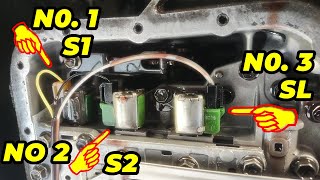
Est. part cost: $80-$150 - Failed Shift Solenoid 'A' (S1/SL1) 🔴 High Probability → Shop Transmission Valve Body The solenoid is an electro-mechanical part that can fail electrically (coil burns out) or mechanically (plunger gets stuck) over many shift cycles.
How to confirm: After dropping the transmission pan, the solenoid's resistance can be tested with a multimeter. It should be within the manufacturer's specified range (typically 11-15 ohms for many Toyota solenoids, but check the specific model's manual). A capable scan tool can also perform an active test to command the solenoid on and off, listening for a click.
Typical fix: Replace the faulty shift solenoid. This requires removing the transmission pan and sometimes the valve body.
Est. part cost: $150-$300 - Wiring or Connector Issue 🟡 Medium Probability
How to confirm: Visually inspect the wiring harness leading to the transmission for any signs of damage, corrosion, or loose connections. Test for power (approx. 12V) and ground at the solenoid connector with a multimeter.
Typical fix: Repair or replace the damaged section of the wiring harness or clean/replace the connector. Applying dielectric grease can prevent future corrosion.
Est. part cost: $20-$100
Rare But Worth Checking
- Faulty Engine Control Module (ECM/PCM): While less common for this specific year range, 2001-2003 RAV4s had a well-documented issue where a faulty ECM would damage the transmission and cause solenoid codes. If all other causes are ruled out on an early (2004-2005) model, the ECM should be considered a potential, though rare, cause.
- Internal Transmission Failure: → Shop Transmission Assembly If the transmission fluid contains a significant amount of metal shavings, it points to a more severe internal problem like a failing clutch pack or valve body issue. In this case, the P0751 code is a symptom of a larger mechanical failure that a solenoid replacement won't fix.
- Clogged Transmission Filter: → Shop Transmission Assembly A clogged filter can restrict fluid flow, leading to pressure issues that can manifest as a solenoid performance code. This is often a consequence of old, dirty fluid.
Diagnosis Steps
- Check and verify the transmission fluid level and condition. Top up or change if necessary. Fluid should be pink/red and not smell burnt.
- Use an OBD-II scanner to check for any other related trouble codes.
- Inspect the transmission wiring harness and connectors for any visible damage, corrosion, or loose pins.
- If you have a bi-directional scanner, command Shift Solenoid 'A' on and off to see if it responds. You may hear a faint click.
- Drop the transmission pan to gain access to the valve body and solenoids. Inspect the fluid in the pan for metal shavings.
- Using a multimeter set to Ohms, measure the resistance of Shift Solenoid 'A'. Compare the reading to the factory specification (often 11-15 Ohms for this era).
- If the solenoid resistance is out of spec, replace it.
- If the solenoid tests good, check for battery voltage (approx. 12V) and ground at the solenoid's connector in the harness to rule out a wiring issue.
- If the solenoid and wiring are good, the issue may be a blockage in the valve body or, in rare cases, a faulty ECM/TCM.
Parts You'll Likely Need
- Shift Solenoid 'A' (S1/SL1)
(OEM #Varies: e.g., 35220-21010 for U140/U240; check VIN.)— This is the solenoid directly identified by the P0751 code and is a common failure point after fluid issues are ruled out. Note: Part number varies significantly by transmission type (U140F, U151E, U760E, etc.).
Trusted brands: Toyota (Genuine), Aisin (OEM supplier), Rostra
OEM price range: $250-$350
Aftermarket price range: $100-$250 - Automatic Transmission Fluid
(OEM #00289-ATFWS)— Low or dirty fluid is a primary cause of this code. A fluid and filter service is the first step in diagnosis and repair.
Trusted brands: Toyota (Genuine WS), Idemitsu ATF-TLS-LV (WS compatible), Valvoline MaxLife Full Synthetic Multi-Vehicle ATF
OEM price range: $12-$18 per quart
Aftermarket price range: $8-$12 per quart - Transmission Filter and Pan Gasket Kit — When replacing the solenoid or servicing the fluid, the filter and pan gasket should always be replaced to ensure a clean system and proper seal.
Trusted brands: Wix, ATP, Pro-King, Toyota (Genuine)
OEM price range: $50-$80
Aftermarket price range: $30-$50
Related Codes That Often Appear With This One
- P0750 — This is the electrical circuit malfunction code for the same Shift Solenoid 'A'. If both are present, it points more strongly to a wiring issue or a completely failed solenoid.
- P0700 — This is a generic code indicating the Transmission Control Module (TCM) has stored a fault. It's an informational code that will always appear alongside a specific transmission code like P0751.
- P0752 — This code indicates Shift Solenoid 'A' is stuck ON, the opposite of P0751 (Stuck OFF). Seeing either code points to a problem with the same component or circuit.
Technical Service Bulletins (TSBs) & Recalls
- TC002-06 (Superseded) / T-SB-0132-10: Addresses harsh shifting and various solenoid codes (P0750, P0753, etc.) on 2001-2003 RAV4 models due to ECM failure. While not covering the full 2004-
Platform-Specific Known Issues
- For 2004-2005 models with the U140F/U241E transmission, be aware of the historical ECM issues on slightly older (2001-2003) RAV4s that caused similar transmission codes. While a TSB specifically covers up to 2003, a failing ECM remains a possibility if all other components test good.
- For 2013 models with the U760E/F transmission, Toyota issued a warranty enhancement (ZH1) for torque converter shudder. While this doesn't directly cause P0751, it's a known issue with the transmission in that specific model year and can cause confusing drivability symptoms.
- Owners on forums frequently solve P0751 and related codes with a simple drain and fill (sometimes multiple times) of Toyota WS ATF, suggesting fluid condition is a very common culprit before solenoid failure.
Mechanic-Grade Diagnostic Values
- Shift Solenoid S1/SL1 Resistance (U140/U240 series) — expected: 11 - 15 Ω at 20°C (68°F). Failure: Resistance outside this range indicates a faulty solenoid coil.
- Shift Solenoid SL1 Resistance (U140E/F, U240E/F, U241E/F) — expected: 5.0 - 5.6 Ω. Failure: Resistance outside this range. Note the significant difference from other solenoids in the same valve body.
- SL1 Solenoid Voltage Test (U140 series) — expected: Approximately 5-6 volts in 1st gear, dropping to 0 volts on the 1-2 shift, then returning to 5-6 volts for the 2-3 shift.. Failure: Voltage does not change as expected during shifts, pointing towards a potential PCM/ECM issue rather than a solenoid failure.
- ECM/PCM Ground Circuit Voltage Drop — expected: Less than 0.1 volts with the engine running.. Failure: Voltage greater than 0.1V indicates a poor ground, which can cause erratic computer and solenoid behavior.
Scan Tool Commands That Help
- Toyota Techstream: Active Test: 'Control the Shift Position' — Allows the technician to manually command gear shifts while driving at low speeds (<30 mph) to confirm if the mechanical part of the transmission can engage gears when commanded electronically. This helps isolate a mechanical vs. electrical problem.
- Toyota Techstream: Active Test: 'Activate the Solenoid (S1)' — With the vehicle stationary (Key On, Engine Off), this command directly energizes the S1 solenoid. The technician should listen for an audible 'click' from the transmission pan. A lack of a click strongly suggests a failed or stuck solenoid, or a wiring issue.
- Toyota Techstream: Data List: Monitor 'Shift Solenoid S1' status — While performing active tests or driving, monitoring the live data for the solenoid's commanded state (On/Off) versus the actual resulting gear can confirm if the ECM is sending the signal and if the transmission is responding.
Wiring & Ground Locations
- Transmission Case Connector (U140) — External connector on the transmission housing.. This is the primary point for testing the solenoid circuits without opening the transmission. For the SL1 solenoid, technicians backprobe terminals 5 and 10 to perform voltage tests during shifts.
- ECM/PCM Ground Points — Varies by year and engine, but typically located on the engine block or inner fender. A wiring diagram is required for exact locations.. A high-resistance or corroded ground for the engine computer can cause incorrect readings and erratic solenoid operation, potentially mimicking a failed solenoid and setting a P0751.
OEM Part Supersession History
35210-21010→Current— This is the #1 Control Shift Solenoid for U140/U240/U241 transmissions.
Heads up: This solenoid (often with a white connector) is for the SL2 position. The SL1 solenoid is a different part number (e.g., 35220-21010). It is critical to match the correct part to the correct solenoid position in the valve body.35220-21010→Current— This is the #2 Control Shift Solenoid (SL1) for U140/U240/U241 transmissions.
Heads up: This part is often sold as a remanufactured unit. Ensure the supplier has tested it. Physically similar solenoids from different transmission families (e.g., U241E vs U660E) may fit but have incorrect resistance, causing immediate failure or limp mode.
Model Year Variations Within This Range
- 2004-2005: These models primarily use the U140F/U241E 4-speed transmissions. Solenoid resistance values and diagnostic procedures are specific to this family. They are also closer in age to the 2001-2003 models known for ECM failures, making it a slightly more probable (though still rare) cause.
- 2006-2012: This generation introduced 5-speed (U151E/F) and 6-speed (U660E/F) transmissions, particularly with the V6 engine. The valve bodies and solenoids are completely different from the earlier 4-speeds. Part numbers must be checked carefully against the VIN.
- 2013: The 2013 model year introduced the U760E/F 6-speed transmission. While the P0751 code applies, the specific solenoid (S1) and its location are unique to this transmission. This model year also had a known torque converter issue covered by a warranty extension, which can cause confusing, similar symptoms.
Diagnostic Flowchart
Other Known Issues on This Vehicle
Issues unrelated to this code that are worth knowing about as an owner of this generation:
- Excessive Oil Consumption (2AZ-FE Engine) 🔴 High — Very common in 2006-2008 models with the 2.4L engine, often starting around 60,000-80,000 miles. Caused by faulty piston ring design. (Ref: T-SB-0094-11 details a warranty enhancement program (ZE7) for repair, which has since expired.)
- Steering Intermediate Shaft Clunk 🟠 Medium — Common in 2006-2012 models, causing a clunking or popping noise when turning the steering wheel at low speeds. (Ref: T-SB-0318-08 addresses the issue with an updated part.)
- Water Pump Failure (2GR-FE Engine) 🟠 Medium — The water pump on the 3.5L V6 is a known weak point and can fail prematurely, leading to coolant leaks and potential overheating.
- ECM Failure (Early Models) 🔴 High — Primarily affected 2001-2003 models, but some 2004 models can still be at risk. A faulty ECM causes harsh shifting and can lead to transmission failure. (Ref: T-SB-0132-10 (supersedes earlier TSBs))
Used vs. New Parts: Buying Guide for This Vehicle
When a used part is the smart pick: A complete used valve body from a low-mileage, crashed vehicle can be a cost-effective alternative to buying a new one, especially if a blocked passage is suspected rather than just a single solenoid failure. A single used solenoid is also a viable option if its history is known.
Donor-vehicle mileage cap: roughly under 80000 miles for the part to have meaningful remaining life.
What to inspect on the donor part:
- Verify the donor vehicle's mileage.
- Ask for photos of the transmission fluid from the donor car if possible; it should be red/pink, not dark brown or black.
- Ensure the part comes with a short warranty (e.g., 30-90 days) from the salvage yard.
OEM-only on this vehicle (don't cheap out):
- Engine Control Module (ECM) / Transmission Control Module (TCM) - Aftermarket or improperly programmed units often cause more problems.
- Transmission Solenoids - While some aftermarket brands are reliable, OEM (Toyota) or the original supplier (Aisin) is strongly recommended for best compatibility and longevity.
Aftermarket brands forum-validated for this vehicle:
- Aisin (often the OEM supplier)
- Rostra (well-regarded in the transmission parts industry)
- Sonnax (specializes in valve body repair kits and upgraded components)
Brands owners have reported issues with on this vehicle:
- Unnamed, no-brand solenoids from online marketplaces should be avoided. They often have incorrect resistance values or use inferior materials, leading to premature failure.
Real Owner Stories
Aggregated from forums and TSBs cited above. Mileages and costs reflect what owners reported in those sources.
2007 Toyota RAV4 V6
Symptoms: P0751 code and shifting issues.
What fixed it: Replacing the 'SL1' solenoid, which was accessible after dropping the transmission pan.
Source hint: ToyotaNation.com
2012 Toyota Camry (Platform Mate)
Symptoms: Overheating due to water pump failure, leading to transmission stress and performance codes.
What fixed it: Addressing the water pump failure and overheating issue to prevent further transmission fluid degradation.
Source hint: Reddit (r/Toyota)
2004 Toyota RAV4
Symptoms: Harsh shifting and transmission codes.
What fixed it: Replacing the ECM, as early 2004 models can still be susceptible to the failure described in T-SB-0132-10.
Source hint: vehicle_specific_issues
Related OBD-II Codes
Frequently Asked Questions
I have a 2004 RAV4 with harsh shifting; could this be the ECM issue mentioned in TSB T-SB-0132-10?
What specific transmission fluid should I use for my 2004-2013 RAV4 to avoid P0751?
My 2013 RAV4 has a weird shuddering feeling; is this related to the P0751 code?
Can I test the Shift Solenoid 'A' (S1/SL1) myself on a 2007 RAV4 V6?
Is it true that a water pump failure can lead to transmission codes like P0751?
Do I have to remove the entire valve body to fix a P0751 on my 2007 RAV4?
Helpful Videos
We Have This Part in Stock

The information in this article is provided for general reference and educational purposes only. Vehicle specifications, procedures, and part compatibility can vary by production date, trim level, and region. Always consult your vehicle's factory service manual and verify part numbers before purchasing or performing repairs. Safety-critical components such as airbags, seat belts, and braking systems should be installed by a qualified professional.
- Toyota RAV4:
- 🧭 Diagnostic Flowchart
- 🎬 Helpful Videos
- 🛍️ Shop This Part
- What's Unique About the 2004-2013 Toyota RAV4
- Symptoms You May Notice
- Most Likely Causes
- Rare But Worth Checking
- Diagnosis Steps
- Parts You'll Likely Need
- Related Codes That Often Appear With This One
- Technical Service Bulletins (TSBs) & Recalls
- Platform-Specific Known Issues
- Mechanic-Grade Diagnostic Values
- Scan Tool Commands That Help
- Wiring & Ground Locations
- OEM Part Supersession History
- Model Year Variations Within This Range
- Other Known Issues on This Vehicle
- Used vs. New Parts: Buying Guide for This Vehicle
- Real Owner Stories
- 2007 Toyota RAV4 V6
- 2012 Toyota Camry (Platform Mate)
- 2004 Toyota RAV4
- Related OBD-II Codes
- Frequently Asked Questions
- 🎟️ Get 5% Off