

P0752 on 2006-2011 Chevrolet HHR: Shift Solenoid 'A' Stuck On Causes and Fixes
This code means the 1-2 shift solenoid in your 4T45-E transmission is stuck on, often due to internal debris or solenoid failure. The most common fix is replacing the shift solenoids, which is a complex job requiring lowering the subframe. Expect a shop to charge between $1,200 and $2,200 for this repair.
- P0752 on a Chevy HHR means the 1-2 shift solenoid is stuck, which will cause severe shifting problems.
- The most likely cause is a failed shift solenoid, but low or dirty fluid should be considered first.
- Checking the transmission fluid on an HHR is not simple and requires a specific procedure on a vehicle lift.
- Replacing the solenoid is a very involved repair (5/5 difficulty) and is best left to a professional mechanic.
- When having the repair done, it is wise to replace both the 'A' and 'B' shift solenoids, along with the transmission fluid and filter.
What's Unique About the 2006-2011 Chevrolet HHR
The Chevrolet HHR uses a 4T45-E automatic transmission that does not have a dipstick for checking transmission fluid. This makes the most basic diagnostic step—checking the fluid level and condition—difficult for a DIYer, as it requires the vehicle to be hot and perfectly level on a lift. 🎬 Watch: How to find the filler and check plug locations. Furthermore, replacing the shift solenoids is a particularly labor-intensive job on this platform, often requiring the engine to be supported with a brace while the subframe is partially lowered to access the transmission's side cover.
Symptoms You May Notice
- Check Engine Light is illuminated
- Harsh, delayed, or failed shifts
- Transmission stuck in a low gear (e.g., won't shift past 2nd gear)
- Vehicle enters 'limp mode' with reduced power
- Transmission overheating
- Transmission slipping between gears
- Increased fuel consumption
- Replacing only the transmission fluid without addressing the faulty solenoid. While old fluid can be a cause, a 'stuck on' code often indicates the solenoid itself has failed mechanically or electrically.
- Replacing the entire transmission when only the solenoids, fluid, and filter are needed. This is a much more expensive repair that is often unnecessary for this specific code.
Most Likely Causes
- Faulty 1-2 Shift Solenoid ('A') 🔴 High Probability → Shop Transmission Valve Body The solenoid is a moving part submerged in fluid that can wear out or fail electrically over time. More commonly, fine metallic debris in the fluid can cause the internal valve of the solenoid to physically jam or stick.
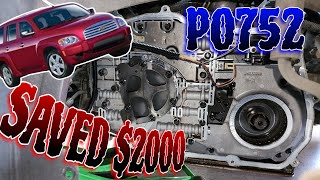
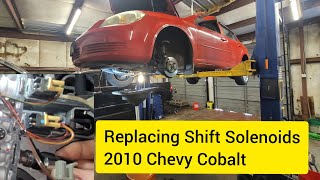
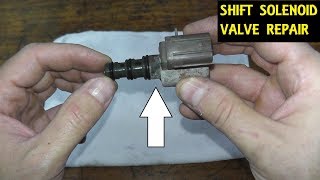
How to confirm: Requires accessing the solenoid's connector to test resistance with a multimeter. 🎬 Watch: Step-by-step guide for testing and replacing shift solenoids. A healthy solenoid should read between 19-31 ohms. A reading outside this range (especially a very low reading like 3 ohms) indicates a shorted solenoid. Often, it is replaced based on the code alone due to the high labor cost of diagnosis.
Typical fix: Replace the 1-2 shift solenoid ('A'). It is highly recommended to replace the 2-3 shift solenoid ('B') at the same time, as they are identical parts subject to the same wear and labor.
Est. part cost: $30-$60 per solenoid - Low or Dirty Transmission Fluid 🟡 Medium Probability → Shop Transmission Assembly The 4T45-E transmission has no dipstick, making it easy for the fluid level to become low from a minor leak (like an axle seal) without the owner noticing. Old, degraded fluid loses its hydraulic properties and can carry debris that causes solenoids to stick.
How to confirm: The vehicle must be raised level, brought to operating temperature (180-200°F), and the check plug on the side of the transmission must be removed. A slow drip indicates a correct level. No fluid or a stream indicates an incorrect level.
Typical fix: Perform a transmission fluid and filter change using DEXRON-VI fluid. This is often done as a first step, but may not fix a solenoid that is already mechanically stuck.
Est. part cost: $80-$150 for fluid and a filter - Clogged Transmission Filter ⚪ Low Probability → Shop Transmission Assembly If the transmission fluid has not been changed regularly, the filter can become saturated with clutch material and debris, restricting fluid flow and pressure, which can affect solenoid operation.
How to confirm: The filter can only be inspected by removing the transmission pan or side cover during a fluid service or solenoid replacement.
Typical fix: Replace the transmission filter and fluid.
Est. part cost: $20-$40 - Wiring or Connector Damage ⚪ Low Probability The main transmission connector is exposed to road debris and moisture, which can lead to corrosion on the pins or damage to the wires, causing a short or open in the solenoid circuit.
How to confirm: Visually inspect the wiring harness leading to the transmission. Perform a continuity and voltage test at the connector pins corresponding to shift solenoid 'A'. A forum user confirmed a bad solenoid by testing resistance at the TCM connector, which showed a short that disappeared when the transmission harness was disconnected.
Typical fix: Repair the damaged section of the wiring harness or clean/replace the connector.
Est. part cost: $10-$100
Rare But Worth Checking
- Defective Transmission Valve Body: → Shop Transmission Valve Body The valve body houses the solenoids. If its internal passages are blocked with sludge or it becomes warped, it can cause even a new solenoid to stick. Manufacturer Bulletin #PIP4831E advises technicians to specifically look for debris in the valve body when P0752 is set.
- Faulty Transmission Control Module (TCM): → Shop Transmission Assembly A failure of the TCM's internal driver circuit for the solenoid can cause this code. This is uncommon and should be suspected only after all other causes are ruled out, especially if other, unrelated transmission codes are present simultaneously. Bulletin #PIP4831E also suggests reviewing the date code on the TCM as part of the diagnostic process.
Diagnosis Steps
- Check the transmission fluid level and condition. This is the first and most important step, but it is difficult on the HHR and requires a lift and specific temperature procedure.
- If the fluid is low, top it off, clear the code, and test drive. If the fluid is dark or burnt, a full fluid and filter change is recommended as a first attempt at a fix.
- If the fluid level is correct, test the shift solenoid circuit. Disconnect the TCM connector and measure the resistance of the solenoid circuit. A healthy solenoid should measure between 19-31 ohms.
- If the resistance is out of spec, the solenoid itself is the primary suspect. Due to the high labor involved in accessing it, it is often replaced without further internal testing.
- To replace the solenoid, a technician will support the engine/transmission with an engine support bar.
- The technician will then lower the driver's side of the subframe, remove the driver's side axle shaft, and then remove the transmission side cover.
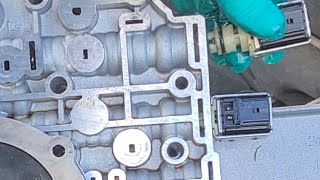
- With the cover off, the 1-2 ('A') and 2-3 ('B') shift solenoids are accessible for replacement. It is best practice to replace both.
- After replacement, the transmission is reassembled with new gaskets, and the fluid is refilled to the correct level using the side check plug.
- Clear the code and perform a test drive, including multiple upshifts and downshifts, to verify the repair.
Parts You'll Likely Need
- Automatic Transmission Shift Solenoid
(OEM #ACDelco 24227792 (Kit with both A/B solenoids), 24207236 (Single solenoid))— This is the 1-2 shift solenoid ('A') that is indicated by the P0752 code. It is the most common point of failure. The same part is used for the 'B' solenoid, and they are almost always replaced in pairs. The ACDelco 24227792 kit is a common all-in-one replacement part.
Trusted brands: ACDelco, Rostra, ATP
OEM price range: $70-$100 (for kit)
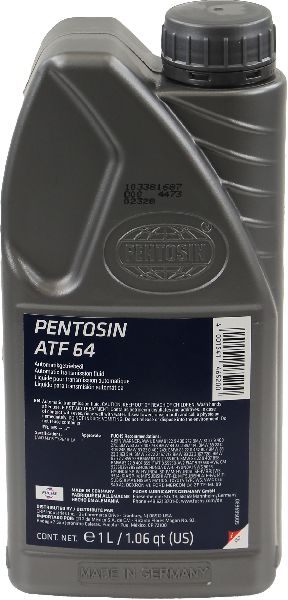
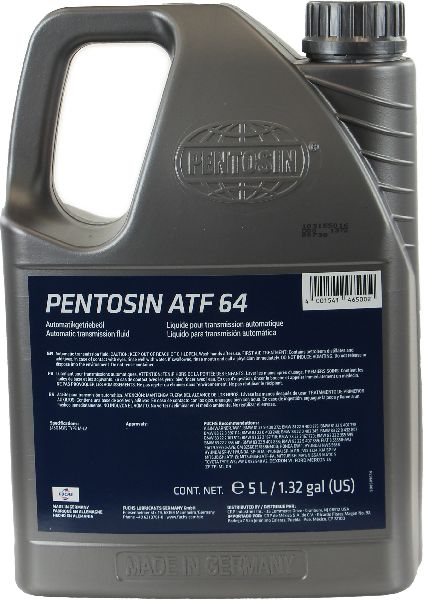
Aftermarket price range: $40-$60 (for kit) - Automatic Transmission Fluid — New fluid is required when replacing internal transmission components. The HHR specifies DEXRON-VI fluid. A typical drain and fill for this job requires 5-7 quarts.
Trusted brands: ACDelco, Valvoline, Castrol
OEM price range: $10-$15 per quart
Aftermarket price range: $8-$12 per quart - Automatic Transmission Filter Kit — The filter should always be replaced when the transmission pan or side cover is removed to prevent old debris from contaminating the new fluid and parts.
Trusted brands: ACDelco, Wix, ATP
OEM price range: $30-$50
Aftermarket price range: $15-$30 - Transmission Side Cover Gasket — This gasket is required to be replaced when the side cover is removed to access the solenoids. It is critical for preventing leaks. Some original metal-reinforced gaskets may be reusable if in excellent condition, but replacement is recommended.
Trusted brands: ACDelco, Fel-Pro
OEM price range: $25-$40
Aftermarket price range: $15-$30
Related Codes That Often Appear With This One
- P0700 — This is a generic transmission fault code that simply tells the Engine Control Module (ECM) that the Transmission Control Module (TCM) has stored a fault. It will almost always be present with P0752.
- P0751 — This code is for 'Shift Solenoid A Performance/Stuck Off'. It relates to the same solenoid but a different failure mode. Seeing both may indicate an intermittent electrical problem or a solenoid that is mechanically binding.
- P0757 — This code is for 'Shift Solenoid B Stuck On'. If debris is the root cause, it can affect multiple solenoids simultaneously. Since both solenoids are replaced together, this code often accompanies P0752.
Technical Service Bulletins (TSBs) & Recalls
- While no TSB directly addresses the P0752 code specifically for the HHR, manufacturer Bulletin #PIE0371B notes that vehicles across the GM lineup have exhibited conditions of a Check Engine Light, delayed shifts, and being stuck in gear when P0752 is set.
- NHTSA Campaign 14V047000 (and others): Covers the infamous ignition switch failure that can cause the vehicle to shut off while driving.
- GM Special Coverage 14119: Provides an extended warranty (for the life of the vehicle) to replace the electric power steering motor if it fails.
Platform-Specific Known Issues
- Real-World Repair Experience: A YouTube video by user 'Fluffy Mexicanik' titled '2008 HHR P0752 1ST AND 4TH GEAR MISSING AND HARD SHIFT' documents the entire repair. The mechanic confirms the extreme difficulty, showing the need for an engine support bar, removal of mounts, and dropping the subframe just to access the side cover. The final fix was replacing both shift solenoids.
Mechanic-Grade Diagnostic Values
- 1-2 Shift Solenoid ('A') Resistance — expected: 19-31 Ohms. Failure: A reading outside this range, especially an open (infinite) or short (near zero) reading, indicates a failed solenoid.
Scan Tool Commands That Help
- GM Tech 2 / GDS2: Transmission Data Display — A professional scan tool is used to monitor the commanded state of Shift Solenoid 'A' versus the actual gear ratio reported by the input and output speed sensors. A mismatch between the command and the outcome is what triggers the P0752 code. While there isn't a simple bidirectional on/off command for this specific solenoid, viewing this live data is the primary electronic diagnostic step.
Wiring & Ground Locations
- G107 — On the front left corner of the transmission case, near the engine block.. This is a primary ground point for the Transmission Control Module (TCM). A poor connection at G107 can cause erratic behavior from the TCM and its outputs, potentially leading to false solenoid codes. Checking and cleaning this ground is a critical and often overlooked diagnostic step.
- TCM Connector — The TCM is located on the driver's side of the engine bay, near the fuse box.. This is the ideal location to test the solenoid's resistance without opening the transmission. By identifying the correct pins for the 1-2 shift solenoid, you can test the entire circuit (wiring and solenoid) from one easily accessible point.
Real Owner Repair Stories
- YouTube channel 'Fluffy Mexicanik' (2008 Chevrolet HHR) — P0752 code, missing 1st and 4th gears, hard shifting.
❌ Tried (didn't work) The video proceeds directly to the solenoid replacement, implying it was the primary diagnosis.
✅ What actually fixed it Replaced both the 1-2 and 3-4 shift solenoids inside the transmission side cover. The mechanic noted the plastic on the old solenoid connectors was brittle and broke during removal.
Documented NHTSA Reports
- An owner reported in NHTSA ODI #11327300 that their vehicle was throwing codes P0752 and P0700 along with engine codes, leading them to believe the transmission had failed.
OEM Part Supersession History
24212690→24227792— Part update or consolidation by GM.
Heads up: The description for 24227792 is often 'Torque Converter Clutch Pulse Width Modulation Valve', which can be confusing. However, it is the correct service replacement kit for the shift solenoids on this application.
Model Year Variations Within This Range
- 2006-2011: The 4T45-E transmission used in the HHR and other GM vehicles came with different final drive ratios (e.g., 3.63, 3.91). While the solenoids are the same, swapping a complete transmission from a donor vehicle (like a Cobalt or another HHR) with a different ratio could potentially cause issues with the TCM and speedometer calibration. There is also anecdotal evidence of valve body changes between early (2006-2007) and later (2008-2011) models, which could impact internal parts compatibility.
Diagnostic Flowchart
Other Known Issues on This Vehicle
Issues unrelated to this code that are worth knowing about as an owner of this generation:
- Electric Power Steering (EPS) Motor Failure 🔴 High — Very common. Can cause a sudden loss of power steering assist while driving. GM issued a special coverage adjustment (extended warranty) for the motor. (Ref: Special Coverage 14119 / Recall 14115A (for 2009-2010 models).)
- Ignition Switch Failure / Recall 🔴 High — Extremely widespread and dangerous issue. The ignition switch can move out of the 'run' position if the key is bumped or has a heavy keychain, shutting off the engine and disabling airbags. (Ref: NHTSA Campaign Number: 14V047000.)
- Front Lower Control Arm Bushing Wear 🟠 Medium — Common failure item, often occurring between 60,000 and 100,000 miles. Causes clunking noises over bumps, steering wheel vibration during braking, and a feeling of the front end shifting.
- Timing Chain Tensioner Failure 🟠 Medium — A known weak point on the 2.2L Ecotec engine. Failure of the tensioner can lead to chain slack, rattling noises, and potentially jumped timing if ignored.
- EVAP System Leak (Faulty Gas Cap) 🟡 Low — A very common cause for a Check Engine Light with EVAP codes. The gas cap seal degrades or the ratchet mechanism fails, preventing a proper seal.
Used vs. New Parts: Buying Guide for This Vehicle
When a used part is the smart pick: For this specific repair, using a used part is strongly discouraged. Given the 7+ hours of labor required to access the solenoids, the small cost savings of a used solenoid presents a massive financial risk if it fails prematurely. A complete used transmission assembly from a low-mileage donor is a viable, but risky, alternative to a full rebuild if the entire unit is confirmed to be failing.
Donor-vehicle mileage cap: roughly under 80000 miles for the part to have meaningful remaining life.
What to inspect on the donor part:
- Verify the donor vehicle's mileage and ask for service records if possible; regular fluid changes are a good sign.
- Inspect the transmission fluid from the donor car. If it's dark, burnt, or contains metallic particles, avoid it.
- Check for leaks around the axle seals and side cover on the donor unit.
- Ensure the donor is the same model year range or has the same final drive ratio to avoid compatibility issues.
OEM-only on this vehicle (don't cheap out):
- While not strictly 'OEM-only', using a new ACDelco solenoid kit (24227792) is the most reliable and recommended path due to the high labor cost of the job.
Aftermarket brands forum-validated for this vehicle:
- Rostra
- ATP
Brands owners have reported issues with on this vehicle:
- No-name, unbranded solenoid kits from online marketplaces are a significant gamble and should be avoided.
Real Owner Stories
Aggregated from forums and TSBs cited above. Mileages and costs reflect what owners reported in those sources.
2008 Chevrolet HHR 2.2L
Symptoms: 1st and 4th gear missing and hard shift
What fixed it: Replacing both the 1-2 ('A') and 2-3 ('B') shift solenoids.
Source hint: YouTube video by user 'Fluffy Mexicanik' titled '2008 HHR P0752 1ST AND 4TH GEAR MISSING AND HARD SHIFT'
Chevrolet HHR 2.2L
Symptoms: Check Engine Light with code P0752. Diagnostic testing at the TCM connector showed a solenoid resistance of 3 ohms, indicating a short.
What fixed it: The diagnostic process confirmed a shorted solenoid, leading to the replacement of both shift solenoids.
Source hint: Chevy HHR Network (chevyhhr.net): In a thread titled 'Shift Solenoid'
Chevrolet Equinox Owner
Symptoms: The vehicle was throwing codes P0752 and P0700 along with engine codes P0008, P0018, and P0017.
What fixed it: The owner reported these symptoms in NHTSA ODI #11327300, suspecting a total transmission failure due to the combination of codes.
Source hint: NHTSA ODI #11327300
Related OBD-II Codes
Frequently Asked Questions
How do I check the transmission fluid on my HHR? I can't find a dipstick.
My mechanic says the code is for the 1-2 shift solenoid 'A'. Why do they recommend replacing the 2-3 solenoid 'B' too?
What is the correct resistance for the shift solenoid on my HHR's transmission?
What type of transmission fluid does my 2006-2011 HHR take?
Is there a recall for the power steering on my HHR?
I heard about a dangerous ignition switch problem. Does that apply to my HHR?
Helpful Videos
We Have This Part in Stock

The information in this article is provided for general reference and educational purposes only. Vehicle specifications, procedures, and part compatibility can vary by production date, trim level, and region. Always consult your vehicle's factory service manual and verify part numbers before purchasing or performing repairs. Safety-critical components such as airbags, seat belts, and braking systems should be installed by a qualified professional.
- Chevrolet HHR:
- 🧭 Diagnostic Flowchart
- 🎬 Helpful Videos
- 🛍️ Shop This Part
- What's Unique About the 2006-2011 Chevrolet HHR
- Symptoms You May Notice
- Most Likely Causes
- Rare But Worth Checking
- Diagnosis Steps
- Parts You'll Likely Need
- Related Codes That Often Appear With This One
- Technical Service Bulletins (TSBs) & Recalls
- Platform-Specific Known Issues
- Mechanic-Grade Diagnostic Values
- Scan Tool Commands That Help
- Wiring & Ground Locations
- Real Owner Repair Stories
- Documented NHTSA Reports
- OEM Part Supersession History
- Model Year Variations Within This Range
- Other Known Issues on This Vehicle
- Used vs. New Parts: Buying Guide for This Vehicle
- Real Owner Stories
- 2008 Chevrolet HHR 2.2L
- Chevrolet HHR 2.2L
- Chevrolet Equinox Owner
- Related OBD-II Codes
- Frequently Asked Questions
- 🎟️ Get 5% Off