

P0755 on 2010-2013 Ford Transit Connect: Shift Solenoid 'B' Causes and Fixes
On a 2010-2013 Transit Connect, code P0755 usually points to a faulty Shift Solenoid 'B' inside the 4F27E transmission. Replacing the solenoid is the most common fix. Expect to pay $40-$70 for an aftermarket solenoid and 2-3 hours of labor if you take it to a shop. Checking for dirty fluid and excessive metal shavings on the pan magnet is a critical first step.
- P0755 on your Transit Connect points to a problem with Shift Solenoid 'B' in the 4-speed automatic transmission.
- The most likely cause is a failed solenoid, but low or dirty fluid is a common contributing factor that must be checked first.
- This is a well-known issue on the 4F27E transmission, which is also used in the Ford Focus and some Mazda vehicles.
- When servicing, inspect the transmission pan for excessive metal debris, which could indicate a more serious failure requiring a rebuild or replacement.
What's Unique About the 2010-2013 Ford Transit Connect
The 2010-2013 Transit Connect uses a 4-speed automatic transmission known as the 4F27E, which it shares with the popular Ford Focus and some Mazda models. This means that common issues on the Focus of the same era are highly relevant here. The shift solenoids (A and B are identical) in this transmission are a known common failure point, sometimes due to fine internal coil wires breaking. Because the Transit Connect is often used as a commercial work vehicle, its transmission may be subjected to more stress from heavy loads and high idle times, potentially accelerating this common failure.
Symptoms You May Notice
- Harsh, erratic, or delayed shifting
- Transmission stuck in one gear (limp-home mode)
- Failure to shift into or out of certain gears
- Transmission slipping
- Illuminated Check Engine Light or Transmission Warning Light
- Transmission overheating
- Misfire-like symptoms or reduced fuel efficiency
- Replacing the shift solenoid without first checking the fluid level and condition, or without testing the wiring circuit. The problem could be as simple as low fluid or a bad wire, which is a much cheaper fix.
- Assuming the solenoid is the only problem when the transmission pan contains a large amount of metal shavings. This can indicate a larger mechanical failure that will not be solved by a new solenoid alone.
Most Likely Causes
- Faulty Shift Solenoid 'B' 🔴 High Probability → Shop Transmission Valve Body The 4F27E transmission's shift solenoids are a frequent failure item, sometimes due to internal coil wire breakage or the internal plunger getting stuck from debris. They are the most common point of failure for this code.
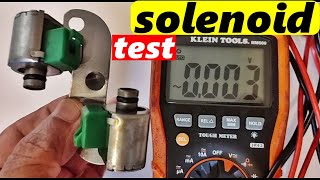
How to confirm: After checking fluid and wiring, test the solenoid's resistance at the transmission connector. For the 4F27E, the resistance for Shift Solenoid 'B' should be between 10.9 and 26.2 ohms. This can be measured between pin 8 and the transmission case 🎬 See how to test a shift solenoid with a multimeter (ground). If the resistance is out of spec, the solenoid is bad.
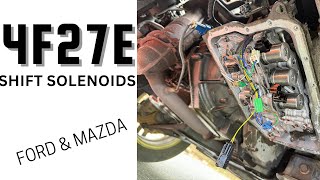
Typical fix: Replace the Shift Solenoid 'B'. Since Solenoids 'A' and 'B' are identical and have similar lifespans, it is often recommended to replace them as a pair. 🎬 Watch: Replacing shift solenoids on the 4F27E transmission Some owners opt to replace the entire solenoid pack at once.
Est. part cost: $40-$70 for a single aftermarket solenoid or a pair. - Low or Dirty Transmission Fluid 🟡 Medium Probability → Shop Transmission Assembly Fluid is the lifeblood of the transmission. Low fluid levels reduce hydraulic pressure, while dirty, burnt, or contaminated fluid can clog the solenoid's small passages, causing it to stick. Owners often report very dirty fluid and significant metal filings on the pan magnet when this code appears, indicating widespread wear.
How to confirm: Check the transmission fluid dipstick. The fluid should be at the correct level, red in color, and not smell burnt. Dark, brown, or metallic-looking fluid indicates a problem requiring a fluid and filter change at a minimum.
Typical fix: Perform a transmission fluid and filter change using Motorcraft MERCON LV fluid or a compatible equivalent. If the fluid is very low, the source of the leak must be found and repaired. If significant metal debris is found, a more serious internal failure may be present.
Est. part cost: $60-$120 for fluid and a filter. - Damaged Wiring or Connectors ⚪ Low Probability The wiring harness leading to the transmission is exposed to heat and road debris, which can cause wires to become brittle, corroded, or damaged over time, leading to an open or short in the solenoid circuit.
How to confirm: Visually inspect the wiring harness and connector at the transmission for any signs of corrosion, loose pins, or frayed wires. Perform a continuity test from the PCM/TCM connector to the transmission connector.
Typical fix: Repair the damaged section of wiring or replace the faulty connector.
Est. part cost: $10-$50 for wiring repair supplies.
Rare But Worth Checking
- Faulty Powertrain Control Module (PCM): → Shop Engine Control Module (ECM) This is a rare cause. The PCM is the vehicle's main computer. All other possibilities, especially the solenoid and its wiring, should be exhaustively ruled out before considering PCM replacement.
- Internal Valve Body Issue: → Shop Transmission Valve Body The valve body is the hydraulic control center of the transmission. A blockage in the passages leading to or from the solenoid, or a stuck valve, can mimic a solenoid failure. This usually requires a transmission specialist to diagnose.
Diagnosis Steps
- Check the transmission fluid level and condition. The correct fluid is MERCON LV. If low, top it off and check for leaks. If dark, burnt, or has a metallic sheen, a fluid and filter change is necessary as a first step.
- Scan for other transmission-related trouble codes. Codes for other solenoids (like P0750) can point to a broader electrical or hydraulic issue.
- Inspect the transmission wiring harness and connector for any visible damage, corrosion, or loose connections.
- If performing a fluid change, inspect the transmission pan magnet for metal shavings. A light metallic paste is normal, but large flakes or a thick coating of filings indicates a serious internal problem.
- Using a multimeter and a technical diagram for the 4F27E, test the resistance of Shift Solenoid 'B' at the transmission connector (Pin 8 to Ground). The reading should be between 10.9 and 26.2 ohms.
- If resistance is out of spec, the solenoid is faulty and needs replacement.
- If resistance is within spec, the problem is likely in the wiring between the connector and the PCM, or a rarer PCM fault.
- If you have access to an advanced scan tool, you can command the solenoid on and off to see if it responds mechanically (often heard as a click).
Parts You'll Likely Need
- Transmission Shift Solenoid (A/B)
(OEM #XS4Z-7H148-AA)— This is the most common cause of a P0755 code on the 4F27E transmission due to electrical failure or becoming clogged/stuck.
Trusted brands: Motorcraft, Rostra, ATP
OEM price range: $55-$80
Aftermarket price range: $30-$60 - Transmission Filter Kit (Filter & Gasket)
(OEM #FT-131 (Filter only))— Required when replacing the solenoid, as the transmission pan must be removed. It's essential to replace the filter and use a new gasket to prevent leaks.
Trusted brands: Motorcraft, Wix (58617), ATP (B-189)
OEM price range: $30-$50
Aftermarket price range: $20-$40 - Automatic Transmission Fluid
(OEM #Motorcraft MERCON LV)— A pan drop and solenoid replacement requires replacing 3-4 quarts of the correct specification fluid.
Trusted brands: Motorcraft
OEM price range: $8-$12 per quart
Related Codes That Often Appear With This One
- P0750 — P0750 is for Shift Solenoid 'A' Malfunction. Since solenoids A and B are identical parts in the same environment, they often fail around the same time. It's common to see codes for both.
- P0700 — P0700 is a generic code from the Transmission Control Module (TCM) indicating that a transmission-specific fault has been stored. It acts as a general alert that points to more specific codes like P0755.
- P0751 — This code indicates Shift Solenoid 'A' Performance/Stuck Off. It is often seen alongside other solenoid codes and points to a hydraulic or mechanical issue rather than just an electrical one.
Technical Service Bulletins (TSBs) & Recalls
- A Ford TSB (12-6-15, superseded by 13-6-8) is mentioned in owner forums regarding 2-3 upshift flares and lack of 3rd/4th gear on the 4F27E transmission. While not specific to P0755, it shows a pattern of known shift-related issues with this transmission.
Platform-Specific Known Issues
- Accelerated Wear from Commercial Use: As a commercial vehicle, the Transit Connect is often subjected to heavy loads, prolonged idling, and stop-and-go city driving. This duty cycle is harder on the 4F27E transmission than the typical use in its passenger car platform mates (Focus, Mazda3), potentially leading to earlier fluid breakdown and more frequent solenoid or mechanical failures.
Mechanic-Grade Diagnostic Values
- Shift Solenoid 'B' (SSB) Coil Resistance — expected: 10.9 - 26.2 Ohms. Failure: A reading outside this range (e.g., infinite for an open circuit, near zero for a short) indicates a faulty solenoid.
- Shift Solenoid 'A' (SSA) Coil Resistance — expected: 10.9 - 26.2 Ohms. Failure: Same as SSB. Since they are identical parts, a significant difference between A and B readings can also suggest a problem.
- PWM Solenoids 'C', 'D', 'E' Coil Resistance — expected: 1.0 - 4.2 Ohms. Failure: A reading outside this range indicates a fault in one of the pressure control solenoids.
- Electronic Pressure Control (EPC) Solenoid Coil Resistance — expected: 2.4 - 7.3 Ohms. Failure: A reading outside this range indicates a fault in the main line pressure control solenoid.
- Shift Solenoid 'B' Voltage at PCM — expected: The PCM grounds the circuit to energize the solenoid. Expect to see battery voltage (~12V) on the control wire when the solenoid is commanded OFF, and near 0V when commanded ON.. Failure: Voltage that doesn't change when the solenoid is commanded, or is always low, points to a wiring short to ground or a faulty PCM driver.
Scan Tool Commands That Help
- Ford IDS (or equivalent high-level scanner): Solenoid On/Off State Command (Output State Control) — This bidirectional test allows a technician to manually command Shift Solenoid 'B' on and off while the vehicle is stationary (Key On, Engine Off). A distinct 'click' from the transmission pan should be audible, confirming the solenoid is mechanically actuating. Lack of a click despite correct resistance points to a stuck solenoid plunger or hydraulic issue.
- Ford IDS (or equivalent high-level scanner): Transmission Relearn Procedure / Adaptive Strategy Reset — After replacing a solenoid or the valve body, the PCM's learned shift adaptations should be cleared. This forces the module to relearn shift pressures and timing with the new components, preventing harsh or erratic shifting after the repair.
Wiring & Ground Locations
- Transmission Harness Connector (C167) — On the top of the transmission case, where the main vehicle harness connects to the transmission.. This is the primary external test point for all transmission solenoids. It is exposed to engine heat and vibration, making it a potential point of failure for pin corrosion or loose connections.
- Shift Solenoid 'B' (SSB) Circuit at C167 — Pin 8 on the transmission harness connector (C167).. This specific pin is where you can test the solenoid's resistance to ground without opening the transmission pan. It is the first step in electrical diagnosis.
- Shift Solenoid 'B' (SSB) Control Wire at PCM — Pin 54 (Light Green / Violet wire) on the Powertrain Control Module (PCM) connector.. This is the other end of the control circuit. Performing a continuity test between this pin and Pin 8 at the transmission connector will confirm if the wiring between the PCM and transmission is intact. A reading of high resistance indicates a broken wire.
Real Owner Repair Stories
- Ford F150 Forum thread (Ford truck with similar electronic transmission controls) — P0755 code, flashing Overdrive light, and a 'trans fault' message on the dash.
❌ Tried (didn't work) Replaced a blown fuse (#33) related to the transmission circuit., Tested resistance of all solenoids at the connector, and all read within specification., Replaced fluid and filter.
✅ What actually fixed it The user reported that after checking everything externally and finding no faults, the issue persisted. This points towards an intermittent wiring fault that only occurs under specific conditions (like heat or vibration) or an internal valve body/PCM issue, as the static tests all passed. The final resolution was not posted, but the story is valuable as it shows that a solenoid testing 'good' with a multimeter can still be part of the problem circuit. - Ford Explorer Owner Report — NHTSA ODI #10319207 describes a chronic O/D light blinking with DTC P0755 (Pressure Control Solenoid B Circuit Malfunction) and slipping during the 2-3 shift.
- Ford Explorer Owner Report — In NHTSA ODI #10577712, an owner reported that after overheating issues, technicians found error codes P0732 and P0755, with gears 1 and 2 severely slipping due to transmission damage.
OEM Part Supersession History
XS4Z-7H148-AA→No direct supersession found, this part number remains the standard OEM reference.— N/A
Heads up: Shift Solenoids 'A' and 'B' (XS4Z-7H148-AA) are simple on/off solenoids. They are NOT interchangeable with the Pulse-Width Modulated (PWM) solenoids 'C', 'D', and 'E' (Part # XS4Z-7G484-AA), even though they may look similar.
Model Year Variations Within This Range
- 2010-2013: No significant internal changes to the 4F27E transmission itself have been documented for this vehicle range. A forum discussion comparing 2010 and 2013 models found no notable differences in the transmission. However, the Transit Connect did use two different final drive ratios during this period, which is critical when sourcing a complete used transmission.
Diagnostic Flowchart
Other Known Issues on This Vehicle
Issues unrelated to this code that are worth knowing about as an owner of this generation:
- Severe Rocker Panel (Sill) and Underbody Rust 🔴 High — Extremely common, especially in rust-belt regions. Can become structurally significant and fail inspections. Often appears on the sills, rear wheel arches, and floor pan.
- Sliding Door Mechanism Failure 🟠 Medium — Common complaint. Issues include stiff or jammed rollers, broken latches, and failed wiring harnesses within the door track, affecting locks and sensors.
- General Transmission Unreliability 🔴 High → Shop Transmission Assembly — Beyond specific solenoid codes, the 4F27E transmission in this van is known to be a weak point, with many owners reporting expensive failures or replacements at relatively low mileage, exacerbated by commercial use.
- Intermittent Throttle Body Faults 🟡 Low — A known issue that can cause sluggishness, stalling, or no-throttle conditions, sometimes triggering codes like P2111 or P2135. Often resolved by cleaning the throttle body.
Used vs. New Parts: Buying Guide for This Vehicle
When a used part is the smart pick: For this repair, sourcing a used solenoid pack or individual solenoids from a low-mileage donor vehicle (like a Ford Focus or Mazda 3 from a junkyard) can be a cost-effective option. Since the solenoids are a common failure item, many reputable sellers offer tested, remanufactured solenoid packs.
Donor-vehicle mileage cap: roughly under 80000 miles for the part to have meaningful remaining life.
What to inspect on the donor part:
- Check the donor vehicle's history for any signs of transmission problems.
- When buying a used solenoid, inspect the electrical connector for corrosion or damage.
- Look for any signs of overheating on the solenoid body (discoloration).
- If possible, check the transmission fluid from the donor car; if it's dark, burnt, or full of metal, avoid the parts.
OEM-only on this vehicle (don't cheap out):
- While aftermarket solenoids are widely available and often work well, sticking with an OEM Motorcraft part (XS4Z-7H148-AA) is the safest bet for guaranteed compatibility and longevity.
Aftermarket brands forum-validated for this vehicle:
- Rostra is a well-regarded aftermarket brand for transmission solenoids.
- ATP (Automatic Transmission Parts) is another common and generally reliable choice.
Brands owners have reported issues with on this vehicle:
- Be cautious of unbranded, generic solenoid kits from online marketplaces, as quality control can be inconsistent. While they may be cheap, failure rates can be higher.
Real Owner Stories
Aggregated from forums and TSBs cited above. Mileages and costs reflect what owners reported in those sources.
2012 Ford Transit Connect Duratec 20 2.0L I4
Symptoms: Owner experienced related shift solenoid codes (P0772, P0751) and, upon inspection, found the transmission fluid was dirty and contained metal filings.
What fixed it: The source describes the diagnostic process, which revealed dirty fluid and metal filings, pointing to widespread wear. A fluid and filter change would be the first step, but the metal suggests a more serious internal problem may be present.
Source hint: r/AskMechanics on Reddit: '2012 Ford Transit Connect Transmission Woes'
Related OBD-II Codes
Frequently Asked Questions
My Transit Connect is used for my business and gets driven hard. Does that make this P0755 code more likely?
I need to replace Shift Solenoid 'B'. Should I replace anything else while I'm in there?
What is the correct transmission fluid for my 2010-2013 Transit Connect?
I found TSB 13-6-8 for my van's transmission. Does it specifically address code P0755?
Can I use a transmission solenoid from a Ford Focus or Mazda 3 to fix my Transit Connect?
How can I test Shift Solenoid 'B' myself before buying a new one?
Helpful Videos


We Have This Part in Stock





The information in this article is provided for general reference and educational purposes only. Vehicle specifications, procedures, and part compatibility can vary by production date, trim level, and region. Always consult your vehicle's factory service manual and verify part numbers before purchasing or performing repairs. Safety-critical components such as airbags, seat belts, and braking systems should be installed by a qualified professional.
- Ford Transit Connect:
- 🧭 Diagnostic Flowchart
- 🎬 Helpful Videos
- 🛍️ Shop This Part
- What's Unique About the 2010-2013 Ford Transit Connect
- Symptoms You May Notice
- Most Likely Causes
- Rare But Worth Checking
- Diagnosis Steps
- Parts You'll Likely Need
- Related Codes That Often Appear With This One
- Technical Service Bulletins (TSBs) & Recalls
- Platform-Specific Known Issues
- Mechanic-Grade Diagnostic Values
- Scan Tool Commands That Help
- Wiring & Ground Locations
- Real Owner Repair Stories
- OEM Part Supersession History
- Model Year Variations Within This Range
- Other Known Issues on This Vehicle
- Used vs. New Parts: Buying Guide for This Vehicle
- Real Owner Stories
- 2012 Ford Transit Connect Duratec 20 2.0L I4
- Related OBD-II Codes
- Frequently Asked Questions
- 🎟️ Get 5% Off