

P0841 on 2011-2014 Chrysler 200: Transmission Pressure Sensor Causes and Fixes
This code usually points to a faulty transmission fluid pressure sensor or low/dirty transmission fluid. On the Chrysler 200 with the 62TE transmission, this sensor is part of the solenoid pack (or 'block'), which is the most common part to fail and require replacement. Diagnosis is key, as wiring or internal transmission issues can also be the cause.
- P0841 indicates a problem with the transmission fluid pressure sensor's performance, not necessarily a failed sensor.
- Always check the transmission fluid level and condition first, as it's a simple and common cause of pressure-related codes.
- On the 62TE transmission in the Chrysler 200, the pressure sensor is part of the solenoid pack, which is a common failure point and is replaced as a single unit.
- Before replacing expensive parts, check for wiring issues at the transmission connector and see if any TCM software updates (TSBs) are available.
What's Unique About the 2011-2014 Chrysler 200
For the 2011-2014 Chrysler 200, most commonly equipped with the 6-speed 62TE automatic transmission, the fluid pressure sensors are integrated into the main solenoid pack (also called a solenoid block). This entire pack is a very common failure item. While the code is generic, on this platform it often points directly to an issue with the solenoid pack itself, the fluid condition, or the wiring harness leading to the transmission. Owners should be aware that while replacing the entire solenoid pack is a frequent and effective repair, a thorough fluid check and wiring inspection are crucial first steps.
Symptoms You May Notice
- Check Engine Light or transmission warning light is on.
- Harsh, erratic, or delayed gear shifting.
- Transmission slipping between gears.
- Vehicle may enter "limp mode," often stuck in 2nd or 3rd gear.
- Vehicle feels sluggish on takeoff, as if starting in a higher gear.
- Decreased fuel efficiency.
- Replacing the entire transmission without first diagnosing the solenoid pack and wiring.
- Assuming the solenoid pack is bad without first checking the transmission fluid level, condition, and for any relevant TCM software updates.
Most Likely Causes
- Faulty Transmission Solenoid Pack (contains the TFPS) 🔴 High Probability → Shop Transmission Assembly The solenoid pack in the 62TE transmission is a known high-failure item. The internal pressure switches and solenoids are exposed to heat and fluid contamination, leading to electrical and mechanical failure over time.
How to confirm: A diagnostic scan tool can monitor the sensor's voltage readings in real-time. The sensor itself is part of the larger solenoid pack, which is typically replaced as a complete unit. Resistance checks can be performed at the main 23-pin connector to isolate 🎬 Watch: A mechanic demonstrates replacing the solenoid pack on a 62TE. a faulty solenoid or switch resistor.
Typical fix: Replace the entire transmission solenoid pack. This requires removing the transmission oil pan 🎬 See this step-by-step walkthrough of the solenoid pack replacement process. and valve body to access the pack. A fluid and filter change is done as part of the job.
Est. part cost: $150-$350 - Low or Dirty Transmission Fluid 🟡 Medium Probability → Shop Transmission Assembly Fluid level and condition are common causes of general transmission issues. Contaminated or broken-down ATF+4 fluid can clog the small passages and screens within the solenoid pack, causing incorrect pressure readings.
How to confirm: Check the transmission fluid level and condition using the dipstick. The fluid should be at the correct level, bright red, and not smell burnt. If it's brown, black, or has debris, it's contaminated.
Typical fix: Perform a transmission fluid and filter change. Ensure the correct Mopar ATF+4 fluid is used. If this doesn't resolve the code, the solenoid pack is likely already damaged or clogged internally.
Est. part cost: $50-$150 - Wiring or Connector Issues 🟡 Medium Probability The wiring harness to the transmission is exposed to road debris, heat, and vibration, which can cause damage, corrosion, or loose connections over time, especially at the main connector.
How to confirm: Visually inspect the wiring harness and connectors leading to the transmission for any signs of damage, corrosion, or loose pins. A wiggle test on the harness while monitoring sensor data can help identify intermittent connections. One owner found a wire had rubbed through inside the connector housing.
Typical fix: Repair or replace the damaged section of the wiring harness or clean/replace the corroded connector.
Est. part cost: $20-$200
Rare But Worth Checking
- Faulty Transmission Valve Body: → Shop Transmission Valve Body Debris can cause valves to stick or check balls to fail, leading to incorrect pressure readings even with a good sensor.
- Failing Powertrain Control Module (PCM) or Transmission Control Module (TCM): → Shop Transmission Assembly This is the least likely cause and should only be considered after all other possibilities have been thoroughly exhausted.
Diagnosis Steps
- Check for other stored diagnostic trouble codes, especially other transmission codes.
- Check the transmission fluid level and condition. Top off or change the fluid and filter if necessary using Mopar ATF+4.
- Check for any available Technical Service Bulletins (TSBs) for your vehicle's VIN. A TCM software update like TSB 21-012-12 could address shift quality logic.
- Use a scan tool to monitor the live data from the Transmission Fluid Pressure Sensor 'A'.
- Visually inspect the transmission wiring harness and main connector for any signs of damage, corrosion, or loose connections. Perform a wiggle test.
- If wiring is intact, test the sensor's voltage and ground signals with a multimeter according to the vehicle's service manual.
- If the fluid, wiring, and software are all good, the most likely culprit is the internal solenoid pack, which requires replacement.
Parts You'll Likely Need
- Transmission Solenoid Pack
(OEM #68376696AA (supersedes 5078709AB, 5078709AC, 5078709AD))— This assembly contains the pressure sensor/switch that most commonly fails and causes the P0841 code in the 62TE transmission.
Trusted brands: Mopar, Dorman, Rostra, Sonnax (offers repair kits)
OEM price range: $250-$400
Aftermarket price range: $150-$250 - Transmission Fluid and Filter Kit — Low or dirty fluid is a primary cause, and a fluid/filter change is required when replacing the internal solenoid pack. Mopar ATF+4 fluid is specified.
Trusted brands: Mopar, Wix, ATP
OEM price range: $80-$150
Aftermarket price range: $50-$100
Related Codes That Often Appear With This One
- P0868 — P0868 indicates 'Transmission Fluid Pressure Low'. If the fluid is low or there's a hydraulic issue, both codes can appear as the pressure sensor's performance (P0841) is affected by the low base pressure (P0868).
- P0840, P0842, P0843, P0844 — These are all related to the transmission fluid pressure sensor circuits. The presence of other codes in this family can help pinpoint whether the issue is with a specific circuit or a more general problem.
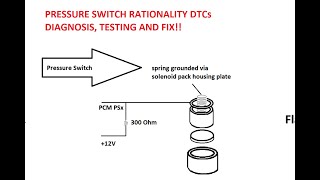
- P0871 — This code is for the 'Transmission Fluid Pressure Sensor/Switch 'C' Circuit Range/Performance', indicating a similar fault but on a different hydraulic circuit 🎬 Watch: Understanding pressure switch rationality codes and how to fix them. within the 62TE transmission. It often points to the same root cause: a failing solenoid pack.
Technical Service Bulletins (TSBs) & Recalls
- TSB 21-004-14: Involves flash reprogramming the Transmission Control Module (TCM) for shift quality improvements. While not a direct fix for a failed part, it's a valid diagnostic step to ensure the control logic is up to date before replacing hardware.
Platform-Specific Known Issues
- On the 62TE transmission, the pressure sensor ('switch') is not a small, individual screw-in sensor but is integrated into the larger solenoid block/pack. Therefore, the fix is almost always a replacement of the entire pack, not just a single sensor.
Mechanic-Grade Diagnostic Values
- Solenoid Resistance (most) — expected: 1.8 Ohms (approx. at 70°F). Failure: A reading that is significantly higher (e.g., 7.2 Ohms), lower, or an open circuit (OL).
- Line Pressure Solenoid Resistance — expected: 4.9 Ohms (approx. at 70°F). Failure: A reading significantly outside this value or an open circuit.
- Pressure Switch Resistors Resistance — expected: Around 300 Ohms. Failure: An open line (OL) or a reading far from the 300 Ohm target.
- L/R Pressure Switch Sense Circuit to Ground — expected: Above 5.0 Ohms. Failure: Resistance below 5.0 Ohms indicates a short to ground.
Scan Tool Commands That Help
- wiTECH: Quick Learn — This function should be performed after replacing the solenoid pack or valve body to allow the TCM to learn the hydraulic characteristics of the new components.
- wiTECH: Clear VLP Counters (Variable Line Pressure) — This is a required step after a PCM flash or major transmission hardware replacement to reset the adaptive values for line pressure control.
Wiring & Ground Locations
- Transmission Solenoid Connector (C1) — A 23-pin round connector on the driver's side of the transmission, on the side pan.. This is the main connection point for all solenoids and pressure switches. All electrical tests (resistance, voltage) begin here. Corrosion or damage to this connector is a common cause of electrical faults.
- Pin 10 (Power) — On the 23-pin solenoid connector.. This is the main power feed from the transmission control relay. It is used as the positive lead reference point for most resistance checks of the solenoids and switches within the pack.
- Pin 16 (L/R Pressure Switch Signal) — On the 23-pin solenoid connector.. This is the specific signal wire for the Low/Reverse pressure switch, which is often the 'A' switch in a P0841 fault. Testing this pin against power and ground can identify wiring issues.
Real Owner Repair Stories
- YouTube user '62TE Pressure Switch Rationality, P083B' (Dodge Grand Caravan with 62TE (242,000 miles)) — Intermittent limp mode, pending P083B code (LC Pressure Switch Rationality, a similar code to P0841).
❌ Tried (didn't work) The initial fix of cleaning the solenoid pack contacts worked for 21,000 miles before the issue returned.
✅ What actually fixed it The owner disassembled the solenoid pack again, cleaned all electrical components with alcohol, and installed a Sonnax solenoid spacer and service kit (44836-02K). The kit includes a spacer designed to prevent the internal circuit board from flexing, which can cause intermittent contact issues and false codes.
OEM Part Supersession History
5078709AB, 5078709AC, 5078709AD→68376696AA— Part revision and improvement by the manufacturer.
Heads up: The latest part number, 68376696AA, is the correct service replacement for all previous versions for the 62TE transmission.
Diagnostic Flowchart
Other Known Issues on This Vehicle
Issues unrelated to this code that are worth knowing about as an owner of this generation:
- Clogged Heater Core 🔴 High — Very common. Often manifests as no heat or poor heat on the passenger side, progressing to no heat at all. Can occur at various mileages, often after 50,000 miles.
- TIPM (Totally Integrated Power Module) Failure 🔴 High — A widespread and well-documented issue causing a vast range of erratic electrical problems, including engine stalling, fuel pump failure, and random horn/airbag lights. (Ref: Multiple recalls and customer satisfaction programs, including N38, have been issued to address specific TIPM-related problems like active head restraint deployment and fuel pump relay failure.)
- 3.6L Pentastar V6 Rocker Arm Failure 🟠 Medium — A known design flaw in early Pentastar engines (2011-2014) where needle bearings in the rocker arms fail, causing a distinct 'Pentastar tick', misfires, and potential camshaft damage if ignored. (Ref: No specific recall, but it is the subject of class-action lawsuits.)
- Engine Stalling While Driving 🔴 High — Frequently reported problem, particularly during low-speed deceleration. Can be caused by a faulty TIPM fuel pump relay or a defective Powertrain Control Module (PCM). (Ref: NHTSA investigations and recalls for the TIPM were initiated to address stalling conditions.)
Used vs. New Parts: Buying Guide for This Vehicle
When a used part is the smart pick: A used solenoid pack is generally not recommended. The failure rate is high, and the labor to replace it is significant, making it a poor risk. A used part should only be considered as a last resort if a new part is unavailable and the donor vehicle's history and low mileage (< 60,000 miles) can be verified.
Donor-vehicle mileage cap: roughly under 60000 miles for the part to have meaningful remaining life.
What to inspect on the donor part:
- Verify the transmission fluid from the donor car was clean and red, not burnt or dark.
- Inspect the 23-pin connector for any signs of corrosion, bent pins, or heat damage.
- If possible, perform a bench test of all solenoid and resistor resistances before installation.
OEM-only on this vehicle (don't cheap out):
- While not strictly OEM-only, using a genuine Mopar solenoid pack is the highest probability for a successful, long-term repair. The cost is higher, but it avoids potential quality control issues with some aftermarket remanufactured units.
Aftermarket brands forum-validated for this vehicle:
- Sonnax: Offers highly-regarded repair kits (like 44836-02K) and individual components for rebuilding solenoid packs, often addressing OEM design flaws.
- Rostra: A known manufacturer of aftermarket transmission components.
Brands owners have reported issues with on this vehicle:
- Dorman (Remanufactured): While widely available, owner reviews are mixed. Some report premature failure or out-of-box issues, making it a higher-risk choice compared to Mopar or a Sonnax-rebuilt unit.
Real Owner Stories
Aggregated from forums and TSBs cited above. Mileages and costs reflect what owners reported in those sources.
2013 Chrysler 200 — 85000 miles
Symptoms: The car lost the ability to accelerate. The transmission was slipping, whining, and a diagnostic scan showed a transmission pressure pump warning.
What fixed it: After a fluid and filter change failed to solve the problem, a transmission shop diagnosed a failing transmission pump and slipping, quoting a full rebuild. The shop noted they see this issue 'all the time with Chryslers'.
Cost: $3300-$3300
Source hint: Reddit r/Cartalk
Chrysler Town & Country
Symptoms: Owner was diagnosing a P0841 code after experiencing transmission issues.
What fixed it: The owner discovered and repaired a corroded wire that had rubbed through on the inside of the main transmission harness connector housing.
Source hint: ChryslerForum.com thread titled 'Need Experienced advice on 41TE P0841'
Related OBD-II Codes
Frequently Asked Questions
Can I just replace the single Transmission Fluid Pressure Sensor for a P0841 code on my Chrysler 200?
My 200 is stuck in a single gear with a P0841 code. What is happening?
Will the software update from TSB 21-004-14 fix my P0841 code?
What is the most common reason for a P0841 code on this specific vehicle?
What kind of transmission fluid should I use if I'm checking the fluid for a P0841 issue?
Is this P0841 problem unique to the Chrysler 200?
Helpful Videos
We Have This Part in Stock

The information in this article is provided for general reference and educational purposes only. Vehicle specifications, procedures, and part compatibility can vary by production date, trim level, and region. Always consult your vehicle's factory service manual and verify part numbers before purchasing or performing repairs. Safety-critical components such as airbags, seat belts, and braking systems should be installed by a qualified professional.
- Chrysler 200:
- 🧭 Diagnostic Flowchart
- 🎬 Helpful Videos
- 🛍️ Shop This Part
- What's Unique About the 2011-2014 Chrysler 200
- Symptoms You May Notice
- Most Likely Causes
- Rare But Worth Checking
- Diagnosis Steps
- Parts You'll Likely Need
- Related Codes That Often Appear With This One
- Technical Service Bulletins (TSBs) & Recalls
- Platform-Specific Known Issues
- Mechanic-Grade Diagnostic Values
- Scan Tool Commands That Help
- Wiring & Ground Locations
- Real Owner Repair Stories
- OEM Part Supersession History
- Other Known Issues on This Vehicle
- Used vs. New Parts: Buying Guide for This Vehicle
- Real Owner Stories
- 2013 Chrysler 200 — 85000 miles
- Chrysler Town & Country
- Related OBD-II Codes
- Frequently Asked Questions
- 🎟️ Get 5% Off