

P1440 on 2005-2009 Toyota 4Runner 4.7L V8: Secondary Air Injection System Causes and Fixes
P1440 on your 4.7L V8 means the Secondary Air Injection (SAI) system has failed, which triggers a low-power 'limp mode'. The root cause is a failed air pump that sends debris into the switching valves. A full OEM repair is very expensive ($2000+), so most owners install a much cheaper electronic bypass kit to disable the system and clear the code permanently.
- P1440 on your 4Runner is a serious Secondary Air Injection system fault, not a minor EVAP issue.
- The vehicle will enter a low-power 'limp mode', which is a major symptom that needs to be addressed for safe driving.
- The root cause is a failed air pump under the intake manifold; simply replacing the valve that the code points to will not fix the issue long-term.
- You have two main choices: a very expensive full system replacement (pump and valves) or a much cheaper and highly effective electronic bypass kit.
- For most owners outside of strict emissions inspection areas, the bypass kit is the most logical and permanent solution.
What's Unique About the 2005-2009 Toyota 4Runner
This entire problem is a notorious design flaw on 2005 and later Toyota 4.7L V8 (2UZ-FE) engines, which were updated with this specific Secondary Air Injection (SAI) system. The air pump is located in the engine valley, under the intake manifold, where it is prone to ingesting moisture and its own disintegrating foam filter. This causes the pump's plastic fan blades to break apart, sending shrapnel throughout the system. This failure is so common and the OEM repair so expensive that a robust aftermarket of electronic bypass kits has emerged as the preferred, permanent, and cost-effective solution for most owners. While Tundra and Sequoia models with the same engine received a warranty extension (Customer Support Program ZT8) for this issue, the 4Runner and GX470 were notably excluded, leaving owners to bear the full cost of the repair.
Symptoms You May Notice
- Check Engine Light is on
- VSC and TRAC warning lights are on
- Vehicle is in 'limp mode' with drastically reduced engine power and slow acceleration
- Inability to accelerate past a certain speed (e.g., 40-50 mph)
- Vehicle will fail an emissions test.
- Loud whining or 'vacuum cleaner' sound from the engine bay on a cold start that lasts for about a minute.
- Replacing only the Bank 1 Air Switching Valve. This fails to address the root cause, which is the disintegrating air pump that will quickly destroy the new valve.
- Diagnosing the issue as an EVAP system fault. Technicians unfamiliar with this specific Toyota issue may misinterpret the P1440 code based on its definition for other manufacturers like Nissan or Ford.
Most Likely Causes
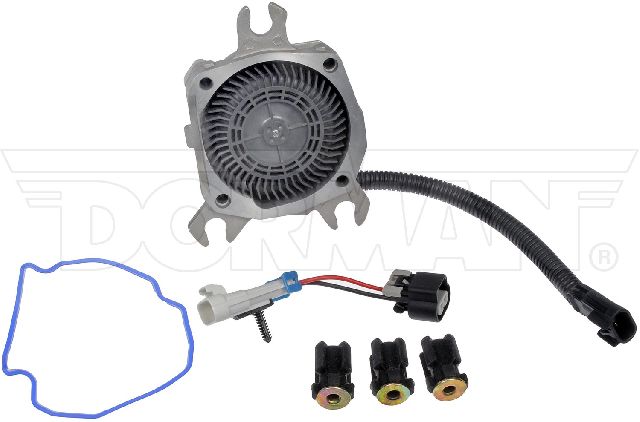
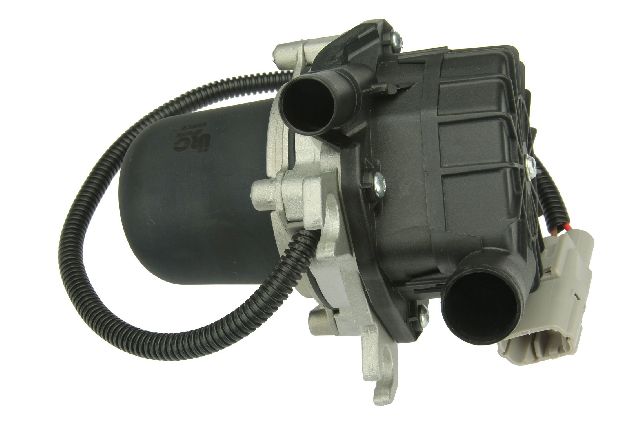
- Failed Secondary Air Injection Pump 🔴 High Probability → Shop Secondary Air Injection Pump The pump is located under the intake manifold and has an un-filtered air inlet, allowing it to suck in moisture and debris. Over time, the internal foam filter disintegrates, gets ingested by the plastic fan, and the resulting shrapnel is sent downstream, contaminating the entire system.
How to confirm: Upon removal of the intake manifold, the pump and associated air passages will contain black, crumbly debris from the failed pump's filter or broken plastic fan blades. The pump motor itself may be seized or make a grinding noise on cold start before failing completely.
Typical fix: Replace the air pump assembly. This MUST be done in conjunction with replacing the air switching valves, as the debris from the pump has already contaminated them. Some owners drill a small drain hole in the bottom of the new pump housing to prevent future water accumulation.
Est. part cost: $450-$650 - Failed Air Switching Valve (Bank 1) 🔴 High Probability This is almost always a secondary failure. Debris from the disintegrating air pump is forced into the valve, causing it to become stuck open or closed. This mechanical blockage eventually leads to an electrical fault in the control circuit, triggering the P1440 code.
How to confirm: The valve, located under the intake manifold against the firewall, will not actuate when tested with a scan tool or when direct voltage is applied. Physical inspection after removal will often show black debris inside. Resistance across the valve's solenoid should be between 4.5 and 5.5 Ω at 68°F (20°C).
Typical fix: Replace the air switching valve assembly. However, this will not solve the problem long-term unless the root cause—the failing air pump—is also replaced.
Est. part cost: $200-$400 - SAI System Bypass Kit Installation (A Fix, Not a Cause) 🔴 High Probability Due to the extremely high cost of replacing the pump and valves ($2000-$3500), this is the most common and practical fix for out-of-warranty vehicles.
How to confirm: An electronic module is wired into the engine bay to intercept signals to the ECU, tricking it into thinking the system is working perfectly. This often involves a plug-in harness near the MAF sensor, a connection to the fuse box, and small metal plates to block off the valve ports.
Typical fix: Install an aftermarket Secondary Air Injection System bypass kit. This disables the system, prevents the codes from returning, and takes the vehicle out of limp mode. This is not legal in states with strict emissions testing.
Est. part cost: $50-$150
Rare But Worth Checking
- Damaged Wiring or Connectors: The wiring harness for the switching valves is located in a tight space at the back of the engine against the firewall. It can become brittle from heat or damaged during other service, leading to a circuit fault. In some cases, the main engine harness can rub against the back of the valve assembly, breaking off a vacuum nipple and causing a failure. Rodent damage is also a possibility in this location.
- Failed Air Injection Control Driver: This is the electronic module, typically on the driver-side inner fender, that powers the pump and valves. While uncommon, TSB T-SB-0230-12 Rev1 notes it can fail, often setting codes P0418 and P2445. The driver receives main power from a 50A fuse (A/PUMP) and ignition power from a 10A fuse (EFI No 2).
Diagnosis Steps
- Confirm the presence of P1440 and any other related SAI codes (P1443, P2440, P2441, P2442, P2445, etc.) with an OBD-II scanner.
- On a cold start, listen for the air pump. A loud 'vacuum cleaner' or grinding noise for 60-90 seconds indicates the pump is failing. No noise suggests it has already seized.
- Acknowledge that the vehicle is likely in 'limp mode' and that this is a hallmark of this specific failure.
- Decide on the repair path: a full OEM component replacement or installing a bypass kit.
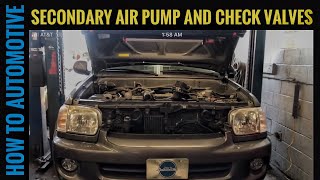
- If choosing OEM repair: The intake manifold must be removed to access the components in the engine valley. This is a labor-intensive job (5-6+ hours). 🎬 Watch this step-by-step guide to replacing the pump and valves.
- Inspect the air pump and air passages for black, crumbly debris. If debris is present, the pump is the root cause and all downstream components are suspect.
- Replace the Air Pump Assembly, the main Air Switching Valve Assembly, and both Bank 1 and Bank 2 valves as a set. Replacing only one part will lead to a repeat failure.
- Thoroughly clean all air passages of debris before installing new parts.
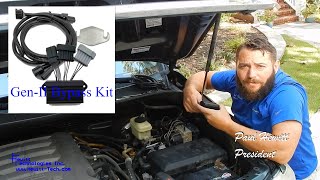
- If choosing a bypass kit: Follow the manufacturer's instructions (e.g., from Hewitt-Tech). 🎬 Watch a demonstration of the Hewitt Technologies bypass module installation. This typically involves installing a plug-and-play module at the MAF sensor, running a wire to the fuse box, and installing block-off plates at the air valve ports, which can be accessed from the wheel wells.
- After either repair, clear all DTCs with the scanner and perform a cold start to verify the fix and ensure the vehicle is no longer in limp mode.
Parts You'll Likely Need
- Secondary Air Injection System Bypass Kit — This is the most common, cost-effective, and permanent solution chosen by owners to eliminate the check engine light and limp mode without the extreme cost of replacing the OEM system.
Trusted brands: Hewitt-Tech, Slyfox, RuTech
Aftermarket price range: $50-$150 - Air Pump Assembly
(OEM #17600-0F010)— This is the root cause of the entire system failure. Its internal foam filter and plastic fan disintegrate, sending debris downstream. It must be replaced if performing a full OEM-style repair.
Trusted brands: Toyota (Genuine), Dorman
OEM price range: $450-$650
Aftermarket price range: $150-$300 - Air Switching Valve Assembly
(OEM #25710-50022)— This part is what directly triggers the P1440 code. It gets damaged by debris from the failed air pump and must be replaced during an OEM repair. The OEM part number supersedes 25710-50021 and 25710-50020.
Trusted brands: Toyota (Genuine), Dorman (911-643)
OEM price range: $200-$400
Aftermarket price range: $150-$250
Related Codes That Often Appear With This One
- P1443 — This is the companion code for the Bank 2 (driver's side) air switching valve circuit. When the pump fails, it often damages both valves, causing multiple codes.
- P2440 — This code indicates the Bank 1 switching valve is stuck open, a mechanical fault that is the direct result of debris from the failed pump. It is often seen with P1441.
- P2445 — This code means the air pump is stuck off. It is often set when the pump motor seizes or burns out from water intrusion or debris.
- C1201 — This code indicates an Engine Control System Malfunction and is the code that actually triggers the VSC/TRAC lights and puts the vehicle into 'limp mode' as a protective measure.
- P0418 — This code points to a fault in the Secondary Air Injection System Relay 'A' Circuit and is often triggered when the pump motor fails, sometimes in conjunction with the Air Injection Control Driver.
Technical Service Bulletins (TSBs) & Recalls
- T-SB-0230-12 Rev1: Confirms that a MIL 'ON' condition with codes P1440, P1443, P2440, P2445, and others on the 2UZ-FE engine may be caused by debris from the air injection pump contaminating other system components. It lists affected vehicles as the 2005-2009 4Runner, 2005-2006 Tundra, 2005-2007 Sequoia, and 2006-2007 Land Cruiser.
- Bulletin #T-SB-0230-12: This manufacturer bulletin notes that the P1440/P1443 codes specifically refer to a Secondary Air Injection System Control Valve Circuit fault for Bank 1 and Bank 2 respectively.
- Bulletin #T-SB-0230-12 Rev: This updated record from 2013 reinforces that P1440 and P1443 indicate a circuit fault in the Secondary Air Injection System Control Valve for both engine banks.
Platform-Specific Known Issues
- The Secondary Air Injection system was added to the 2UZ-FE V8 engine in 2005 to meet stricter emissions standards, which is why earlier 4.7L 4Runners do not have this problem.
- The failure of this emissions component triggers a severe 'limp mode', which many owners feel is an overly aggressive and dangerous response from the vehicle's control system.
- On some 2005-2006 models, a separate ECM glitch can cause a P2445 code when driving in near-freezing temperatures, which is unrelated to mechanical failure and was addressed by a limited service campaign from Toyota.
Mechanic-Grade Diagnostic Values
- Air Switching Valve Solenoid Resistance — expected: 4.5 - 5.5 Ω at 68°F (20°C). Failure: Resistance outside this range indicates a faulty solenoid coil.
- Torque Specification for Air Switching Valve — expected: 18 N·m (13 ft·lbf). Failure: N/A - This is an assembly specification.
- Torque Specification for Air Pump Assembly — expected: 16 N·m (12 ft·lbf). Failure: N/A - This is an assembly specification.
- Air Injection Control Driver Main Power — expected: Battery Voltage (Hot at all times). Failure: No voltage indicates a blown 50A A/PUMP fuse or a wiring issue.
- Air Injection Control Driver Ignition Power — expected: Battery Voltage (Hot in Run & Start). Failure: No voltage indicates a blown 10A EFI No 2 fuse or a wiring issue.
Scan Tool Commands That Help
- Toyota Techstream: Active Test: 'Control the Air Injection System' — This bidirectional command allows the technician to manually turn the air pump and switching valves ON and OFF to verify their operation independently of the ECM's cold-start logic. It is essential for isolating whether the fault lies with the pump, a specific valve, the driver, or the wiring.
Wiring & Ground Locations
- Air Injection Control Driver (AID) — Typically located on the driver's side inner fender well in the engine bay.. This module is the intermediary between the low-current ECM signals and the high-current air pump and valves. A failure in the driver or its wiring can directly cause circuit codes like P1440.
- AID Power (Connector A6, Pin 1 - White wire) — At the Air Injection Control Driver connector.. This is the main 12V+ supply from the 50A A/PUMP fuse. A loss of power here will disable the entire system.
- AID Ignition (Connector A7, Pin 5 - Blue/White wire) — At the Air Injection Control Driver connector.. This is the ignition-switched power from the 10A EFI No 2 fuse. A loss of this signal will prevent the driver from activating.
- AID Ground (Connector A7, Pin 1 - White/Black wire) — At the Air Injection Control Driver connector, leading to Ground Point EA.. A poor ground connection is a common cause of electronic module failure and can lead to intermittent or incorrect operation, triggering circuit faults.
- ECM Pins for Air Switching Valves — At the main Engine Control Module (ECM), Connector A, Pins 26 (AIV1 for Bank 1) & 27 (AIV2 for Bank 2).. These are the specific ECM pins that control the valves via the AID. Testing for continuity or voltage here can diagnose a wiring break between the ECM and the AID.
Real Owner Repair Stories
- YouTube user 'CARNAGE' (Toyota Tundra with 2UZ-FE engine (same SAI system design)) — Check engine light, VSC/TRAC lights on, vehicle in limp mode, unable to accelerate past 50-60 mph.
❌ Tried (didn't work) Initial diagnosis pointed to the secondary air injection valves.
✅ What actually fixed it Upon removing the intake manifold, the owner found a vacuum nipple on the rear of the air switching valve assembly had broken off. This was caused by the main engine wiring harness pressing and rubbing against it over time. The owner replaced the entire valve assembly (new part number was a supersession of the old one) and zip-tied a piece of foam to the new valve to prevent the harness from rubbing on it in the future. He also proactively drilled a small drain hole in the bottom of the air pump housings to prevent water accumulation. - IH8MUD.com Forum User (2006 Toyota Land Cruiser, 153,000 miles) — DTC for a sticking air switching valve during cold weather (below 20°F). The code would clear on longer trips but return on the next cold start.
❌ Tried (didn't work) The owner had previously replaced a noisy air pump in 2021, but did not replace the valves at that time.
✅ What actually fixed it The owner chose to perform a full OEM repair rather than a bypass. The fix involved removing the intake manifold and replacing the starter (while access was available), the No. 2 air switching valves, and several brittle vacuum hoses. The owner noted that removing a bolt holding electrical connectors on top of the transmission was key to getting access to the starter bolts, and that a topside creeper was essential for reaching components at the back of the engine.
OEM Part Supersession History
25710-50020, 25710-50021→25710-50022— Part revision and improvement by Toyota for the Air Switching Valve Assembly.
Heads up: The newer part number 25710-50022 is the correct and compatible replacement for the earlier versions on all affected 2005-2009 4.7L V8 models.89580-34010, 89580-34011, and others→89580-34012— Part revision for the Air Injection Control Driver, as noted in TSB T-SB-0230-12 Rev1.
Heads up: The newer part is the recommended replacement for all previous versions.
Model Year Variations Within This Range
- 2005+: The Secondary Air Injection (SAI) system was added to the 2UZ-FE V8 engine starting in the 2005 model year to meet stricter emissions standards. 2003-2004 4Runners with the 4.7L V8 do not have this system and are therefore not susceptible to this entire class of failures.
Diagnostic Flowchart
Real Owner Stories
Aggregated from forums and TSBs cited above. Mileages and costs reflect what owners reported in those sources.
2005-2006 Toyota Tundra 4.7L V8 (2UZ-FE)
Symptoms: Experienced a P2440 code and the dealer refused warranty coverage. A partial repair was attempted, but another valve subsequently failed.
What fixed it: Installed a Hewitt-Tech bypass kit which solved the problem.
Source hint: https://www.tundras.com/threads/secondary-air-injection-pump-failure.18933/
Lexus LX 470 4.7L V8 (2UZ-FE)
Symptoms: Received P1440 and P1443 codes after installing a bypass kit, requiring further troubleshooting.
What fixed it: Troubleshooting of the wiring and bypass kit installation.
Source hint: https://forum.ih8mud.com/threads/p1440-p1443-code-after-hewitt-tech-sais-bypass.1241518/
Toyota 4Runner 4.7L V8 (2UZ-FE)
Symptoms: Secondary air injection pump failed, filling the system with debris.
What fixed it: Performed a DIY replacement of the SAI pump, locating the pump under the intake manifold and cleaning out the debris.
Source hint: https://www.toyota-4runner.org/4th-gen-t4rs/289113-diy-secondary-air-injection-pump-s-replacement.html
Toyota 4.7L V8 (2UZ-FE)
Symptoms: Concerned about the factory foam filter disintegrating and destroying the SAI system.
What fixed it: Performed a preventative modification by adding an external filter to the pump's air intake to prevent filter shrapnel from entering the system.
Source hint: https://forum.ih8mud.com/threads/s-a-i-filter-modification-in-vvt-engines-to-prevent-its-failure-alert-alert.1271101/
Related OBD-II Codes
Frequently Asked Questions
Does TSB T-SB-0230-12 Rev1 apply to my 2005-2009 4Runner?
Why is my 4Runner stuck in limp mode and won't accelerate past 40-50 mph with code P1440?
Can I just replace the Bank 1 Air Switching Valve to fix the P1440 code?
Is the Hewitt-Tech bypass kit a permanent fix for my 4.7L V8?
Why didn't earlier 4.7L V8 4Runners have this P1440 issue?
I have a 2005 4Runner and got a P2445 code in freezing weather. Is my air pump broken?
Helpful Videos
We Have This Part in Stock


The information in this article is provided for general reference and educational purposes only. Vehicle specifications, procedures, and part compatibility can vary by production date, trim level, and region. Always consult your vehicle's factory service manual and verify part numbers before purchasing or performing repairs. Safety-critical components such as airbags, seat belts, and braking systems should be installed by a qualified professional.
- Toyota 4Runner:
- 🧭 Diagnostic Flowchart
- 🎬 Helpful Videos
- 🛍️ Shop This Part
- What's Unique About the 2005-2009 Toyota 4Runner
- Symptoms You May Notice
- Most Likely Causes
- Rare But Worth Checking
- Diagnosis Steps
- Parts You'll Likely Need
- Related Codes That Often Appear With This One
- Technical Service Bulletins (TSBs) & Recalls
- Platform-Specific Known Issues
- Mechanic-Grade Diagnostic Values
- Scan Tool Commands That Help
- Wiring & Ground Locations
- Real Owner Repair Stories
- OEM Part Supersession History
- Model Year Variations Within This Range
- Real Owner Stories
- 2005-2006 Toyota Tundra 4.7L V8 (2UZ-FE)
- Lexus LX 470 4.7L V8 (2UZ-FE)
- Toyota 4Runner 4.7L V8 (2UZ-FE)
- Toyota 4.7L V8 (2UZ-FE)
- Related OBD-II Codes
- Frequently Asked Questions
- 🎟️ Get 5% Off