

P2008 on 2011-2017 Chrysler 200 3.6L: Intake Runner Control Circuit Causes and Fixes
On a 2011-2017 Chrysler 200 with the 3.6L V6, code P2008 almost always means the actuator for the intake manifold runners has failed. Because this actuator is built into the upper intake manifold, the fix is to replace the entire upper intake manifold assembly. Expect to pay $200-$400 for the part, with a DIY difficulty of 3/5. While the intake is off, it is critical to inspect and likely replace the oil filter/cooler housing located underneath it, as it is a notorious failure point.
- P2008 on your 3.6L Chrysler 200 is an electrical code pointing to a problem with the intake runner control circuit.
- The most likely cause is a failed actuator motor, which is built into the upper intake manifold and is not sold separately.
- The standard and most reliable repair is to replace the entire upper intake manifold assembly along with its gaskets.
- Before buying parts, perform a quick visual check of the wiring and connector at the front of the manifold for obvious damage.
- While the manifold is off, strongly consider replacing the oil filter housing assembly underneath it to prevent a common and costly future oil leak.
What's Unique About the 2011-2017 Chrysler 200
On the 3.6L Pentastar V6 engine, the intake manifold runner control actuator, the position sensor, and the runner flaps themselves are all integrated into a single, non-serviceable upper intake manifold assembly. Unlike some vehicles where you can replace just a faulty solenoid or sensor, a P2008 code on a Chrysler 200 with this engine almost always leads to replacing the entire upper intake manifold.
Generation note: The 2011-2017 year range covers two generations of the Chrysler 200: the first generation (2011-2014) and the second generation (2015-2017). However, both generations used the 3.6L Pentastar V6, and this specific fault (P2008) related to the integrated intake manifold assembly is common to the engine across both vehicle generations and many other Chrysler/Dodge/Jeep/Ram products.
Symptoms You May Notice
- Check Engine Light is on
- Reduced engine power and poor acceleration, especially at higher RPM
- Rough or uneven idle
- Decreased fuel economy
- Engine hesitation or stumbling
- Sluggish or 'choked' feeling when accelerating hard
- Replacing only the IMRC actuator or sensor. On the 3.6L Pentastar, these parts are integrated into the intake manifold and are not sold separately from the OEM.
- Assuming the issue is a software fault. While some TSBs exist for PCM updates on other Pentastar platforms for this code (e.g., TSB 18-103-16 REV. B for Ram), it's not the common cause, and hardware failure is far more likely.
- Confusing an electrical fault (P2008) with a mechanical one (P2006/P2007). P2008 specifically points to an open circuit, so the diagnostic process should focus on electrical testing first.
Most Likely Causes
- Failed Intake Manifold Runner Control (IMRC) Actuator 🔴 High Probability → Shop Engine Intake Manifold The electronic actuator motor is integrated into the upper intake manifold assembly and is a common failure point on the 3.6L Pentastar engine. The internal coil can break from heat and vibration over time. It is not sold separately by the OEM.
How to confirm: Use a bidirectional scan tool to command the IMRC actuator. If there is no clicking sound from the actuator despite having power and ground at the connector, the internal motor has failed. If a scan tool is unavailable, you can test for battery voltage (12V+) and ground at the connector pins with a multimeter while the key is on.
Typical fix: Replace the entire upper intake manifold assembly along with the upper and lower intake gaskets.
Est. part cost: $200-$450 - Damaged Wiring or Loose Connector 🟡 Medium Probability The wiring harness to the actuator is in the engine bay and subject to heat and vibration, which can lead to breaks or loose connections over time. Rodent damage is also a possibility. TSB S2308000109 for other Pentastar applications notes that a spread terminal at the connector can cause this code.
How to confirm: Visually inspect the wiring harness and the connector at the front of the intake manifold for any signs of damage, corrosion, or loose pins. Test for continuity and voltage with a multimeter. Wiggle the harness while monitoring voltage to check for intermittent breaks.
Typical fix: Repair the broken wire or replace the connector pigtail. If the terminal is spread, it may need to be re-pinned or the pigtail replaced.
Est. part cost: $15-$50
Rare But Worth Checking
- Blown Fuse: Always check the simple things first. The IMRC system may be on a fused circuit. Check the owner's manual for the fuse box diagram related to engine controls.
- Failed Powertrain Control Module (PCM): → Shop Engine Control Module (ECM) This is extremely rare. The PCM's driver circuit for the IMRC actuator can fail. This should only be considered after all other possibilities (actuator, wiring) have been definitively ruled out.
Diagnosis Steps
- Scan the vehicle for all stored trouble codes to see if other codes are present, such as P2006 or P2017.
- Perform a thorough visual inspection of the IMRC actuator's electrical connector and wiring harness at the front of the upper intake manifold. Look for disconnected plugs, damaged wires, corrosion, or signs of rodent activity.
- If available, use a bidirectional scan tool to command the IMRC actuator open and closed. Listen for a distinct clicking sound from the actuator.
- If no click is heard, disconnect the connector and use a multimeter to test for battery voltage and a good ground at the actuator connector pins when the key is on. Refer to a wiring diagram for your specific vehicle for correct pinout.
- If power and ground are present at the connector but the actuator does not function when commanded, the actuator has failed internally and the upper intake manifold assembly must be replaced.
- If power or ground is missing, trace the wiring back towards the PCM to locate the open circuit. Also, check the fuse panel for any related blown fuses.
- If the actuator works with the scan tool, check for an intermittent connection issue by wiggling the harness while observing data or commanding the actuator.
- After repair, clear all DTCs and perform a test drive, including varied RPMs, to ensure the fault does not return.
Parts You'll Likely Need
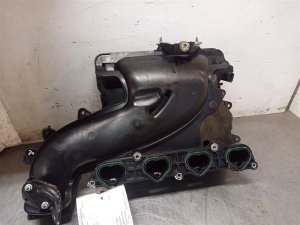
- Upper Intake Manifold Assembly
(OEM #05184693AE)— This is the most common fix because the IMRC actuator motor that fails is integrated into this assembly for the 3.6L Pentastar engine. This part number supersedes previous versions like 68621090AA.
Trusted brands: Mopar, Dorman (P/N: 615-911)
OEM price range: $300-$450
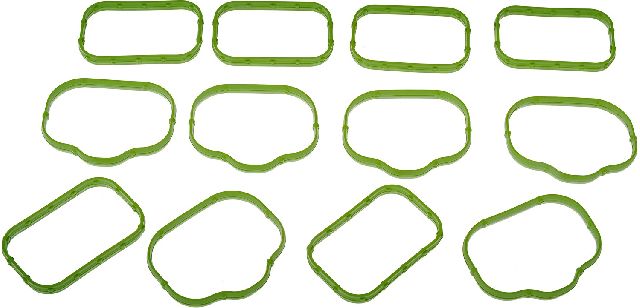
Aftermarket price range: $200-$350 - Intake Manifold Gasket Set (Upper and Lower)
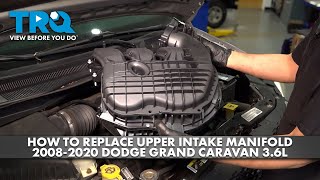
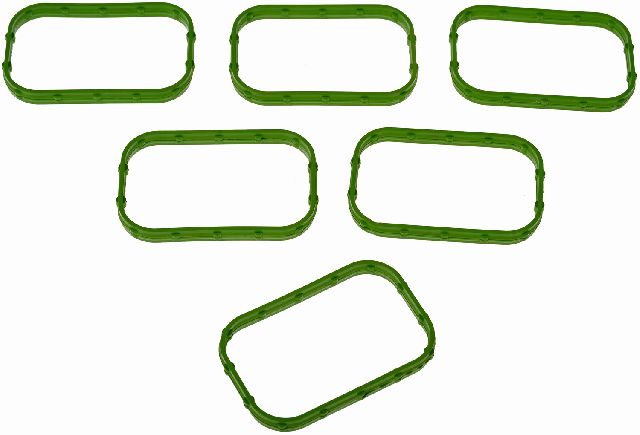
(OEM #5184562AC (Upper), 5184331AC (Lower))— These gaskets are single-use and must be replaced anytime the intake manifold is removed to prevent vacuum leaks. 🎬 See this step-by-step intake manifold gasket replacement guide
Trusted brands: Mopar, Fel-Pro, Mahle
OEM price range: $40-$60
Aftermarket price range: $20-$40
Related Codes That Often Appear With This One
- P2006 — P2008 is an electrical 'open circuit' code. If the actuator doesn't get the electrical signal to move, the flaps will remain in their default position, which is typically closed. This will then trigger the P2006 'Intake Manifold Runner Control Stuck Closed' code as a secondary, mechanical result of the primary electrical failure.
- P2017 — This code means 'Intake Manifold Runner Position Sensor Circuit High'. Since the position sensor is part of the same integrated manifold assembly as the actuator motor, a failure within the unit can trigger faults for both the motor circuit (P2008) and the sensor circuit (P2017).
- P2016 — Similar to P2017, this code indicates 'Intake Manifold Runner Position Sensor Circuit Low'. TSB S2308000109 groups P2008, P2016, and P2017 together, suggesting a common root cause within the manifold assembly or its connector.
Technical Service Bulletins (TSBs) & Recalls
- TSB S2308000109: While for a newer Ram, this TSB is highly relevant as it addresses P2008, P2016, and P2017 on a 3.6L Pentastar, pointing to a potential 'spread terminal' at the short runner valve connector as a cause for the open circuit.
- Bulletin #9001645: This manufacturer bulletin notes that for certain short runner valve (SRV) faults including P2008, technicians should not immediately replace the intake manifold. Instead, it advises following specific service procedures to investigate the P codes for the manifold tuning valve and SRV systems.
Platform-Specific Known Issues
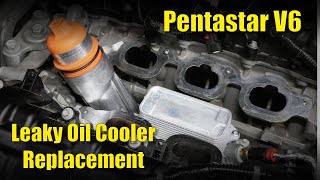
- While the intake manifold is removed, it is highly recommended to inspect the oil filter housing assembly located in the engine valley directly beneath it. This component is made of plastic and is a notoriously common source of major oil leaks on the 3.6L Pentastar engine. The plastic becomes brittle from heat cycles and cracks, often causing oil to run down the back of the transmission bellhousing. Replacing it with an upgraded aluminum version (e.g., Dorman 926-959) as a preventative measure during the P2008 repair can save significant future labor costs. 🎬 Watch: How to replace the oil filter housing and spark plugs
- Since the spark plugs are also located under the intake manifold, it is a cost-effective time to perform a tune-up and replace them if they are near the end of their service life.
Mechanic-Grade Diagnostic Values
- IMRC Actuator Connector Pin 5 Voltage — expected: 12V+ (Battery Voltage) with key on. Failure: Absence of 12V+ indicates a power supply issue from the PCM or a blown fuse.
- IMRC Actuator Connector Pin 6 Ground — expected: Good ground connection. Failure: High resistance to ground indicates a wiring or chassis ground fault.
- IMRC Actuator Connector Pin 1 (Control Signal) — expected: Varying voltage or PWM signal when commanded by a scan tool. Failure: No signal when commanded points to a wiring or PCM driver fault.
- Continuity of IMRC control circuit wiring — expected: Less than 5.0 Ohms. Failure: A reading higher than 5.0 Ohms (or 'OL') indicates an open circuit in the harness between the actuator and PCM.
Scan Tool Commands That Help
- wiTECH or other professional bidirectional scanner: Intake Manifold Runner Control (IMRC) Actuation Test or Active Test — This is a primary diagnostic step. Use this with the key on, engine off, to command the actuator motor to move. Listening for a 'click' from the actuator confirms if the PCM, wiring, and actuator motor are capable of functioning. No click points directly to a failure in that circuit.
Wiring & Ground Locations
- IMRC Actuator Connector — On the front face of the upper intake manifold, connecting to the integrated actuator motor.. This is the primary point for all electrical testing for P2008. Verifying power (Pin 5), ground (Pin 6), and signal (Pin 1) at this connector is the fastest way to isolate the fault to either the wiring/PCM or the integrated manifold assembly itself.
- G100 / G104 — Main engine bay ground points. G100 is typically located on the passenger side of the engine bay near the battery, and G104 is on the driver's side.. A poor main engine or chassis ground can cause a wide range of intermittent electrical faults. While not a direct cause, a corroded ground strap should be checked as part of any electrical diagnosis.
- Cylinder Head Ground Stud — There are threaded studs on both the driver and passenger side cylinder heads that serve as grounding points.. The ignition system and various sensors rely on a solid ground to the cylinder heads. Ensuring these grounds are clean and tight is crucial for overall engine electrical health.
Real Owner Repair Stories
- RamForum.com user 'SyN' (2016 Ram 1500 (with 3.6L Pentastar, same IMRC system)) — Check Engine Light with code P2008 that returned immediately after clearing.
❌ Tried (didn't work) Clearing the code.
✅ What actually fixed it The dealer found a bad wiring connector at the short runner valve. They replaced the connector pigtail by splicing in a new one from a harness and sealing it. This was identified via a STAR case with Chrysler, indicating it's a known, if less common, failure mode.
OEM Part Supersession History
68621090AA→05184693AE— Standard part revision and update by the manufacturer.
Heads up: The new part number (05184693AE) is the correct and current replacement for all 2011-2017 Chrysler 200 models with the 3.6L engine.
Model Year Variations Within This Range
- 2016+: Around 2016, the 3.6L Pentastar engine received an update (known as the PUG - Pentastar Upgrade). While the upper intake manifold causing the P2008 code remained largely the same, the *lower* intake manifold was redesigned for better airflow. Some owners of pre-2016 models choose to install the newer, higher-flowing lower intake manifold as an upgrade when they are already replacing the upper manifold for the P2008 code.
Diagnostic Flowchart
Other Known Issues on This Vehicle
Issues unrelated to this code that are worth knowing about as an owner of this generation:
- Cracked Oil Filter / Cooler Housing 🔴 High — Extremely common across all model years. The plastic housing becomes brittle from heat cycles and cracks, causing significant oil and/or coolant leaks into the engine valley.
- Rocker Arm / Lifter Failure ('Pentastar Tick') 🔴 High — Common across all model years, often appearing after 60,000 miles. Failed needle bearings in the rocker arms cause a distinct ticking noise, which can lead to misfires and camshaft damage if ignored.
- Left Cylinder Head Failure 🔴 High — Primarily affects early 2011-2013 model year engines. Premature wear of the valve guides on the left-bank cylinder head (cylinders 2, 4, 6) leads to misfires. (Ref: TSB 09-002-14, Warranty Extension X56 (10 years/150,000 miles))
- ZF 9-Speed Transmission Failure/Harsh Shifting 🔴 High — Widespread on second-generation models (2015-2017). Symptoms include hard/jerky shifting, lurching, and unexpected shifts into neutral. Caused by both software issues and internal mechanical/electrical faults. (Ref: Multiple software update TSBs and a recall (NHTSA 16V-473) for some 2015 models shifting to neutral.)
- Engine Stalls While Driving 🔴 High — Reported on both generations. The NHTSA opened an investigation into 2011-2013 models for stalling without warning. (Ref: NHTSA investigation PE12-023)
- Cooling System Failures (Water Pump, Radiator) 🟠 Medium — Water pumps and radiators can fail, leading to coolant leaks and potential overheating. This is a common issue for many vehicles as they age but is frequently reported on the Pentastar.
Used vs. New Parts: Buying Guide for This Vehicle
When a used part is the smart pick: For the upper intake manifold (the primary fix for P2008), a used part from a low-mileage, late-model donor vehicle can be a cost-effective option. The failure is electronic, so a part from a vehicle that was running well is likely to have a functional actuator.
Donor-vehicle mileage cap: roughly under 60000 miles for the part to have meaningful remaining life.
What to inspect on the donor part:
- Verify the donor vehicle's mileage. Lower is always better.
- Inspect the electrical connector pins for any corrosion, bending, or damage.
- Check the plastic housing for any visible cracks or signs of extreme heat stress, although this is rare for the intake itself.
- Ensure the red locking tab on the electrical connector is intact and not broken.
- If possible, manually actuate the runner flaps via the linkage (if accessible) to ensure they are not physically seized, though P2008 is an electrical code.
OEM-only on this vehicle (don't cheap out):
- While aftermarket manifolds exist, Mopar (OEM) is generally recommended for best fit and compatibility. If choosing aftermarket, Dorman is a well-documented alternative.
Aftermarket brands forum-validated for this vehicle:
- Dorman (Intake Manifold, P/N: 615-911)
- Dorman (Upgraded Aluminum Oil Filter Housing, P/N: 926-959)
Brands owners have reported issues with on this vehicle:
- No-name, unbranded intake manifolds from online marketplaces can have fitment issues or use lower-quality electronics for the integrated actuator.
Real Owner Stories
Aggregated from forums and TSBs cited above. Mileages and costs reflect what owners reported in those sources.
2011-2017 Chrysler 200 3.6L Pentastar V6
Symptoms: The user noted that the plastic oil cooler failure is a common issue on this engine platform, often resulting in oil running down the back of the transmission bellhousing.
What fixed it: Replacing the plastic oil filter housing assembly with an upgraded aluminum version while the intake manifold was removed for other service.
Source hint: BobIsTheOilGuy.com - '3.6 pentastar as bad as it seems ???'
Related OBD-II Codes
Frequently Asked Questions
Can I just replace the IMRC actuator motor on my 3.6L Pentastar engine?
Does TSB S2308000109 apply to my Chrysler 200 regarding the P2008 code?
Are there any other repairs I should perform while the intake manifold is off for the P2008 fix?
What causes the IMRC actuator to fail on the Chrysler 200 3.6L?
Will a P2008 code affect my car's performance?
Should I replace the intake manifold immediately if I have a P2008 code?
Helpful Videos
Used OEM Parts in Stock
New Aftermarket Parts Available


The information in this article is provided for general reference and educational purposes only. Vehicle specifications, procedures, and part compatibility can vary by production date, trim level, and region. Always consult your vehicle's factory service manual and verify part numbers before purchasing or performing repairs. Safety-critical components such as airbags, seat belts, and braking systems should be installed by a qualified professional.
- Chrysler 200:
- 🧭 Diagnostic Flowchart
- 🎬 Helpful Videos
- 🛍️ Shop This Part
- What's Unique About the 2011-2017 Chrysler 200
- Symptoms You May Notice
- Most Likely Causes
- Rare But Worth Checking
- Diagnosis Steps
- Parts You'll Likely Need
- Related Codes That Often Appear With This One
- Technical Service Bulletins (TSBs) & Recalls
- Platform-Specific Known Issues
- Mechanic-Grade Diagnostic Values
- Scan Tool Commands That Help
- Wiring & Ground Locations
- Real Owner Repair Stories
- OEM Part Supersession History
- Model Year Variations Within This Range
- Other Known Issues on This Vehicle
- Used vs. New Parts: Buying Guide for This Vehicle
- Real Owner Stories
- 2011-2017 Chrysler 200 3.6L Pentastar V6
- Related OBD-II Codes
- Frequently Asked Questions
- 🎟️ Get 5% Off