

U0001 on 2011-2015 Ford Explorer: High-Speed CAN Bus Failure Causes and Fixes
Code U0001 on a 2011-2015 Ford Explorer means there's a critical communication failure on the High-Speed CAN Bus. This is most often caused by damaged wiring, a faulty ABS module, or other failed modules on the network. Diagnosis is complex, requiring professional tools to trace the network fault, and driving is not recommended.
- U0001 is a critical network failure code that makes the vehicle unsafe to drive.
- The most common causes are physical damage to the wiring harness or a single faulty computer module bringing down the network.
- Diagnosis is complex and requires professional tools and knowledge; this is not a simple DIY fix.
- Do not replace any modules until the wiring harness has been thoroughly tested, as wiring is the most probable cause.
- Always check for accompanying 'U' codes, as they can help narrow down which systems are affected.
What's Unique About the 2011-2015 Ford Explorer
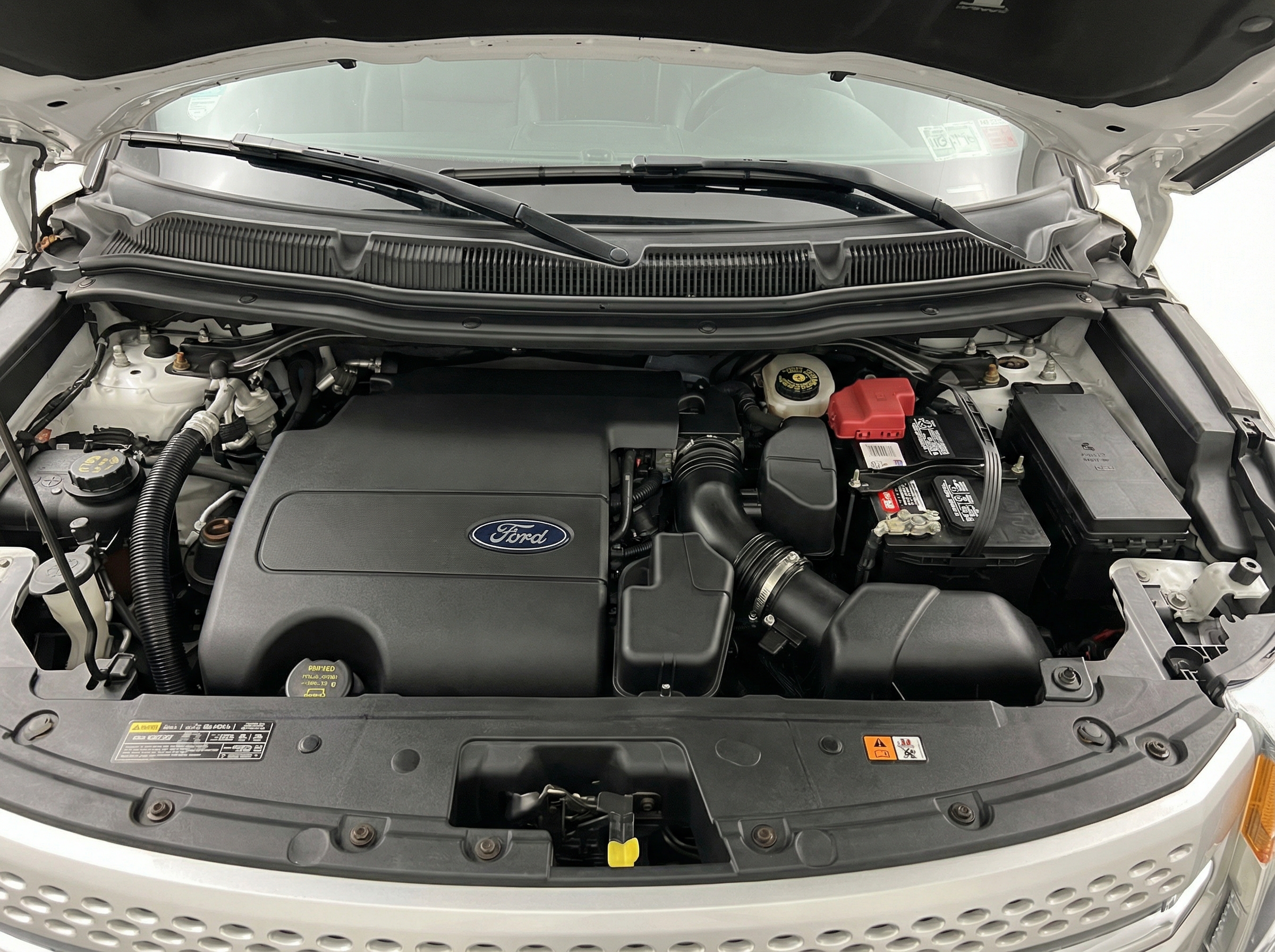
On the fifth-generation Ford Explorer (U502 platform), the U0001 code points to a complete breakdown of the primary vehicle network (HS-CAN). While the causes are often universal (wiring, modules), this platform integrates numerous systems onto the high-speed bus, including the PCM, ABS, Power Steering Control Module (PSCM), and Instrument Panel Cluster (IPC). A failure can simultaneously affect the engine, transmission, power steering, ABS, and instrument cluster, making diagnosis a process of elimination to find which wire or module is causing the entire network to go down. The ABS module and its wiring are frequently cited as culprits in owner forums.
Symptoms You May Notice
- Check Engine Light is on
- Multiple other warning lights may illuminate, such as ABS, Traction Control, Airbag, or Power Steering Assist Fault lights
- Engine may stall, refuse to start, or have reduced power
- Transmission may shift erratically or get stuck in one gear (limp mode)
- Loss of power steering assist
- Instrument cluster gauges may behave erratically, go blank, or stop working
- Scan tool may report 'no communication' with multiple modules
- Multiple 'U' codes for lost communication (e.g., U0100, U0101, U0121) stored across various modules
- Replacing a single module (like the PCM or TCM) without first confirming the integrity of the CAN bus wiring. The problem is often in the 'road' (the wiring) between the 'cities' (the modules), not the modules themselves.
Most Likely Causes
- Damaged Wiring Harness 🔴 High Probability Wiring harnesses in the engine bay are exposed to heat, vibration, and potential chafing. A short or open in the twisted pair of CAN bus wires (CAN High and CAN Low) is a frequent cause of network failure. Common chafe points are reported near the ABS module, around the battery tray, and where the harness may contact engine or suspension components. Rodent damage is also a possible cause due to soy-based wire insulation.
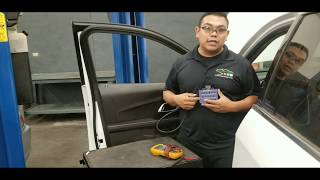
How to confirm: Perform a thorough visual inspection of harnesses for chafing, breaks, or corrosion, especially near the major modules (PCM, ABS). With the battery disconnected, measure the resistance between Pin 6 (CAN-H) and Pin 14 (CAN-L) at the OBD-II port. A healthy 🎬 Watch: How to test a CAN bus network with a meter network should read approximately 60 ohms. A reading of 120 ohms indicates an open circuit or a missing terminating resistor, while a reading near 0 ohms indicates a short between the two wires.
Typical fix: Repair the damaged section of the wiring harness, ensuring the twisted-pair configuration is maintained to prevent interference. Corroded connectors should be cleaned or replaced.
Est. part cost: $10-$50 for wiring repair supplies - Faulty Control Module (Especially ABS) 🟡 Medium Probability Any module on the high-speed network (PCM, ABS, BCM, PSCM, IPC) can fail internally. When it fails, it can either stop communicating or 'shout' on the network with garbage data, preventing other modules from communicating. The ABS module is a commonly reported failure point on this platform that can bring down the entire HS-CAN bus.
How to confirm: This is the most difficult cause to diagnose. It involves systematically unplugging one module at a time from the CAN bus and re-checking the network's integrity (e.g., with the 60-ohm resistance test). If unplugging a specific module restores communication for the others, that module is the likely culprit. This requires a wiring diagram to locate all modules and their connectors.
Typical fix: Replace the faulty module. The new module will require programming (often called Programmable Module Installation or PMI) to the vehicle's VIN and configuration using Ford's diagnostic software (IDS or FDRS).
Est. part cost: $300-$1500 depending on the specific module - Low Battery Voltage or Poor Grounds ⚪ Low Probability → Shop Vehicle Battery Control modules require a stable voltage to operate correctly. A weak battery, failing alternator, or corroded battery terminals or chassis ground straps can cause unpredictable communication errors across the network, especially during engine cranking.
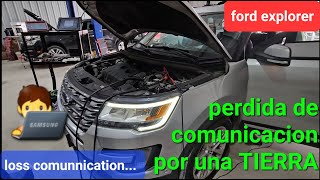
How to confirm: Test the battery voltage with the engine off (should be ~12.4V or higher) and with the engine running (should be ~13.7-14.7V). Inspect the main battery terminals and chassis 🎬 See: Ford Explorer communication loss due to a bad chassis ground ground connections for corrosion or looseness. Perform a voltage drop test on the main ground connections.
Typical fix: Clean battery terminals and ground points. Charge or replace the battery if it fails a load test. Replace the alternator if it is not charging correctly.
Est. part cost: $150-$400 for a new battery or alternator
Rare But Worth Checking
- Aftermarket Device Interference: Improperly installed aftermarket devices (remote starters, alarms, telematics/GPS trackers) that are spliced into the CAN bus wiring can disrupt communication and cause a U0001 code.
- Failed Terminating Resistor: The HS-CAN bus has two 120-ohm terminating resistors, one typically in the PCM and the other in the Instrument Panel Cluster (IPC). If one of these modules fails in a way that takes the resistor offline, the total network resistance will jump to 120 ohms, causing signal integrity issues. This is confirmed by the resistance test at the OBD-II port.
Diagnosis Steps
- Check and record any and all trouble codes stored in all modules. Note which modules are not communicating.
- Check the battery. Ensure it has a full charge and that the terminals are clean and tight.
- Perform a thorough visual inspection of the main wiring harnesses in the engine bay and under the vehicle. Look for any signs of damage, chafing, or corrosion near connectors, paying close attention to the harness near the ABS module and battery.
- With the ignition off and battery disconnected, use a multimeter to measure the resistance between Pin 6 (CAN-H) and Pin 14 (CAN-L) at the OBD-II diagnostic port. The reading should be approximately 60 ohms.
- If the resistance is 120 ohms, there is an open in the circuit or one of the two terminating resistors (usually in the PCM and IPC) is offline.
- If the resistance is near 0 ohms, the CAN-H and CAN-L wires are shorted together.
- If resistance is correct but the problem persists, the issue may be intermittent or a faulty module 'shouting' on the bus. This requires an oscilloscope to check the CAN signal waveform or the methodical process of isolating modules.
- Using a wiring diagram, begin disconnecting modules on the HS-CAN bus one by one. After disconnecting each module, re-check the 60-ohm resistance or see if communication is restored to the other modules. If unplugging a specific module fixes the issue, that module is the source of the fault.
- If a module is identified as the cause, replace it and have it programmed by a dealer or a qualified shop with the proper equipment.
Parts You'll Likely Need
- Wiring Harness Repair Supplies — If the cause is a broken, corroded, or shorted wire, repairing the harness is the most common fix.
Trusted brands: Motorcraft (pigtails), General wiring supplies
OEM price range: $20-$100
Aftermarket price range: $10-$50 - ABS Control Module
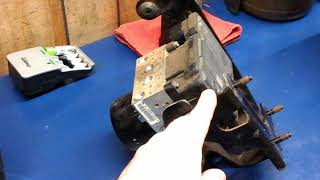
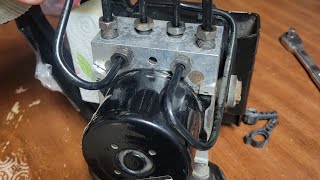
(OEM #BB5Z-2C219-A, DB5Z-2C219-A (Verify by VIN))— The ABS module is a common point of failure on the 2011-2015 Explorer and can bring down the entire HS-CAN network. It must be programmed upon installation. 🎬 Watch: Step-by-step Explorer ABS module replacement walkthrough
Trusted brands: Motorcraft, Bosch (OEM supplier)
OEM price range: $500-$900
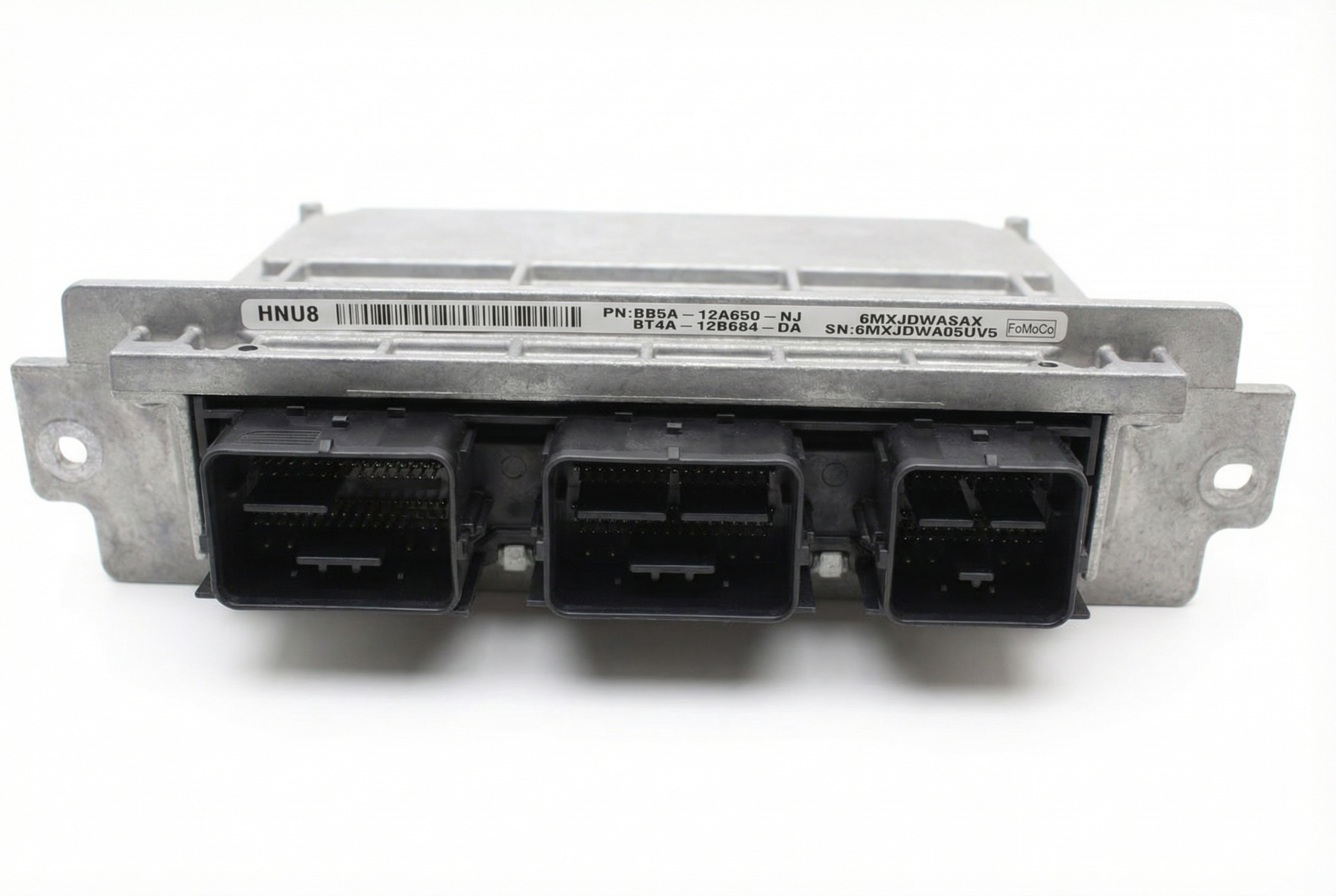
Aftermarket price range: $300-$600 (remanufactured) - Powertrain Control Module (PCM)
(OEM #Verify by VIN)— As one of the main terminating resistors and the central brain of the vehicle, a PCM failure will cause a U0001 code. It is less common than wiring or ABS module issues.
Trusted brands: Motorcraft
OEM price range: $800-$1500
Aftermarket price range: $400-$800 (remanufactured)
Related Codes That Often Appear With This One
- U0100 — Lost Communication With ECM/PCM
- U0101 — Lost Communication with TCM
- U0121 — Lost Communication With Anti-Lock Brake System (ABS) Control Module
- U0140 — Lost Communication With Body Control Module (BCM)
- U0155 — Lost Communication With Instrument Panel Cluster (IPC) Control Module
Platform-Specific Known Issues
- ABS Module Wiring Harness Chafing: → Shop ABS Control Module Owners and technicians frequently report that the wiring harness leading to the ABS module can rub against nearby components, causing wires to chafe and eventually short out. This can directly cause a U0001 code and a loss of communication with multiple systems. A careful
Mechanic-Grade Diagnostic Values
- HS-CAN Bus Resistance (Key Off, Battery Disconnected) — expected: ~60 Ohms (±5 Ohms) between Pin 6 and Pin 14 of the OBD-II port.. Failure: 120 Ohms indicates an open circuit or one missing terminating resistor. ~0 Ohms indicates a short between CAN High and CAN Low wires.
- HS-CAN Bus Voltage (Key On, Engine Off) — expected: CAN High (Pin 6): ~2.6V. CAN Low (Pin 14): ~2.4V. Both are referenced to chassis ground.. Failure: Significant deviation from these voltages, or voltage on one line mirroring the other (shorted together), or one line at 0V (short to ground) or battery voltage (short to power) indicates a wiring fault.
- Oscilloscope Waveform (Key On) — expected: Clean, square, mirror-image waveforms on CAN High and CAN Low. CAN High should swing from ~2.5V to ~3.5V, while CAN Low swings from ~2.5V to ~1.5V.. Failure: Noisy signals, rounded-off square waves, or a flat line. A signal that is stuck high or low indicates a short to power or ground, respectively.
Scan Tool Commands That Help
- Ford IDS/FDRS, FORScan, high-end Snap-on/Autel: Programmable Module Installation (PMI) — This function is required when replacing a major control module (like the ABS, PCM, or BCM). It copies the configuration data from the old module and writes it to the new one. If the old module is unreadable, it can download 'As-Built' data from Ford's servers based on the VIN.
- Ford IDS/FDRS, FORScan: ABS Service Bleed / IVD Initialization — After replacing the ABS module, the system must be bled using this automated procedure to purge all air from the hydraulic control unit (HCU). The IVD (Interactive Vehicle Dynamics) system must also be initialized/calibrated.
- Ford IDS/FDRS: Network Test (or 'Self Test' on all modules) — This is a primary diagnostic step. The tool attempts to communicate with every module on the vehicle's networks and provides a list of which modules are responding and which are not. This helps to quickly identify the scope of the communication failure.
Wiring & Ground Locations
- G200 / G201 — G200 is under the left front of the center console; G201 is under the right front of the center console.. These are major interior ground points for several modules and connectors that reside on the vehicle's communication networks. A poor connection here can cause intermittent network issues.
- G300 — Located in the left kick panel area.. This is a key ground point for the Body Control Module (BCM) and other dash-related components. A loose G300 can cause a wide variety of electrical and network faults.
- C2280B Connector at BCM — The Body Control Module (BCM) is located at the lower driver's side of the dash. C2280B is one of its main connectors.. The HS-CAN lines pass through this connector. Specifically, Pin 10 (WH-BU wire) is HS CAN High and Pin 9 (WH wire) is HS CAN Low, leading to the diagnostic connector. A bad pin fitment or corrosion here can disrupt the entire network.
- HS-CAN Splice S330 — Located in the main body wiring harness, near the breakout to the HS-CAN joint connector.. This is a factory splice where multiple CAN bus branches come together. While rare, a failure or corrosion at this splice point can take down large segments of the network.
OEM Part Supersession History
BB5Z-2C219-A→DB5Z-2C219-A— Part revision or update by manufacturer.
Heads up: Part DB5Z-2C219-A is specified for 2011-2013 Explorers built up to 09/03/2012, without adaptive cruise control. Using the wrong module for a vehicle with adaptive cruise or from a different year range will likely result in configuration errors (DTC U2300) and non-functional ABS/stability systems. Always verify the part number by VIN.
Model Year Variations Within This Range
- 2011-2013 (up to 09/03/2012): The ABS control module part number is specific to this earlier range (DB5Z-2C219-A). Later models use a different part number, likely due to changes in software or integration with other systems.
Diagnostic Flowchart
Other Known Issues on This Vehicle
Issues unrelated to this code that are worth knowing about as an owner of this generation:
- Internal Water Pump Failure (3.5L V6) 🔴 High — Common at higher mileage (typically over 100k miles). A failure can cause coolant to mix with engine oil, leading to catastrophic engine damage.
- Power Transfer Unit (PTU) Overheating/Failure (AWD Models) 🔴 High → Shop Transfer Case Assembly — The PTU fluid is considered 'lifetime' by Ford but is cooked by the adjacent exhaust, leading to breakdown and failure. Service is often neglected. Failure can occur from 70k miles onward.
- Electric Power Steering (EPAS) Rack Failure 🔴 High → Shop Steering Gear — Sudden loss of power steering assist is a common complaint, which led to a recall. The failure can be intermittent or permanent. (Ref: NHTSA Campaign 14V286000 (Recall 14S06))
- Exhaust Fumes/Odor in Cabin 🟠 Medium — Owners report an exhaust or sulfur smell inside the cabin, especially during heavy acceleration. This is caused by body seam leaks and airflow dynamics at the rear of the vehicle. (Ref: TSB 14-0130, 16-0166, 17-0029)
- Electronic Throttle Body Malfunction 🟠 Medium — Can cause sudden power loss, hesitation, and the vehicle entering 'limp mode'. Often sets codes P2111 or P2112.
- Rear Suspension Toe Link Corrosion/Fracture 🔴 High — Rear toe links can fracture due to corrosion, especially in salt-belt regions, causing a loss of steering control. This has been the subject of multiple recalls. (Ref: Multiple recalls, including NHTSA 19V435000)
Used vs. New Parts: Buying Guide for This Vehicle
When a used part is the smart pick: A used ABS module can be a cost-effective option if the failure is confirmed to be the module itself and not wiring. However, it introduces complexity with programming.
Donor-vehicle mileage cap: roughly under 100000 miles for the part to have meaningful remaining life.
What to inspect on the donor part:
- Match the part number EXACTLY. Pay close attention to suffixes.
- Ensure the donor vehicle has the same options (e.g., with/without adaptive cruise control).
- Inspect the connector pins on the used module for any corrosion or damage.
- Obtain the VIN of the donor vehicle if possible, as it may be needed for 'As-Built' data retrieval if standard programming fails.
OEM-only on this vehicle (don't cheap out):
- Control Modules (PCM, ABS, BCM): While used OEM modules are an option, they MUST be OEM. Aftermarket or 'rebuilt' modules from unknown brands are a significant risk for communication and programming issues. If buying new, stick to Motorcraft.
Brands owners have reported issues with on this vehicle:
- Unbranded or 'no-name' electronic modules sold on auction sites. The programming and internal components are often unreliable and can fail to communicate with the vehicle's other systems, making the problem worse.
Real Owner Stories
Aggregated from forums and TSBs cited above. Mileages and costs reflect what owners reported in those sources.
2011 Ford Explorer XLT
Symptoms: Multiple warning lights and failures, including a U0001 code stored in the system.
What fixed it: Diagnosis of the high-speed communication bus to identify the specific module or wiring fault interrupting the network.
Source hint: https://www.explorerforum.com/forums/threads/2011-xlt-multiple-warning-lights-and-failures-u0001-code.478913/
2013 Ford Explorer Sport
Symptoms: Vehicle would not start and the scan tool reported no communication with the PCM.
What fixed it: Troubleshooting the HS-CAN bus for communication interruptions preventing the PCM from being recognized.
Source hint: https://www.explorerforum.com/forums/threads/2013-explorer-sport-no-start-no-communication-with-pcm.444328/
Related OBD-II Codes
Frequently Asked Questions
My 2011-2015 Explorer has a U0001 code and lost power steering; is there a recall for this?
I'm seeing U0001 along with an exhaust smell in the cabin of my Explorer. Are these related?
Could a bad battery cause the High Speed CAN Communication Bus (U0001) to fail on my Ford?
Where is the most common place for wiring damage causing U0001 on this vehicle?
How can I test if the HS-CAN network is physically intact on my Explorer?
If I have to replace a control module to fix U0001, can I just plug it in?
Helpful Videos

We Have This Part in Stock

The information in this article is provided for general reference and educational purposes only. Vehicle specifications, procedures, and part compatibility can vary by production date, trim level, and region. Always consult your vehicle's factory service manual and verify part numbers before purchasing or performing repairs. Safety-critical components such as airbags, seat belts, and braking systems should be installed by a qualified professional.
- Ford Explorer:
- 🧭 Diagnostic Flowchart
- 🎬 Helpful Videos
- 🛍️ Shop This Part
- What's Unique About the 2011-2015 Ford Explorer
- Symptoms You May Notice
- Most Likely Causes
- Rare But Worth Checking
- Diagnosis Steps
- Parts You'll Likely Need
- Related Codes That Often Appear With This One
- Platform-Specific Known Issues
- Mechanic-Grade Diagnostic Values
- Scan Tool Commands That Help
- Wiring & Ground Locations
- OEM Part Supersession History
- Model Year Variations Within This Range
- Other Known Issues on This Vehicle
- Used vs. New Parts: Buying Guide for This Vehicle
- Real Owner Stories
- 2011 Ford Explorer XLT
- 2013 Ford Explorer Sport
- Related OBD-II Codes
- Frequently Asked Questions
- 🎟️ Get 5% Off