

U0001 on 2012-2017 Hyundai Azera: High-Speed CAN Bus Failure Diagnosis and Fixes
The U0001 code on a 2012-2017 Hyundai Azera indicates a serious communication failure on the High-Speed CAN bus. This is most often caused by a wiring issue, a weak battery, or a faulty control module, particularly the ABS module which is subject to a recall. Diagnosis is complex and often requires professional tools to pinpoint the exact cause.
- U0001 is a critical network failure code that makes the vehicle unsafe to drive.
- Always start diagnosis by checking the simplest things first: the battery's state of charge and the cleanliness of its connections.
- For 2012-2015 models, the recalled ABS module is a primary suspect and should be investigated early in the diagnostic process.
- The problem is more likely to be in the wiring or connectors than a failed ECM, unless the ABS module recall applies.
What's Unique About the 2012-2017 Hyundai Azera
For the 2012-2017 Hyundai Azera (HG generation), a significant vehicle-specific issue is the ABS module recall (NHTSA 23V651000). The module can leak brake fluid internally, causing an electrical short. This short can not only create a fire risk but can also disrupt the entire CAN bus network, directly causing a U0001 code. Beyond this recall, the issue is typically one of general electrical integrity. A Reddit user with a 2014 Azera described symptoms consistent with a CAN bus failure, including a non-responsive instrument cluster and an OBD scanner that reported a 'communication error,' highlighting how a network failure can manifest on this platform.
Symptoms You May Notice
- Check Engine Light is on
- Multiple other warning lights may illuminate (ABS, Traction Control, Airbag).
- Engine may stall, have trouble starting, or not start at all.
- Transmission may shift erratically or get stuck in one gear (limp mode).
- Malfunctioning dashboard electronics (e.g., gauges drop to zero, radio or infotainment system fails).
- Power windows, locks, or other convenience features may stop working.
- Inability to communicate with the vehicle's computer using an OBD-II scanner.
- Brake pedal feels different or the brakes lock up, as the ABS system is offline.
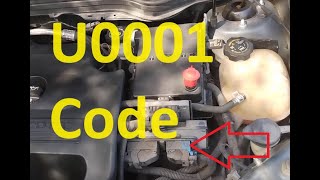
- Replacing a single control module (like the ECM or TCM) without confirming it is the source of the network failure. The code often indicates a network-wide problem, 🎬 Watch: U0001 code explained and how to fix it fast not necessarily a fault with the module that stored the code.
Most Likely Causes
- CAN Bus Wiring or Connector Issue 🔴 High Probability Wiring harnesses can be susceptible to damage from vibrations, moisture, or previous repairs. Connectors can become loose or corroded over time, especially at modules exposed to the elements.
How to confirm: A visual inspection of the wiring harness for any signs of damage, chafing, or corrosion. A multimeter is used to check for continuity and resistance (should be ~60 Ohms between CAN-H and CAN-L at the OBD-II port 🎬 Watch: How to test a CAN bus network with a multimeter with the battery disconnected).
Typical fix: Repairing the damaged section of wiring or cleaning/replacing the faulty connector.
Est. part cost: $10-$100 - Weak or Failing Battery / Poor Battery Connections 🟡 Medium Probability → Shop Vehicle Battery Low voltage from a weak battery can cause unpredictable behavior in electronic modules, leading to communication dropouts on the CAN network.
How to confirm: Test the battery voltage with a multimeter (should be above 12.4V with the engine off). Check the battery terminals for tightness and any signs of corrosion. Ensure charging voltage is stable (typically 13.5V-14.5V) when the engine is running.
Typical fix: Clean the battery terminals and cable ends thoroughly. If the battery is weak, it will need to be replaced.
Est. part cost: $150-$300 - Faulty Control Module (Especially ABS Module) 🟡 Medium Probability Any module on the CAN network (ECM, TCM, BCM, ABS, etc.) can fail internally and disrupt communication. On the 2012-2015 Azera, the ABS module is a known failure point due to a recall for internal shorts. A faulty module can continuously transmit garbage data, bringing down the whole network.
How to confirm: This is a process of elimination. A technician will use a high-end scan tool to see which modules are not communicating. They may then disconnect modules one by one to see if communication is restored to the rest of the network.
Typical fix: Replacement and reprogramming of the faulty module. For the ABS module recall, the fix involves replacing the ABS fuse.
Est. part cost: $200-$2000+
Rare But Worth Checking
- Aftermarket Electronics Interference: Poorly installed aftermarket devices like remote starters, alarms, or stereos can be improperly tapped into the CAN bus, introducing electrical noise that disrupts communication.
Diagnosis Steps
- Check the Battery: Ensure the battery is fully charged and the terminals are clean and tight. A weak battery is a common cause of network communication errors.
- Visual Inspection: Carefully inspect the main wiring harnesses, especially around the engine bay, under the dashboard, and near the ABS module, for any signs of damage, corrosion, or loose connectors.
- Scan for Other Codes: Use a professional scan tool to check for any other 'U' codes. Codes pointing to a specific module (like U0121 for the ABS module) can provide a starting point for diagnosis.
- Check CAN Bus Resistance: With the battery disconnected, use a multimeter to measure the resistance between Pin 6 (CAN High) and Pin 14 (CAN Low) on the OBD-II port. A healthy network should read approximately 60 ohms. A reading of 120 ohms suggests one of the terminating resistors (or the module containing it) is offline. An open or shorted reading indicates a wiring problem.
- Check CAN Bus Voltage (Advanced): With the ignition on, use an oscilloscope or multimeter to check voltages. On a healthy bus, CAN-H should be ~2.5V-3.5V and CAN-L should be ~1.5V-2.5V. A line stuck high or low indicates a short.
- Isolate Modules: If resistance or voltage is incorrect, a technician will disconnect modules one by one (starting with the most likely culprits like the ABS module or any aftermarket devices) to see if the correct readings return, thereby isolating the faulty module or wiring branch.
Parts You'll Likely Need
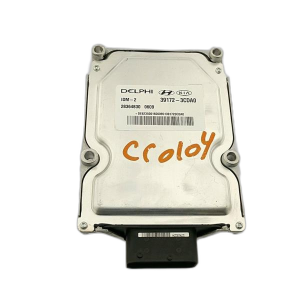
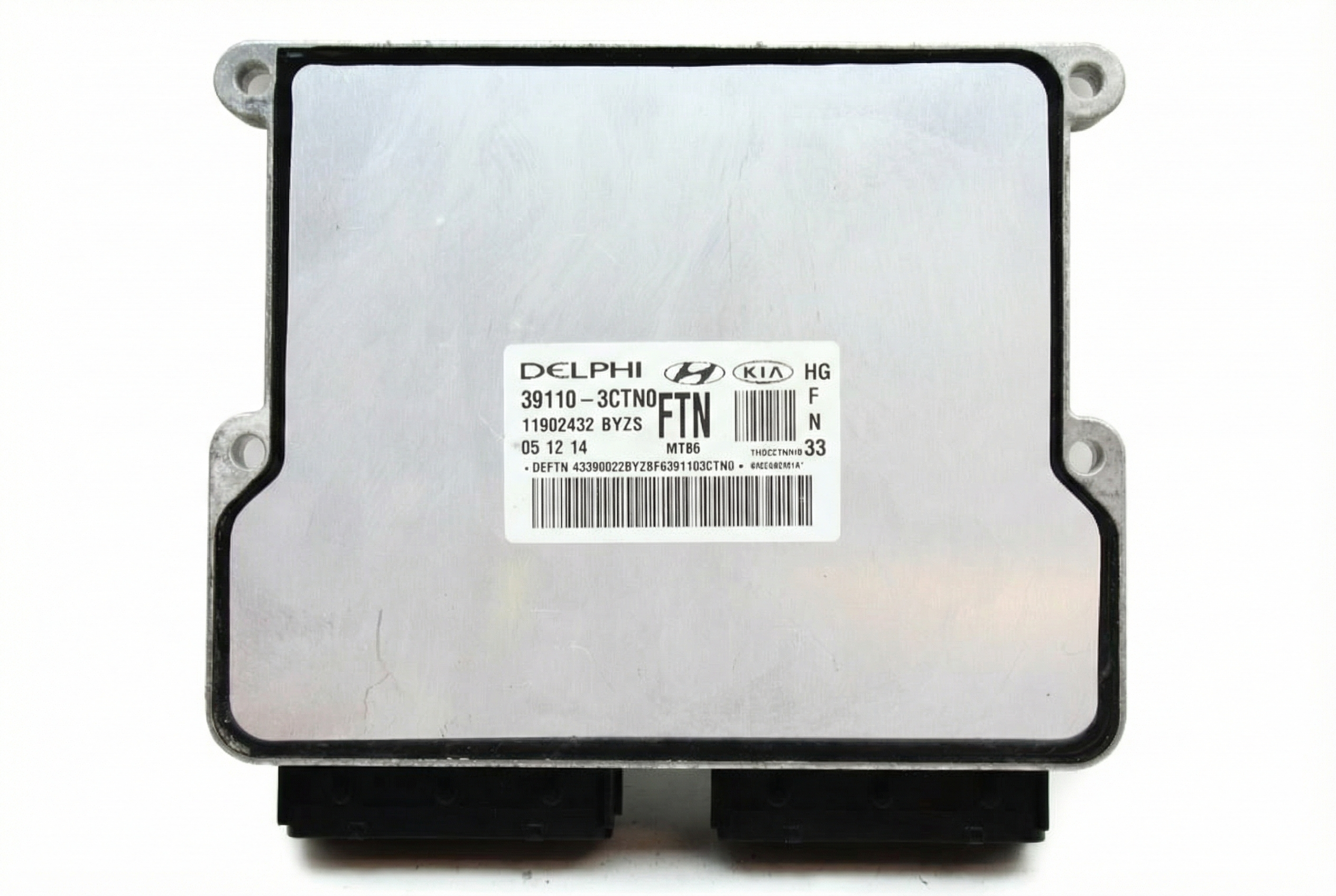
- Engine Control Module (ECM/PCM) — While less common than wiring issues, a faulty ECM can bring down the entire CAN network. This is often a last resort after all wiring and other modules have been checked.
Trusted brands: Hyundai (OEM)
OEM price range: $2100-$2200
Aftermarket price range: $500-$1000 (Remanufactured) - ABS Control Module
(OEM #58900-xxxxx (Varies by year/options))— The ABS module is a critical node on the high-speed CAN bus. There is a major recall (NHTSA 23V651000) for 2012-2015 Azera models where the ABS module could short circuit, which could directly disrupt network communication and trigger a U0001 code.
Trusted brands: Hyundai (OEM), Mando
OEM price range: $800-$1500
Aftermarket price range: $300-$600 (Remanufactured)
Related Codes That Often Appear With This One
- C1616 — This is another Hyundai-specific code for 'CAN Bus Off', which directly relates to the communication failure indicated by U0001.
- U01xx (e.g., U0100, U0101, U0121) — These codes indicate a loss of communication with a specific module (e.g., ECM, TCM, ABS). They can help pinpoint which module might be offline or causing the network to go down.
Platform-Specific Known Issues
- There is a recall (NHTSA 23V651000) for the ABS module on 2012-2015 Azera models, which may leak brake fluid internally and cause an electrical short. While this recall is primarily for a fire risk, an electrical short within the ABS module could potentially disrupt CAN bus communication and trigger a U0001 code. The remedy offered by Hyundai is to replace the ABS fuse with a lower amperage one.
Mechanic-Grade Diagnostic Values
- CAN Bus Resistance (Battery Disconnected) — expected: ~60 Ohms. Failure: 120 Ohms (one terminating resistor offline), 0 Ohms (short circuit), or Open Loop (OL) indicates a wiring or module fault.
- CAN High (CAN-H) Voltage (Ignition ON) — expected: 2.5V to 3.5V. Failure: Voltage outside this range, or stuck high/low, indicates a short or open in the wiring or a faulty module transceiver.
- CAN Low (CAN-L) Voltage (Ignition ON) — expected: 1.5V to 2.5V. Failure: Voltage outside this range, or stuck high/low, indicates a short or open in the wiring or a faulty module transceiver.
- Ground Resistance at Module — expected: ≤ 0.1 Ω. Failure: Higher resistance indicates a poor ground connection, which can cause communication errors.
Scan Tool Commands That Help
- Hyundai GDS (Global Diagnostic System): Network Scan / Module Status Check — This is the first step with a professional scanner. It polls all expected modules on the network and reports which ones are communicating ('OK') and which are not responding. This quickly identifies which modules are offline and helps create a diagnostic path.
Wiring & Ground Locations
- OBD-II / Data Link Connector (DLC) — Located under the driver's side dashboard, behind a small fuse panel cover.. This is the primary access point for scanning codes and measuring network-wide CAN bus resistance between Pin 6 (CAN-H) and Pin 14 (CAN-L).
- Central Gateway (CGW) — Integrated into the Smart Junction Box (SJB) or as part of an Integrated Central Control Unit (ICU). The SJB is typically located under the driver's side dash.. The CGW acts as a router between different CAN networks in the vehicle. A failure here can bring down all communication. Diagnostics at the OBD-II port may be inconclusive if the gateway itself is the problem, requiring direct testing of the networks entering and leaving the gateway.
- EM11 Connector — A large connector that joins the front wiring harness to the main interior harness, often found near the driver's side kick panel or firewall area.. This is a major junction for the CAN bus wiring. A poor connection, corrosion, or damage at this connector can sever communication between the engine bay modules (ECM, TCM, ABS) and the interior modules (BCM, Instrument Cluster).
OEM Part Supersession History
58920-3V300→N/A— This is a known part number for the ABS Pump/Module assembly for 2012-2014 Azera models, which are included in the NHTSA recall.
Model Year Variations Within This Range
- 2012-2015: These model years are specifically cited in the NHTSA recall (23V651000) for the ABS module short circuit risk, making the ABS module a higher probability cause for a U0001 code compared to 2016-2017 models.
Diagnostic Flowchart
Other Known Issues on This Vehicle
Issues unrelated to this code that are worth knowing about as an owner of this generation:
- ABS Module Internal Short Circuit 🔴 High → Shop ABS Control Module — Widespread enough to trigger a massive recall (NHTSA 23V651000) affecting 2012-2015 models. (Ref: NHTSA Recall 23V651000)
- Shattering Panoramic Sunroof 🟠 Medium — A known issue across many Hyundai models of this era, leading to a class-action lawsuit and an extended warranty for the sunroof assembly. (Ref: Glenn v. Hyundai Motor America et al. (class-action lawsuit))
- Engine Problems (Lambda II 3.3L GDI) 🔴 High — This engine has a high number of complaints reported to the NHTSA, covering various issues including stalling and internal failures.
- Faulty Trunk Latch 🟡 Low — Subject to a recall (NHTSA 21V619000) on 2016-2017 models where the latch can fail, preventing the trunk from being opened from the inside. (Ref: NHTSA Recall 21V619000)
- Airbag Occupant Detection System Failure 🔴 High — A recall was issued for 2012-2013 models because the system could fail to properly classify the front passenger, affecting airbag deployment force. (Ref: Hyundai Campaign 111)
Used vs. New Parts: Buying Guide for This Vehicle
When a used part is the smart pick: For control modules like the ABS module or Body Control Module (BCM), a used part from a reputable salvage yard can be a cost-effective option, provided it comes from a vehicle with a similar build date and options. Ensure the seller offers a warranty and return policy.
Donor-vehicle mileage cap: roughly under 100000 miles for the part to have meaningful remaining life.
What to inspect on the donor part:
- Verify the part number on the used module exactly matches the original.
- Inspect connectors for any signs of corrosion, moisture, or bent pins.
- Choose parts from vehicles that were not involved in floods or major front-end collisions.
- Ask for the VIN of the donor vehicle to check its history and recall status.
OEM-only on this vehicle (don't cheap out):
- Engine Control Module (ECM/PCM)
Aftermarket brands forum-validated for this vehicle:
- For control modules, remanufactured units from reputable suppliers can be a good alternative to new OEM parts.
Brands owners have reported issues with on this vehicle:
- Avoid unbranded, no-name electronic modules from online marketplaces, as they often lack proper programming and quality control.
Real Owner Stories
Aggregated from forums and TSBs cited above. Mileages and costs reflect what owners reported in those sources.
2014 Hyundai Azera
Symptoms: Electrical issues including a dead instrument cluster and an OBD scanner that could not communicate with the car.
What fixed it: Diagnosis of a CAN bus failure (High-speed CAN communication bus).
Source hint: Reddit r/AutoDIY
2012 Hyundai Azera
Symptoms: Intermittent warning lights and loss of features described as 'electrical gremlins'.
What fixed it: Replacement of a faulty Body Control Module (BCM) that was affecting CAN communication.
Source hint: Hyundai-Forums.com thread titled '2012 Azera Electrical Gremlins'
Related OBD-II Codes
Frequently Asked Questions
Is there a recall for the ABS module on my 2012-2015 Hyundai Azera that could cause a U0001 code?
My 2014 Azera's instrument cluster went dead and I can't connect my OBD scanner. Is this related to U0001?
Can a weak battery cause communication codes on a 2012-2017 Azera?
What should the resistance be when testing the CAN bus at the OBD-II port?
Are there other modules besides the ABS that commonly fail and cause 'electrical gremlins' on the Azera?
Is the 3.3L Lambda II GDI V6 engine in my Azera known for issues that might coincide with electrical codes?
Helpful Videos

We Have This Part in Stock

The information in this article is provided for general reference and educational purposes only. Vehicle specifications, procedures, and part compatibility can vary by production date, trim level, and region. Always consult your vehicle's factory service manual and verify part numbers before purchasing or performing repairs. Safety-critical components such as airbags, seat belts, and braking systems should be installed by a qualified professional.
- Hyundai Azera:
- 🧭 Diagnostic Flowchart
- 🎬 Helpful Videos
- 🛍️ Shop This Part
- What's Unique About the 2012-2017 Hyundai Azera
- Symptoms You May Notice
- Most Likely Causes
- Rare But Worth Checking
- Diagnosis Steps
- Parts You'll Likely Need
- Related Codes That Often Appear With This One
- Platform-Specific Known Issues
- Mechanic-Grade Diagnostic Values
- Scan Tool Commands That Help
- Wiring & Ground Locations
- OEM Part Supersession History
- Model Year Variations Within This Range
- Other Known Issues on This Vehicle
- Used vs. New Parts: Buying Guide for This Vehicle
- Real Owner Stories
- 2014 Hyundai Azera
- 2012 Hyundai Azera
- Related OBD-II Codes
- Frequently Asked Questions
- 🎟️ Get 5% Off