

U0076 on 2010-2014 Volkswagen Golf: Causes and Fixes for Communication Bus Failure
On a 2010-2014 (Mk6) Golf, code U0076 is most often caused by a water-damaged CAN Gateway module. This happens when scuttle (cowl) drains under the windshield become clogged with leaves and debris, causing rainwater to overflow and leak into the driver's footwell directly onto the module. Expect to pay $100-$300 for a used or new module, plus labor for diagnosis and coding. Preventing recurrence by cleaning the drains is critical.
- U0076 on a Mk6 Golf is overwhelmingly caused by water ingress into the CAN Gateway module from clogged cowl drains.
- Symptoms are widespread and severe, including multiple dashboard warning lights and loss of major systems like power steering and ABS.
- Diagnosis requires checking for water in the driver's footwell and using a VW-specific scan tool like VCDS.
- Repair involves replacing the CAN Gateway module, which MUST be coded to the vehicle by a dealer or specialist with online access (ODIS).
- Preventing a repeat failure by thoroughly cleaning the cowl drains is a critical part of the repair.
What's Unique About the 2010-2014 Volkswagen Golf
The Mk6 Golf platform (and its PQ35 chassis mates) has a specific and well-documented vulnerability that leads to this code. The CAN Gateway module (J533), which is the central hub for all network traffic, is located high in the driver's side footwell. Drains in the scuttle panel (the area below the windshield) are prone to clogging with leaves and debris. When this happens, rainwater overflows the plenum and leaks directly onto the CAN Gateway, causing corrosion and internal short circuits that bring down the entire network. This is a widely discussed failure mode in owner forums.
Symptoms You May Notice
- Multiple warning lights on the dashboard, often including ABS, ESC/Traction Control, Airbag, and a flashing glow plug light (on TDI models).
- Instrument cluster needles (speedometer, tachometer) intermittently dropping to zero or the entire cluster going dead. 🎬 Watch: See what a dashboard looks like during this failure.
- Loss of power steering assist.
- Failure of convenience features like power windows, HVAC controls, or radio.
- Engine may not start (no-crank or crank-no-start) or may stall unexpectedly while driving.
- Inability to communicate with multiple control modules using a standard OBD-II scanner; often the CAN Gateway itself (Address 19) is unreachable.
- Visible water or dampness in the driver's side footwell carpet.
- Battery light may illuminate on the dash after attempting to start.
- Replacing the instrument cluster. While the cluster may show many errors, it is usually just reporting the communication loss; it is rarely the root cause.
- Replacing the Engine Control Module (ECM). The ECM is a robust and expensive component. It is more likely that the ECM cannot communicate due to a network problem than that it has failed itself.
- Replacing the battery. While a failing battery can cause a host of electrical issues, it will not typically cause a targeted U0076 code while leaving other systems powered.
Most Likely Causes
- Water-Damaged CAN Gateway Module 🔴 High Probability The scuttle panel (cowl) drains under the windshield are known to clog with leaves and debris, causing rainwater to overflow and leak directly onto the unprotected Gateway module (J533) located in the driver's footwell. This is the most common cause of U0076 on this platform.
How to confirm: Check for dampness or signs of water staining on the carpets in the driver's footwell, especially high up behind the dashboard and on the sound-deadening sponge above the pedals. Unplug the Gateway module (typically a red connector 🎬 See this walkthrough on how to access the gateway module.) and inspect the module and its pins for any green or white corrosion. Water may literally drip out of the module when removed.
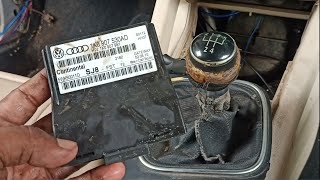
Typical fix: The Gateway module must be replaced. The scuttle drains must be thoroughly cleared to prevent a repeat failure. This involves removing the wiper arms and the plastic cowl cover to access the drain holes on each side. The new module will require 'Component Protection' to be removed by a dealer or specialist with the appropriate tools (like ODIS) 🎬 Watch: A guide on how to code the new gateway. to code it to the car's VIN.
Est. part cost: $150-$400 - Wiring Harness Damage 🟡 Medium Probability Wires for the CAN bus can become chafed, broken, or corroded. Common chafe points on related platforms include where the harness passes near the ECM/TCM bracket, the upper control arm, or the shock tower. While less common than gateway water damage for this specific code, it's a possibility if the car is dry.
How to confirm: Perform a visual inspection of major wiring harnesses in the engine bay, particularly under the battery tray and around the transmission. With the battery disconnected, use a multimeter to check for continuity on the CAN High and CAN Low wires (typically twisted pairs of orange/brown and orange/black) and check for shorts to power or ground. The total resistance between CAN High and CAN Low should be approximately 60 Ohms. A reading of 120 Ohms suggests a missing termination resistor (often in a module) or a break in the wiring. An open circuit (infinite resistance) indicates a definite break.
Typical fix: Repair the damaged section of wire. This involves soldering in a new piece of wire and protecting it with heat shrink tubing. Secure the harness away from any sharp edges to prevent future chafing.
Est. part cost: $5-$20 - Faulty ABS Control Module ⚪ Low Probability The ABS module is a key node on the powertrain CAN bus. An internal failure can cause it to stop communicating or, in some cases, broadcast corrupt data that disrupts the entire network. This is a known, though less frequent, issue on Mk6 Golfs.
How to confirm: With a diagnostic tool like VCDS, attempt to communicate directly with the ABS module (Address 03). If it's unreachable while other modules are, and the wiring to it is intact, the module itself is suspect. You can also try disconnecting the ABS module's main electrical connector to see if communication with other modules is restored. If the network comes back to life, the ABS module is the culprit.
Typical fix: Replace the ABS control module and pump assembly. The replacement will need to be coded and adapted to the vehicle using a specialized scan tool.
Est. part cost: $300-$800
Rare But Worth Checking
- Faulty Ignition Switch: A failing electrical portion of the ignition switch can cause intermittent power loss to various modules, leading to a cascade of communication faults that can mimic a CAN bus failure.
- Improperly Installed Aftermarket Electronics: Devices like remote starters, alarms, or even diagnostic dongles plugged into the CAN bus can interfere with network communication if they are faulty or were installed/removed incorrectly (e.g., without disconnecting the battery). Aftermarket stereos are a common cause if not installed with the correct CAN bus adapter harness.
- Clogged Sunroof Drains: In addition to cowl drains, clogged sunroof drains can also cause water to enter the cabin, potentially damaging various electronics. The front drains exit near the front door hinges and the rears exit near the rear bumper. The rubber ends of these drains can get clogged with debris.
Diagnosis Steps
- Check for signs of water ingress in the driver's side footwell. Pull back the carpet and under-padding near the pedals and up behind the dashboard. Feel the thick foam padding high up for any dampness.
- Connect a VW-specific scan tool (like VCDS or ODIS). Attempt to run an auto-scan. Note which modules are 'Not Reachable'. If the CAN Gateway (Address 19) is unreachable, it is the primary suspect.
- Inspect all fuses in both the engine bay and interior fuse panels, paying close attention to any related to the Gateway, Instrument Cluster, or Diagnostics.
- Locate the CAN Gateway module (J533). It is mounted high in the driver's footwell, above the pedals, often near the steering column. It typically has a prominent red multi-pin connector.
- Disconnect the battery. Then, disconnect the Gateway module and inspect the module's pins and the harness connector for any signs of water damage, green or white corrosion, or bent pins.
- If no water damage is found, the network wiring must be tested. Disconnect the battery. Measure the resistance between Pin 6 (CAN High) and Pin 14 (CAN Low) at the OBD-II port. A healthy network should read approximately 60 Ohms. A reading of 120 Ohms suggests a break in the wiring or a faulty terminating resistor in a module. A reading near 0 Ohms indicates a short between the CAN lines.
- If a single module is suspected (e.g., ABS), try disconnecting its main electrical connector. Re-run the scan to see if communication is restored to the rest of the network. If it is, that module was bringing the bus down.
- As a preventative measure, clean the cowl/scuttle drains. Remove the wiper arms and the plastic cowl panel. Locate the drains on the driver and passenger sides and clear out all leaves and debris. Some owners modify the rubber drain ends to allow for better flow.
Parts You'll Likely Need
- CAN Gateway Module
(OEM #7N0907530 (various suffixes like R, AK, AN, etc.))— This module is the central point of failure, most commonly due to water damage from clogged scuttle drains on the Mk6 platform. The part number has been revised many times; it's critical to get a compatible replacement for your vehicle's specific equipment.
Trusted brands: Volkswagen (OEM)
OEM price range: $250-$450
Aftermarket price range: $100-$200 (Used)
Related Codes That Often Appear With This One
- Multiple U-codes (U0100, U0121, U0141, etc.) — These codes indicate a loss of communication with specific modules (ECM, ABS, BCM, etc.). They will appear alongside U0076 because the entire bus is down, preventing the Gateway from talking to any of them.
- 01314, 01315, 01316 — These are VW-specific fault codes indicating 'No Communication' with the Engine, Transmission, or ABS control modules, respectively. They are symptoms of the underlying U0076 network failure.
- 01044 — This is a VW-specific fault code for 'Control Module Incorrectly Coded'. This will often appear after a new CAN Gateway is installed but before Component Protection has been removed and it has been properly coded to the vehicle.
- 02095 — This VW-specific fault indicates 'Component Protection Active'. It will be present after installing a new or used CAN Gateway and must be cleared by a dealer or specialist using ODIS online functions before the module will work correctly.
Platform-Specific Known Issues
- Clogged scuttle panel drains are a very common issue on the Mk6 Golf platform and are the direct cause of most U0076 faults due to water damage to the CAN Gateway module. Regular cleaning is the best prevention.
- A Reddit user with a 2010 Golf 2.0TDI detailed their experience with U0076, describing a dashboard full of errors, the car dying, and finding the Gateway module 'really wet and dripping water' after discovering submerged carpets on the driver's side.
Mechanic-Grade Diagnostic Values
- CAN Bus Network Resistance — expected: ~60 Ω. Failure: A reading of ~120 Ω indicates an open circuit or a missing terminating resistor. A reading near 0 Ω indicates a short between the CAN High and Low wires.
- CAN High Voltage (recessive/idle state) — expected: ~2.5 V to 3.5 V. Failure: Voltage stuck high or low, or shorted to ground/power.
- CAN Low Voltage (recessive/idle state) — expected: ~1.5 V to 2.5 V. Failure: Voltage stuck high or low, or shorted to ground/power.
Hidden / Shadow Codes Worth Checking
- 02095: Component Protection Active. This is a VW-specific fault that indicates a new or used module (like the CAN Gateway) has been installed and is 'locked' until it is matched to the vehicle's VIN online. (see via Visible with VW-specific scan tools like VCDS or ODIS after module replacement.)
Scan Tool Commands That Help
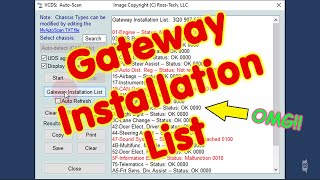
- VCDS (VAG-COM): Auto-Scan & Gateway Installation List — Run an Auto-Scan to see which modules are unreachable. After installing a new gateway, use the 'Installation List' function within the CAN Gateway (Address 19) to tell the new module which other modules are present in the vehicle.
- ODIS (Offboard Diagnostic Information System): Component Protection Removal — This dealer-level function is mandatory after replacing the CAN Gateway (J533). It requires an online connection to VW's servers (GEKO access) to unlock the new module and pair it to the car's VIN. Without this step, the module will not function correctly and fault 02095 will remain.
- VCDS (VAG-COM): Advanced Measuring Values — For controllers using the UDS protocol (common in newer Mk6 models), the standard 'Measuring Blocks' may be unavailable. 'Advanced Measuring Values' must be used to view live data from modules.
Wiring & Ground Locations
- J533 CAN Gateway Connector (Red) — High in the driver's footwell, above the pedals, often attached to a bracket near the steering column.. This is the main connector for the module that fails. Pin 1 is Terminal 30 (Battery+), Pin 11 is Terminal 31 (Ground). Powertrain CAN lines are on Pins 6 (High) and 16 (Low). Comfort CAN lines are on Pins 7 (High) and 17 (Low). Infotainment CAN lines are on Pins 8 (High) and 18 (Low).
- Driver's A-Pillar Ground Point — Located under the driver's side door sill plastic trim, toward the front of the car near the A-pillar. The carpet must be pulled back to access it.. This is a primary grounding point for multiple components in the driver's side dash area. A loose or corroded connection here can cause intermittent communication issues for various modules, including the CAN Gateway.
- Ground Point near Hood Release — A factory ground lug is located near the hood release lever in the driver's footwell. It is often identifiable by a dome-shaped nut cover.. This is another key ground connection in the vicinity of the CAN Gateway. Verifying it is clean and tight is a crucial step when diagnosing communication faults that aren't caused by water damage.
Real Owner Repair Stories
- Ross-Tech Forums user (MK6 Golf R) — After unplugging an aftermarket Polar FIS unit (which connects inline with the CAN Gateway) with the battery connected, the car threw numerous faults. The cluster would beep, needles would drop to zero, and doors would unlock intermittently. VCDS showed no communication with ECM, ABS, AWD, Airbags, etc.
❌ Tried (didn't work) Clearing codes with VCDS, Disconnecting the battery for 15 minutes, Removing the aftermarket unit and restoring factory wiring
✅ What actually fixed it The user had likely shorted or damaged the CAN Gateway module by unplugging the connector with the power on. The resolution required replacing the CAN Gateway module (J533) and having it properly coded to the vehicle. This story highlights the sensitivity of the module to electrical shorts.
OEM Part Supersession History
1K0 907 530 [various letter revisions like L, Q, S, AA, AD]→7N0 907 530 [various letter revisions like C, H, R, AN, BC, etc.]— Revision and update of the hardware and software over time. The 7N0 series gateways are generally more capable and required for newer radio/navigation head units (like the RNS-510) to prevent battery drain issues.
Heads up: When upgrading a radio, you often must also upgrade the CAN Gateway to a newer revision (e.g., from 1K0... to 7N0...) to avoid a widely documented battery drain issue. The new gateway must then be coded via VCDS to list the car's installed modules.
Diagnostic Flowchart
Other Known Issues on This Vehicle
Issues unrelated to this code that are worth knowing about as an owner of this generation:
- Timing Chain Tensioner Failure (2.0T TSI) 🔴 High — Common on pre-2013 models with the EA888 Gen 1/2 engine. Failure can occur at any mileage and leads to catastrophic engine damage. (Ref: No recall, but an updated tensioner part is available (P/N 06K-109-467-K).)
- DSG Mechatronics Unit Failure 🔴 High — Affects both 6-speed (DQ250) and 7-speed (DQ200) DSG transmissions. Symptoms include jerky shifting, flashing PRNDS indicator, and loss of gears. (Ref: Recalls were issued in some markets, but not universally. Failures are still common.)
- Water Pump & Thermostat Housing Leaks 🟠 Medium — Very common across all engines (TSI, TDI, 2.5L). The plastic housing warps and cracks, causing coolant leaks. Often occurs between 60k-100k miles. (Ref: A service action was issued for some GTI models, but it is a widespread issue.)
- Intake Manifold Runner Flap Motor/Sensor Failure (TSI) 🟠 Medium — The runner flaps or their position sensor can fail, causing a check engine light (P2015) and rough running. Requires replacement of the entire intake manifold. (Ref: A warranty extension was offered for this issue on some vehicles.)
- High-Pressure Fuel Pump (HPFP) Failure (TDI) 🔴 High — Early 2.0L TDI engines (2009-2012) were prone to HPFP failure, which sends metal debris throughout the entire fuel system, requiring a very expensive repair. (Ref: A warranty extension was issued for certain TDI models to cover this failure.)
- Carbon Buildup on Intake Valves (TSI) 🟠 Medium — As a direct-injection engine, fuel doesn't wash over the intake valves, leading to carbon buildup over time (typically 60k-100k miles), causing misfires and loss of power.
Used vs. New Parts: Buying Guide for This Vehicle
When a used part is the smart pick: A used CAN Gateway (J533) is a very sensible and cost-effective option for this repair, as the part itself is a simple electronic module with no moving parts. The failure is almost always caused by external water damage, not internal wear. A dry part from a donor vehicle is likely to have a long service life.
Donor-vehicle mileage cap: roughly under 150000 miles for the part to have meaningful remaining life.
What to inspect on the donor part:
- Verify the part number is a compatible revision for your vehicle's equipment (e.g., if you have an upgraded factory radio, you may need a newer 7N0 series gateway).
- Inspect the red connector port and all pins on the used module. There should be absolutely no signs of green or white corrosion, or any water staining on the casing.
- Ask the dismantler if the donor car showed signs of water leaks in the footwell; avoid parts from flood-damaged vehicles.
- Ensure the seller offers a return policy in case the module is faulty.
OEM-only on this vehicle (don't cheap out):
- CAN Gateway Module (J533). While aftermarket 'clones' may exist, they are not recommended due to the critical nature of this module and the complexities of Component Protection and vehicle-specific coding. Stick with genuine used or new OEM parts.
Brands owners have reported issues with on this vehicle:
- Unbranded 'clone' CAN Gateway modules from online marketplaces.
Real Owner Stories
Aggregated from forums and TSBs cited above. Mileages and costs reflect what owners reported in those sources.
2010 Volkswagen Golf 2.0TDI
Symptoms: A dashboard full of errors, the car dying, and discovering submerged carpets on the driver's side. The CAN Gateway module was found to be 'really wet and dripping water'.
What fixed it: The water-damaged CAN Gateway module (J533) had to be replaced and the clogged scuttle drains cleared to prevent a recurrence.
Source hint: Reddit r/AskMechanics: Issues with Golf MK6 Gateway module? - UK RHD
Related OBD-II Codes
Frequently Asked Questions
I found water in the driver's side footwell of my 2011 Golf. Could this be related to the U0076 code and all the warning lights on my dash?
Where is the CAN Gateway module (J533) located on my 2010-2014 Golf?
How can I prevent the U0076 code from happening to my Golf in the first place?
I'm testing the wiring at the OBD-II port. What resistance reading should I expect for a healthy CAN bus?
If I buy a new CAN Gateway module and install it myself, will that fix the problem immediately?
My ABS and ESC lights are on, and my scanner can't talk to the ABS module. Could the ABS module itself cause the U0076 code?
Helpful Videos




The information in this article is provided for general reference and educational purposes only. Vehicle specifications, procedures, and part compatibility can vary by production date, trim level, and region. Always consult your vehicle's factory service manual and verify part numbers before purchasing or performing repairs. Safety-critical components such as airbags, seat belts, and braking systems should be installed by a qualified professional.
- Volkswagen Golf:
- 🧭 Diagnostic Flowchart
- 🎬 Helpful Videos
- What's Unique About the 2010-2014 Volkswagen Golf
- Symptoms You May Notice
- Most Likely Causes
- Rare But Worth Checking
- Diagnosis Steps
- Parts You'll Likely Need
- Related Codes That Often Appear With This One
- Platform-Specific Known Issues
- Mechanic-Grade Diagnostic Values
- Hidden / Shadow Codes Worth Checking
- Scan Tool Commands That Help
- Wiring & Ground Locations
- Real Owner Repair Stories
- OEM Part Supersession History
- Other Known Issues on This Vehicle
- Used vs. New Parts: Buying Guide for This Vehicle
- Real Owner Stories
- 2010 Volkswagen Golf 2.0TDI
- Related OBD-II Codes
- Frequently Asked Questions
- 🎟️ Get 5% Off