

U0100 on 2016-2026 Volvo XC90: Lost Communication With ECM Causes and Fixes
On a 2016-2026 Volvo XC90, code U0100 almost always points to a battery issue. These vehicles use both a main AGM battery and a smaller auxiliary battery; a fault in either can cause this code. Before suspecting an expensive ECM failure, fully test both batteries and inspect all major ground connections. A failing auxiliary battery is a very common culprit for a cascade of electrical warnings.
- Always start by load testing BOTH the main AGM battery and the smaller auxiliary battery. This is the most common fix.
- If batteries are healthy, inspect and clean all major ground connections, especially on the engine and strut towers.
- Do not assume the ECM has failed. It is the most expensive and least likely cause of a U0100 code.
- This code indicates a critical fault. Do not drive the vehicle, as it may stall at any time.
- Be aware that a software update from a Volvo dealer may be required to fully clear communication faults after a repair.
What's Unique About the 2016-2026 Volvo XC90
The Volvo XC90 (SPA platform) is an electronically sophisticated vehicle that is highly sensitive to battery voltage. Unlike older cars, it uses two batteries: a large 12V AGM (Absorbent Glass Mat) battery for main power and a smaller auxiliary battery to support the Start/Stop function and other electronics. A failure or weakness in *either* battery can disrupt the CAN bus network and trigger a U0100 code, making a thorough battery system check the most critical first step. The main AGM battery is located in the trunk/cargo area, while the auxiliary battery is in the engine bay, and many owners are unaware of its existence.
Symptoms You May Notice
- Engine will not start or cranks for a long time
- Engine stalls intermittently while driving
- Multiple warning lights on the dashboard (Check Engine, ABS, SRS, etc.)
- Transmission may enter a 'limp mode' or shift erratically
- Loss of power steering or other electronic features
- Message on dash displaying 'Start/Stop support battery service required'
- Instrument cluster gauges may stop working or go blank
- Infotainment screen (Sensus) may freeze or go black
- Replacing the ECM first. The ECM is rarely the root cause; the problem is almost always in the power or ground supply to the module.
- Ignoring the small auxiliary battery. Many owners and even some shops are unaware of the second battery and only check the main one in the trunk, leading to repeated issues.
Most Likely Causes
- Failed Auxiliary (Start/Stop) Battery 🔴 High Probability → Shop Vehicle Battery This smaller battery, located under the hood, has a typical lifespan of 3-5 years and its failure is a very common cause of widespread electrical faults and communication codes like U0100 on the XC90. Its failure often precedes the main battery's failure.
How to confirm: Test the auxiliary battery separately. It is located in the engine bay near the firewall. A voltage reading below 12V with the car off indicates a problem. A professional load test is the most definitive confirmation. A reading of 10.65V or lower is a clear sign of failure.
Typical fix: Replace the auxiliary battery. This is a relatively simple replacement. The OEM part number is 30659531. 🎬 Watch this DIY guide to diagnose and replace your auxiliary battery. Aftermarket equivalents like Die-Hard AUX14 may be slightly taller and require modification of the battery box cover. After replacement, the 'Start/Stop Service Required' message may remain until cleared with a VIDA scan tool, though sometimes it disappears after a few drive cycles.
Est. part cost: $80-$180 - Weak or Failing Main 12V AGM Battery 🔴 High Probability → Shop Vehicle Battery The SPA platform has a high and constant electrical demand. The main AGM battery, located in the trunk, can cause communication faults when its voltage drops even slightly. Its lifespan is typically 3-5 years.
How to confirm: Use a digital multimeter to test the battery voltage with the engine off; a healthy AGM battery should read ~12.6-12.8V. Perform a load test with a dedicated battery tester to confirm its health, as voltage alone can be misleading.
Typical fix: Replace the main 12V AGM battery (H7/Group Size 94R or H8/Group Size 49). The new battery must be registered to the vehicle's Battery Monitoring System (BMS) using a capable scan tool to ensure proper charging and longevity.
Est. part cost: $250-$450 - Corroded or Loose Ground Straps 🟡 Medium Probability → Shop Engine Ground Strap Key ground points, such as the engine-to-chassis strap and connections on the strut towers, can corrode or loosen over time, creating high resistance and causing voltage drops that trigger network faults.
How to confirm: Visually inspect the main ground cable from the battery, the braided strap from the engine to the chassis, and the smaller ground points on both front strut towers. Look for green/white corrosion or any looseness. A voltage drop test across the ground strap is a more definitive test.
Typical fix: Remove, clean all contact surfaces to bare metal, and securely re-tighten the ground connections. Replace any straps that are badly corroded. 🎬 Learn how to check and clean your vehicle's electrical ground connections.
Est. part cost: $20-$60 - Blown Fuse for the ECM ⚪ Low Probability While not common, a fuse providing power to the Engine Control Module can blow, causing it to drop off the network instantly.
How to confirm: Consult the owner's manual for the fuse box diagrams (engine bay and interior). Locate and visually inspect all fuses labeled 'ECM', 'ECU', or 'Engine Control'. The engine bay fuse box protects engine and brake electronics.
Typical fix: Replace the blown fuse with a new one of the exact same amperage rating. If the new fuse blows immediately, this indicates a short circuit that needs further diagnosis.
Est. part cost: $1-$5 - ECM Software Glitch ⚪ Low Probability Communication modules on modern Volvos sometimes require software updates to resolve bugs that can cause communication to drop. This is especially true after a battery replacement, where modules may not re-initialize correctly.
How to confirm: This can only be confirmed by a Volvo dealer or a specialist with access to Volvo's diagnostic software (VIDA), which can check the current software version against available updates.
Typical fix: A Volvo dealership performs a software update on the ECM and potentially other related modules. This is often done after another repair (like a battery replacement) to ensure all modules are communicating correctly.
Est. part cost: $0-$250 (Labor for update)
Rare But Worth Checking
- Damaged CAN Bus Wiring: Check for this if the vehicle has a history of rodent damage or has had aftermarket electronics installed. A chafed wire in the harness can short the network, causing intermittent faults. The two CAN wires are typically twisted together.
- Failed Engine Control Module (ECM): → Shop Engine Control Module (ECM) This is the least likely cause. The ECM is a robust component. It should only be suspected after all power, ground, and wiring issues have been definitively ruled out by a professional.
Diagnosis Steps
- Scan for All Codes: Use an advanced OBD-II scanner to read codes from all vehicle modules, not just the engine. Note any other 'U' codes or power-related codes like P0562.
- Test Both Batteries: Start with the small auxiliary battery under the hood. Then, test the main AGM battery in the trunk. Use a professional load tester for both. Do not trust a voltage reading alone. A healthy battery should be above 12.4V at rest.
- Inspect Battery Terminals: Check the terminals on both batteries for any signs of corrosion or looseness. Clean and tighten as needed.
- Inspect Main Grounds: Visually inspect and physically check the main chassis ground points. Key locations are the front strut towers, the engine block, and near the battery in the trunk. Ensure they are clean, tight, and free of corrosion.
- Check ECM Fuses: Locate the fuse boxes (engine bay and passenger compartment) and check all fuses related to the Engine Control Module.
- CAN Bus Inspection (Professional): If the above steps do not resolve the issue, a technician will need to check the CAN bus wiring for shorts or open circuits. This involves checking for ~60 ohms of resistance across the CAN High and CAN Low pins at the OBD-II port (with the battery disconnected).
- ECM Power/Ground Check (Professional): A technician will verify that the ECM itself is receiving proper voltage and has a solid ground connection at its main connector.
- Consider ECM Replacement: Only after all other possibilities have been exhausted should the ECM be considered faulty.
Parts You'll Likely Need
- Auxiliary Battery
(OEM #30659531)— This small battery for the start/stop system is a very common failure point and a primary cause of electrical and communication faults.
Trusted brands: Volvo Genuine, Varta, Banner, AC Delco, DieHard (AUX14)
OEM price range: $120-$180
Aftermarket price range: $80-$120 - Main AGM Battery
(OEM #31652065 (H7 800CCA), 31652067 (H8 850CCA))— The main power source for the vehicle's complex electronics. Its health is critical for network stability. Requires BMS reset after replacement.
Related Codes That Often Appear With This One
- U0101 — Lost Communication with TCM (Transmission Control Module). The TCM and ECM work closely together, and a network failure often affects both.
- U0401 — Invalid Data Received From ECM/PCM. This means other modules are still connected to the network but are receiving nonsensical data from the ECM, often a precursor or result of a U0100.
- P0562 — System Voltage Low. This code is a strong indicator that a weak or failing battery is the root cause of the communication failure.
Platform-Specific Known Issues
- The 2016+ XC90 platform is known for its sensitivity to battery health, with both the main and auxiliary batteries being potential culprits for a wide range of electronic issues, including communication codes.
- Some communication issues, particularly those related to specific modules like the VCM (Vehicle Communication Module), may require a dealer software update to fully resolve, even after a hardware part like a battery has been replaced.
Mechanic-Grade Diagnostic Values
- CAN Bus Network Resistance — expected: ~60 Ohms. Failure: A reading of ~120 Ohms indicates an open circuit or one of the two terminating resistors is offline. A reading near 0 Ohms indicates a short between CAN High and CAN Low wires.
- CAN High Voltage (Key On, Engine Off) — expected: ~2.6V to ~3.5V. Failure: Significant deviation from this range, or voltage matching CAN Low, indicates a fault.
- CAN Low Voltage (Key On, Engine Off) — expected: ~1.5V to ~2.4V. Failure: Significant deviation from this range, or voltage matching CAN High, indicates a fault.
- Auxiliary Battery Resting Voltage — expected: ~12.4V or higher. Failure: A reading of 10-11V indicates a bad battery that needs replacement.
- Ground Circuit Resistance — expected: < 0.1 Ohms. Failure: Higher resistance indicates a corroded or loose ground connection that can cause intermittent module communication.
Hidden / Shadow Codes Worth Checking
- CEM-DF03 to CEM-DF16: These are Volvo-specific codes stored in the Central Electronic Module (CEM) that indicate a short-to-ground or short-to-voltage on the CAN bus network. For example, DF13-DF16 refer to the high-speed network where the ECM communicates. (see via These codes are not visible with a standard OBD-II reader and require a Volvo-specific scan tool like VIDA to be read from the CEM.)
- VCM-U300049 (or B105096 on older VIDA): Control Module - Internal Electronic Failure. This code is often stored in the Vehicle Connectivity Module (VCM) and points to a failure of its internal backup battery, which can cause a 'Volvo On Call Service Required' message and sometimes contribute to network instability. (see via Requires a Volvo-specific scan tool (VIDA) to read codes from the VCM.)
Scan Tool Commands That Help
- Volvo VIDA: Battery Replacement/BMS Reset — After replacing the main 12V AGM battery, VIDA is used to reset the Battery Monitoring System (BMS). This tells the car a new battery has been installed, ensuring correct charging strategy and preventing premature battery failure.
- Volvo VIDA: Clear 'Start/Stop Service Required' Message — After replacing the auxiliary battery, the warning message may persist. While it sometimes clears on its own after driving, using VIDA to clear the code from the relevant module is the definitive way to extinguish the light immediately.
- Volvo VIDA or advanced bidirectional scanner: Network Test / Module Status — To diagnose a U0100, a technician can use this function to poll all modules on the CAN bus. The tool will display a list of all expected modules and show which ones are not responding, confirming that the ECM is offline.
Wiring & Ground Locations
- Auxiliary Battery Location — In the engine bay, on the passenger side, under a plastic cover near the firewall and windshield. The positive jump-start terminal is often integrated into this cover.. This is the location of the most common failure point (the auxiliary battery) for electrical and communication codes on this vehicle.
- Main Battery Location — In the trunk/cargo area, under the floor panel, typically on the driver's side.. The second most common cause is the main battery. Its location in the rear means the main power and ground cables run the length of the vehicle, offering more potential points for damage.
- Main Engine/Chassis Ground Points — Key points include a dedicated ground post on the passenger side strut tower (often used for jump-starting), a braided strap from the engine block to the chassis, and ground connections near the main battery in the trunk.. Corrosion or looseness at these critical ground points can create voltage drops sufficient to disrupt module communication and trigger a U0100.
- Multiple Earth Point (MEP) — Located behind the kick panel trim in both the driver and passenger footwells.. These are central grounding locations for many interior modules. A fault here can cause widespread, difficult-to-diagnose communication issues.
- Vehicle Connectivity Module (VCM) — Located in the rear passenger side, behind the D-pillar trim panel.. A failure of the VCM's internal backup battery can cause the 'On Call Service Required' message and, in some edge cases, contribute to network noise.
Real Owner Repair Stories
- FCP Euro YouTube Commenter (Volvo SPA Platform Vehicle (S90, XC90, etc.)) — 'Start/Stop Service Required' message, plus AC fan speed would not function at higher speeds.
❌ Tried (didn't work) Took to a 'Volvo specialist' who quoted $700 to diagnose a suspected AC hose leak for the fan issue and $500 to replace the auxiliary battery.
✅ What actually fixed it The owner replaced the auxiliary battery themselves for $92. This not only cleared the start/stop message but also completely resolved the unrelated AC fan speed problem, indicating the failing battery was causing widespread electronic issues. - Reddit user /u/chauzer (2018+ CPO Volvo XC90) — 'Start/Stop support battery error' message appeared, followed by the Park Assist system failing to work.
❌ Tried (didn't work) Initial googling and forum searching.
✅ What actually fixed it The issue was the auxiliary battery. The user scheduled an appointment with the dealership, and the battery replacement was covered under the Certified Pre-Owned (CPO) warranty. This highlights that even secondary batteries can be covered under warranty.
OEM Part Supersession History
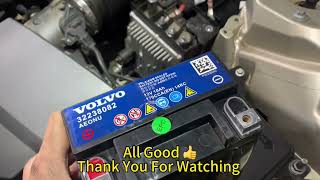
30659531→32238082— Standard part revision and supplier change for the auxiliary support battery.
Heads up: Both part numbers are generally interchangeable for the 10Ah AGM auxiliary battery. Some aftermarket replacements like the Duralast AUX14 are known to be slightly taller, which may require leaving the plastic battery box cover slightly unseated.31450445→N/A— This is the part number for the small, non-rechargeable backup battery inside the Vehicle Connectivity Module (VCM).
Heads up: When replacing this battery for the 'On Call Service Required' message, a software update via VIDA is recommended to reset the module's internal service life counter. Failure to do so may cause the warning to return prematurely.
Model Year Variations Within This Range
- 2019+: For the 2019 model year, the Sensus infotainment display received a 50% faster processor. While not directly related to U0100, a more stable infotainment system can reduce the chances of network data storms that sometimes trigger communication faults.
- 2020+: Starting in 2020, Volvo introduced new mild-hybrid 'B' badged powertrains in some markets, which use a more complex 48V system alongside the 12V system. The T8 plug-in hybrid also received a larger capacity battery (11.6 kWh). These changes add complexity to the electrical system, though the root causes for U0100 (12V main/aux batteries, grounds) remain the primary culprits.
- 2022.5+: Later models (T8 Recharge Extended Range) feature a much larger high-voltage battery (18.8 kWh) and a more powerful rear electric motor. While this doesn't change the U0100 diagnosis related to the 12V system, it's a significant powertrain evolution within the generation.
Diagnostic Flowchart
Other Known Issues on This Vehicle
Issues unrelated to this code that are worth knowing about as an owner of this generation:
- Excessive Oil Consumption (2.0L Engines) 🔴 High — Common on early (2016-2017) T6 models, often appearing after 50,000 miles. Caused by faulty piston ring design. (Ref: Volvo issued an extended warranty program (P10207) covering repairs for qualifying vehicles up to 8 years/100,000 miles.)
- Air Suspension Failure 🟠 Medium — Failures of air springs (leaks) or the compressor can occur, typically after 100,000 km. Symptoms include the vehicle sitting low on one corner or a harsh ride. (Ref: Technical Journal TJ30517 addresses issues with dust covers on rear air springs, which can lead to premature failure.)
- Infotainment (Sensus) System Glitches/Black Screen 🟡 Low — Owners frequently report the center screen freezing, becoming unresponsive, or going completely black. This can often be temporarily resolved by a system reboot. (Ref: Software updates from the dealer can address some of these issues, but they can also be caused by underlying hardware or voltage problems.)
- Premature Brake Wear 🟠 Medium — Due to the vehicle's weight and systems like auto-braking, some owners report needing to replace pads and rotors more frequently than expected, sometimes as early as 20,000-30,000 miles.
- Water Leaks from Sunroof Drains 🟠 Medium — Clogged sunroof drains can cause water to leak into the cabin, potentially damaging sensitive electronics located in the footwells or dashboard, such as the Central Electronic Module (CEM).
Used vs. New Parts: Buying Guide for This Vehicle
When a used part is the smart pick: For this specific fault code, using used parts is strongly discouraged. The primary culprits are batteries, which have a finite lifespan and should always be purchased new. While a used wiring harness section could be used for a repair, the risk of obtaining another faulty part is high.
What to inspect on the donor part:
- Not applicable, as used electrical wear items are not recommended.
OEM-only on this vehicle (don't cheap out):
- Engine Control Module (ECM): While the ECM is rarely the fault, if it must be replaced, a new or professionally remanufactured OEM unit is essential. Used ECMs are often VIN-locked and cannot be reprogrammed to a different vehicle, making them useless.
- Central Electronic Module (CEM): Similar to the ECM, the CEM is coded to the vehicle and a used unit will not work without specialized, and often impossible, reprogramming.
Aftermarket brands forum-validated for this vehicle:
- Auxiliary Battery: Duralast (AUX14), ACDelco, and other reputable battery brands are considered reliable alternatives to the Genuine Volvo part.
- Main AGM Battery: Bosch, Duralast, and Interstate are well-regarded brands for the main H7 or H8 AGM battery.
Brands owners have reported issues with on this vehicle:
- Unbranded/No-Name Batteries: Avoid generic, unbranded auxiliary or main batteries from online marketplaces. Inconsistent voltage and quality can fail to solve the U0100 code or may fail prematurely, especially given the high electrical demands of the XC90.
Real Owner Stories
Aggregated from forums and TSBs cited above. Mileages and costs reflect what owners reported in those sources.
2016-2023 Volvo XC90
Symptoms: The 'Start/Stop Service Required' message appeared on the dash. The owner noted the auxiliary battery was failing.
What fixed it: Replacement of the auxiliary battery with an aftermarket Die-Hard AUX14, which required modifying the battery box cover to fit the taller height.
Source hint: YouTube: Volvo Start Stop Service Required - Support Battery Replacement by 'B Rich Solution'
2024 Volvo XC90 Recharge
Symptoms: The infotainment screen blacked out while driving the vehicle.
What fixed it: System reboot (though context notes this is a temporary fix if the root cause is a voltage issue).
Source hint: Reddit r/VolvoXC90: Screen blacked out while driving my 2024 XC 90 recharge
Related OBD-II Codes
Frequently Asked Questions
My 2016 XC90 shows 'Start/Stop support battery service required.' Is this related to the U0100 code?
Where is the auxiliary battery located on my XC90, and how do I test it?
Can I use an aftermarket battery like the Die-Hard AUX14 for my XC90?
Do I need to do anything special after replacing the main AGM battery in the trunk?
Why did my Sensus infotainment screen go black while driving?
Will replacing the battery automatically clear the 'Start/Stop Service Required' message?
Helpful Videos



The information in this article is provided for general reference and educational purposes only. Vehicle specifications, procedures, and part compatibility can vary by production date, trim level, and region. Always consult your vehicle's factory service manual and verify part numbers before purchasing or performing repairs. Safety-critical components such as airbags, seat belts, and braking systems should be installed by a qualified professional.
- Volvo XC90:
- 🧭 Diagnostic Flowchart
- 🎬 Helpful Videos
- What's Unique About the 2016-2026 Volvo XC90
- Symptoms You May Notice
- Most Likely Causes
- Rare But Worth Checking
- Diagnosis Steps
- Parts You'll Likely Need
- Related Codes That Often Appear With This One
- Platform-Specific Known Issues
- Mechanic-Grade Diagnostic Values
- Hidden / Shadow Codes Worth Checking
- Scan Tool Commands That Help
- Wiring & Ground Locations
- Real Owner Repair Stories
- OEM Part Supersession History
- Model Year Variations Within This Range
- Other Known Issues on This Vehicle
- Used vs. New Parts: Buying Guide for This Vehicle
- Real Owner Stories
- 2016-2023 Volvo XC90
- 2024 Volvo XC90 Recharge
- Related OBD-II Codes
- Frequently Asked Questions
- 🎟️ Get 5% Off