

U0141 on 2011-2017 Hyundai Sonata: Lost Communication With Body Control Module Fixes
U0141 on a 2011-2017 Sonata usually means there's an electrical problem preventing the Body Control Module (BCM) from communicating. Before replacing the expensive BCM, check for blown fuses in the driver-side and engine bay panels, a weak battery, or corroded wiring and grounds, as these are the most common and cheapest fixes.
- U0141 means the Body Control Module (BCM) has stopped communicating, causing failures in lights, locks, and windows.
- ALWAYS check the battery, grounds, and all BCM-related fuses in the dash and engine bay before considering BCM replacement. This is the most likely fix.
- On the 2011-2017 Sonata, corroded wiring is a known culprit for this code. Inspect connectors for damage.
- Driving is not recommended due to the risk of safety system failures like headlights or turn signals.
- If the BCM must be replaced, it requires professional programming to your car's VIN to function.
What's Unique About the 2011-2017 Hyundai Sonata
On this generation of Hyundai Sonata, the U0141 code is frequently traced back to simple power supply problems or wiring issues rather than an outright failure of the Body Control Module itself. Owners often find the root cause to be a blown fuse, a poor ground connection, or corrosion in a wiring connector under the dash or in the engine bay. The BCM is located above the gas pedal, tucked between the heater box and a support brace, making access tight but possible for inspection. While the BCM can fail, it's critical to exhaust all wiring and power-related checks first, as these are far more common culprits on this specific vehicle.
Generation note: This guide covers the 6th generation (YF, 2011-2014) and 7th generation (LF, 2015-2017) Hyundai Sonata. The causes and diagnostic principles for U0141 are largely the same across both generations, as they rely on a similar CAN bus architecture. However, fuse locations and specific wiring harness routes may differ slightly. For the YF generation, the BCM is located above the gas pedal.
Symptoms You May Notice
- Power windows, door locks, or key fob not working
- Interior dome lights, map lights, or dashboard lights failing or staying on
- Headlights, tail lights, or turn signals working erratically or not at all
- Parking lights stay on even when the car is off.
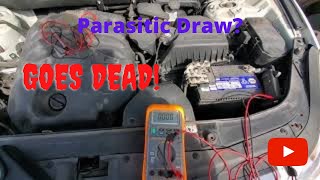
- Parasitic battery drain that causes the battery to die overnight 🎬 Watch: How to diagnose a parasitic battery drain
- Multiple unrelated warning lights appearing on the instrument cluster (a 'Christmas tree' effect)
- Car won't start, or starts and immediately stalls (due to immobilizer issue)
- Factory alarm may trigger randomly
- No sound from speakers (if the amplifier communication is routed through the BCM).
- Replacing the BCM without first thoroughly checking all related fuses, battery voltage, and ground connections. These simple issues are far more common causes for the U0141 code on this vehicle.
- Mistaking a general CAN bus network failure for a BCM-specific failure. If multiple 'U' codes are present (e.g., U0100, U0155), the problem may lie in the shared network wiring, not the BCM itself.
Most Likely Causes
- Blown Fuse(s) for the BCM 🔴 High Probability The BCM is powered by multiple fuses. A short in a connected component (like a light or lock actuator) can blow a fuse, cutting power to the module and triggering the U0141 code. This is a very common first point of failure.
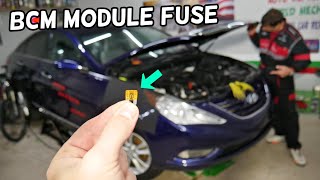
How to confirm: Visually inspect and test all fuses labeled 'Module,' 'BCM,' or 'Room LP' in both the interior (driver's side dash) and engine bay fuse panels. A video for a 2013 Sonata shows at least four separate fuses to check: 'Module 1' (7.5A), 'Module 2' (7.5A), a 10A fuse, and the 'Room LP' fuse. Always check the diagram on your vehicle's fuse box cover.
Typical fix: Replace the blown fuse with a new one of the exact same amperage. If the fuse blows again, there is an underlying short circuit that must be diagnosed.
Est. part cost: $1-$10 - Low Battery Voltage or Faulty Ground 🔴 High Probability → Shop Vehicle Battery Modern control modules are highly sensitive to voltage. An old battery, failing alternator, or corroded ground strap can cause voltage to drop below the ~12.4V threshold, making the BCM shut down unexpectedly and lose communication.
How to confirm: Test the battery voltage with a multimeter; it should be above 12.4V with the engine off. Check that the charging system is providing over 13V with the engine running. Inspect the main battery terminals and the BCM's ground wire connection to the chassis for corrosion or looseness. Wiring diagrams show a primary ground point (GM03) located on the top left side of the dash area for some models.
Typical fix: Replace a weak battery, repair the charging system, or clean/tighten the ground connection.
Est. part cost: $5-$300 - Corroded or Damaged Wiring/Connectors 🟡 Medium Probability Repair databases specifically note that for the 2011-2017 Sonata, this code often traces back to corroded wiring or damaged connectors in the engine bay or under the dash, rather than a faulty BCM. Moisture intrusion or chafing can damage the delicate CAN bus wires.
How to confirm: Visually inspect the wiring harnesses connected to the BCM (typically located behind the driver's side dash/fuse panel, above the gas pedal). Unplug its connectors and inspect for any signs of green/white corrosion, pinched wires, or pushed-out pins in the connectors. Pay close attention to the CAN High and CAN Low wires.
Typical fix: Clean the corroded terminals with an electrical contact cleaner and apply dielectric grease. Repair or replace the damaged section of the wiring harness.
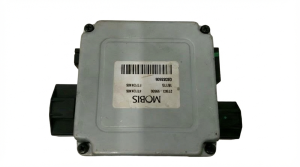
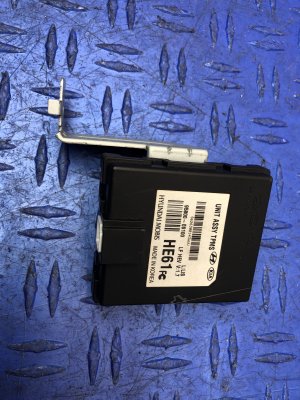
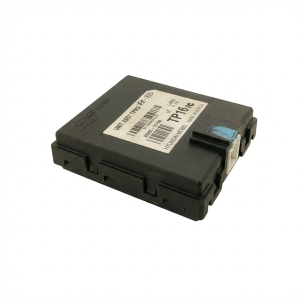
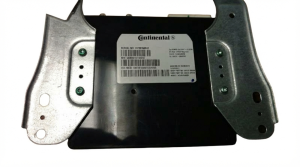
Est. part cost: $10-$200 - Failed Body Control Module (BCM) ⚪ Low Probability → Shop Body Control Module
How to confirm: This is diagnosed by exclusion. If all power sources, grounds, and wiring to the BCM have been tested and confirmed to be good, the module itself is the likely point of failure. A professional scan tool that can attempt direct communication with the BCM is needed for final confirmation. If the scan tool shows the BCM is not on the network, this points towards module failure.
Typical fix: Replace the BCM. The new or used module MUST be programmed to the vehicle's VIN by a dealer or a qualified locksmith with specialized equipment. Failure to program will result in a no-start condition or malfunctioning features.
Est. part cost: $400-$950
Diagnosis Steps
- Check Battery and Charging System: Ensure the battery has at least 12.4 volts and that the alternator is charging correctly (typically 13.2-14.8V) when the engine is running.
- Scan for All Codes: Use an OBD-II scanner capable of a full network scan to read codes from all vehicle modules, not just the engine computer. Note any other 'U' codes, as they point to the scope of the problem.
- Inspect All BCM Fuses: Carefully check all fuses related to the Body Control Module in both the interior and under-hood fuse boxes. On the YF Sonata, these may be labeled 'Module 1', 'Module 2', and 'Room LP'. Refer to your owner's manual or the fuse box lid for exact locations.
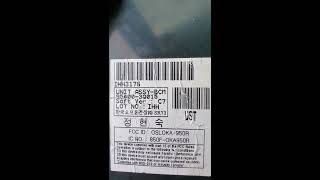
- Inspect BCM Wiring and Connectors: Gain access to the BCM (located above the gas pedal on YF models). 🎬 See this BCM location and removal walkthrough Unplug its connectors and inspect for any signs of corrosion, moisture, or damaged pins. Check for a secure connection.
- Verify Power and Ground at the BCM: Using a multimeter and a wiring diagram for your specific year, back-probe the BCM connector to confirm it is receiving constant battery voltage on the appropriate pins and has a solid ground connection (less than 0.5 ohms of resistance to chassis ground).
- Test CAN Bus Wires: This is an advanced step. With the key on, check for approximately 2.5V on both the CAN High and CAN Low wires at the BCM connector. With the battery disconnected, measure the resistance between the two CAN wires; it should be approximately 60 ohms if the network is intact.
- Condemn the BCM: If all previous steps show good power, ground, and CAN bus wiring, the BCM has likely failed internally and requires replacement and programming.
Parts You'll Likely Need
- Body Control Module (BCM)
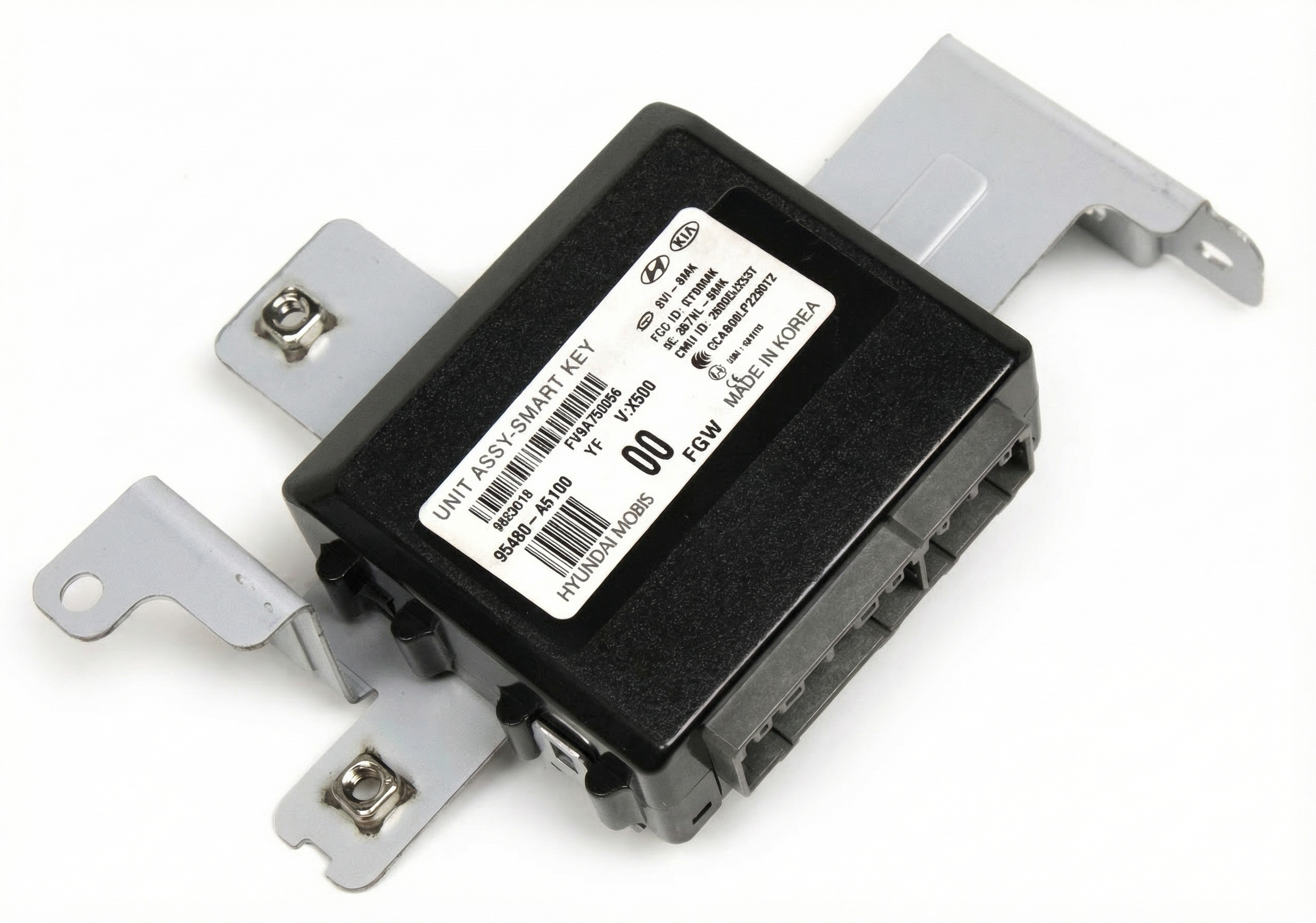
(OEM #95400-3Q001 (2011-2013, w/o Smart Key), 95400-3Q015 (2012-2014, w/ Smart Key))— This is the part to replace only after all wiring, fuse, and power/ground issues have been ruled out. It is the 'brain' for the body electronics. Part numbers are highly specific to year and options like Smart Key.
Trusted brands: Hyundai (OEM)
OEM price range: $650-$950
Aftermarket price range: $400-$700 (Remanufactured) - Automotive Fuses — A blown fuse is a very common cause for the BCM losing power and triggering this code.
Trusted brands: Bussmann, Littlefuse
OEM price range: $5-$15 (for a pack)
Aftermarket price range: $5-$10 (for a pack)
Related Codes That Often Appear With This One
- U0100 — Lost Communication with ECM/PCM. If you see this with U0141, it could indicate a more widespread network problem or a failure of the ECM itself.
- U0155 — Lost Communication With Instrument Panel Cluster (IPC). The instrument cluster can act as a gateway between other modules. Its failure can interrupt the signal between the ECM and BCM, causing U0141 as a secondary code.
Platform-Specific Known Issues
- There is a known safety recall (NHTSA Campaign 18V137000, Hyundai Recall 174) for 2011-2013 Sonatas concerning electrical overstress on the Airbag Control Unit. While not directly for the BCM, it indicates a sensitivity in the vehicle's electrical architecture that could be related to network communication faults.
Mechanic-Grade Diagnostic Values
- CAN Bus Resistance — expected: ~60 ohms. Failure: A reading of ~120 ohms indicates an open circuit or a missing terminating resistor. A reading near 0 ohms indicates a short between the CAN High and CAN Low wires.
- CAN High (CAN-H) Voltage — expected: ~2.5V to 3.5V (recessive state to dominant state). Failure: Voltage significantly outside this range, or stuck high/low, indicates a bus fault or short.
- CAN Low (CAN-L) Voltage — expected: ~1.5V to 2.5V (dominant state to recessive state). Failure: Voltage significantly outside this range, or stuck high/low, indicates a bus fault or short.
- BCM Ground Resistance — expected: Below 0.5 ohms. Failure: Higher resistance indicates a poor ground connection, which can cause intermittent module operation.
Scan Tool Commands That Help
- Hyundai GDS (Global Diagnostic System): Current DATA — To view live input/output values from the BCM, such as switch statuses (doors, lights, locks) and sensor readings. This helps confirm if the BCM is receiving commands correctly even if it's not activating the component.
- Hyundai GDS (Global Diagnostic System): Actuation Test — To force-operate outputs controlled by the BCM (e.g., turn on a specific light, lock a door). If the component activates during the test, it confirms the wiring and component are good, pointing the issue back to the BCM's logic or input signals.
- Hyundai GDS (Global Diagnostic System): Vehicle S/W Management — This function is used for ECU reprogramming, variant coding, and resetting adaptive values. It is required when installing a new or used BCM to program the vehicle's VIN and configure it for the specific options on the car.
Wiring & Ground Locations
- BCM Location (YF) — Located above the gas pedal, mounted sideways against the heater box.. This is the physical location of the module that needs to be accessed for visual inspection, connector testing, and replacement.
- Ground Point GM03 — Located on the top left side of the dash area for some 2014 Hybrid models.. This is a primary ground point for the BCM. A loose or corroded connection here will cut power to the module, causing a U0141 code.
- Dash Fuse Box Connector (F) — Rear of the driver's side interior fuse panel.. For some models, the B-CAN High (White/Orange, Pin 12) and B-CAN Low (Yellow/Orange, Pin 11) wires run through this connector. It's a potential point of failure for the communication network.
Real Owner Repair Stories
- YouTube channel 'Pine Hollow Auto Diagnostics' (2012 Hyundai Sonata 2.4L) — Transmission stuck in park, no communication with multiple control modules, scan tool could not identify the vehicle.
❌ Tried (didn't work) Initial scan showed multiple 'U' codes and no communication.
✅ What actually fixed it A visual inspection revealed a wiring harness in the engine bay had been chewed by mice. The broken wires included CAN bus lines, which took down the entire network. Repairing the damaged wires restored communication to all modules, cleared the U0141 and other codes, and fixed the stuck shifter.
OEM Part Supersession History
95400-3K200→95400-3K201— Part revision or update by manufacturer.
Heads up: Always confirm the latest part number with a dealer using the vehicle's VIN, as multiple revisions may exist.
Model Year Variations Within This Range
- 2011-2014 (YF Generation): The BCM is located above the gas pedal. Part numbers like 95400-3Q010 and 95400-3Q015 are common for these years, with variations for Smart Key systems.
- 2015-2017 (LF Generation): The CAN bus architecture and BCM part numbers were updated for the new generation. For example, a 2016-2018 Sonata Hybrid might use part number 95400-E6801. While the diagnostic principles are similar, wiring diagrams and part numbers are not interchangeable with the YF generation.
Diagnostic Flowchart
Other Known Issues on This Vehicle
Issues unrelated to this code that are worth knowing about as an owner of this generation:
- Theta II GDI Engine Failure 🔴 High — Widespread across 2.0L and 2.4L engines, particularly in 2011-2014 models. Can occur at various mileages, often starting with a knocking noise. (Ref: Multiple recalls (e.g., NHTSA 15V568000) and a class-action lawsuit settlement extended warranties and offered replacements for failures caused by manufacturing debris leading to connecting rod bearing wear.)
- Worn Steering Coupler 🟠 Medium — Extremely common. Owners notice a distinct clicking or ticking sound from the steering column when turning the wheel. The issue is a small, flexible rubber coupling inside the power steering motor that degrades. (Ref: Hyundai extended the warranty for this part to 10 years/100,000 miles (Campaign TXX7). The replacement part is an improved material. TSB 17-ST-002 provides details.)
- Parking Lights Stay On 🟡 Low — A frequently reported electrical issue where the parking lights will not turn off, leading to a dead battery. It is often caused by an internal failure of the cabin fuse box (Junction Block).
- Transmission Speed Sensor Failure 🟠 Medium — Common on earlier models, this causes harsh shifting, inability to shift, and a Check Engine Light. It's often misdiagnosed as a major transmission failure.
Used vs. New Parts: Buying Guide for This Vehicle
When a used part is the smart pick: A used BCM is a cost-effective option, especially if the original module has failed internally and the issue is not a simple fuse or wiring problem. It can save hundreds of dollars over a new OEM part.
Donor-vehicle mileage cap: roughly under 120000 miles for the part to have meaningful remaining life.
What to inspect on the donor part:
- Match the OEM part number EXACTLY. Do not rely on vehicle year/make/model alone.
- Inspect the connectors on the used module for any bent, broken, or corroded pins.
- Avoid any modules that show signs of water damage, such as discoloration or a white, chalky residue.
- Purchase from a reputable seller that offers a warranty and a return policy.
OEM-only on this vehicle (don't cheap out):
- Body Control Module (BCM) - While used OEM is viable, aftermarket 'new' BCMs are generally not available or recommended. The choice is between new OEM, used OEM, or a remanufactured OEM unit.
Brands owners have reported issues with on this vehicle:
- Unbranded or no-name 'new' modules from third-party marketplaces should be avoided due to likely programming and compatibility issues.
Real Owner Stories
Aggregated from forums and TSBs cited above. Mileages and costs reflect what owners reported in those sources.
2008 Hyundai Sonata
Symptoms: A no-start condition that was difficult to diagnose, potentially involving the BCM or neutral safety switch.
What fixed it: The discussion highlighted the complexity of diagnosing the BCM versus other electrical components like the neutral safety switch.
Source hint: Hyundai Forums: 2008 Sonata - Won't Start
2011-2014 Hyundai Sonata
Symptoms: Intermittent no-start problem, often appearing to be related to temperature changes.
What fixed it: The issue was linked to potential electronic module or relay failures that mimic BCM communication faults.
Source hint: Car Talk Community: Hyundai sonata intermittent no start
Related OBD-II Codes
Frequently Asked Questions
Where is the Body Control Module (BCM) located on my 2011-2017 Hyundai Sonata?
Is there a recall for electrical issues on the 2011-2013 Sonata that might cause communication codes?
Which specific fuses should I check for a U0141 code on my 2013 Sonata?
Can I just swap in a used BCM from a junkyard to fix the U0141 code?
Why is my Sonata's battery dying overnight along with the U0141 code?
Does the Kia Optima have the same U0141 issues as my Sonata?
Helpful Videos
We Have This Part in Stock

The information in this article is provided for general reference and educational purposes only. Vehicle specifications, procedures, and part compatibility can vary by production date, trim level, and region. Always consult your vehicle's factory service manual and verify part numbers before purchasing or performing repairs. Safety-critical components such as airbags, seat belts, and braking systems should be installed by a qualified professional.
- Hyundai Sonata:
- 🧭 Diagnostic Flowchart
- 🎬 Helpful Videos
- 🛍️ Shop This Part
- What's Unique About the 2011-2017 Hyundai Sonata
- Symptoms You May Notice
- Most Likely Causes
- Diagnosis Steps
- Parts You'll Likely Need
- Related Codes That Often Appear With This One
- Platform-Specific Known Issues
- Mechanic-Grade Diagnostic Values
- Scan Tool Commands That Help
- Wiring & Ground Locations
- Real Owner Repair Stories
- OEM Part Supersession History
- Model Year Variations Within This Range
- Other Known Issues on This Vehicle
- Used vs. New Parts: Buying Guide for This Vehicle
- Real Owner Stories
- 2008 Hyundai Sonata
- 2011-2014 Hyundai Sonata
- Related OBD-II Codes
- Frequently Asked Questions
- 🎟️ Get 5% Off