

C0045 on 2012-2015 Honda Civic: Left Rear Wheel Speed Sensor Circuit Fixes
Code C0045 on a 2012-2015 Honda Civic means there's a fault with the left rear wheel speed sensor circuit. This is most often caused by a damaged sensor wire in the wheel well or a failed sensor. An aftermarket sensor costs around $20-$70, and it's a manageable DIY fix for many.
- C0045 on a 2012-2015 Civic points to a problem with the left rear wheel speed sensor circuit.
- Before buying a new sensor, carefully inspect the wiring harness in the wheel well for breaks or damage, as this is a very common failure point.
- This fault will disable your ABS and VSA systems, so exercise caution when driving, especially in wet or slippery conditions.
- An ABS-capable scan tool that can read live data is the most effective tool for confirming which wheel sensor is faulting.
- The repair is DIY-friendly for those with basic tools, with aftermarket sensors being very affordable.
What's Unique About the 2012-2015 Honda Civic
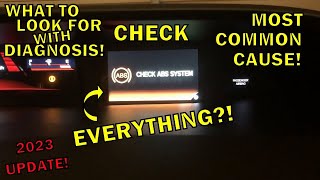
On the 9th generation (2012-2015) Honda Civic, the wiring for the wheel speed sensors is a known weak point. The wires are exposed in the wheel well and can become brittle over time, leading to fraying or snapping completely from suspension movement or road debris. Owners frequently report a cascade of warning lights, including ABS, VSA, Power Steering (EPS), and Hill Start Assist, all stemming from this single sensor circuit failure. 🎬 Watch this diagnosis of the common 'Check Everything' warning light cascade. This is a well-documented failure mode in owner forums.
Symptoms You May Notice
- ABS warning light is on
- VSA (Vehicle Stability Assist) or traction control warning light is on
- Power Steering (EPS) warning light may illuminate
- Hill Start Assist warning light may illuminate
- Anti-lock brakes do not function during hard stops
- Traction control does not function on slippery surfaces
- Replacing the wheel speed sensor without first thoroughly inspecting the wiring harness. A broken wire is a very common cause on this vehicle and replacing the sensor will not fix the issue.
- Replacing the wheel speed sensor when the actual fault is a contaminated magnetic encoder ring on the wheel bearing. Cleaning the ring is a much cheaper first step.
Most Likely Causes
- Damaged or Broken Sensor Wiring Harness 🔴 High Probability The wiring harness in the wheel well is susceptible to damage from road debris, ice buildup, or repeated suspension movement, which can cause wires to fray or break. This is the most common point of failure for this code on this platform.
How to confirm: Visually inspect the entire length of the wire from the sensor to where it enters the car body. Pay close attention to the areas where the wire is secured by clips or passes near suspension components. Look for any breaks, chafing, or corrosion on the wire and at the connector plug.
Typical fix: Repair the broken section of wire using solder and heat-shrink tubing or replace the sensor pigtail/harness if the damage is close to the connector.
Est. part cost: $15-$40 for a pigtail connector - Failed Left Rear Wheel Speed Sensor 🔴 High Probability → Shop ABS Wheel Speed Sensor The sensor is exposed to harsh conditions like water, salt, and dirt, which can lead to internal failure over time.
How to confirm: After confirming the wiring is good, use a multimeter to test the sensor's internal resistance and compare it to the manufacturer's specification. An out-of-spec reading indicates a bad sensor. Alternatively, use an ABS-capable scan tool to monitor live data; if the left rear wheel shows 0 MPH while the others show speed, the sensor has likely failed.
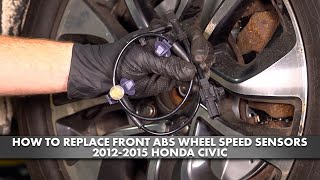
Typical fix: Replace the left rear wheel speed sensor. This typically involves removing one 10mm bolt and unplugging the electrical connector. 🎬 See this step-by-step walkthrough for replacing the wheel speed sensor.
Est. part cost: $20-$70 for aftermarket, $180+ for OEM - Damaged or Debris on Magnetic Encoder Ring ⚪ Low Probability Instead of a traditional toothed tone ring, this Civic uses a magnetic encoder built into the wheel bearing's dust seal. While protected, metallic debris (like brake dust) can accumulate on the seal, disrupting the magnetic field and causing an erratic signal.
How to confirm: After removing the sensor, visually inspect the surface of the wheel bearing seal where the sensor reads. Look for a buildup of metallic dust or physical damage to the seal. You can also use a cotton swab or a clean rag with brake cleaner to wipe the surface through the sensor hole.
Typical fix: In many cases, simply cleaning the magnetic encoder surface can restore the signal. If the encoder ring itself is damaged (e.g., cracked seal), the entire wheel hub/bearing assembly must be replaced as the ring is integrated.
Est. part cost: $80-$150 for a hub assembly
Rare But Worth Checking
- Faulty ABS Control Module: → Shop ABS Control Module This is the least likely cause and should only be considered after the sensor, wiring, and hub assembly have been ruled out. It is an expensive part and often requires programming by a dealer or specialized shop. In some cross-manufacturer instances, such as described in NHTSA ODI #10382746 for a Subaru, dealers have been instructed to erase codes and re-program software when C0045 appears alongside other communication codes.
Diagnosis Steps
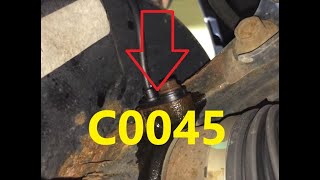
- Read the codes with an ABS-capable OBD-II scanner to confirm C0045 is the active fault. 🎬 Watch a breakdown of the causes and fixes for code C0045.
- Use the scanner's live data function to view the wheel speed from all four sensors while driving slowly or spinning the wheel by hand. Confirm that the left rear sensor reads 0 or has an erratic signal compared to the others.
- Safely raise and support the vehicle and remove the left rear wheel.
- Perform a thorough visual inspection of the wheel speed sensor wiring harness. Gently tug on the wire near the connector and along its path to check for hidden breaks inside the insulation.
- If the wiring looks good, disconnect the sensor and test its internal resistance with a multimeter. Compare the reading to the factory specification. An open (OL) or shorted (near 0 ohms) reading indicates a failed sensor.
- If the sensor tests good, check for continuity on the wiring harness between the sensor connector and the ABS control module to rule out a break in the harness.
- Remove the 10mm bolt holding the sensor and pull the sensor out. Inspect the magnetic encoder ring on the wheel bearing for metallic debris or damage. Clean the surface with brake cleaner and a rag.
- If all other components check out, the fault may lie with the ABS control module, which typically requires professional diagnosis.
Parts You'll Likely Need
- Left Rear ABS Wheel Speed Sensor
(OEM #57475-TR3-A02, 57475-TV0-E01)— This is the most commonly replaced part to fix a C0045 code, assuming the wiring is intact. Note: Two part numbers are listed in catalogs; verify the correct one for your vehicle's VIN and build location (US/Canada).
Trusted brands: Honda (OEM), NTK, Delphi, Standard Motor Products (SMP), Beck/Arnley
OEM price range: $180-$202
Aftermarket price range: $20-$70
Related Codes That Often Appear With This One
- C0050 — This is the code for the Right Rear Wheel Speed Sensor. If both C0045 and C0050 appear together, it strongly suggests a problem with a shared part of the circuit, like the main rear wiring harness or the ABS module itself, rather than two failed sensors.
- P0463 / P069E — While primarily seen on other makes like Chevrolet (NHTSA ODI #11399819), these fuel system codes have occasionally been documented appearing alongside C0045, though they usually point to separate electrical circuit issues.
Platform-Specific Known Issues
- A video from a 9th generation Civic Si owner shows the ABS sensor wire completely snapped off inside the wheel well, which triggered a host of warning lights including ABS, VSA, TPMS, Hill Start Assist, and Power Steering.
- A thread on the 9thgencivic.com forum titled 'ABS, VSA, and power steering lights all on' details an owner's experience where the C0045 code was caused by a severed wire near the sensor connector, a repair that involved soldering the wires back together.
Mechanic-Grade Diagnostic Values
- Left Rear Wheel Speed Sensor Signal (at VSA modulator connector) — expected: Pulsing voltage (AC for passive, square-wave for active) when wheel is spun.. Failure: No signal, or a constant voltage, indicates an open or short in the circuit.
- Battery Voltage (Key Off) — expected: Approximately 12.5 volts or higher.. Failure: A reading below 12.0 volts can indicate a weak or bad battery, which can cause multiple, seemingly unrelated electronic faults and warning lights on this platform.
- Alternator Voltage (Engine Running) — expected: Approximately 13.7 to 14.7 volts.. Failure: Voltage outside this range suggests a charging system problem that could induce electrical issues mimicking a sensor fault.
Hidden / Shadow Codes Worth Checking
- DTC Information (Sub-code): With the Honda HDS (or a capable aftermarket scanner), after retrieving the main DTC like C0045, you can select 'DTC Information' or 'DTC Details'. This may show a sub-code, such as '12' for 'open or short in the circuit' or '14' for 'erratic signal'. This helps differentiate a broken wire from a contaminated tone ring without physical inspection. (see via Honda Diagnostic System (HDS) or advanced OBD-II scanner with Honda-specific software.)
Scan Tool Commands That Help
- Honda HDS (or equivalent): VSA System DTC Information Check — Use this function immediately after retrieving code C0045. It provides sub-codes that narrow down the electrical fault type (e.g., open circuit, short circuit, erratic signal), guiding the technician to test wiring continuity first vs. inspecting the magnetic encoder.
- Honda HDS (or equivalent): Live Data - Wheel Speed Sensors — This is the primary diagnostic step. While driving slowly or spinning the wheel by hand, a technician can monitor the speed readings from all four wheels. A reading of '0' or a value that doesn't change on the left rear wheel while others respond correctly confirms the fault is isolated to that corner.
Wiring & Ground Locations
- VSA Modulator-Control Unit Connector (46-Pin) — Located in the left rear corner of the engine compartment.. This is the central connector for the ABS/VSA system. For code C0045, a technician would test for signal continuity at Pin 37 (Signal from Left Rear Sensor) and Pin 38 (Ground/Return for Left Rear Sensor) to determine if the fault is in the harness between the wheel and the module, or within the module itself.
- G501 — Under the left side of the dashboard, near the fuse/relay box.. This is a primary chassis ground point for multiple interior electronic systems, including the VSA control unit. While a poor ground here would likely cause multiple system codes, it's a relevant check if C0045 is accompanied by other seemingly unrelated electrical faults.
Real Owner Repair Stories
- 9thgencivic.com forum (2012 Honda Civic Si) — ABS, VSA, and Power Steering lights all came on simultaneously.
❌ Tried (didn't work) The owner first suspected a bad sensor.
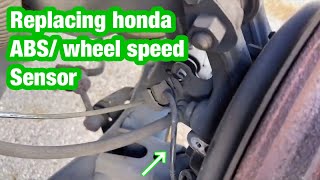
✅ What actually fixed it Upon visual inspection, the user found the sensor wire was completely severed in the wheel well. The final fix was to solder the two broken ends of the wire back together and protect the repair with heat shrink tubing. All warning lights went away after the repair. - YouTube video by 'Track Palmer' (Honda Civic (generation not specified but similar procedure)) — ABS light was on.
❌ Tried (didn't work) The owner had previously installed a cheap, unbranded aftermarket ABS sensor which failed after only one week.
✅ What actually fixed it The user replaced the failed aftermarket sensor with a new one from a more reputable auto parts store brand that offered a lifetime warranty. The video emphasizes applying anti-seize to the sensor body to prevent it from getting stuck in the future and notes that the ABS light will often reset on its own after driving for a bit with a functional sensor.
Documented NHTSA Reports
- An owner reported in NHTSA ODI #11165895 (Chevrolet Equinox reference) that a service center recommended replacing the L/R hub bearing assembly for code C0045, noting that the duration of warning messages varied from seconds to minutes before lights extinguished.
- According to NHTSA ODI #11219167 (Cadillac SRX reference), an owner found the C0045 code was caused by a broken left rear wheel speed sensor encoder ring at 96,020 miles, requiring replacement of both the sensor and the rear hub assembly.
OEM Part Supersession History
57475-TR3-A02→57475-TV0-E01— Part consolidation and potential minor revisions for durability or manufacturing efficiency across different Civic models (5-door, Tourer) within the generation.
Heads up: Both part numbers are generally interchangeable for the left rear position on 2012-2015 Civics. However, 57475-TV0-E01 is more commonly associated with European/UK models and later years, while 57475-TR3-A02 is more common for early US-built models. Always verify with VIN, but most aftermarket suppliers cross-reference both numbers to a single replacement part.
Diagnostic Flowchart
Other Known Issues on This Vehicle
Issues unrelated to this code that are worth knowing about as an owner of this generation:
- Premature/Uneven Rear Tire Wear 🔴 High — Common issue, particularly on 2012 models, due to rear suspension geometry. Wear may appear as inner edge or diagonal patterns. (Ref: Honda TSB 08-001 (originally for 8th gen, but principle applies and updated arms are a known fix).)
- Defective Paint (Peeling/Flaking) 🟠 Medium — Widespread complaints, especially for white and other light-colored paints. The clear coat and paint can delaminate, bubble, or peel. (Ref: Honda extended the warranty for this issue on some models/colors, but many owners report issues outside the coverage period.)
- Battery Drain/Weak Battery Logic 🟡 Low → Shop Vehicle Battery — Some vehicles may experience a dead battery because the PCM fails to select the correct charging mode. (Ref: Honda TSB 12-041 describes a software update to correct the battery management logic.)
- Harsh Automatic Transmission Shifting 🟡 Low → Shop Transmission Assembly — Some owners report harsh or jerky shifting from the automatic transmission.
- Failing A/C Compressor or Leaks 🟠 Medium — Noted as a common problem area, leading to loss of air conditioning.
Used vs. New Parts: Buying Guide for This Vehicle
When a used part is the smart pick: A used wiring harness pigtail from a junkyard is a smart choice if your connector is damaged or the break is close to the plug, as this avoids buying a whole new sensor assembly. A used ABS/VSA modulator can be a cost-effective option, but it's critical to match the part number exactly and be prepared for potential VIN programming by a specialist.
Donor-vehicle mileage cap: roughly under 100000 miles for the part to have meaningful remaining life.
What to inspect on the donor part:
- For a wiring pigtail, inspect for any brittleness, cracks, or previous repairs. Ensure the locking tab on the connector is intact.
- For an ABS module, check that the electrical connector pins are clean and straight. Avoid units with any signs of corrosion or physical damage to the housing.
OEM-only on this vehicle (don't cheap out):
- ABS/VSA Control Module: While a used OEM module can work, it's a high-risk part. Aftermarket modules are not recommended due to the complexity and need for precise software calibration. If buying new, stick to genuine Honda.
Aftermarket brands forum-validated for this vehicle:
- NTK (often the OEM supplier for Japanese vehicles)
- Delphi
- Standard Motor Products (SMP)
- Beck/Arnley (often repackages OEM parts)
Brands owners have reported issues with on this vehicle:
- Generic, unbranded sensors from online marketplaces have a high reported failure rate, sometimes within days or weeks of installation.
- Some users on forums have reported intermittent issues with lower-tier store brands like Duralast, though experiences vary.
Real Owner Stories
Aggregated from forums and TSBs cited above. Mileages and costs reflect what owners reported in those sources.
2014 Honda Civic
Symptoms: The ABS and stabilizer warning lights were on. The mechanic noted the sensor would initially provide a signal and then stop working.
What fixed it: Replacement of the left rear wheel speed sensor after a diagnostic dead end where the wheel bearing (valero) was replaced unnecessarily.
Source hint: youtube_comment from felipe vinalay
2012-2015 Honda Civic Si
Symptoms: ABS sensor wire completely snapped off inside the wheel well, triggering ABS, VSA, TPMS, Hill Start Assist, and Power Steering lights.
What fixed it: Repairing the severed wire in the wheel well.
Source hint: 9th Gen Civic Forum (via YouTube) video demonstration
2012-2015 Honda Civic
Symptoms: The 'trifecta' of ABS, VSA, and power steering lights all illuminated simultaneously.
What fixed it: Soldering the wires back together after finding a severed wire near the sensor connector in the left rear wheel well.
Source hint: 9thgencivic.com forum thread titled 'ABS, VSA, and power steering lights all on'
Related OBD-II Codes
Frequently Asked Questions
Why are my ABS, VSA, and Power Steering lights all on at the same time on my 2012 Civic?
Is there a TSB for the battery drain issues on my 2012 Honda Civic?
Can I just clean the sensor area instead of replacing parts on my 2014 Civic?
My 2012 Civic has uneven rear tire wear; is this related to the ABS code?
How much does it cost to fix the wiring for the C0045 code on a 9th Gen Civic?
Does the Acura ILX suffer from the same C0045 sensor issues as the Civic?
Helpful Videos
We Have This Part in Stock


The information in this article is provided for general reference and educational purposes only. Vehicle specifications, procedures, and part compatibility can vary by production date, trim level, and region. Always consult your vehicle's factory service manual and verify part numbers before purchasing or performing repairs. Safety-critical components such as airbags, seat belts, and braking systems should be installed by a qualified professional.
- Honda Civic:
- 🧭 Diagnostic Flowchart
- 🎬 Helpful Videos
- 🛍️ Shop This Part
- What's Unique About the 2012-2015 Honda Civic
- Symptoms You May Notice
- Most Likely Causes
- Rare But Worth Checking
- Diagnosis Steps
- Parts You'll Likely Need
- Related Codes That Often Appear With This One
- Platform-Specific Known Issues
- Mechanic-Grade Diagnostic Values
- Hidden / Shadow Codes Worth Checking
- Scan Tool Commands That Help
- Wiring & Ground Locations
- Real Owner Repair Stories
- Documented NHTSA Reports
- OEM Part Supersession History
- Other Known Issues on This Vehicle
- Used vs. New Parts: Buying Guide for This Vehicle
- Real Owner Stories
- 2014 Honda Civic
- 2012-2015 Honda Civic Si
- 2012-2015 Honda Civic
- Related OBD-II Codes
- Frequently Asked Questions
- 🎟️ Get 5% Off