

C0050 on 2006-2013 Volvo C70: Right Rear Wheel Speed Sensor Fault Causes and Fixes
On a 2006-2013 Volvo C70, code C0050 almost always means the right rear ABS wheel speed sensor has failed. This triggers an 'Anti-Skid Service Required' message. Replacing the sensor is the most common fix, costing about $40-$90 for an aftermarket part. However, be aware that damaged wiring, a faulty wheel bearing/hub, or a failing ABS module are also distinct possibilities on this platform.
- C0050 on your C70 means a problem with the right rear wheel speed sensor circuit, which will disable your ABS and stability control.
- The most likely fix is replacing the sensor, but inspect the wiring for damage first.
- If a new sensor and good wiring don't fix it, the problem is likely either the wheel bearing/hub assembly or the notorious ATE Teves Mk60 ABS module.
- Using a scanner that can read Volvo-specific live data is crucial for an accurate diagnosis.
What's Unique About the 2006-2013 Volvo C70
The 2006-2013 C70 is built on Volvo's P1 platform, shared with the S40, V50, and C30. This platform has a well-documented weakness with the ATE Teves Mk60 ABS control module. While C0050 often points to a simple sensor failure, it can also be a misleading symptom of an internal ABS module fault, which is a common pitfall for this specific vehicle range. This can manifest as a single wheel speed sensor code when the module is actually at fault. Additionally, the magnetic encoder ring the sensor reads is integrated into the rear wheel bearing and hub assembly and cannot be replaced separately.
Symptoms You May Notice
- "Anti-Skid Service Required" or "Anti-Skid Temporarily Off" message in the instrument cluster.
- ABS warning light is on.
- Stability/Traction Control (DSTC) warning light is on.
- Cruise control is disabled.
- ABS system does not activate during hard braking (wheels may lock and skid).
- In some cases, the vehicle may enter limp mode or stall.
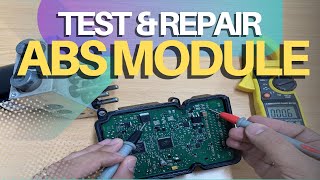
- Replacing the ABS module before thoroughly testing the sensor and wiring. 🎬 Watch: How to test and repair an ABS module The sensor is a much more common and cheaper failure point.
- Replacing the wheel bearing without first confirming the magnetic ring is damaged. A faulty sensor or wire is more likely.
- Replacing the wheel speed sensor when the actual fault is corrosion inside the connector or a break in the wiring harness further up.
Most Likely Causes
- Failed Right Rear Wheel Speed Sensor 🔴 High Probability → Shop ABS Wheel Speed Sensor The sensor is an exposed electronic component located at the wheel hub, subject to constant vibration, water, road salt, and debris, leading to eventual failure. It is the most common point of failure for this code.
How to confirm: Use a scan tool capable of reading live ABS data (like Volvo's VIDA). Observe the wheel speed readings while driving. If the right rear wheel reads 0 MPH or an erratic speed while the others read correctly, the sensor is the primary suspect. You can also test the sensor's resistance with a multimeter, though live data is more definitive.
Typical fix: Replace the right rear wheel speed sensor. The sensor is typically held in by a single Torx or Allen bolt. The bolt can be prone to seizing, so applying penetrating oil beforehand is recommended.
Est. part cost: $40-$150 - Damaged Wiring or Connector 🟡 Medium Probability The wiring harness runs along the suspension and into the wheel well, making it vulnerable to damage from road debris, improper jacking, suspension work, or corrosion at the connector pins.
How to confirm: Visually inspect the wiring from the wheel speed sensor back to the main harness. Look for chafing, breaks, or corrosion in the connector pins. Perform a continuity and short-to-ground test on the wires with a multimeter between the sensor connector and the ABS module connector.
Typical fix: Repair the damaged section of wire or replace the connector pigtail. Volvo offers a specific repair harness for this purpose. In some cases, corrosion can travel up the wiring, requiring a longer section to be replaced.
Est. part cost: $20-$60 - Damaged Wheel Bearing Magnetic Encoder Ring ⚪ Low Probability The magnetic ring is integrated into the wheel bearing assembly. Rust buildup between the bearing and the knuckle can cause the bearing to swell and damage the ring, or the ring can be damaged during other suspension work. A failing bearing can also introduce excessive play, causing an inconsistent signal.
How to confirm: After removing the wheel speed sensor, use a flashlight to inspect the magnetic ring inside the hub for cracks, rust, debris, or missing segments. Spin the hub to check the entire ring. Also, check for any play or roughness in the wheel bearing itself by rocking the wheel at the 12 and 6 o'clock positions.
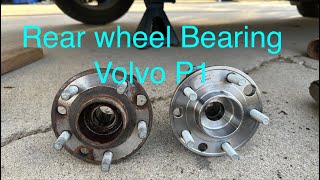
Typical fix: The entire rear wheel bearing and hub assembly must be replaced, as the magnetic ring is not available as a separate part. 🎬 Watch: Rear wheel bearing and hub replacement walkthrough This is a more involved repair requiring removal of the brake caliper and rotor.
Est. part cost: $100-$250
Rare But Worth Checking
- Failed ABS Control Module (BCM): → Shop ABS Control Module This is a known, widespread issue on the Volvo P1 platform's ATE Teves Mk60 ABS module. Internal failure of the module, often related to the brake pressure sensor or processing circuits, can falsely trigger a C0050 code. This should be suspected if a new sensor and verified wiring do not resolve the issue. The module can often be removed and sent to a specialist for repair without replacing the entire hydraulic unit. 🎬 See how to remove the Brake Control Module
Diagnosis Steps
- Connect a Volvo-compatible OBD-II scanner (like VIDA) and confirm C0050 is the active code. Note any other BCM or CEM codes.
- Check and ensure battery voltage is stable and above 12.4V with the engine off. Low voltage can cause spurious electronic faults.
- Access the live data stream for the ABS module.
- Drive the vehicle slowly (or spin the wheel by hand with the vehicle raised) and monitor the speed readings from all four wheel speed sensors.
- Confirm that the Right Rear (RR) sensor is reading incorrectly (e.g., 0 MPH or an erratic/jumpy signal) compared to the other three sensors.
- If the reading is faulty, raise and secure the rear of the vehicle. Visually inspect the RR wheel speed sensor and its wiring harness for any obvious damage, corrosion, or loose connections. Pay close attention to the harness routing and any potential chafe points.
- If no visual damage is found, disconnect the sensor. Inspect the connector pins on both the sensor and harness side for green or white corrosion.
- If the connector is clean, test the sensor's internal resistance with a multimeter (if specs are available) or, more reliably, substitute a known good sensor if possible.
- If the sensor tests good or is replaced without change, inspect the magnetic encoder ring on the wheel hub for physical damage, heavy rust, or metallic debris.
- If the sensor and ring are good, test the wiring harness for continuity (no open circuits) and for shorts to ground or power between the sensor connector and the ABS module connector.
- If the sensor, ring, and wiring are all confirmed to be good, the fault likely lies within the ABS control module itself, a known issue for this platform.
Parts You'll Likely Need
- Rear ABS Wheel Speed Sensor
(OEM #30748149)— This is the most frequent cause of code C0050 due to its exposed location and electronic nature. Note that this part number may fit multiple locations on different Volvo models, so confirm fitment for the C70 rear.
Trusted brands: Bosch, ATE, URO Parts, Genuine Volvo
OEM price range: $90-$150
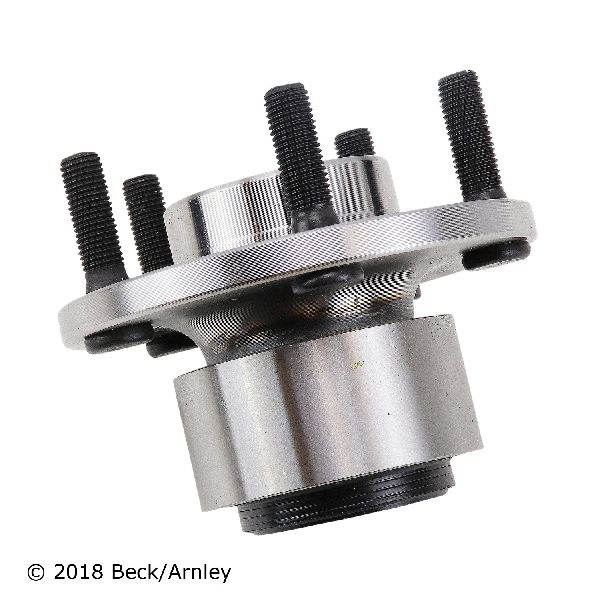
Aftermarket price range: $40-$90 - Rear Wheel Bearing and Hub Assembly (FWD)
(OEM #31340686)— Required if the integrated magnetic encoder ring is damaged, which will cause an incorrect signal from the sensor.
Trusted brands: SKF, FAG, GMB, Genuine Volvo
OEM price range: $200-$300
Aftermarket price range: $100-$180
Related Codes That Often Appear With This One
- U0121 — If the ABS module itself is failing or has a communication breakdown, you may also see a 'Lost Communication With Anti-Lock Brake System (ABS) Control Module' code.
- BCM-0130 — This code, for 'Brake pressure sensor Signal missing', is another common indicator of the internal ATE Mk60 ABS module failure on P1 platform cars. If you see this alongside C0050, the module is highly suspect.
Platform-Specific Known Issues
- The ATE Teves Mk60 ABS module used on this platform is known to fail, sometimes causing individual wheel speed sensor codes when the sensor itself is not at fault. Repair services exist that can rebuild the module for a fraction of the cost of a new one.
- The retaining bolt for the ABS sensor is prone to seizing and breaking off in the steering knuckle. Generous use of penetrating oil and careful extraction is recommended. Some DIYers preemptively purchase a replacement bolt.
Mechanic-Grade Diagnostic Values
- Passive 2-wire ABS Sensor Resistance — expected: 600 - 1600 Ohms for rear sensors on this platform. A key diagnostic step is comparing the reading from the suspect sensor to the known-good sensor on the other side; they should be very close.. Failure: A reading of infinite Ohms (open circuit), zero Ohms (short circuit), or a significant deviation from the value of the opposing wheel's sensor.
- Passive 2-wire ABS Sensor AC Voltage Output — expected: Greater than 100-200 mV AC when spinning the wheel by hand at about one revolution per second.. Failure: No AC voltage is generated, or the voltage is significantly lower than expected while spinning the wheel, indicating a dead sensor.
- Wiring Harness Continuity — expected: Less than 2 Ohms of resistance on each wire between the sensor connector and the ABS module connector.. Failure: Resistance is higher than 2 Ohms, or the reading is OL (Over Limit), indicating a break in the wire.
- Wiring Harness Short to Ground — expected: OL (Over Limit / infinite resistance) between each sensor wire and a known good chassis ground.. Failure: Any continuity or low resistance reading indicates the wire is shorted to ground.
Scan Tool Commands That Help
- Volvo VIDA (Vehicle Information & Diagnostics for Aftersales): Fault Tracing & Live Data Monitoring — VIDA is the dealer-level tool. It should be the first step to read Volvo-specific DTCs, access detailed fault tracing procedures that guide the technician step-by-step, and monitor live wheel speed data from all four sensors simultaneously to confirm which one is faulty.
Wiring & Ground Locations
- 7/57 — Right rear wheel hub assembly.. This is the specific component designator for the Right Rear ABS Sensor in Volvo wiring diagrams for the P1 platform, confirming the component linked to code C0050.
- Brake Control Module (BCM) — At the left rear corner of the engine compartment, attached to the ABS hydraulic unit.. This module receives the signal from the right rear wheel speed sensor. The main connector at the BCM is the final point to test the wiring continuity from the sensor if a fault is suspected in the harness.
- Ground Connection G12 — Located at the right rear of the vehicle.. While the sensor circuit grounds through the BCM, a poor main chassis ground in the vicinity of the sensor can cause electrical interference and signal problems. This should be checked if the fault is intermittent or hard to trace.
Real Owner Repair Stories
- Go-Parts V50 Article (Volvo V50 (P1 Platform sibling)) — ABS/Anti-Skid warning light on.
❌ Tried (didn't work) Initial diagnosis was uncertain due to conflicting information about expected resistance values.
✅ What actually fixed it The owner tested the resistance of the faulty sensor and found it was 1600 ohms, while the good sensor on the other side was 1100 ohms. Despite the 1600 ohm reading being technically 'in-spec' for some guides, the significant difference from the known-good sensor was the key indicator. Replacing the sensor with the higher resistance reading resolved the fault.
Documented NHTSA Reports
- An owner reported that the vehicle disables ABS and supporting systems and sets codes C0050 and C2227, noting that extra brake fluid required to take up open space after service may be a factor (NHTSA ODI #11649367).
- A technician noted in NHTSA ODI #11693418 that diagnostic codes showed C0050-00, which led to rotors, rear brake pads, and an adapter plate needing replacement.
- NHTSA ODI #11228687 describes a vehicle where C0050 appeared alongside several other codes including C0035, C0040, and various U-series communication codes.
- In a cross-manufacturer instance, NHTSA ODI #10763888 describes a case where code C0050 was given, identifying a problem as a faulty power steering control module (PSCM) requiring the entire steering column to be replaced.
OEM Part Supersession History
30736885, 31201642, 31262571, 31280051→31340686— Standard part evolution and consolidation by Volvo.
Heads up: The latest part number, 31340686, is specified for C70 models from chassis/VIN 141708 onwards. While it may physically fit earlier models, using the correct part for the vehicle's specific VIN is crucial.
Model Year Variations Within This Range
- 2006-2007: The engine produced 218 horsepower.
- 2008-2013: The engine was boosted to 227 horsepower. While this doesn't directly affect the C0050 code, it's a notable change within the generation.
- 2011-2013: The C70 received a significant facelift with revised front and rear styling and a new instrument panel. Wiring and module locations remained consistent with the P1 platform architecture.
Diagnostic Flowchart
Other Known Issues on This Vehicle
Issues unrelated to this code that are worth knowing about as an owner of this generation:
- Retractable Hardtop Malfunctions 🔴 High — Common, especially on earlier 2006-2008 models. Can be caused by hydraulic leaks, sensor failures, or control module issues.
- Clogged PCV / Breather System 🟠 Medium — Common on the 5-cylinder engines, typically after 60k miles. A clogged system or torn diaphragm in the oil filter housing causes a loud whistling/squealing noise at idle and can lead to oil leaks.
- Automatic Transmission Shift Issues 🔴 High — The Aisin 5-speed automatic can develop harsh shifting, delayed engagement, or slipping, particularly at higher mileage (60k-100k miles).
- Leaking Sunroof Drains 🟠 Medium — The sunroof drain tubes can become clogged with debris, causing water to leak into the cabin, typically affecting the front footwells and potentially damaging electronic modules located there.
- Premature Wheel Bearing Wear 🟠 Medium — Front wheel bearings can become noisy as early as 60,000 km, while rear bearings tend to last longer. Failure requires replacement of the hub assembly.
Used vs. New Parts: Buying Guide for This Vehicle
When a used part is the smart pick: A used wheel bearing/hub assembly can be a cost-effective choice if the donor vehicle has very low mileage and is from a salt-free region to minimize the risk of bearing wear and corrosion on the integrated magnetic ring. A used ABS sensor is generally not recommended due to its high failure rate and low cost new; the labor to replace it again outweighs the part savings.
Donor-vehicle mileage cap: roughly under 50000 miles for the part to have meaningful remaining life.
What to inspect on the donor part:
- For a hub assembly, spin the bearing by hand; it must be perfectly smooth with no noise, roughness, or play.
- Visually inspect the integrated magnetic encoder ring. It must be clean, free of rust, and have no cracks or physical damage.
- Check the electrical connector on any part for corrosion, bent pins, or a brittle plastic housing.
OEM-only on this vehicle (don't cheap out):
- ABS Control Module (BCM) - Used modules are often VIN-locked and cannot be reprogrammed to a different car. A professionally rebuilt unit (from a service like Xemodex or ECU Testing) or a new OEM module that is properly coded to the car with VIDA is the only reliable solution.
Aftermarket brands forum-validated for this vehicle:
- ABS Sensor: ATE (often the OEM), Bosch.
- Wheel Bearing/Hub Assembly: SKF, FAG.
Brands owners have reported issues with on this vehicle:
- Unbranded, no-name sensors from online marketplaces are frequently reported to fail prematurely or be dead-on-arrival.
Real Owner Stories
Aggregated from forums and TSBs cited above. Mileages and costs reflect what owners reported in those sources.
2006-2013 Volvo C70 P1 Platform
Symptoms: The 'Anti-Skid Service Required' message appeared on the instrument cluster. Owners frequently reported that while the code pointed to a sensor, the ABS system would not activate during hard braking.
What fixed it: Replacement of the indicated wheel speed sensor resolved the issue for many, though others required an ABS module rebuild from services like ECU Testing or Xemodex.
Source hint: SwedeSpeed Forum - General P1 Platform Discussion
2004-2012 Volvo V50 (P1 Platform Mate)
Symptoms: Faulty wheel speed readings and ABS/traction control warnings related to the rear hub assembly.
What fixed it: Replacement of the entire rear wheel bearing and hub assembly because the magnetic encoder ring is integrated and not available separately.
Source hint: Volvo Owners Club Forum - V50 Rear Wheel Bearing Replacement
Related OBD-II Codes
Frequently Asked Questions
My 2008 C70 is displaying 'Anti-Skid Service Required' and the cruise control stopped working. Are these related to code C0050?
I replaced the Right Rear sensor on my C70 but the C0050 code persists. Could it be the ABS module?
Is there a specific repair kit for wiring issues related to C0050 on the C70?
Can a bad wheel bearing cause the C0050 code on my Volvo?
I'm trying to replace the RR sensor myself; is there anything I should watch out for on this chassis?
Could my C70's low battery voltage be causing the Anti-Skid warning?
Helpful Videos

Used OEM Parts in Stock
New Aftermarket Parts Available


The information in this article is provided for general reference and educational purposes only. Vehicle specifications, procedures, and part compatibility can vary by production date, trim level, and region. Always consult your vehicle's factory service manual and verify part numbers before purchasing or performing repairs. Safety-critical components such as airbags, seat belts, and braking systems should be installed by a qualified professional.
- Volvo C70:
- 🧭 Diagnostic Flowchart
- 🎬 Helpful Videos
- 🛍️ Shop This Part
- What's Unique About the 2006-2013 Volvo C70
- Symptoms You May Notice
- Most Likely Causes
- Rare But Worth Checking
- Diagnosis Steps
- Parts You'll Likely Need
- Related Codes That Often Appear With This One
- Platform-Specific Known Issues
- Mechanic-Grade Diagnostic Values
- Scan Tool Commands That Help
- Wiring & Ground Locations
- Real Owner Repair Stories
- Documented NHTSA Reports
- OEM Part Supersession History
- Model Year Variations Within This Range
- Other Known Issues on This Vehicle
- Used vs. New Parts: Buying Guide for This Vehicle
- Real Owner Stories
- 2006-2013 Volvo C70 P1 Platform
- 2004-2012 Volvo V50 (P1 Platform Mate)
- Related OBD-II Codes
- Frequently Asked Questions
- 🎟️ Get 5% Off